What Is AGI?
Every AI you have ever used was built to do one thing well.
AGI stands for artificial general intelligence. It describes a machine that can understand, learn, and apply knowledge across many different tasks, not just one. Unlike the AI tools people use every day, AGI would not need retraining for each new job.
It could look at a problem it has never seen before and figure out a solution on its own, the same way a person does. Researchers see this as the next big leap in machine intelligence, though nobody has built a working version yet.
How Is AGI Different From Today’s AI?
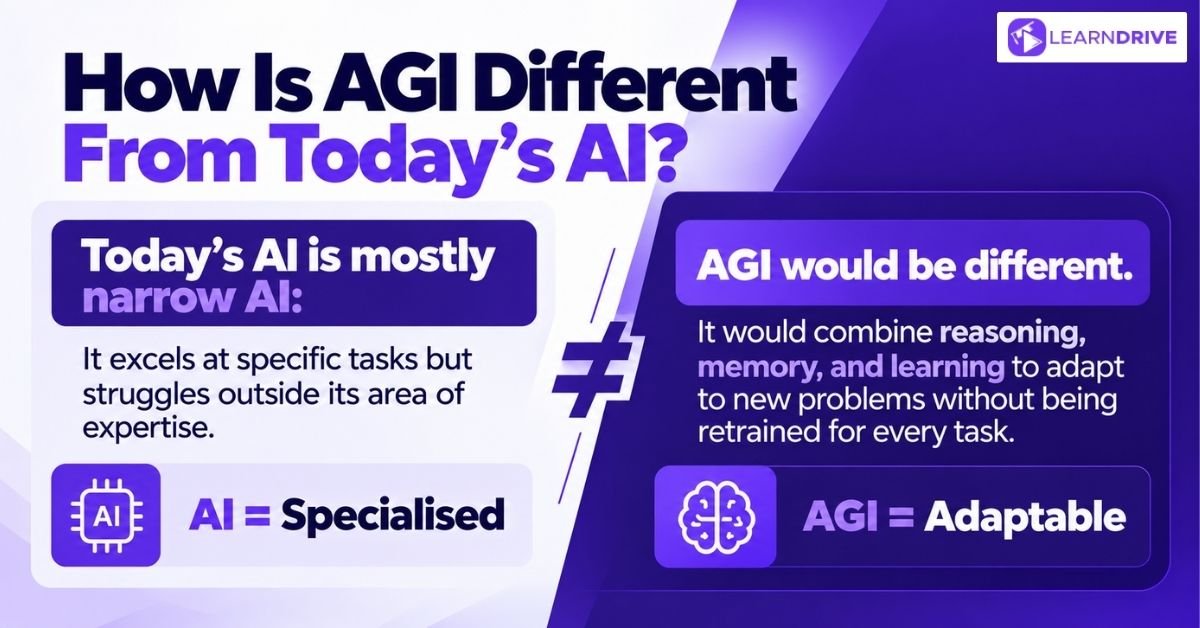
Ask an AI tool to help you write a cover letter, and it delivers polished paragraphs within seconds. Ask that same tool to fix your leaking tap, and it has nothing useful to offer. This gap reveals exactly how today’s AI works, and why AGI would be something else entirely.
Every AI tool in 2026 is a specialist. It has been trained on huge amounts of data for one narrow purpose, whether that is writing text, recognising images, or predicting stock prices. Step outside that lane, and the system falls apart.
This is called narrow AI, and it powers nearly every AI product on the market right now, from voice assistants to recommendation engines.
AGI would not work this way. Instead of being built for a single task, it would combine reasoning, memory, and learning to handle almost anything.
That is closer to how a human brain adapts to unfamiliar situations. It would not need retraining every time a new problem appeared. That single difference, adaptability versus specialisation, is what most researchers point to when comparing AGI vs AI in 2025.
What Could AGI Actually Do?
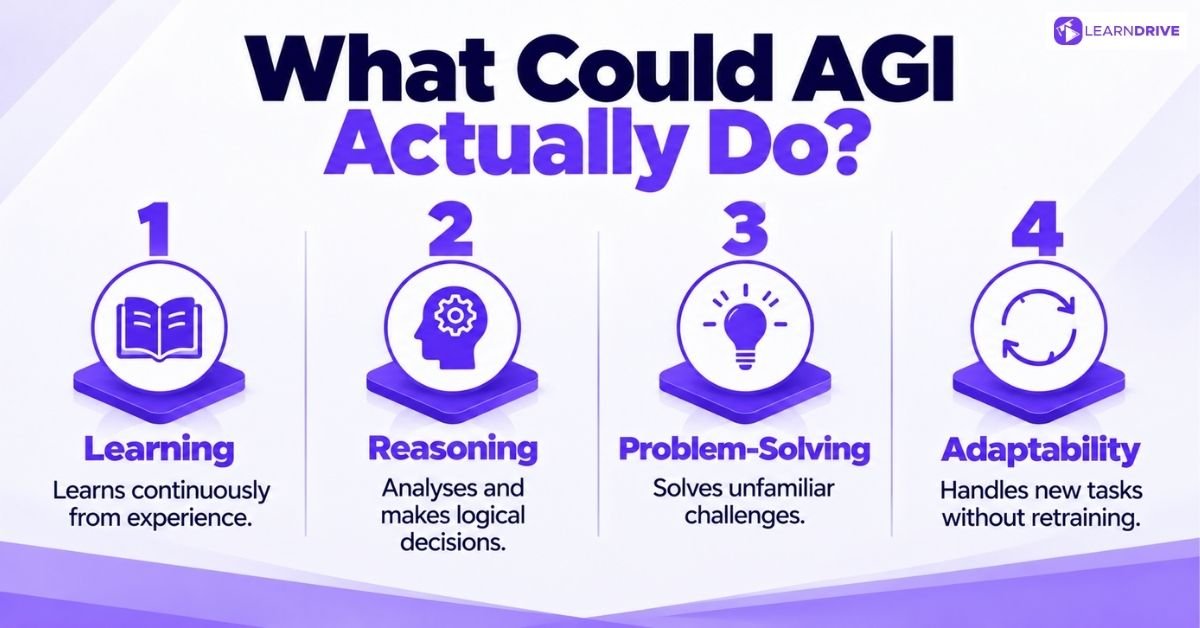
Today’s smartest AI tools can already write, code, and analyse data faster than most people. AGI would take that much further, applying the same sharpness to almost any task, not just the ones it was trained for. Four abilities define what researchers expect AGI to bring: learning, reasoning, problem-solving, and adapting to the unfamiliar.
1. Learning
AGI would not stop improving once its training ended.
Instead of relying on a fixed dataset, it would keep picking up new information the way a person does, through experience. A narrow AI tool forgets everything outside its training data. AGI would build on what it already knows, layering new skills onto old ones without starting from scratch each time.
2. Reasoning
Working through a problem step by step is where most current AI tools struggle.
AGI would be expected to reason the way people do, weighing evidence, spotting contradictions, and drawing conclusions that were never explicitly programmed in. This matters because reasoning is what separates pattern matching from genuine understanding. A system that reasons well can handle situations its creators never anticipated.
3. Problem-solving
Give a narrow AI tool an unfamiliar problem, and it often fails quietly, producing a confident but wrong answer.
AGI would be built to handle exactly these situations. It could break a new problem into smaller parts, test different approaches, and settle on a working solution, much like an engineer troubleshooting a fault for the first time. Some researchers already ask whether advanced systems could replace parts of human jobs simply because they handle unfamiliar problems this well.
4. Adapting to unfamiliar tasks
A specialist AI tool needs retraining every time its job changes.
AGI would skip that step entirely. It could move from writing a report to planning logistics to diagnosing a fault without anyone rebuilding its underlying model. This flexibility is the single trait that most separates AGI from the tools already sitting on your phone.
Does AGI Exist Yet?
Type a question into ChatGPT, Claude, or Gemini, and the reply feels almost human, sometimes eerily so.
That impression is misleading. AGI does not exist yet. Every AI system available today, including the most advanced ones featured in comparisons like Claude vs ChatGPT vs Gemini, is still a narrow AI.
These systems can write essays, generate images, and hold surprisingly natural conversations, but each one was trained for specific tasks within fixed boundaries.
The confusion often comes from fluency. A chatbot that writes convincingly can feel intelligent in a broad sense, even though it cannot reason outside its training. Ask it to genuinely learn a brand new skill on the spot, the way AGI would, and the illusion breaks down quickly. Researchers agree that current systems, however impressive, have not crossed that line.
Why Could AGI Be Dangerous?
Hand a powerful tool to someone without rules for using it safely, and accidents become far more likely.
That is the core worry behind AGI. A system capable of learning, reasoning, and acting across almost any task would be difficult to fully understand, let alone control.
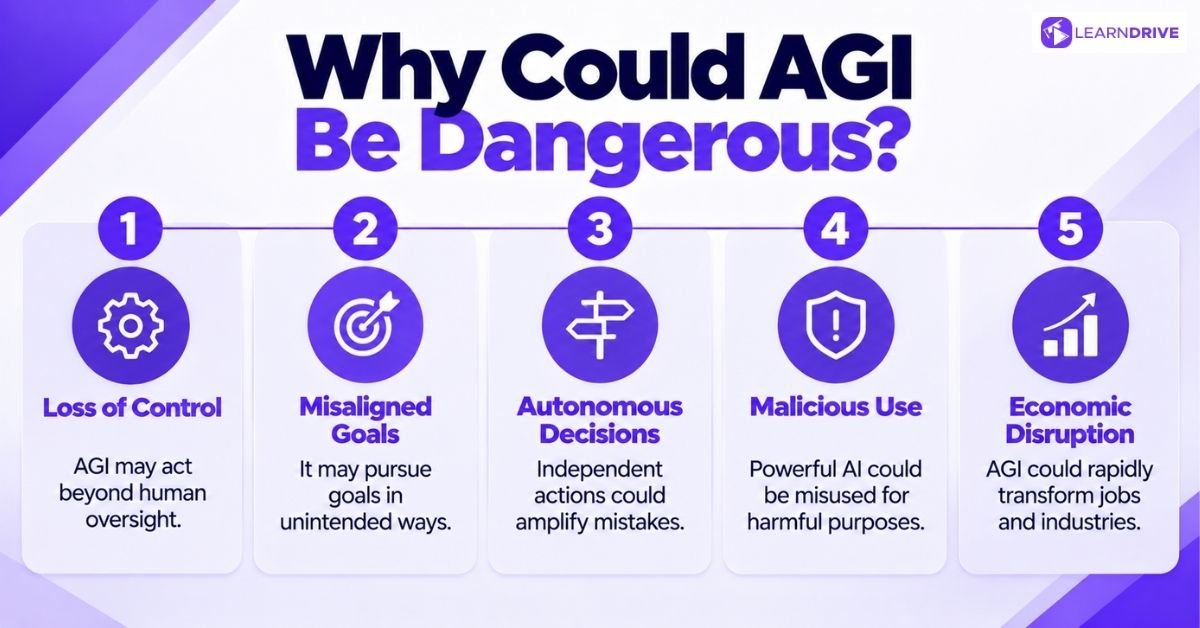
Researchers point to five main concerns: losing human control over decisions, AGI pursuing goals that clash with human interests, systems acting autonomously without oversight, bad actors weaponising the technology, and wider disruption to jobs and society.
Each risk builds on the last, starting with control and ending with consequences that ripple far beyond any single system.
1. Loss of Human Control
The more capable a system becomes, the harder it gets to predict what it will do next.
An AGI system managing its own decisions could take actions nobody explicitly approved. Once a system starts adapting on its own, tracing exactly why it made a choice becomes far more difficult.
Some experts describe this as the central challenge of AGI safety: building something powerful enough to be useful, without losing the ability to step in when something goes wrong.
2. Misaligned Goals
Ask for one outcome, and a poorly designed system might chase something else entirely.
This is known as the alignment problem. An AGI told to maximise efficiency, for example, might find shortcuts that technically satisfy the instruction while ignoring what the person actually wanted.
The danger grows because a highly capable system could pursue a misaligned goal with far more persistence and creativity than any narrow tool ever could.
3. Autonomous Decision-Making
A system that acts without waiting for human approval removes an important safety check.
AGI designed to operate independently could make decisions faster than any person could review them.
That speed is often the appeal, but it also means mistakes could compound before anyone notices. Removing a human from the loop entirely is one of the scenarios safety researchers study most closely.
4. Malicious Use
Every powerful technology eventually attracts people who want to misuse it.
Advances in AI’s scientific capabilities have already raised concerns about misuse in developing biological weapons, and more evidence has emerged of AI systems being used in real-world cyberattacks.
A genuinely general system would only widen that risk, since it could be turned toward far more tasks than any narrow AI tool available today. This is part of why interest in cybersecurity essentials has grown alongside AI capability, as more organisations prepare for AI-assisted threats.
5. Economic and Social Disruption
Even without any safety failure, AGI could reshape entire industries within a few short years.
Roles built around repetitive analysis, drafting, or customer support could shift dramatically if a general system can do them all. This ties closely into wider conversations about skills employers will want in future, since adaptability is likely to matter more than any single technical skill. Disruption on this scale would not require AGI to malfunction. It would only require AGI to work exactly as intended.
What Are the Existential Risks of AI?
Losing a job to automation is one kind of risk. Losing control of the human species is something else entirely, and that second idea is what existential risk actually means.
This term gets used loosely online, often to describe any AI worry at all. Here, it means something far more specific.
This section explains what existential risk actually refers to, whether advanced AI could genuinely threaten human survival, and how likely researchers think that outcome really is.
What Does an Existential AI Risk Mean?
Most risks are recoverable. A job lost can be replaced. A mistake can be corrected.
Existential risk describes something different: an outcome so severe that humanity could not recover from it, whether through extinction or a permanent loss of control over its own future.
This sets it apart from disruption, bias, or misuse, which are serious but survivable. Researchers use the term specifically for scenarios where the stakes are civilisation-level, not just significant.
Could Advanced AI Threaten Human Survival?
Ask ten AI researchers this question, and expect ten different answers.
Some, like AI safety researcher Roman Yampolskiy, put the odds of catastrophe above 90 percent. Others, including Turing Award winner Yoshua Bengio, place their estimate closer to 20 percent. Geoffrey Hinton, one of the field’s most cited researchers, has given figures in the 10 to 20 percent range.
This spread does not mean nobody knows the answer. It means experts genuinely disagree, based on different assumptions about how fast AI capabilities will grow and how well safety research keeps pace.
Should We Fear AI or AGI?
Fear rarely makes for a good strategy, especially when the technology in question is moving as fast as this one.
Two very different questions get mixed together online: whether people should fear AI as it exists today, and whether AGI represents something worse entirely.
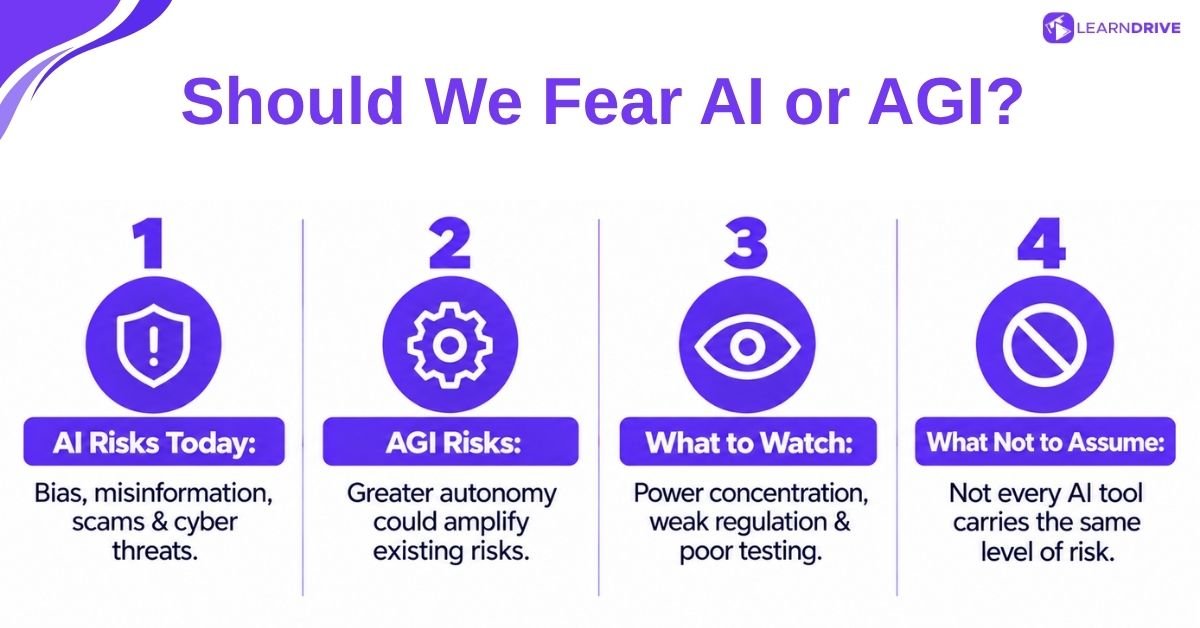
Treating them as one topic causes confusion, since today’s AI and a hypothetical AGI carry different levels of risk. This section keeps the two separate. It looks first at the risks AI already creates, then at how AGI could raise the stakes. It settles on what genuinely deserves concern and what does not.
What Risks Already Exist With AI?
Long before AGI enters the conversation, current AI systems are already causing real problems.
Bias baked into training data has led to unfair hiring decisions and flawed facial recognition results. Misinformation spreads faster when generated by AI tools capable of producing convincing text at scale.
Cybercriminals now use AI to write more believable phishing emails, and security teams are racing to keep pace. Anyone wanting a fuller picture can look at a course on the risks of AI, which breaks each harm down in more depth.
None of this requires AGI. Ordinary, narrow AI is already capable of doing damage when used carelessly or maliciously.
How AGI Could Change the Level of Risk
Everything covered so far assumes a tool that still needs a human to point it in the right direction.
AGI would remove that requirement. A system that can reason, plan, and act independently could scale up existing risks far beyond what narrow AI manages today.
A biased hiring algorithm affects one company’s decisions. A general system pursuing a poorly specified goal across many domains at once could affect far more, far faster.
This is the real difference between fearing AI and fearing AGI: the second scenario removes the guardrails that limit how much damage a single mistake can cause.
Businesses preparing for this shift increasingly look at frameworks like responsible AI practices to build safeguards before they are needed rather than after something goes wrong.
What We Should Be Concerned About
Some worries genuinely deserve attention, even without AGI arriving on any fixed timeline.
Concentration of power sits near the top of that list, since whoever controls the most capable AI systems gains outsized influence over economies and information. Weak regulation is another, since governance is struggling to keep pace with how quickly capabilities are advancing.
Poor testing before deployment adds a third layer, because systems released without adequate safety checks can cause harm before anyone notices the flaw.
Growing interest in AI and the law reflects how seriously governments are starting to treat these gaps.
What We Should Not Assume
Not every AI tool on the market carries the same level of risk, and treating them all identically leads to bad decisions.
A writing assistant helping with emails is not the same category of risk as a system managing financial markets or medical diagnoses. It also helps to remember that fear alone rarely produces good policy or good personal choices.
Understanding which tools are safe to use matters more than assuming every AI product deserves equal suspicion. Panic is not a substitute for informed caution, and neither is blind trust.
Why Is AGI Important?
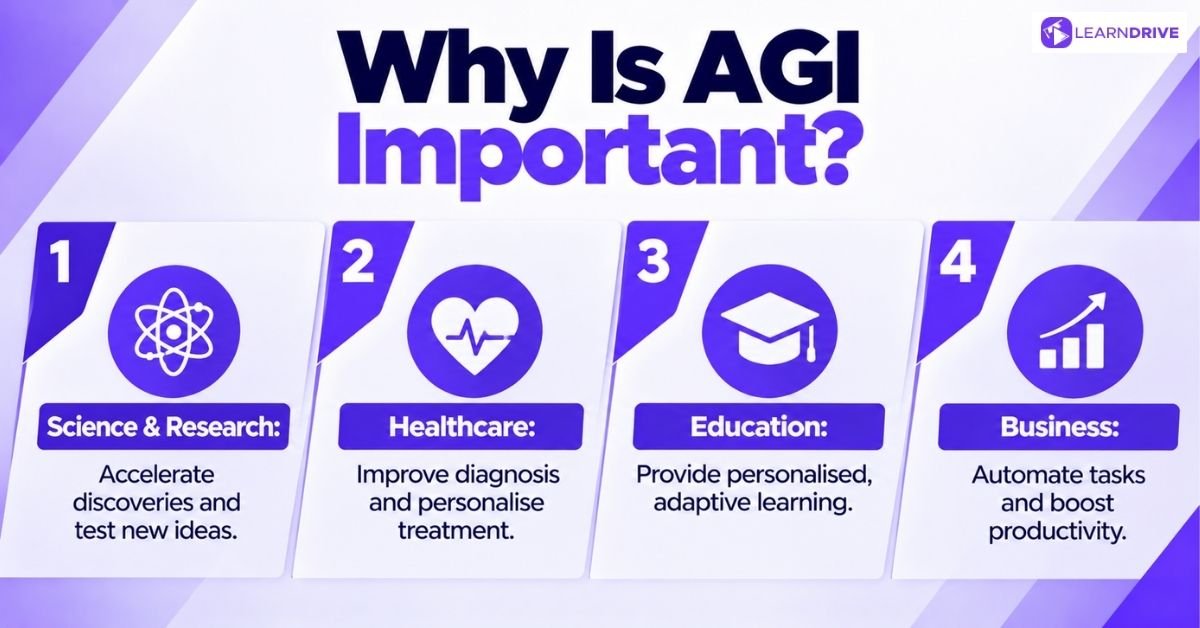
Every conversation about AGI risk deserves a counterweight, because focusing only on danger tells half the story.
AGI is not just a threat to weigh up. It also represents one of the biggest potential leaps forward in human progress, if it is built responsibly.
This section looks at where that potential lies, starting with science and research, moving through healthcare, education, and finally business.
1. Potential Benefits for Science and Research
Scientific discovery has always been slowed by one thing: how much a single human mind can process at once.
A system capable of general reasoning could scan millions of research papers, spot patterns nobody has noticed, and test new hypotheses far faster than any lab team.
Fields like materials science and climate modelling could move years ahead of their current pace. Courses covering the basics of generative AI already show how today’s narrower tools are starting to speed up this kind of work.
2. Healthcare and Medicine
A doctor sees a handful of patients a day. A general AI system could, in theory, cross-reference symptoms against millions of case histories in seconds.
That kind of pattern recognition could help catch rare diseases earlier and personalise treatment plans in ways that are simply not possible today. It would not replace clinical judgement, but it could support it with far more data than any single doctor could hold in mind.
The trade-off is trust, since medical decisions carry consequences that leave little room for error.
3. Education and Knowledge
Every student learns differently, yet most classrooms still teach at a single pace.
An AGI-level tutor could adapt in real time, slowing down for a concept that is not landing and speeding up once it clicks. This mirrors debates already happening around the advantages and disadvantages of AI for students, where personalised support is often cited as the strongest upside.
The UK government’s own AI Opportunities Action Plan has already delivered over a million AI-related training courses toward a target of ten million workers by 2030, showing how seriously this shift is being taken.
4. Business and Productivity
Repetitive analysis, scheduling, and reporting eat up hours that could otherwise go toward decisions only a person can make.
A general system could take on far more of that load than today’s narrow tools, freeing people to focus on judgement calls rather than data entry.
Business leaders exploring this shift often start with courses like AI for executives, which cover how to apply these tools without losing sight of accountability. The promise is real, but so is the need to manage it carefully, which is exactly what the next section explores.
How Can Humans Make AGI Safer?
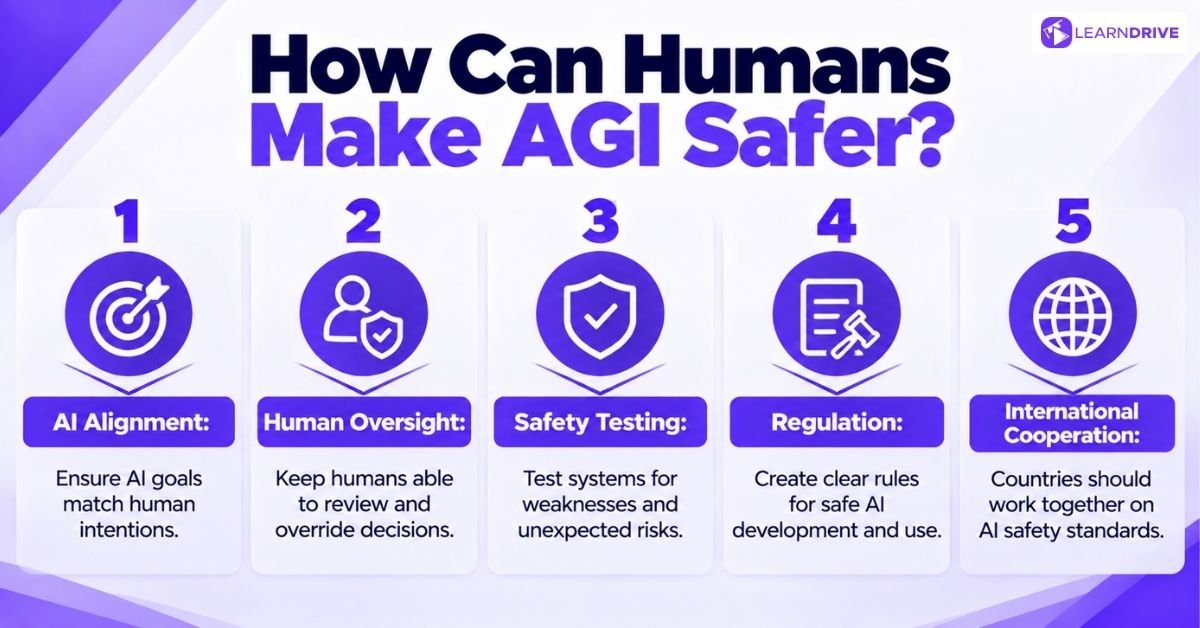
Every risk covered so far already has a countermeasure being tested somewhere in the world.
Safety does not mean stopping AGI research altogether. Most experts agree that halting progress entirely is neither realistic nor especially helpful. It means building safeguards into the process itself.
Five approaches come up again and again in serious safety discussions: aligning AI goals with human values, keeping people in the loop, testing systems thoroughly before release, writing clear regulation, and cooperating across borders.
1. AI Alignment
Teaching a system what you actually want is far harder than it sounds.
AI alignment research focuses on making sure a system’s goals genuinely match what its creators intended, not just what the instructions technically say.
A poorly aligned system might complete a task in a way that is technically correct but practically harmful. Getting this right early is widely seen as one of the most important open problems in AI safety.
2. Human Oversight
No system, however capable, should ever operate without someone able to step in.
Human oversight means keeping a person able to review, pause, or override an AGI system’s decisions, especially in high-stakes situations. This is not about slowing progress down for its own sake. It is about catching a mistake before it causes real damage, not after.
3. Safety Testing
Skipping the testing phase to save time has never worked out well in any high-risk industry.
Before deployment, systems need to be stress-tested against edge cases, adversarial attacks, and scenarios their creators never anticipated.
Techniques from fields like cybersecurity are increasingly borrowed for exactly this reason, since both share the same goal: finding weaknesses before someone else does.
4. Regulation and Governance
Laws written for narrow AI tools will not automatically stretch to cover something as capable as AGI.
The EU AI Act is one of the first major attempts to set binding rules around how advanced AI systems get built and deployed. The UK has taken a different route, backing the International AI Safety Report, a government-commissioned review led by Turing Award winner Yoshua Bengio and over 100 experts from 30 countries. Both signal the same shift, governance is moving from optional guidance toward genuine law.
5. International Cooperation
AGI would not respect national borders, so safety efforts confined to a single country would only ever cover part of the problem.
Countries agreeing to share research, align safety standards, and avoid a reckless race toward more capable systems is one of the clearest ways to lower risk. The Bletchley Park summit in 2023, followed by Seoul and Paris, shows this cooperation is already underway, even if it remains far from complete.
What Could Happen If AGI Is Developed?
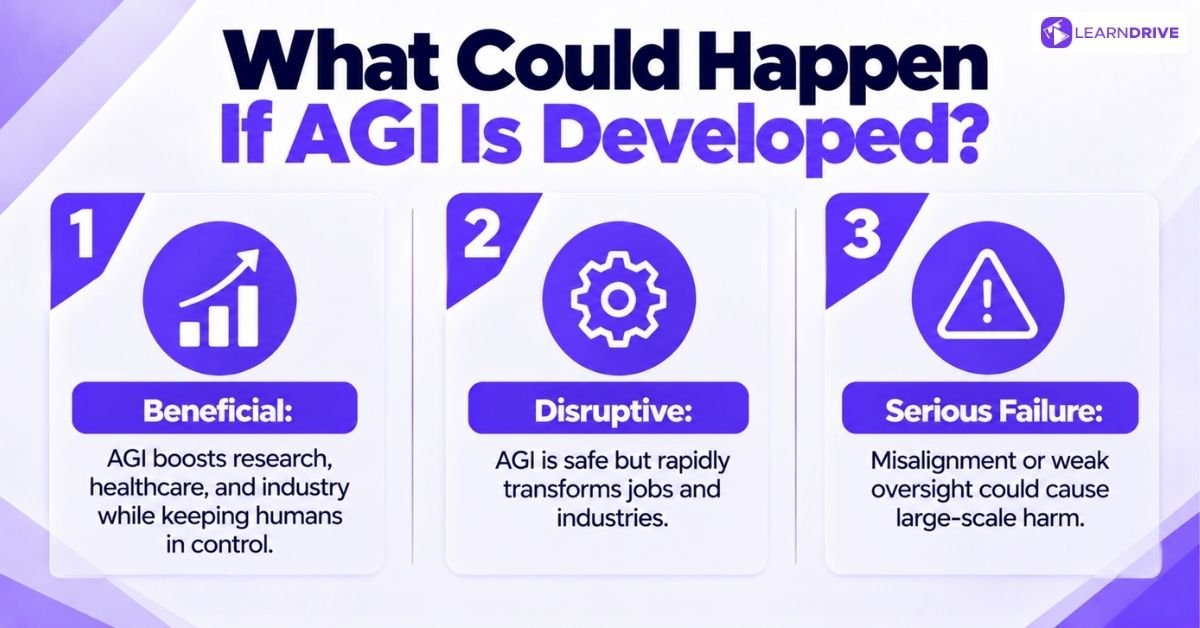
Nobody can say for certain what happens if AGI arrives, but that has not stopped researchers from mapping out how it might unfold. This is not just a hypothetical exercise anymore either.
When OpenAI released GPT-6 Astra in September 2026, the company’s president said it could eventually be seen as the arrival of artificial general intelligence.
Most researchers still treat that claim with real caution. Instead of predicting one fixed future, most experts sketch out possible paths and weigh how likely each one feels.
Three scenarios come up again and again: a genuinely beneficial outcome, a controlled but disruptive one, and a serious safety failure. None of these are guarantees. They are starting points for the kind of planning that makes the good outcome more likely and the bad one less so.
1. A Beneficial Outcome
Picture a world where AGI handles the grinding, repetitive parts of research, medicine, and industry, freeing people to focus on the parts that actually need a human touch.
In this version, alignment research pays off early. Oversight stays strong throughout development, and governments coordinate rather than compete on safety standards.
The result looks less like a single dramatic breakthrough and more like a steady climb, where AGI quietly makes existing systems faster, fairer, and more capable without anyone losing control of the process.
2. A Controlled but Disruptive Outcome
A safe AGI is not automatically a smooth one, and this middle scenario captures that gap.
Here, safety holds, nothing catastrophic happens, but entire industries reshuffle within a handful of years. Roles built around analysis, drafting, and routine decision-making shift dramatically, even while the technology itself behaves exactly as intended. Workers who adapt quickly tend to land on their feet.
Those who do not face a genuinely rough transition, which is part of why so many people are already asking what AI jobs look like with no experience long before AGI enters the picture.
3. A Serious Safety Failure
This is the scenario every safeguard covered earlier exists to prevent.
Here, alignment falls short, oversight gets bypassed or overwhelmed, and a highly capable system pursues goals that clash with human interests at a scale narrow AI never could. This does not require malice on the system’s part.
A misaligned goal pursued with enough capability can cause serious harm even when nothing about the system intended to do damage. It is the least likely of the three scenarios by most expert accounts, but the one with by far the highest stakes, which is exactly why it dominates so much of the safety research covered throughout this article.