NOTICEWe're upgrading our learning platform. You may notice temporary changes or brief interruptions while the migration is completed. Thank you for your patience! For any urgent query, contact info@learndrive.org
NEWThe Complete AI Skills Bundle 2026 — 9 courses, 9 CPD certificates, one price. Explore the bundle →
Why AI Is Bad for Students_ The Risks of Overusing Artificial Intelligence in Education

Why AI Is Bad for Students: The Risks of Overusing Artificial Intelligence in Education

A student opens ChatGPT, pastes in the essay question, and has a finished draft in ninety seconds. No research. No struggle. No thinking. What used to take an evening of genuine effort now takes less time than making a cup of tea.

AI can be bad for students because it allows them to skip the mental effort that actual learning depends on, weakening critical thinking, research skills, and independent problem-solving over time. The convenience is real. So is the cost, even if it doesn’t show up immediately on a report card.

This isn’t a fringe concern anymore. It’s the default way an entire generation now approaches schoolwork. Teachers are noticing it in classroom discussions.

Parents are noticing it in homework that reads nothing like their child’s usual voice. Universities are noticing it in essays that all somehow sound the same.

The scale of this shift is genuinely striking. A 2026 HEPI survey of UK undergraduates found that 95% now use AI in some way, up from just 66% in 2024, with 94% using it directly for assessed coursework.

Usage exploded in under two years, far faster than most schools or universities have managed to respond with clear rules or guidance.

None of this makes AI worthless for students. But used carelessly, it quietly removes the very struggle that builds real understanding, and that trade-off deserves a much closer look than most students are currently giving it.

Table of Contents

Only £1  £249
All-Access Course Bundle
Unlock 100+ CPD-accredited courses for just £1. Industry-recognised certificates. Learn at your own pace.

Why Are Students Using AI More Than Ever?

Understanding why AI use has exploded starts with a simple truth. It removes friction from nearly every part of studying, and that convenience is hard to resist.

Instant answers are the biggest draw. Instead of working through math problems or searching for a definition, students can get a clear answer in seconds. That speed feels like progress, even when the understanding behind it never actually forms.

Homework assistance follows closely behind. Many students now turn to AI the moment they get stuck, rather than sitting with a problem and working through it themselves. The temptation to skip that struggle only grows as deadlines pile up.

Essay writing support has become just as common. AI can structure an argument, suggest phrasing, or draft entire paragraphs in a fraction of the time it would take a student to write independently. For some, that’s a starting point. For others, it becomes the whole assignment.

Study shortcuts extend well beyond essays. Summarising long readings, generating revision notes, and creating practice questions all happen instantly now, cutting hours out of traditional study routines.

Academic pressure ties all of this together. Heavier workloads, competitive grading, and limited time push students toward whatever tool saves the most effort. 

Why AI Is Bad for Students’ Learning Process
Why AI Is Bad for Students' Learning Process (2)

 Convenience always comes at a cost, even when that cost isn’t obvious at first. A finished answer in seconds feels like a win in the moment, but learning was never supposed to be effortless. The struggle itself, the part AI removes, is often where the actual understanding happens.

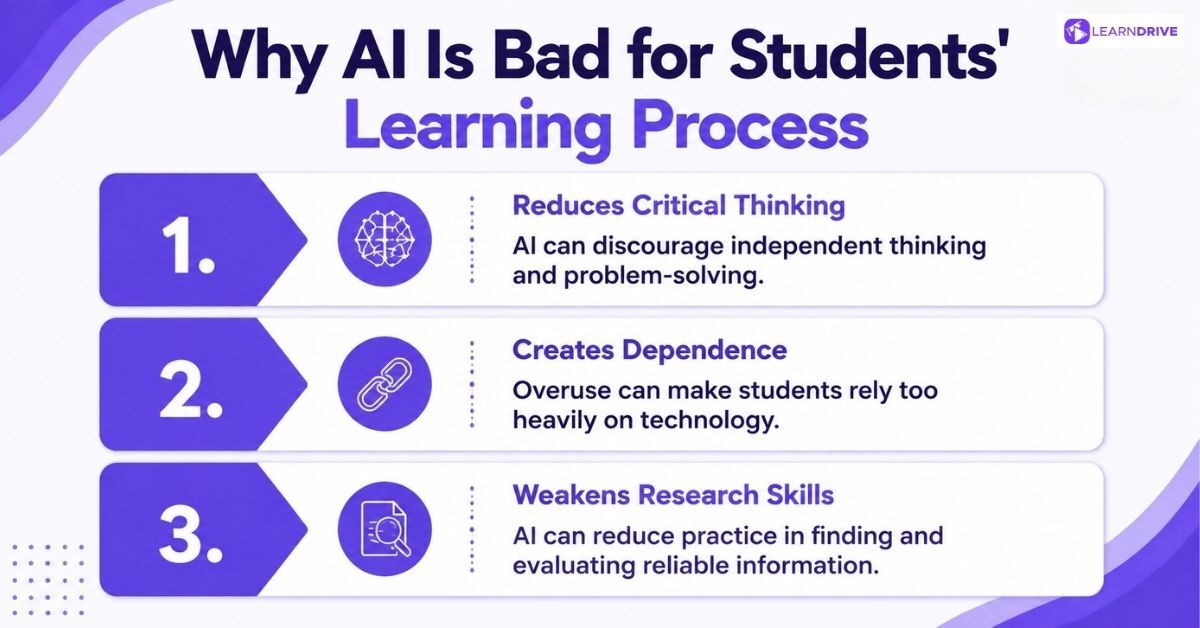
That cost shows up in three specific ways here. AI can dull critical thinking by handing over answers students never have to analyse. It can build unhealthy dependence, until basic tasks start to feel impossible without it. 

And it can quietly weaken the research skills students will need long after school ends, skills that don’t come back easily once the habit of skipping them sets in.


1. AI Can Reduce Critical Thinking Skills

Accepting an answer is not the same as understanding it. When AI hands over a finished solution, students often move on without ever analysing how or why it works.

This matters more than it might seem. Problem-solving is a skill built through repeated practice, not something absorbed by reading a correct answer once.

Students themselves are noticing the effect. A RAND Corporation survey found that 67% of students believe AI use is harming their critical thinking, up sharply from just a year earlier, even as their own AI use kept climbing.

Independent thinking fades gradually rather than all at once. Each shortcut feels harmless on its own, but the cumulative effect leaves students less equipped to reason through problems alone.

Structured critical thinking training works differently to how most students study for exams. It focuses on reasoning through unfamiliar problems, weighing evidence, and questioning assumptions, the exact muscles AI shortcuts tend to leave unused. 

Building that skill deliberately, rather than picking it up by accident through years of homework, is becoming more important as AI takes over more of the thinking students used to do themselves. 


2. AI Can Make Students Dependent on Technology

Relying on AI for every task creates a habit that’s hard to break. Writing an email, solving a maths problem, or planning an essay all start to feel impossible without it.

This dependence extends beyond convenience. Students who consistently rely on AI report struggling more when faced with a task and no tool available to help them.

Confidence takes a hit too. Solving something independently builds a sense of capability that using AI simply doesn’t provide, even when the AI-assisted result looks identical on paper.

3. AI Can Reduce Research and Learning Skills

Finding information used to mean searching, comparing sources, and judging what was actually reliable. AI now skips that entire process, delivering an answer without any of the groundwork behind it.

This has a real cost. Weak information judgement makes students more vulnerable to inaccurate or biased content, since they’ve had less practice spotting it.

Curiosity often suffers as a result. Digging into a topic naturally raises further questions, but a single AI-generated answer tends to close the loop before that curiosity has a chance to develop.

 
Learndrive.org
100+ Free
Courses
Enhance your skills — no spending required. CPDQE Accredited.

Why Generative AI Can Be Harmful for Students?
 

Why Generative AI Can Be Harmful for Students

Generative AI creates a different kind of problem beyond simple convenience. It doesn’t just answer questions, it produces entire pieces of finished work.

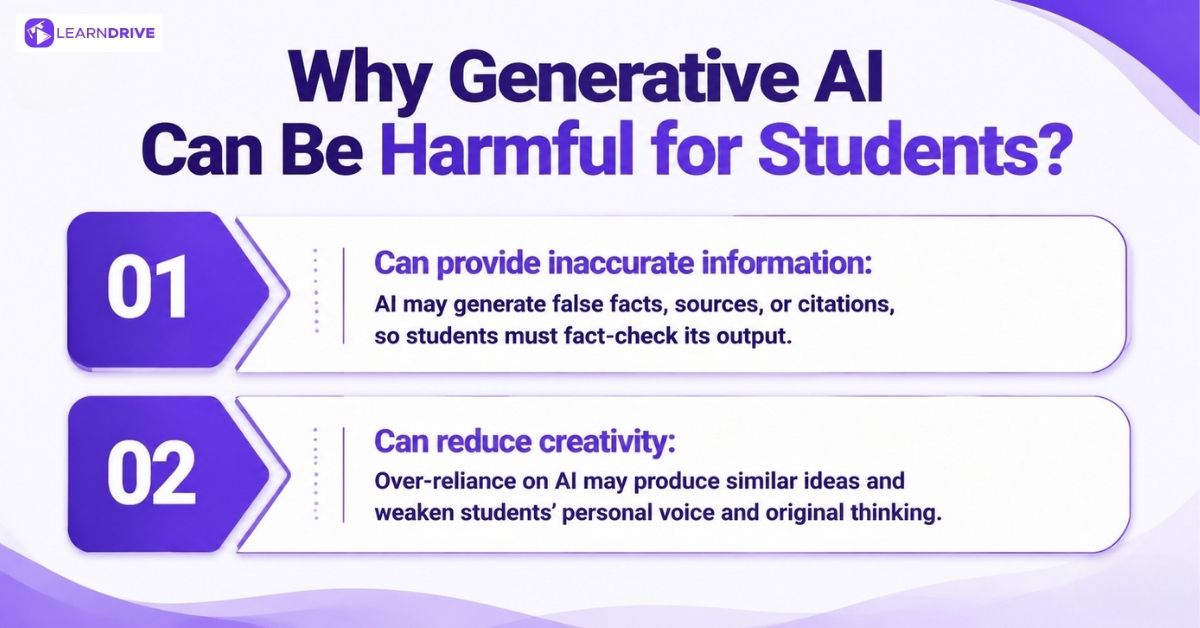
A student can now submit an essay they never wrote, understood, or engaged with, technically completing the task while learning almost nothing. That gap between finished work and real understanding shows up in two specific ways: answers that sound right but aren’t, and ideas that stop feeling like the student’s own. Weighing the pros and cons of AI for students helps explain why that gap matters so much. 

AI Does Not Always Provide Accurate Answers

AI hallucinations are a genuine risk, not a rare edge case. These tools can generate false facts, invented sources, or entirely fabricated citations, all delivered with the same confident tone as accurate information.

Fact-checking becomes essential as a result. Students who treat AI output as automatically correct are far more likely to submit inaccurate work without realising it. Learning to write clearer, more specific prompts, such as through a prompt engineering course, can reduce how often these errors slip through.

Reliable sources still matter more than AI convenience. Textbooks, academic journals, and verified references remain more trustworthy than an AI-generated summary, particularly for anything factual or citation-heavy.


AI Can Limit Creativity and Original Ideas

Students producing similar answers is becoming a noticeable pattern. When many students prompt AI in similar ways, the responses often echo each other, flattening what used to be a wide range of individual perspectives.

Less personal expression follows from this uniformity. A student’s own voice, the thing that usually makes an essay genuinely theirs, can get lost underneath AI-generated phrasing and structure.

Reduced creative problem-solving is the deeper cost here. Original ideas often come from struggling with a blank page, not from refining something AI has already produced. Skipping that struggle removes the very process creativity depends on.


How AI Complicates Learning Inside the Classroom

Schools depend on being able to see what a student actually knows. AI complicates that in ways classrooms weren’t built to handle. Two problems sit at the heart of it: measuring real ability, and protecting academic integrity.

1. AI Makes It Harder to Measure Student Ability

Grading polished, AI-assisted work makes it difficult to separate genuine skill from tool use. Two students can submit similar-looking essays with very different levels of real understanding behind them.

This creates a real problem for teachers trying to track progress. If assessment can’t reliably measure what a student knows, it becomes much harder to identify where they actually need help.

2. AI Creates New Academic Integrity Problems

AI-written essays raise questions schools are still working out how to answer. Where does legitimate assistance end and academic dishonesty begin, especially when the line isn’t always obvious to students themselves.

Cheating concerns have grown alongside AI access. Traditional plagiarism checkers were built to catch copied text, not AI-generated writing that reads as entirely original.

Misrepresentation of skills is the quieter, longer-term risk. A student who submits AI-written work is claiming an ability they may not actually have, which eventually catches up with them in exams, interviews, or further study, particularly as more employers test directly for the skills they’ll want in future rather than relying on grades alone.

Learndrive.org
100+ Free
Courses
Enhance your skills — no spending required. CPDQE Accredited.

AI in College and University: Where the Risks Deepen
AI in College and University_ Where the Risks Deepen

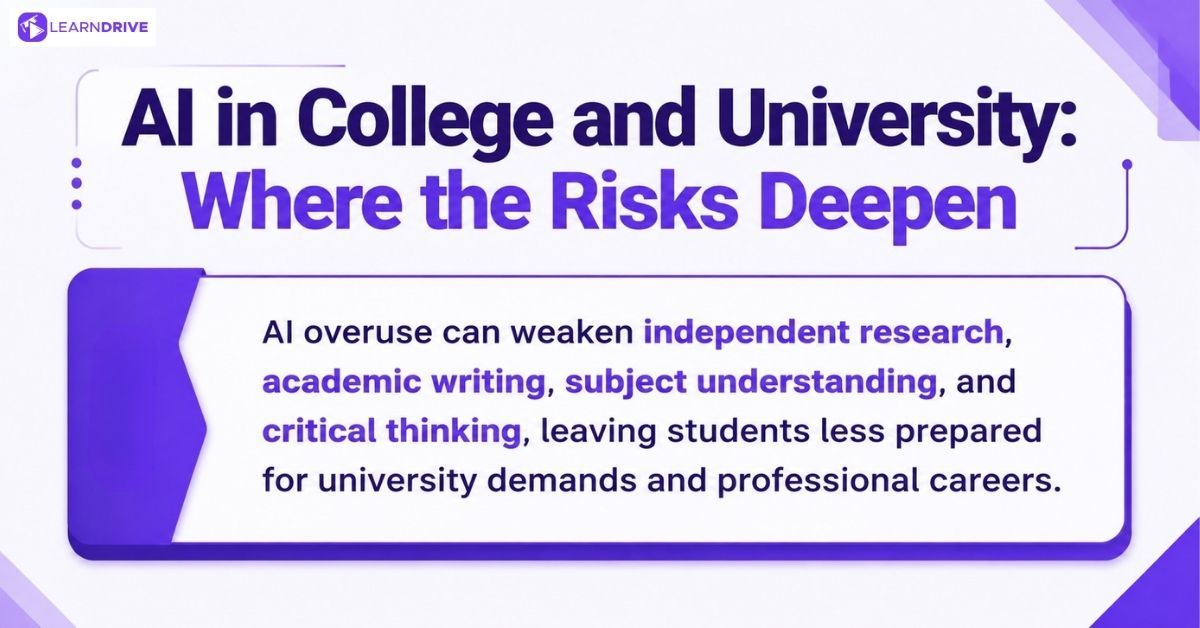
Higher education expects more independence than school ever did. That shift is exactly where AI starts causing deeper problems, particularly around writing ability, subject understanding, and readiness for professional life.

Higher education expectations rise sharply compared to earlier schooling.

Universities expect students to research independently, build their own arguments, and defend their reasoning. After years of relying on AI tools casually, many students find this transition challenging because higher education demands more independent thinking. 

Independent research skills matter more here than at any earlier stage. A student who has leaned on AI throughout school often struggles the first time a university assignment demands genuine, self-directed investigation.

Professional preparation ties everything together. Employers eventually expect graduates to think critically and solve problems without a tool doing it for them, and university is meant to build exactly that capability.


AI Can Weaken Academic Writing Skills

Structuring an argument, developing a thesis, and building evidence-based paragraphs all take repeated practice to master. AI can produce that structure instantly, which removes the practice a student actually needs.


Weaker writing skills often surface later than expected. A student may pass early coursework using AI assistance, only to struggle badly with a dissertation or final-year project that demands sustained, original writing. Rebuilding that muscle deliberately, through something like a dedicated writing course, is often what closes the gap before it becomes a problem. 

AI Can Reduce Deep Understanding of Subjects

Surface-level familiarity with a topic is not the same as genuine mastery. AI can generate a correct-sounding summary without a student ever engaging deeply with the underlying material.

This gap becomes obvious under pressure. Oral exams, vivas, and unscripted discussion quickly expose the difference between a student who understands a subject and one who has only read an AI-generated explanation of it.

The Long-Term Effects of AI Dependence on Students

Consequences rarely show up immediately. They surface later, often in the workplace, where the skills school was meant to build suddenly matter far more than any grade did.

Two things often suffer first: essential human skills such as creativity and collaboration, and the ability to make independent judgements. Employers increasingly value these skills alongside the ability to use AI effectively 

1. Students May Lose Important Human Skills

Creativity fades quietest of all, since original thinking develops through struggle that AI removes. Critical thinking weakens for the same reason already covered earlier.

Collaboration and problem-solving suffer too. Group work depends on genuine contribution, and employers consistently rank interpersonal skills among the most valuable graduate qualities, precisely because AI cannot fully replace human judgement.

2. Employers Still Need AI-Skilled but Independent Thinkers

Businesses want graduates who can use AI well, not avoid it entirely.The most valuable employees combine AI skills with the judgement to recognise when AI-generated results need improvement.

This balance requires strong critical thinking and independent decision-making, the kind of grounding a course like generative AI in business is built to develop rather than a casual, everyday habit of prompting. 

Is AI Always Bad for Students?

No, not always. Used carefully, AI can genuinely support learning rather than replace it, and the difference usually comes down to how it’s used, not whether it’s used at all.

AI as a learning assistant looks very different from AI as a shortcut. A student who asks AI to explain a confusing concept in simpler terms is engaging with the material, not avoiding it.

Using AI for explanations works well precisely because it targets understanding, not output. Asking “why does this formula work” leads somewhere very different than asking AI to solve the problem outright.

Checking information is another genuinely useful application. AI can help students verify their own reasoning or catch a mistake, provided the student still does the original thinking first.

Developing your own answers first, then using AI to refine or challenge them, keeps the learning process intact. That single habit is often what separates AI as a genuine study aid from AI as a replacement for real effort.

One-Time Payment  Best Value
The All-Access Professional Vault
1,100+ Premium Courses  |  £180 One-Time Payment

4 Ways Students Can Use AI Without Hurting Their Learning
4 Ways Students Can Use AI Without Hurting Their Learning

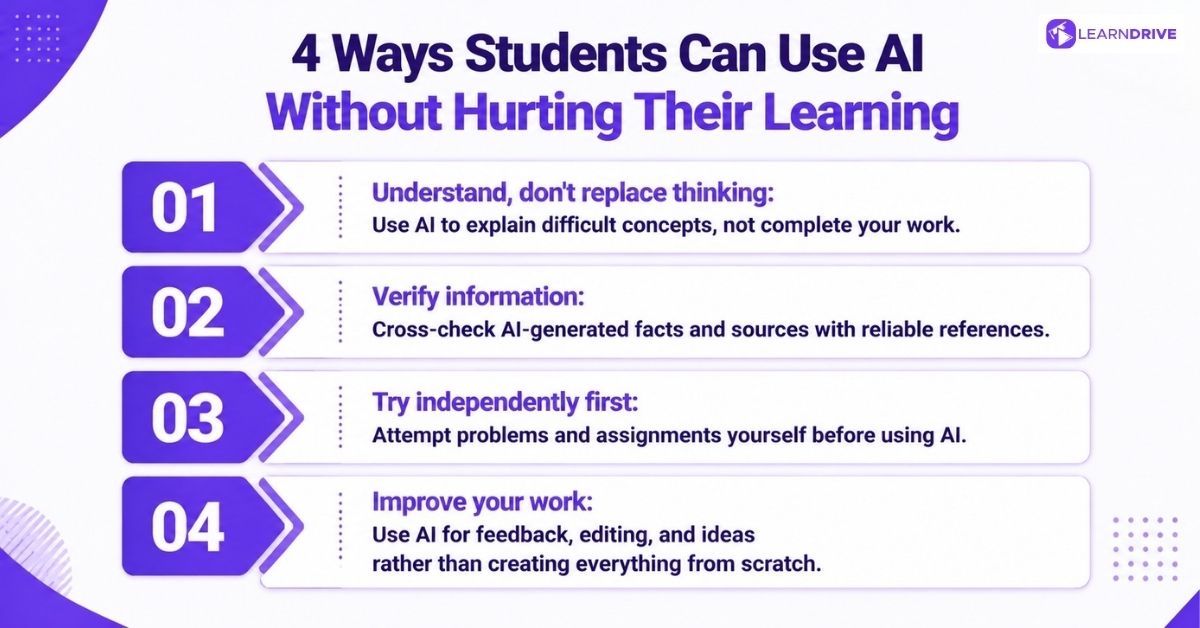
Avoiding AI completely isn’t realistic, and it isn’t really necessary either. What matters is where AI sits in the process, and whether it comes before or after a student has genuinely tried something themselves.


1. Use AI to Understand Concepts, Not Replace Thinking

Asking AI to explain a difficult concept in different ways is a responsible use of the technology.

Courses such as a ChatGPT course for students teach students how to use prompts for deeper understanding rather than simply seeking instant answers. 

The line gets crossed when the question shifts from “explain this” to “solve this for me.” One deepens comprehension, the other quietly removes it.

2. Verify AI-Generated Information

Treating AI output as a first draft, not a final answer, protects against hallucinated facts and invented sources. A quick cross-check against a textbook or reliable source catches most mistakes before they matter.

This habit also builds a valuable skill in its own right. Students who verify AI regularly get better at spotting unreliable information generally, not just from AI.

3. Complete First Attempts Independently

Trying a problem, an essay outline, or a piece of analysis alone first preserves the struggle that actual learning depends on. AI can be introduced afterward, once genuine effort has already happened.

This single habit protects nearly everything covered earlier in this guide. It keeps critical thinking active, research skills intact, and personal understanding genuinely present in the final work.

4. Use AI to Improve Work Instead of Creating Everything

Asking AI to review, tighten, or challenge an already-written piece of work is fundamentally different from asking it to write that work from scratch. Editing assistance sharpens a student’s own ideas rather than replacing them.

This approach mirrors exactly how AI gets used responsibly in most workplaces, where employees are trained to treat AI output as a draft rather than a final answer. 

That same standard sits at the centre of responsible AI practices and principles, which is worth understanding well before graduation, not after a mistake at work makes it necessary. .

 
Training professional
Online Teams Training
Scale Your Team's Skills
with top-notch training
Contact Now!

Frequently Asked Questions


1. Why is AI bad for students?

AI can be harmful for students when it replaces the mental effort required for learning. Using it as a shortcut can weaken critical thinking, research abilities, and independent problem-solving skills that students need to develop. 


2. What is the negative effect of AI on students?

The biggest negative effect of AI on students is reduced independent thinking. When students rely on ready-made answers, they lose valuable opportunities to develop problem-solving, research, and analytical skills over time. 

3. Is artificial intelligence harmful to education?

It can be, depending on how it’s used. AI risks becoming harmful when it replaces genuine effort, but it can support education when used to explain concepts or check understanding.


4. Does AI make students lazy?

It can encourage laziness if used to skip effort entirely, since instant answers remove the incentive to work through problems independently. The tool itself isn’t lazy, but overreliance on it often looks that way.

5. Can AI reduce creativity in students?

Yes, particularly when many students prompt AI in similar ways, producing work that echoes itself across a class. Original ideas typically come from independent struggle, which AI shortcuts can remove.


6. Should students stop using AI completely?

Not necessarily. Avoiding AI entirely ignores how widely it’s used in modern workplaces. The more realistic goal is using it to support learning, not replace the thinking that learning requires.


7. Should AI be banned in schools?

Most education experts argue against a full ban, since AI is already embedded in workplaces students will eventually enter. A more realistic approach focuses on clear guidelines, teaching responsible use, and redesigning assessments AI can’t simply complete.


Final Thoughts

AI is not the enemy of learning, but careless use of it can quietly undermine everything school is meant to build. Critical thinking, research skills, and creativity all depend on effort that AI can bypass if students let it.

The real risk isn’t the technology itself. It’s the habit of reaching for AI before genuinely trying, which trades short-term convenience for long-term understanding.

Used differently, AI becomes a genuine advantage rather than a shortcut. Students who verify its answers, use it to deepen understanding, and complete first attempts independently build exactly the skills employers and universities are still looking for.

The choice ultimately sits with the student. AI can either replace the struggle that real learning requires, or support it, and that decision shapes far more than a single assignment. It shapes how prepared they’ll actually be once the grading stops and the real world starts asking harder questions.


Read more :


Our popular courses 

Picture of Noah Miller
Noah Miller
[social_share_buttons]

Sensational Offer!

Sign up and get access to 49

Premium Short Course just for £1