
Do UK Employers Actually Recognise CPD Certifications?

Most UK employers recognise CPD certifications as good proof that you want to learn. But recognition is not automatic. Bosses look at how well the course matches the daily tasks of the role. They also check if the job legally requires a formal degree or licence.
A hiring manager who looks at your CV is not just counting your study hours. They want to know if the course gave you skills that help their team right now.
What Does a CPD Certificate Tell an Employer?
A relevant CPD certificate sends three clear signals. It shows you want to learn. It proves you keep your skills fresh. And it shows you can finish a course. Employers see these as signs of a self-motivated worker.
A short course will never replace hands-on work history. But it shows that you do not wait around for someone to tell you to learn.
This matches findings from the Learning and Work Institute’s Adult Participation in Learning Survey 2025. In that national survey, 94% of adults who took part in learning said they gained at least one real benefit.
These gains included better work skills, higher confidence, or new social connections. Note that this 94% figure applies only to adults who took part in learning, not to all UK adults.This mirrors advice from the National Careers Service and UK hiring managers. When two job applicants have similar work history and qualifications, the candidate who shows recent, voluntary learning usually wins the interview.
When Does CPD Training Make a Difference in Hiring?
CPD training helps most when it directly matches a skill in the job advert. It also helps if you need to bridge a career gap or learn a new tool. Its value grows when you can show real work examples of what you learned.
Look at live UK job adverts on sites like Reed or Indeed to see this in action:
Essential Criteria: These are legal must-haves. Examples include an NMC PIN for nursing, a law degree for a solicitor, or an ACA qualification for an accountant. A short course cannot replace these.
Desirable Criteria: These are bonus points. Examples include recent safeguarding training, project skills, or Excel data skills. This is where a CPD certificate helps you beat the competition.
This link between learning and good work is backed by national research. The CIPD Good Work Index is an annual benchmark survey of 5,000 UK workers. It shows that employees whose managers support their learning and skills development report higher job satisfaction, better performance, and lower intentions to quit. UK employers who support training know that continuous learning builds stronger, more loyal teams.
Which UK Industries Value CPD Training the Most?

UK industries value CPD in different ways depending on their rules. Regulated sectors like healthcare, care homes, and finance use CPD to meet legal safety audits. Other fields, like business and tech, value CPD because it proves you have up-to-date, practical skills.
Healthcare and Social Care
In healthcare and care homes, CPD protects patients and keeps workers safe. Care workers and support staff need fresh training in safeguarding, infection control, first aid, and moving people safely.
Care employers face strict Care Quality Commission (CQC) checks. They look closely at staff training records. Many care workers stay up to date through bundles like LearnDrive’s Health and Social Care Essentials, which combines Care Certificate standards with verified CPD hours.
Business, Administration and Human Resources
In office, secretarial, and HR jobs, CPD helps staff learn modern project tools, better writing skills, and team management. Because these jobs rarely need a statutory licence, hiring managers use CPD to spot proactive workers.
Employers want skills that save time. Taking a course such as Business Management or in employment law proves you can take on more responsibility in the office.
Finance, Compliance and Professional Services
Finance and compliance jobs require workers to stay ahead of changing financial laws. Staff in banking, legal services, and insurance must understand rules around Anti-Money Laundering (AML) and Know Your Customer (KYC).
Compliance managers look for certificates that prove you understand these laws. A focused course like LearnDrive’s AML and KYC Compliance Course shows you know how to follow UK financial reporting rules.
Digital Marketing, Technology and AI
Tech and digital marketing move too fast for standard college courses to keep up. Tools and AI platforms change every month. Because of this, employers care more about what you can do right now than what degree you finished years ago.
Hiring managers want to see short courses backed by real projects. An online marketer who completes Digital Marketing Fundamentals and uses it to grow website traffic has real proof of skill.
How Can CPD Training Support Your Career Growth?

Targeted CPD training helps you build skills for your daily job, prepares you for promotions, and teaches you the basics when moving into a new industry. Its true value comes from turning what you learn in class into clear results at work.
Building New Skills for Your Current Role
Taking a CPD course helps you fix a weak spot in your daily work. Whether you learn advanced Excel or practice handling difficult customer calls, a short course builds your confidence fast.
The secret is using what you learn right away. When you apply your lessons to your weekly tasks, you make your daily work faster and better.
Preparing for Promotion and Greater Responsibility
Taking voluntary CPD courses gives you proof of your ambition during performance and pay reviews. It shows your boss that you are ready for a bigger role.
Pick courses that match the job you want next. Finishing a course in team leadership shows senior leaders that you are ready to manage other people.
Supporting a Career Change
When changing careers, CPD certificates help bridge the gap between your old job and your new field. They show a future employer that you are serious about learning their industry.
To give yourself the best chance, combine your certificates with transferable skills and personal projects. We explain this step by step in our Career Transition Guide. If you want to compare different training options before spending money, read our review of the top online courses with certificates.
How to Choose a CPD Course That Employers Will Value?

To pick a CPD course that employers respect, choose accredited providers with clear lesson plans, fair tests, and topics that match real job adverts. Skip unaccredited courses that offer no tests, and pick training that teaches skills companies are hiring for right now.
Check the Training Provider’s Credibility
Look into who runs the company. Check their UK contact details, and read real student reviews. Trusted providers share clear information about who wrote the lessons and who teaches them.
You can also check their accreditation badge with the named review body. Honest training companies are happy to show how they run their courses.
Review the Course Content and Assessment
Compare the course outline with live job descriptions in your field. A good course has clear lesson breakdowns, real-world examples, and end-of-module tests.
Avoid courses that only ask you to watch videos without testing your knowledge. Courses with practical quizzes and tests carry far more weight with employers.
Understand Certificate Costs and Recognition
Check the total cost of the course before you sign up. Make sure the price includes your final test and certificate. Some low-cost providers charge extra fees at the end to get your paper.
Make sure the certificate is easy to verify. Reputable providers give you an official digital transcript with your test scores and logged study hours. That way, hiring managers can quickly check your certificate online to confirm that your training is genuine.
Match Your Training to Real UK Job Requirements
Look up five to ten job adverts for the role you want next. Make a list of the skills and software that show up again and again in those adverts.
Then pick a CPD course that teaches those exact skills. Training chosen this way will help your career far more than a random certificate.
How to Present CPD Certifications on Your CV, LinkedIn, and in Interviews
To make your CPD certificates work for you, put them under a clear ‘Professional Development’ heading on your CV. Add your certificate links to LinkedIn, and talk about real workplace results in interviews. Tying your training to business results grabs a hiring manager’s attention.
Adding CPD Courses to Your CV
Group your certificates under a clean heading like ‘Professional Development’ or ‘Certifications’. Write the course title, the provider, the completion year, and your CPD hours.
CPD Certified: Advanced Data Analytics for Business Decisions
LearnDrive | Completed 2026 | 20 CPD Hours
Learned to build automated reports in Excel, cutting monthly reporting time by three hours.
Showcasing CPD on Your LinkedIn Profile
Add your completed courses to the ‘Licenses & Certifications’ section on your LinkedIn page. Enter the course name, the training provider, the date, and your certificate ID or link.
Write a quick sentence explaining what you learned. Adding verifiable details shows recruiters that your skills are genuine.
Discussing CPD in Job Interviews
In job interviews, talk about your training using the STAR method: Situation, Task, Action, and Result. Explain the problem you faced, why you picked that course, and how using your new skills solved the issue.
Interviewers love candidates who can explain the real-world value of their learning. This fits the interview advice in our guide to job search strategies that work.
Are Online CPD Courses Worth the Investment?
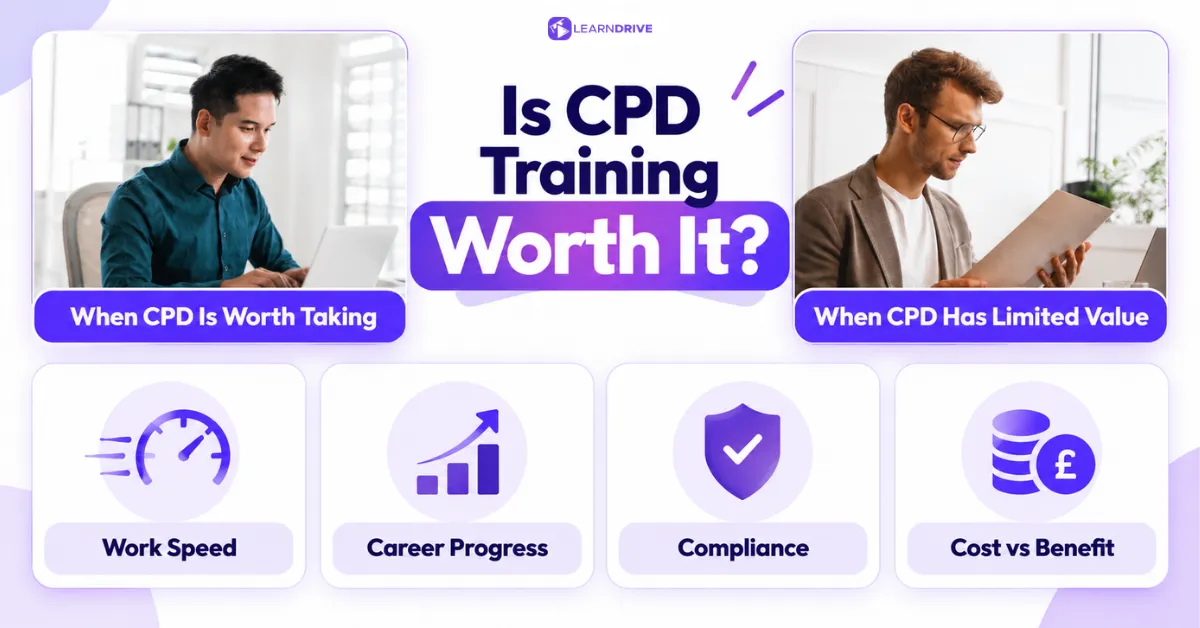
Online CPD courses are worth the money when they teach skills you need for your job, come with a verifiable certificate, and match what employers want. Their true return on investment depends on course quality, trusted accreditation, and how well you use what you learn at work.
When a CPD Course Is Worth Taking
A CPD course is well worth taking when it teaches a skill your boss asked for or helps you do your job faster. If the training helps you win a promotion or fix a daily bottleneck, it pays for itself quickly.
Self-paced online study also lets you learn without taking time off work, keeping your career moving forward.
When a CPD Certificate May Have Limited Value
A certificate has little value if the topic has nothing to do with your career goals, or if you took the course just to collect a badge. Also, if a job legally requires a formal degree or licence, a short CPD certificate cannot help you there.
Courses that have no real tests or cannot be checked online will not impress hiring managers either.
How to Measure the Value of CPD Training
Track the value of your training using four simple questions:
1. Work Speed: Did the course help you work faster or make fewer mistakes?
2. Career Progress: Did the certificate help you land an interview or get a promotion?
3. Following Rules: Does the course meet your yearly workplace training requirements?
4. Cost vs Benefit: Was the price of the course fair for the skills you learned?
When Do CPD Certifications Matter Most in Your Career?
CPD certificates matter most during big career moments. They help early-career workers make up for a short work history. They give mid-career staff the leadership skills for a promotion. And they help career changers prove their interest in a new field.
In every career stage, what matters most is how well your skills fit the job. When you pick training that matches real job needs, CPD certificates become powerful tools for career growth.
Are CPD Certificates Recognised by UK Employers?
Can You Get a Job With a CPD Certificate?
Is a CPD Certificate Equivalent to an NVQ or Diploma?
Do CPD Certificates Expire?
How Many CPD Hours Do UK Employers Require?
Is a Free CPD Certificate as Valuable as a Paid One?
Can CPD Courses Help You Get Promoted?