NOTICEWe're upgrading our learning platform. You may notice temporary changes or brief interruptions while the migration is completed. Thank you for your patience! For any urgent query, contact info@learndrive.org
NEWThe Complete AI Skills Bundle 2026 — 9 courses, 9 CPD certificates, one price. Explore the bundle →
Best Online Learning Platforms in 2026_ Courses, Certificates and Career Skills

15 Best Online Learning Platforms in 2026: Courses, Certificates and Career Skills

The best online learning platforms in 2026, including LearnDrive, Coursera, Udemy, edX and LinkedIn Learning, turn scattered tutorials into structured skills backed by real certificates.

Most people choose a platform on price alone, then regret it once the certificate carries no weight with employers or the course sits unfinished for months. 

That mistake gets more common every year as new platforms launch and marketing gets louder. Around 21% of people in Great Britain have already tried online learning, and the habit is strongest among 16 to 24 year olds, according to Statista.

Fifteen platforms go head to head below on course quality, pricing, certificate credibility and genuine career value, so you pick the right one the first time and skip the trial and error.

Table of Contents

Our Top Online Course Learning Platforms Picks At A Glance

  • 1. Coursera — Best for university-backed certificates & degrees

  • 2. Udemy — Best for budget-friendly, single-topic practical tutorials

  • 3. LearnDrive — Best for accredited UK CPD hours & self-paced workplace qualifications

  • 4. LinkedIn Learning — Best for professional networking & corporate skill badges

  • 5. FutureLearn — Best for short courses backed by UK & European universities

  • 6. edX — Best for rigorous higher-education and advanced academic tracks

  • 7. Khan Academy — Best 100% free resource for core academic foundations

  • 8. OpenLearn — Best free open-access materials from The Open University

  • 9. Skillshare — Best for creative workflows, illustration, video, and design

What Are Online Learning Platforms?

The term covers far more than a YouTube video with a certificate stapled onto the end.

An online learning platform is a website or app that hosts structured courses, assessments and certificates, letting people build skills without stepping into a classroom. Learners sign up, work through video lessons, readings or quizzes at their own pace, then earn a certificate once they finish.

Not every platform works the same way, though. Marketplaces such as Udemy let individual instructors upload their own courses, so quality and depth vary widely between listings.

MOOCs, short for massive open online courses, come from universities and bodies like Coursera and edX, following an academic structure that’s often free to audit. Professional training platforms, including LearnDrive and LinkedIn Learning, focus on career skills through structured pathways, and many carry formal CPD accreditation that employers recognise.

How Online Learning Platforms Help Students and Professionals

A single course can move someone from unemployed to hired within a few months.

New skills come first, whether that’s coding, first aid or a new language, built through short lessons instead of a full degree.

Career development follows close behind. Structured pathways, like career planning and life goals setting, turn a vague ambition into an actual plan with steps behind it.

Academic support matters too, especially for students who need extra help outside school hours. Many platforms fill gaps a normal classroom timetable can’t cover.

Professional certifications carry real weight on a CV, particularly CPD-accredited ones that employers recognise during hiring.

Flexible learning ties all of this together, since courses fit around shift work, childcare or a full-time job. That said, the advantages and disadvantages of online learning are worth weighing before committing to a full programme.

How We Compared the Best Online Learning Platforms
How We Compared the Best Online Learning Platforms

Two platforms can teach the exact same skill and still leave you with completely different results.

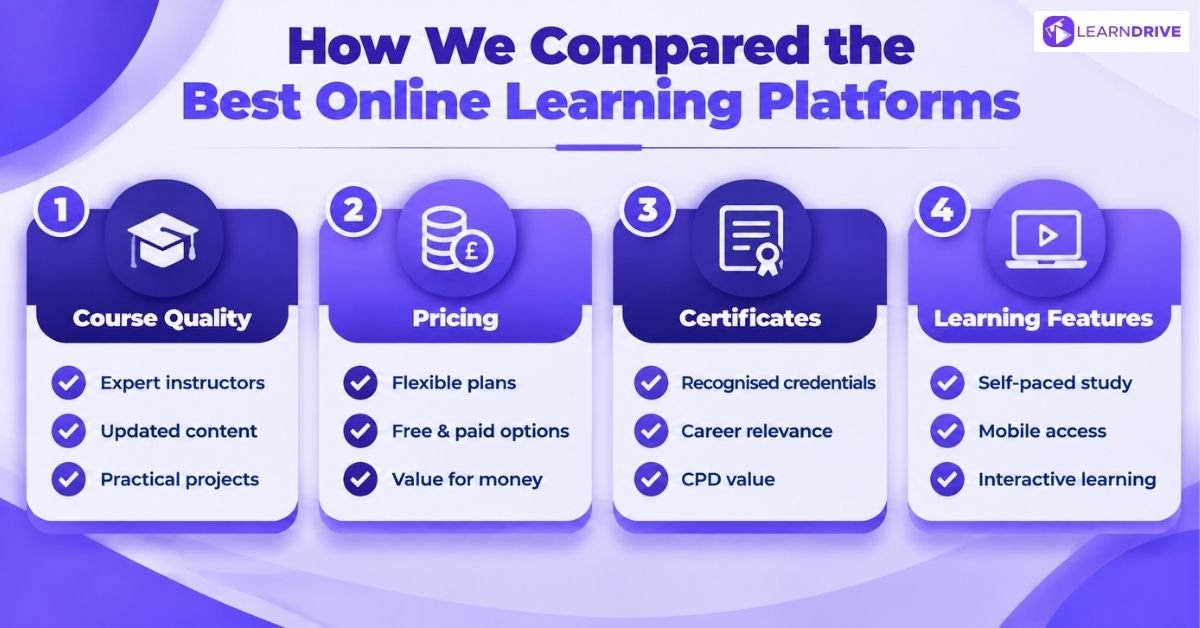
To keep this comparison fair, we judged each platform on four things that actually affect whether a course is worth your evenings: how good the teaching itself is, what it costs to access, whether the certificate carries any real weight with employers, and how easily it fits around a job, studies or family life.

1. Course Quality and Learning Experience

The best instructor in the world still can’t save a course that hasn’t been touched since 2019.

Instructor expertise sets the ceiling for how much you’ll actually learn. Practitioners who still work in the field tend to teach differently from someone reading off a script written years ago.

Course updates matter just as much, especially in fast-moving areas like software, marketing or AI tools. A platform that revises its content regularly saves you from learning outdated methods.

Practical projects turn theory into something you can point to. Courses built around real tasks, rather than endless slides, leave you with proof of what you can do, not just a memory of what you watched.

Learning structure ties it together. Clear modules, defined milestones and a logical order stop a course from feeling like a pile of unrelated videos.

2. Pricing and Subscription Options

The cheapest course isn’t always the cheapest option once you add up wasted subscription months.

Free courses give beginners a low-risk way to test a subject before committing money or time. Monthly subscriptions suit people working through several courses at once, though the value drops fast if life gets busy and courses stall halfway through. Pay-per-course models fit learners who already know exactly what they want and don’t need ongoing access to a library. Lifetime access removes the time pressure entirely, letting people return to material months or years later without paying again.

3. Certificates and Career Value

A certificate only matters if the person reading your CV has actually heard of it.

Certificate credibility varies hugely between platforms, with university-backed and industry-recognised certificates carrying far more weight than a generic completion badge. Resume value depends on recognition rather than effort, so courses from well-known bodies tend to open more doors.

Professional development often continues beyond a single certificate, building toward a recognised qualification over time. CPD certification specifically signals ongoing learning to UK employers, particularly in regulated fields like health and safety or finance.

4. Flexibility and Learning Features

Life doesn’t pause for a course, so the best platforms don’t expect it to.

Self-paced learning lets people study around shifts, childcare or a second job without falling behind. Mobile learning turns a commute or a lunch break into study time instead of wasted minutes. 

Offline access matters for anyone without reliable wifi, letting downloaded lessons continue regardless of signal. Interactive exercises, quizzes and practical tasks keep the material memorable, rather than something skimmed once and forgotten.

15 Best Online Learning Platforms for Different Learning Goals
 

15 Best Online Learning Platforms for Different Learning Goals


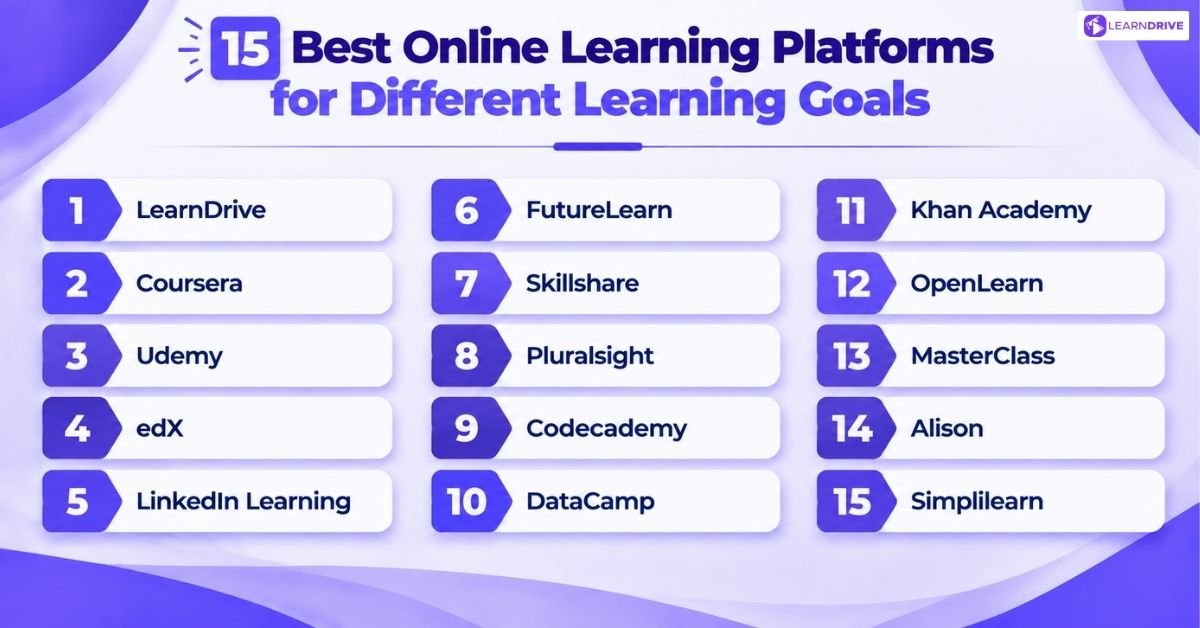
Fifteen platforms make the shortlist below, and no two are built for quite the same learner. Some focus on university-level academic rigour, others on fast, practical career skills, and a few lean entirely into creative or technical training.

Read through the ones that match what you’re actually trying to achieve. A developer chasing a promotion needs a very different platform from someone studying for a career change into healthcare or teaching.


1. Udemy

Udemy works more like a marketplace than a curated platform. Individual instructors upload their own courses, which means the catalogue is enormous, but quality can swing from genuinely excellent to fairly thin within the same search results.

There’s no subscription to commit to. You buy the course you want, keep it for life, and move on, which suits learners who know exactly what skill they’re after.

Price: Pay per course, with list prices often discounted to £10 to £20 during frequent sales.

Why it stands out: No subscription pressure, and lifetime access to whatever you buy.

Pros: Huge catalogue; lifetime access; constant discounts.

Cons: Certificates carry little formal weight; quality depends entirely on the instructor.


2. Coursera

Coursera partners directly with universities like Yale, Michigan and Imperial College London, so many of its courses carry genuine academic weight. Alongside that sit industry-designed certificates from Google, IBM and Meta, aimed squarely at getting people hired.

The subscription model, Coursera Plus, opens up the entire library at once, which suits learners who want to explore several subjects rather than commit to one course at a time.

Price: Coursera Plus costs $59 a month, or $399 a year, around £47 a month in the UK.

Why it stands out: Genuine university-backed credentials most employers recognise on sight.

Pros: Strong academic reputation; huge subject range; professional certificates from major companies.

Cons: Free auditing has largely disappeared; full degrees cost thousands on top of Plus.


3. LearnDrive

LearnDrive focuses on practical, job-ready skills rather than academic theory, covering everything from workplace safety and HR training to AI tools and digital marketing. Courses are built around what employers actually ask for, not what looks good on a university prospectus.

The platform suits beginners and working professionals equally well, since most courses are self-paced and designed to fit around a full-time job rather than compete with it.

Price: LearnDrive Membership starts from £7.50 per month, £75 per year, or £180 for lifetime access, including unlimited course access, accredited certificates, and learner benefits. 

Why it stands out: Flexible, career-focused training that doesn’t demand a huge time commitment upfront.

Pros: Wide range of career-focused courses; flexible study options; recognised certificates.

Cons: Smaller catalogue than large marketplace platforms.

Learndrive.org
100+ Free
Courses
Enhance your skills — no spending required. CPDQE Accredited.


4. edX

Harvard, MIT and dozens of other universities post real course content on edX, much of it free to audit. It’s one of the few places online where you can genuinely sit in on an MIT computer science course without paying a penny.

Where edX charges is for proof. Graded assignments and a verified certificate require payment, though financial aid is available for learners who qualify.

Price: Free to audit; verified certificates run $50 to $300 per course.

Why it stands out: Genuine academic rigour from some of the world’s best universities.

Pros: High-quality university content; financial aid available for certificates.

Cons: Audit windows can close after a few weeks; certificate costs add up across multiple courses.


5. LinkedIn Learning

LinkedIn Learning wraps short, practical video courses around business and soft skills, and every certificate feeds straight back into your LinkedIn profile. Recruiters browsing your profile see the badge the moment you finish.

This e-learning platform is less suited to deep technical training, but for interview skills, management basics or software tutorials, the bite-sized format works well for busy professionals.

Price: Bundled into LinkedIn Premium, around £30 a month or roughly £180 a year.

Why it stands out: Certificates attach directly to your LinkedIn profile, visible to recruiters instantly.

Pros: Strong business and soft skills library; short, practical lessons.

Cons: Weaker for deep technical subjects; no standalone plan outside Premium.


6. FutureLearn

FutureLearn is Britain’s own MOOC platform, built by the Open University and leaning heavily on UK institutions. Courses lean social, with discussion steps built into nearly every module rather than passive video watching.

That makes it a good fit for learners who like debating ideas with classmates, and for anyone specifically after UK-recognised university content.

Price: Unlimited subscription runs around £45 a month, cheaper on the annual plan.

Why it stands out: A strong UK institution catalogue and a genuinely social learning style.

Pros: UK-focused content; free two-week access to most courses.

Cons: Smaller technical catalogue than Coursera; free access expires quickly.


7. Skillshare

Creative subjects dominate Skillshare’s library, from illustration and photography to brand design and freelance business skills. Classes are short and project-based, so you’re usually building something rather than just watching someone talk.

Community feedback is a genuine feature here, not just marketing. Students post their project work and get real critique from other learners and, sometimes, the instructor.

Price: Around $168 a year, with no ongoing free tier.

Why it stands out: A genuine creative community built around real project feedback.

Pros: Deep creative course library; project-based, hands-on learning.

Cons: Weak for technical or academic subjects; no monthly billing on the main site.


8. Pluralsight

Pluralsight is built specifically for software developers, cloud engineers and security professionals, with hands-on labs sitting alongside the video lessons. Skill assessments measure exactly where your gaps are before you spend time relearning things you already know.

It’s a premium price for a narrow focus, but for tech teams and serious individual learners, the depth pays off.

Price: Individual plans run $29 to $45 a month, or roughly $299 to $499 a year.

Why it stands out: Skill assessments and hands-on labs, not just video lectures.

Pros: Deep technical library; practical hands-on practice.

Cons: Narrow focus outside tech; no free tier available.


9. Codecademy

Codecademy teaches coding directly in the browser, checking your work line by line as you type instead of leaving you to copy along with a video. For absolute beginners, that immediate feedback loop makes mistakes easier to catch and fix.

The free Basic plan is fairly limited, though, and the projects, certificates and career paths that make the platform genuinely useful all sit behind a paid Pro subscription.

Price: A free Basic plan exists; Pro starts around $15 to $20 a month billed annually.

Why it stands out: Learning by doing beats watching someone else write code.

Pros: Hands-on interactive editor; broad programming language coverage.

Cons: Certificates and real projects require Pro; some content can feel dated.


10. DataCamp

DataCamp teaches Python, R, SQL and AI tools through short interactive exercises, coding directly inside the browser rather than watching long lecture videos. The format suits people who learn best by doing rather than listening.

Its industry-recognised certifications in data analysis and data science carry genuine weight for anyone trying to break into a data role.

Price: A free Basic plan covers the first chapter of each course; Premium starts around $25 a month billed annually.

Why it stands out: Industry-recognised data certifications, not just completion badges.

Pros: Interactive, code-along format; strong data science focus.

Cons: Narrow subject range; full price climbs quickly without a promotion.


11. Khan Academy

Khan Academy teaches school-level maths, science and humanities completely free, with no premium tier hiding the good material behind a paywall. It was built as a nonprofit, and that mission still shows in how the platform is run.

It’s less useful for professional certification, but for students, parents supporting home learning, or adults rebuilding maths from scratch, nothing else matches it for cost.

Price: Completely free.

Why it stands out: Genuinely free academic support, with no catch anywhere in the model.

Pros: No cost at all; strong for foundational school-level subjects.


Cons: Limited career or professional certification value.


12. OpenLearn

OpenLearn is the Open University’s free learning arm, offering short courses across humanities, science, health and business. The content is written to the same standard as paid Open University modules, just without the fee or formal credit attached.

It works well as a low-risk way to test a subject before committing to a full paid degree elsewhere.

Price: Completely free.

Why it stands out: University-quality material without a university price tag.

Pros: Free access throughout; genuine academic credibility behind the content.


Cons: No formal accredited certificate on most courses.


13. MasterClass

MasterClass brings in well-known names, chefs, novelists, athletes and business leaders, to teach creative and lifestyle skills through cinematic, high-production video lessons. It’s less a structured course and more an extended masterclass, as the name suggests.

There’s no certificate at the end and limited practical assessment, so it suits inspiration and enjoyment more than career progression.

Price: Annual membership only, from $120 to $240 a year depending on the tier.

Why it stands out: Learning directly from recognisable experts feels genuinely motivating.

Pros: High production value; well-known, credible instructors.
Cons: No career certificates; light on practical assessment or feedback.


14. Alison

Alison offers thousands of free courses spanning business, trades, IT and personal development, funded through advertising rather than course fees. Unlike many competitors, the course content itself is never behind a paywall.

The catch comes at the end. Official certificates and diplomas cost extra, though the prices stay low compared with almost every other platform on this list.

Price: Free to learn; certificates cost roughly £20 to £35, with Premium around £7 to £8 a month.

 Why it stands out: The certificate is a low-cost add-on, not a hard paywall blocking your learning.

 Pros: Huge free course library; low-cost certificates compared with competitors.

Cons: Weaker employer recognition; ad-supported unless you pay for Premium.


15. Simplilearn

Simplilearn runs bootcamp-style programmes aimed at specific careers, from cloud computing and cybersecurity to project management and digital marketing. Live cohorts and mentor support set it apart from platforms built purely around pre-recorded video.

That structure suits people who want a defined start and end date, with accountability built in, rather than an open-ended self-paced course they might never finish.

Price: Individual programmes typically run $600 to $5,000 depending on depth.

Why it stands out: Live instructor-led cohorts, not just another video library.

Pros: Career-focused bootcamp structure; live mentorship and support.

Cons: High cost compared with subscription platforms; not built for casual learners.

15 Best Online Learning Platforms Comparison Table 

15 Best Online Learning Platforms: Quick Comparison (2026)

Compare course quality, UK pricing, certification value, and free options to find your ideal learning path.

Platform Best For Certificate Type Starting Price Free Option CPD-Accredited
🎓 Coursera
University credentials & corporate certificates University / Professional certificate £297 / year (Coursera Plus) Free audit on many courses ✕ No
💻 Udemy
Self-paced practical skills & coding Certificate of completion £14.99 to £199.99 (per course) No ✕ No
📚 edX
Academic courses from Harvard, MIT, etc. Verified university certificate $50 to $300 (per certificate) Free audit on most courses ◈ Varies by course
💼 LinkedIn Learning
Business skills & direct LinkedIn profile display Certificate of completion About £29.99 / mo (or annual sub) 30-day free trial ✕ No
🏫 FutureLearn
UK university short courses & social learning University certificate or microcredential From £39 / course (or £45/mo Unlimited) Limited free access ◈ Varies by course
🎨 Skillshare
Creative project-based skills & freelancing Certificate of completion About £10.60 / mo (billed annually) Free trial available ✕ No
🛠️ Pluralsight
Software development, DevOps & IT teams Skill assessment badges / cert £24 to £35 / mo ($29 to $45/mo) 10-day free trial ✕ No
⌨️ Codecademy
Interactive in-browser coding practice Certificate of completion (Pro) From $15 to $20 / mo (billed annually) Free Basic tier ✕ No
📊 DataCamp
Data science, analytics, Python & SQL Statement of accomplishment From $25 / mo (billed annually) Free first chapter of courses ✕ No
🌱 Khan Academy
Foundational school-level & math learning Mastery badges (no formal cert) 100% Free (Non-profit) Yes, fully free forever ✕ No
📖 OpenLearn
UK Open University academic courses Statement of Participation 100% Free (Open University) Yes, fully free forever ✕ No
🎬 MasterClass
Celebrity-led creative & leadership courses None (inspiration & craft) £10 to £19 / mo (billed annually) 30-day money-back guarantee ✕ No
📗 Alison
Free learning with low-cost certificates CPD-accredited certificate (paid) Free study (Certs £20 to £35) Free course study ✓ Yes
🚀 Simplilearn
Digital bootcamps with live instructor support University / Industry certification £500 to £3,500 (per bootcamp) Free SkillUp short courses ◈ Varies by course
🔎 No matching platforms found for this filter.
Showing 15 platforms 💡 Prices, trials and terms may vary over time. Check provider details before enrolling.

Best Online Learning Platforms by Category 

Best Online Learning Platforms by Category

Match your primary learning objective with the highest-rated platforms.

Learning Goal Recommended Platforms Why These Platforms Stand Out
🎯 Career Development
⭐ LearnDrive Coursera LinkedIn Learning Structured vocational courses, career-focused certificates, and recognized CPD accreditation to support career transitions and workplace growth.
💻 Coding & Tech
Codecademy Pluralsight DataCamp Hands-on coding exercises, interactive in-browser environments, and technical skill assessments for developers and data professionals.
💼 Business & Leadership
⭐ LearnDrive Coursera LinkedIn Learning Courses in management, communication, digital skills, compliance, and workplace leadership with profile-ready credentials.
🎨 Creative Skills
Skillshare MasterClass Project-based visual learning in graphic design, photography, video production, writing, and masterclasses taught by world-class creators.
🌱 Free Learning
Khan Academy OpenLearn Alison Completely free or low-cost learning resources without subscription paywalls, ideal for foundational topics and curiosity-led study.
🎯

Career Development

⭐ LearnDrive Coursera LinkedIn Learning
Structured vocational courses, career-focused certificates, and recognized CPD accreditation to support career transitions.
💻

Coding & Technology

Codecademy Pluralsight DataCamp
Hands-on coding exercises, interactive in-browser practice, and technical skill assessments for software careers.
💼

Business Skills

⭐ LearnDrive Coursera LinkedIn Learning
Management, communication, digital skills, compliance, and workplace leadership with recognized certificates.
🎨

Creative Skills

Skillshare MasterClass
Project-based learning in design, photography, video production, writing, and celebrity-led masterclasses.
🌱

Free Online Learning

Khan Academy OpenLearn Alison
100% free courses and accessible resources without high costs, ideal for foundational self-study.

Free vs Paid e-Learning Platforms: Which One Should You Choose?
Free vs Paid Online Learning Platforms_ Which One Should You Choose

“Free” and “worth it” aren’t always the same thing, and paying more doesn’t automatically mean learning more.

Advantages of Free Platforms

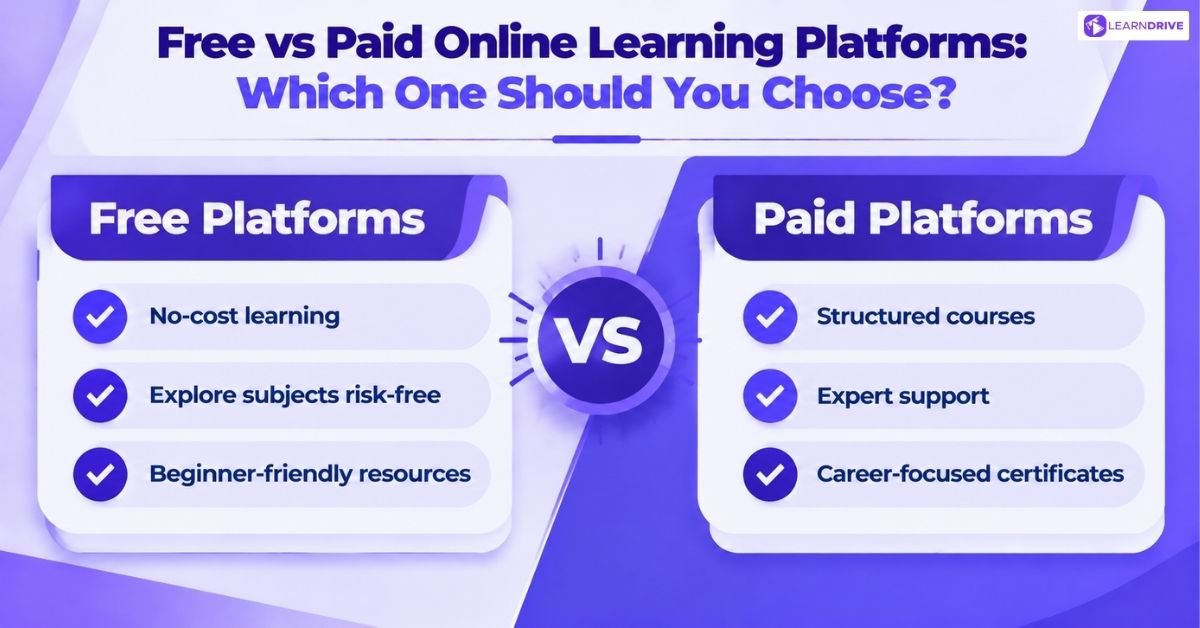
Free platforms like Khan Academy, OpenLearn and Alison remove the biggest barrier to starting: cost. That makes them ideal for testing a subject before committing money, or for building foundational knowledge without financial risk.

  • Low-cost, often zero-cost learning

  • A safe way to explore a new subject before committing further

  • Beginner-friendly resources with no pressure to finish quickly

Advantages of Paid Platforms

Paid platforms tend to offer more structure, stronger support and certificates that actually carry weight with employers. That structure matters most for anyone working toward a specific career outcome rather than general curiosity.

  • Structured learning paths with clear milestones

  • Better support, from mentors to active communities

  • Certificates and career-focused pathways employers recognise


Are Above Mentioned Online Course Certificates Worth It?

Online course certificates are worth it when they come from a recognised institution or employer-backed provider and match the skills you’re actually applying for.

A certificate alone doesn’t guarantee a job, but the right one, from the right source, can move a CV to the top of the pile.

Do Employers Recognise Online Certificates?

Yes, employers do recognise online certificates, but only when a credible issuer stands behind them. A certificate from an accredited university, a well-known company or a CPD-accredited provider carries real weight in hiring conversations.

Recognition depends on the issuer, not the platform hosting the course. Certificates from edX, Coursera or CPD-accredited platforms such as LearnDrive fit that description well. This matters especially in regulated fields such as health and safety, finance or care work. 

A generic completion badge from an unaccredited course usually gets glanced at and forgotten. Hiring managers increasingly check who stands behind a certificate, not just its title.


Which Online Certificates Have More Career Value?

Certificates tied to a specific, in-demand skill and a recognisable name tend to perform best. Google’s IT Support certificate and AWS-backed cloud computing courses are good examples of this. 

A CPD-accredited qualification in a regulated field works the same way. Each signals something concrete an employer can verify, rather than a vague claim of finishing a course.

 Certificates built around a practical project or a graded assessment carry more weight. That beats ones awarded simply for watching every video through to the end.

Can You Add Online Certificates to LinkedIn?

Yes, and it takes only a couple of minutes. Most platforms, including LearnDrive, Coursera and LinkedIn Learning itself, generate a shareable certificate once you finish. 

Each one comes with a direct “Add to LinkedIn” button built in. It appears on your profile under Licenses and Certifications straight away. Recruiters browsing your profile can see it immediately, including those actively searching for those exact skills.


4 Ways to Choose the Best Online Learning Platform
4 way to Choose the best Online Learning Platform

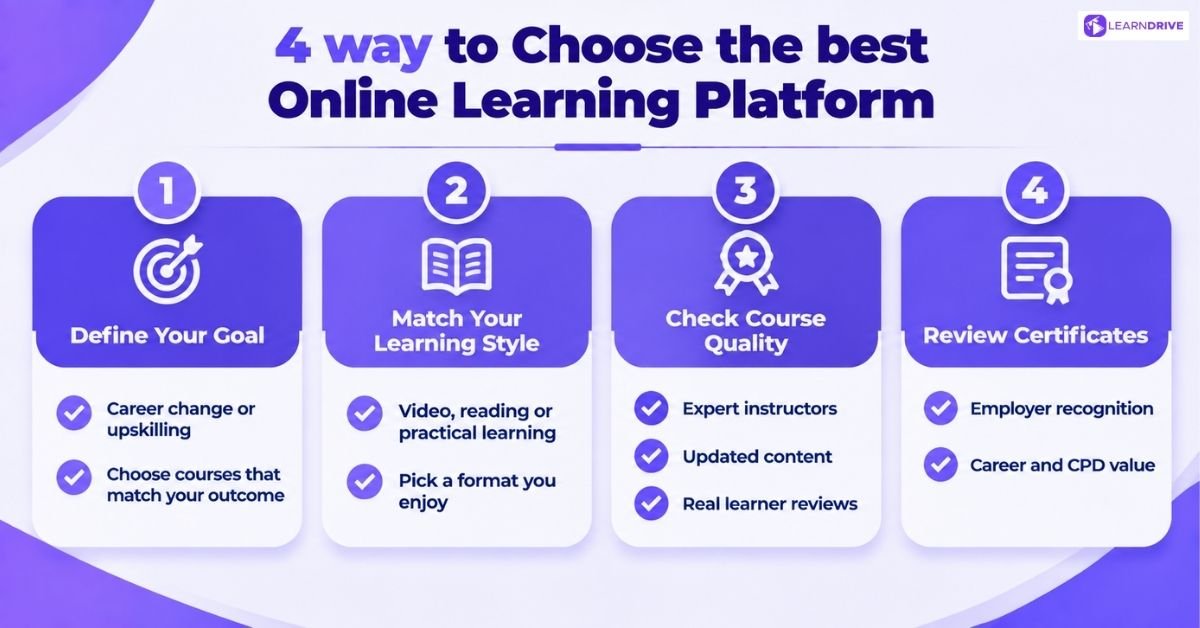
The best platform isn’t the most popular one. It’s the one that actually matches what you need to achieve. Four things decide that match: your career goal, how you learn best, and the quality of the course itself.


The fourth is whether the certificate at the end actually means something to an employer. Work through each one before you commit any money. 

1. Choose Based on Your Career Goal

Start with the outcome you want, not the course that looks most impressive. Someone changing careers needs structured, certificate-backed training.

Someone upskilling in their current role might only need a single short course. Define the goal first, then let that decide the platform.

2. Consider Your Learning Style

Some people learn best from video, others from reading or hands-on practice. Codecademy and DataCamp suit learners who need to type and test as they go.

Coursera and edX suit people who prefer structured lectures and reading material. Pick the format you’ll actually stick with, not the one that sounds best on paper.

3. Compare Course Quality Before Enrolling

Check the instructor’s background, when the course was last updated, and how it’s actually taught. 

A course untouched since 2019 rarely reflects current tools or methods. Reviews and completion rates often reveal more than the course description does.

4. Check Certificate and Employer Recognition

A certificate only helps if the employer you’re applying to actually recognises it. CPD-accredited certificates carry weight in regulated UK industries like care, finance and health and safety. Always check what a certificate actually signals before paying for it.


 

Frequently Asked Questions

There’s no single best platform. Coursera suits academic learning, LearnDrive suits career skills, and Udemy suits affordable, focused courses on almost any topic.

LinkedIn Learning and LearnDrive work well for job-focused skills, since both link certificates directly to a CV or LinkedIn profile employers actually check.

Yes, when they come from an accredited or CPD-recognised provider. A certificate from an unknown, unaccredited course carries far less weight with employers.

Neither is universally better. Coursera suits university-backed certificates and structured learning, while Udemy suits cheap, one-off courses on a specific practical skill.

Khan Academy and OpenLearn are completely free, with no certificate paywall. Alison is also free to learn, though certificates cost a small separate fee.

Rarely on their own. Online courses build specific skills quickly, but most employers still value a degree for graduate-level or regulated professional roles.

Codecademy and Khan Academy work well for total beginners, thanks to free access, simple lessons and no assumed background knowledge before you start.

Conclusion

The right online learning platform depends on what you’re trying to achieve, not which name appears first in a search. LearnDrive suits practical, career-focused skills you can apply straight away, while Coursera and edX suit deeper academic study.

Free platforms like Khan Academy and OpenLearn are worth exploring before you spend anything at all.

Start with your goal, check who stands behind the certificate, and pick the platform built for that outcome. Browse the full LearnDrive course library to see which courses fit where you want to go next.


Related Blogs 


Our  popular courses

Picture of Noah Miller
Noah Miller
[social_share_buttons]

Sensational Offer!

Sign up and get access to 49

Premium Short Course just for £1