What Does an Online Course Certificate Actually Prove?
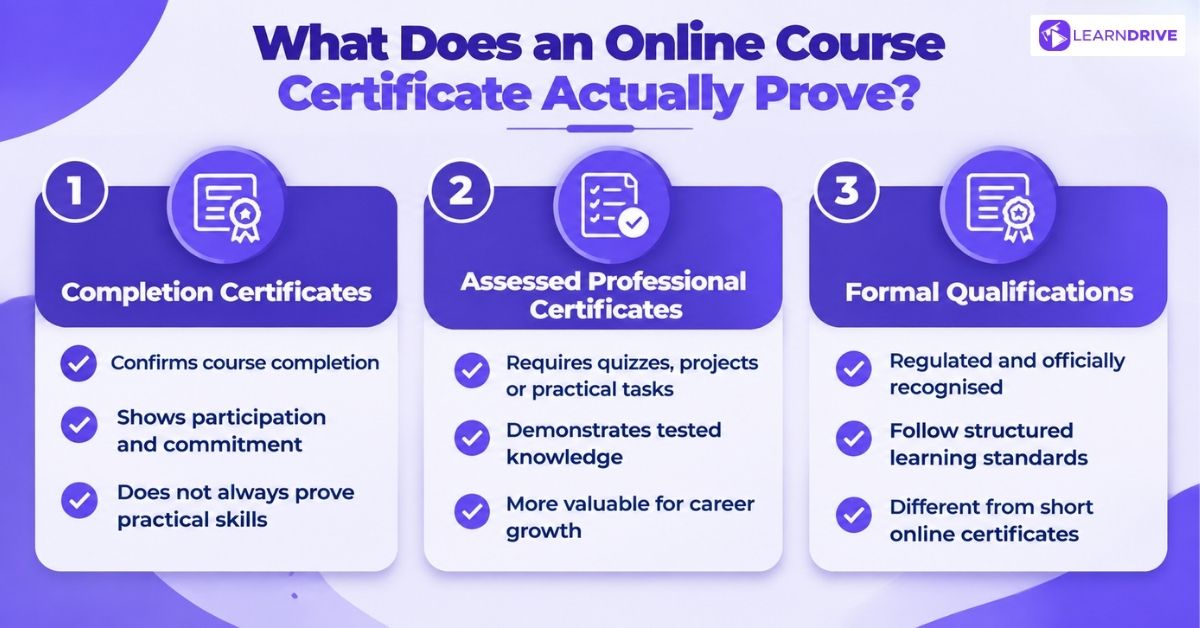
A certificate can mean very different things, depending on who issued it and what you had to do to earn it.
Not every certificate carries the same weight. Some only confirm that you watched a series of videos through to the end. Others need a test, a project, or a timed exam before they get released, and only then reflect real, demonstrated skill.
This distinction matters once you start comparing online courses with recognised certificates UK employers actually check. A polished PDF means little if nobody can verify how it was earned or what standard it was measured against.
Part of the confusion comes from mixing up a certificate of completion vs qualification, and a CPD certificate vs qualification, two comparisons that get blurred constantly in course marketing. Sorting them out now will save you time later, when you’re weighing up which course is worth your money.
Below, we break down three certificate types you’ll keep running into: simple completion certificates, assessed professional certificates, and full regulated qualifications.
Completion Certificates
Finishing every video in a course usually earns you one of these, regardless of how much you actually absorbed along the way.
A completion certificate simply confirms attendance. It shows you started the course and reached the end, nothing more.
Employers rarely treat these as proof of skill. They work well for showing curiosity and follow-through, especially on a CV for someone using a career transition guide to change careers.
Search interest in online certificate courses often assumes a test is involved, but plenty of these platforms hand out completion certificates without checking anything at all.
Assessed Professional Certificates
Here, the certificate only lands in your inbox after you clear a genuine hurdle.
These certificates require a quiz, a graded project, or a practical task before they’re issued. That single step changes what the certificate actually proves.
Recognised online certificates UK employers respond to tend to fall into this category. The assessment gives hiring managers a reason to trust the result, rather than just the provider’s word for it.
Courses like HubSpot Academy’s marketing certification and freeCodeCamp’s coding certifications both sit here, since each one gates the certificate behind a real test of ability.
Formal Qualifications vs Online Certificates
A regulated qualification sits in a different category entirely, and confusing the two can mislead your CV.
Online qualifications UK bodies recognise, such as Ofqual-regulated awards, go through formal accreditation, external moderation, and fixed learning outcomes set by a regulator. A short online course never goes through this process.
Certificates from platforms like Coursera or LinkedIn Learning are valuable, but they sit below a qualification in formal standing. Both have a place, they just answer different questions on an application.
Once you can tell these three apart, spotting a genuinely useful certificate gets far easier, which is exactly what the next section covers.
10 Free Online Courses with Certificates
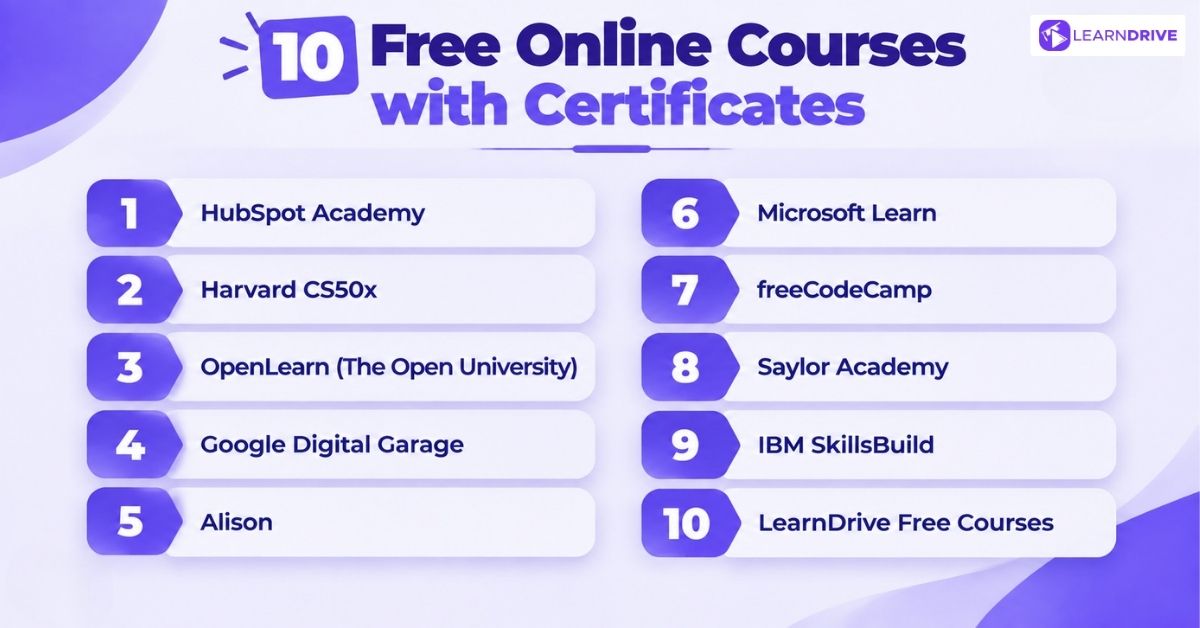
Some platforms hand out a certificate the moment you finish, others make you pass a proper test first. These ten online training programmes stand out for offering online courses that actually help you get a job through genuinely free routes into new skills.
If you’re unsure how much weight these actually carry with employers, our piece on whether online certificates are recognised in the UK is worth reading alongside this list.
1. HubSpot Academy Digital Marketing Certification
HubSpot Academy offers free training covering SEO, content marketing, social media and email marketing in one bundle. Beginners get a clear, structured route into the basics of online marketing.
The certificate only arrives once you pass an assessment, so it carries more weight than a simple attendance badge.
Price: Free, course and certificate included.
Why it stands out: A recognised marketing credential that costs nothing to earn.
Pros: completely free course and certificate; beginner-friendly lessons; useful for marketing portfolios and CVs.
Cons: focused mainly on HubSpot’s own tools; advanced marketers may need more specialised training.
2. CS50x Introduction to Computer Science
CS50x is Harvard University’s introduction to programming, covering C, Python, SQL and JavaScript. Problem sets and projects make the learning practical rather than purely theoretical.
A free certificate option exists, though Harvard also offers a paid, verified version for those who want it framed.
Price: Free (verified certificate option available for a fee).
Why it stands out: Harvard-level computer science teaching, genuinely free to access.
Pros: free access to high-quality teaching; suitable for motivated beginners; builds real problem-solving skills.
Cons: demanding for complete beginners; needs a serious time commitment.
3. OpenLearn Free Courses
OpenLearn is The Open University’s free learning platform, spanning business, health, technology and education. Courses range from short introductions to deeper, university-level study.
A statement of participation or digital badge comes with selected courses, though not every course includes one.
Price: Free.
Why it stands out: A trusted UK university name behind every course.
Pros: completely free access; backed by a well-known UK institution; wide subject range.
Cons: not every course includes a certificate; certificates don’t replace formal qualifications.
4. Google Digital Garage: Fundamentals of Digital Marketing
Google Digital Garage walks through search engines, social media, analytics and online business basics. The course suits complete beginners with no marketing background at all.
The completion certificate is widely recognised, making it a solid first addition to a CV.
Price: Free.
Why it stands out: A well-known certificate from Google, at no cost.
Pros: free certification; clear, beginner-friendly structure; strong grounding in digital marketing basics.
Cons: covers fundamentals only; extra practice needed for professional-level skills.
5. Alison Free Online Courses
Alison hosts thousands of free courses across business, health, technology and languages. Learners can study every lesson without paying, though certificate pricing varies by course.
The sheer range makes it easy to sample several subjects before settling on one.
Price: Free to study (certificate fees vary by course).
Why it stands out: One of the largest free course libraries online.
Pros: huge course selection; free to study; good fit for beginners.
Cons: certificate pricing isn’t consistent; course quality varies between providers.
10 Paid Online Courses with Certificates
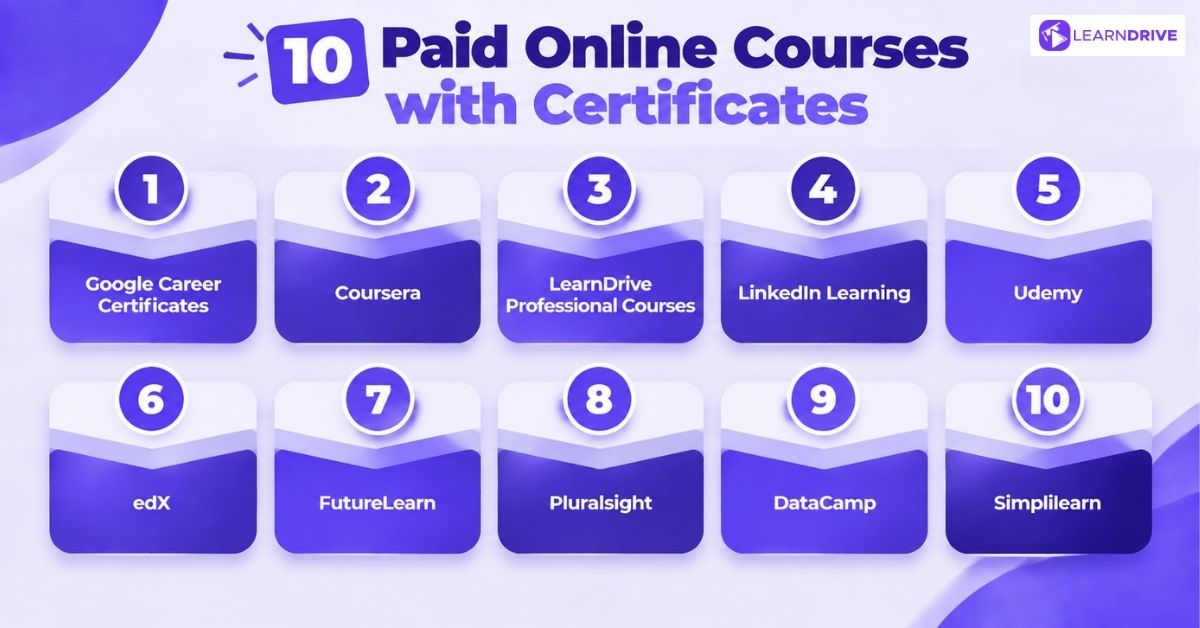
Free courses cover the basics well, but paid certificates often carry more weight with employers, backed by named universities or global tech companies.
The trade-off is straightforward. You pay more, but you usually get better support, sharper content and a certificate that’s easier to verify. Ten paid options stand out for UK learners weighing that cost against the payoff.
1. Google Career Certificates
Google Career Certificates focus on job-ready skills, covering data analytics, cybersecurity, IT support, project management and digital marketing. Each programme is built for beginners with no prior experience required.
Certificates are delivered through Coursera, with structured pathways designed to mirror actual entry-level job tasks rather than academic theory.
Price: from £39 a month through Coursera’s subscription model.
Why it stands out: Built by Google specifically to prepare people for real entry-level roles and highest paying jobs in the UK without degrees.
Pros: practical, job-focused curriculum; no experience needed to start; flexible online pace.
Cons: monthly subscription required throughout; recognition still varies by employer and sector.
2. Coursera
Coursera partners directly with universities like Yale, Michigan and Imperial College London, so many of its courses carry genuine academic weight. Alongside that sit industry-designed certificates from Google, IBM and Meta, aimed squarely at getting people hired.
The subscription model, Coursera Plus, opens up the entire library at once, which suits learners who want to explore several subjects rather than commit to one course at a time.
Price: Coursera Plus costs around £47 a month, or approximately £315 a year.
Why it stands out: Genuine university-backed credentials most employers recognise on sight.
Pros: strong academic reputation; huge subject range; professional certificates from major companies.
Cons: free auditing has largely disappeared; full degrees cost thousands on top of Plus.
3. LearnDrive Professional Courses
LearnDrive covers business, healthcare, technology and personal development, all built for flexible, self-paced study. Certificate options depend on the specific programme chosen.
Courses like the Business Management Diploma Level 5 suit learners after a structured route into management-level skills without a full university commitment.
Price: individual courses typically range from a small one-off fee up to a set price per diploma, depending on the subject and level.
Why it stands out: A UK-focused catalogue built specifically around practical, career-ready skills.
Pros: flexible self-paced learning; wide range of professional subjects; UK-relevant course content.
Cons: recognition depends on the specific programme; not a substitute for a regulated qualification.
4. LinkedIn Learning
LinkedIn Learning offers over 20,000 courses covering leadership, software, communication and business development. Every course connects directly to your LinkedIn profile, so a finished certificate shows up where recruiters actually look.
The library suits people who want short, practical lessons rather than long academic modules.
Price: around £30 a month, or approximately £190 a year in the UK.
Why it stands out: Certificates attach directly to your LinkedIn profile, visible to hiring managers immediately.
Pros: huge library of workplace-skills courses; easy-to-follow, bite-sized lessons; direct LinkedIn profile integration.
Cons: certificates don’t replace formal qualifications; full access needs an ongoing subscription.
5. Udemy
Udemy works differently to subscription platforms, selling individual courses outright rather than bundling access. Thousands of instructors publish content here, covering everything from coding to personal development.
Frequent sales bring most courses down to a fraction of their listed price, making Udemy one of the cheaper paid routes into a new skill.
Price: individual courses typically list between £15 and £150, though regular sales bring prices down to £10 to £15.
Why it stands out: One-time payment gives lifetime access, no ongoing subscription needed.
Pros: affordable, especially during sales; lifetime access once purchased; enormous topic variety.
Cons: quality varies significantly between instructors; certificates are completion-based, not independently assessed.
6. edX
Founded by Harvard and MIT, edX blends free audit access with paid verified certificates from top universities. Most courses can be studied for free, with payment only required if you want the credential itself.
Verified certificates confirm your identity and grade, giving employers something concrete to check.
Price: verified certificates typically range from £40 to £225, depending on the course and institution.
Why it stands out: University-grade content with the option to try before paying for proof.
Pros: audit courses free before committing; certificates from prestigious universities; flexible self-paced structure.
Cons: free certificates are now rare; costs climb quickly for MicroMasters or Professional Certificate programmes.
7. FutureLearn ExpertTracks and Certificates
FutureLearn partners with UK universities and organisations like Goldsmiths, Monash and Coventry to deliver structured, multi-course pathways. ExpertTracks group three or four courses together around one specific skill.
Short courses also exist outside the ExpertTrack format, with a one-off upgrade fee unlocking a certificate for a single course.
Price: ExpertTracks cost £36 a month in the UK; the Unlimited subscription runs at £249.99 a year.
Why it stands out: Strong UK university connections, with flexible pay-per-track pricing.
Pros: UK-focused learning options; genuine university partnerships; short, practical professional courses.
Cons: ExpertTracks sit outside the Unlimited plan; course availability shifts regularly.
8. Pluralsight Technology Courses
Pluralsight specialises entirely in technology training, covering software development, cybersecurity and cloud computing. Skill assessments built into the platform show exactly where your knowledge gaps sit before you start.
Over 70% of Fortune 500 companies use Pluralsight for staff training, which says a lot about its technical depth.
Price: Core plan costs around £22 a month (or £225 a year); Premium runs around £34 a month (or £375 a year).
Why it stands out: Purpose-built for technology careers, with skill-gap assessments included.
Pros: strong IT and software course library; practical, technically focused learning; useful for working professionals.
Cons: limited options outside technology; subscription cost adds up for casual learners.
9. DataCamp Career Tracks
DataCamp focuses entirely on data skills, teaching Python, SQL and analytics through interactive coding exercises. Every lesson happens directly in the browser, so there’s nothing extra to install.
A free basic plan exists, covering the first chapter of each course, before the premium tier unlocks full access and certificates.
Price: Premium subscription costs around £135 a year in the UK.
Why it stands out: Hands-on, browser-based coding practice built specifically for data careers.
Pros: interactive coding environment; beginner-friendly data courses; strong focus on real practice.
Cons: mainly limited to data and analytics; advanced content needs real time commitment.
10. Simplilearn Professional Certification Programmes
Simplilearn runs career-focused programmes in cybersecurity, cloud computing, project management and digital marketing. Courses often partner with universities like Purdue or organisations like IBM for added credibility.
Career support features, including resume reviews and interview preparation, come bundled into many programmes.
Price: self-paced courses typically start from around £300 to £450, with comprehensive certification programmes ranging up to £2,250 or more.
Why it stands out: Career-oriented certification backed by university and industry partnerships.
Pros: strong career-support services; industry-focused subjects; recognised by 40+ accreditation bodies.
Cons: significantly pricier than subscription libraries; suitability depends heavily on career goals.
These paid pathways provide structured, credible routes across technology, business, and data for both career changers and working professionals in the UK.
How to Choose the Right Online Course with a Certificate?
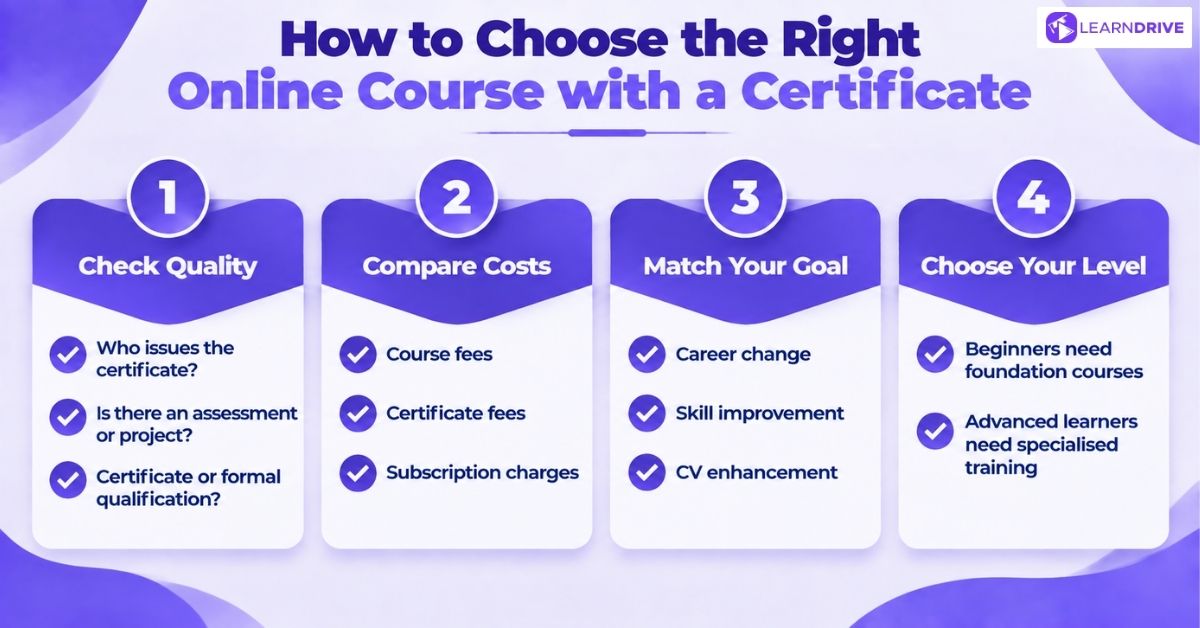
With so many options covered so far, narrowing things down comes down to four practical checks. Each one protects you from wasting time or money.
1. Check the Certificate and Assessment
Start by asking who actually issues the certificate. A well-known university or company name carries far more weight than an unfamiliar platform nobody’s heard of.
Next, check whether an assessment sits behind it. Courses requiring a test, project or graded assignment produce online courses with recognised certificates UK employers are more likely to trust.
Finally, work out whether you’re getting a completion certificate or something closer to a qualification. The two aren’t interchangeable, even though marketing pages often blur that line.
2. Compare the Full Cost
Course price rarely tells the whole story, so it pays to add everything up before enrolling.
Look at three separate costs: the course itself, the certificate fee, and any ongoing subscription charges. Platforms like edX and Alison split learning and certification into two separate payments entirely.
Once you total these figures, free online courses with free certificates suddenly look far more appealing than a cheap course hiding a costly certificate fee.
3. Match the Course With Your Career Goal
Not every certificate needs to be expensive or formal to be useful, so match the course to what you actually need it for.
If your objective is breaking into a new industry, prioritise assessed, portfolio-driven courses that recruiters actively look for. For those simply refreshing existing skills or staying up to date, an unaccredited or free completion badge is often more than sufficient.
Integrating this into your job search strategies ensures you pick the right level of certification for your needs.
CV improvement matters here too. A well-chosen certificate, placed correctly, signals genuine initiative to whoever’s reading your application.
4. Consider Your Experience Level
Your current skill level should shape which course you pick, not just your ambition for where you want to end up.
Complete beginners generally do better starting with short online courses with certificates, such as Google Digital Garage or HubSpot Academy. Jumping straight into something like CS50x without any groundwork often leads to frustration rather than progress.
Once these four checks feel comfortable, the only question left is whether UK employers actually take these certificates seriously.