What Makes an Online Program Actually Useful for Getting a Job?
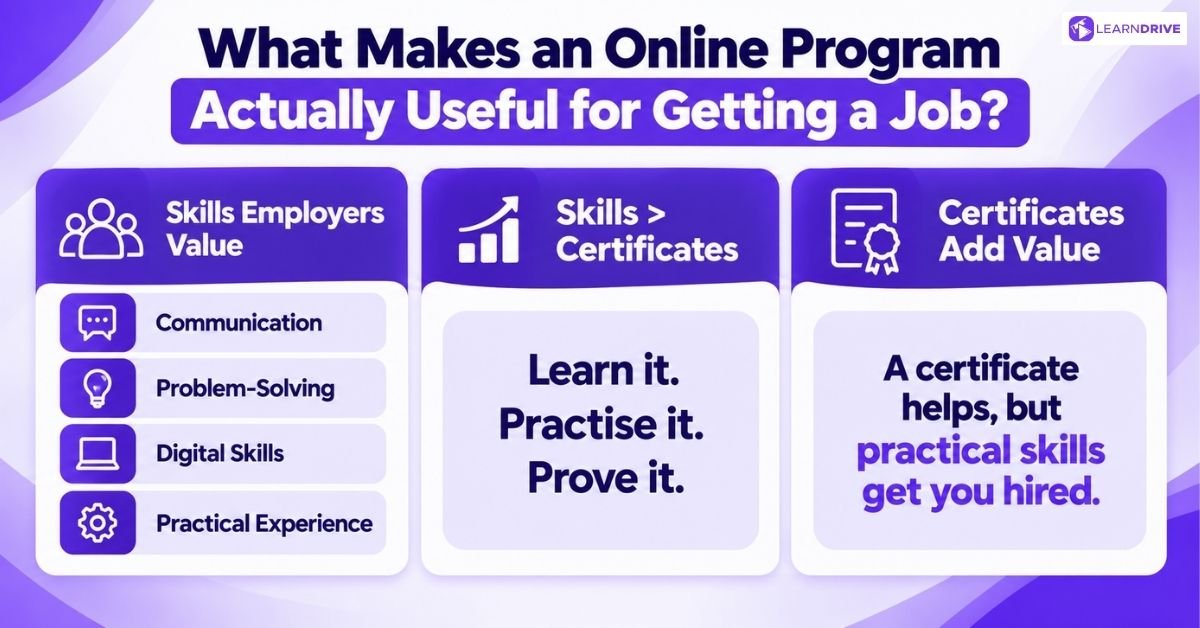
Not every curriculum helps you get hired, even if it looks impressive on paper. Some teach real skills. Others just take up space on a CV. This section looks at what employers actually look for, why practical skills beat a credential on its own, and when formal training genuinely does add value.
Skills Employers Actually Look For
Job adverts often list dozens of requirements, but most employers are really testing for a small set of core abilities. Communication, problem solving, and the ability to use common workplace software still top most hiring checklists. Employers want proof you can apply these skills, not just recognise them.
According to a 2025 CIPD report, 83% of UK employers now prioritise skills-based hiring over traditional qualifications. They are judging candidates on what they can actually do, not just where they studied. This matters for digital credentials too.
A certificate alone rarely proves anything, but a learning path that builds a real, demonstrable skill can.
Practical Skills vs Simply Earning a Certificate
Two people can finish the exact same module and walk away with very different chances of getting hired. The difference usually comes down to what they did with it.
One person watches the videos, passes a quiz, and stops there. The other builds something real: a spreadsheet, a small website, a sample report, anything they can show an employer.
Employers can spot the difference in an interview within minutes. A certificate opens the door, but proof of practical skill is what gets you through it.
When an Online Certificate Adds Value
A certificate is not worthless, it just works best as evidence, not as the main event. It proves you finished a structured programme and met a set standard. That matters for regulated or technical roles, where employers need formal evidence of training.
It also helps when two candidates look similar on paper, since a relevant certificate can be the small detail that tips a decision in your favour. The real question is not whether a course looks good on paper, but whether it teaches something you can actually prove.
10 Online Learning Pathways That Can Actually Help You Get a Job
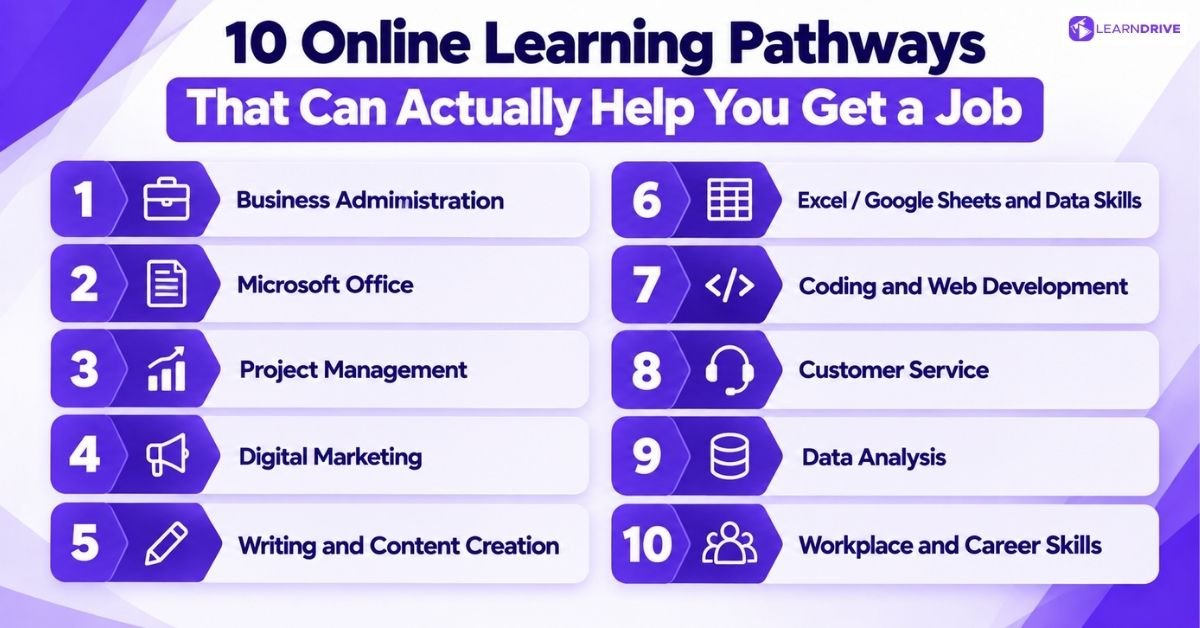
Some skills open far more doors than others, and these ten sit at the top of that list for UK job seekers right now. Each specialization below comes with the roles it leads to, what you will actually learn, and where to study it properly.
1. Business Administration
Every organisation, whatever it sells, needs someone who keeps the daily operations running smoothly.
Best jobs: Administrative Assistant, Office Administrator, Business Administrator.
What you’ll learn: Core office processes, scheduling, business communication, and basic reporting skills employers expect on day one.
Why it can help you get a job: Hiring managers for admin roles want proof you understand how a business actually runs, not just software basics.
Best online training programs to learn :
1. Business Administration by university of london provides a broad foundation in business, management, finance and organisational skills for a range of business careers.
2. Business Administration by MTF Institute covers core business and management principles, helping learners develop practical knowledge for administrative and business-related roles.
3.Business Administration Advanced Diploma – Level 5 is designed for learners who want to strengthen their understanding of strategic management, finance, HR and international business while preparing for greater responsibility.
Good choice if: You want a flexible route into office based work without needing a degree.
2. Microsoft Office
Almost every office job still runs on the same handful of programs, whatever the job title says.
Best jobs: Administrative Assistant, Office Assistant, Data Entry Clerk.
What you’ll learn: Word, Excel, Outlook, and PowerPoint, used the way real offices actually use them.
Why it can help you get a job: These programs appear in almost every office job advert, so confident use sets you apart immediately.
Best online modules to learn :
1. Learning Office 2024 by LinkedIn Learning: A practical introduction to Word, Excel, PowerPoint and other Office tools, with lessons designed around everyday workplace tasks.
2.Ultimate Microsoft Office by Udemy: Brings the main Microsoft Office applications together in one programme for broader workplace software skills.
3. Microsoft 365 Fundamentals Specialization by Coursera: Introduces Microsoft 365, covering its core tools, services and workplace applications.
Good choice if: You are applying for entry level office roles and want an immediate, practical head start.
3. Project Management
Someone has to keep a project on schedule, on budget, and moving forward, even when things go wrong.
Best jobs: Project Coordinator, Project Manager, Operations Coordinator.
What you’ll learn: Planning timelines, managing budgets, coordinating teams, and tracking progress against clear goals.
Why it can help you get a job: Employers across nearly every industry need people who can organise work and keep teams on track.
Best online certifications to learn :
1. Project Management by FutureLearn: Build practical skills in planning, organising and delivering projects while developing an understanding of effective project management practices.
2. Project Management Professional Certificate by Google: Learn the fundamentals of project management, including planning, risk management, Agile methods and stakeholder communication.
Good choice if: You enjoy organising people and tasks, and want a career that works in almost any sector.
4. Digital Marketing
Every brand now competes for attention online, and someone has to plan how that attention gets won.
Best jobs: Digital Marketing Assistant, SEO Executive, Social Media Executive.
What you’ll learn: How search engines rank content, running paid ad campaigns, and building a brand presence on social media.
Why it can help you get a job: Marketing teams increasingly hire on demonstrated results, so real campaign practice speaks louder than a degree alone.
Best online learning paths to learn :
Google Digital Marketing & E-commerce Professional Certificate: Develop practical skills in digital marketing, e-commerce, search, social media, analytics and online customer engagement.
Good choice if: You are creative, enjoy data, and want a fast moving career with clear entry points.
5. Writing and Content Creation
Businesses need a constant stream of words, on their websites, in their emails, and across their social media.
Best jobs: Content Writer, Copywriter, Content Executive.
What you’ll learn: Writing for different audiences, structuring content for search engines, and editing your own work to a professional standard.
Why it can help you get a job: A strong writing portfolio built during training often does more for hiring managers than the certificate itself.
Best online programs to learn :
1.The Complete Writing Course by LearnDrive: Strengthen your writing fundamentals through practical lessons covering clarity, structure, style and effective written communication, helping you build job-ready editorial authority.
2.Content Creation and Copywriting Specialization by coursera: Focus on creating engaging content and persuasive copy for different audiences, platforms and marketing purposes
3. The Content Writing Course by Udemy: Develop content writing skills for blogs, websites and digital platforms, with an emphasis on producing clear and engaging online content.
Good choice if: You enjoy writing and want a career you can start freelance or in house.
Top 10 Platforms for Online Learning
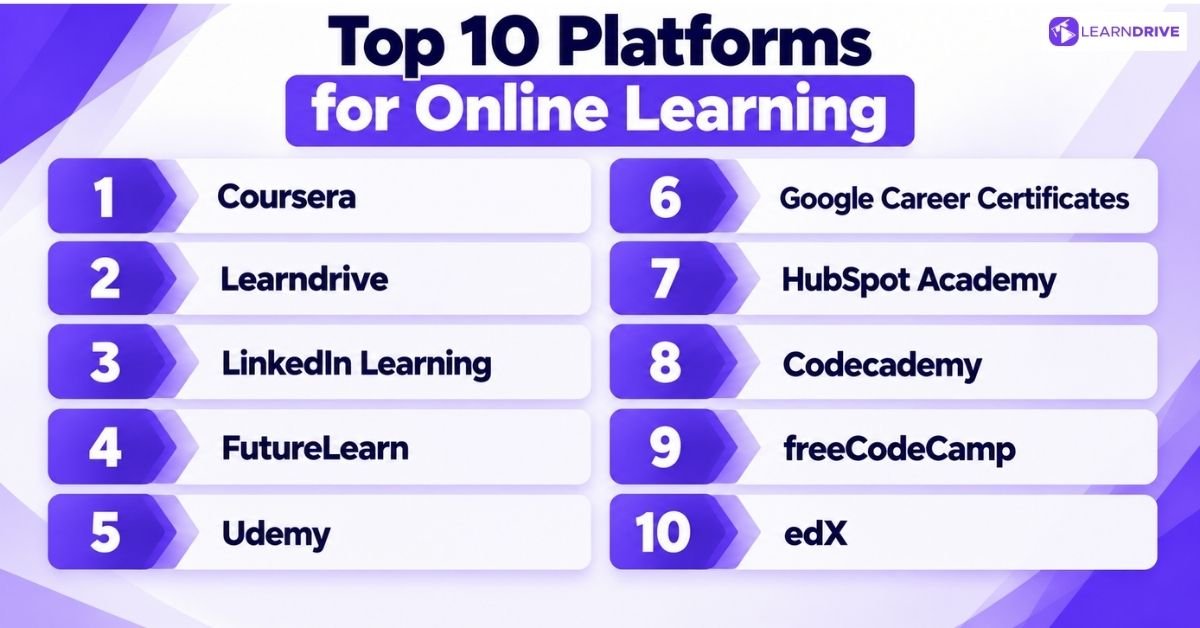
Finishing a program only gets you halfway there. Choosing the right platform decides how practical, recognised, and useful that training actually turns out to be. Some platforms lean academic, others focus purely on hands-on skills, and knowing the difference saves you time and money.
1. Coursera partners directly with universities and major companies, so many specializations come with real academic backing.
You can usually audit the content for free, then pay only if you want the certificate at the end. This suits you if a recognised name on your CV matters for the role you’re chasing.
2. Learndrive pulls together practical, job-focused modules across admin, marketing, writing, customer service, and more, aimed specifically at UK learners.
3. LinkedIn Learning slots neatly into a platform you may already use for job hunting, since completed learning paths appear directly on your profile.
Lessons are broken into short videos, which makes it easy to learn during a lunch break or a commute. Recruiters browsing your profile can see exactly what you’ve studied without asking.
4. FutureLearn was built by UK universities, including the Open University, so its courses tend to feel more structured than most.
Lessons often run over set weeks with discussion boards, closer to a real classroom than a quick video course. Choose this one if you want depth and don’t mind a slower pace.
5. edX also grew out of university partnerships, and many of its syllabi can be audited completely free if you skip the certificate.
That makes it one of the better options if you want genuine academic content without spending anything. Paying only becomes necessary if you need proof of completion for a CV or application.
6. Google designs its own career certificates in areas like data analytics, IT support, and digital marketing, built with hiring in mind from the start. These courses are created with input from Google’s own hiring teams, so the skills taught map closely to real job requirements. The Google name on a certificate tends to catch a recruiter’s eye quickly.
7. HubSpot Academy gives away free certifications in marketing and sales, backed by one of the best known names in marketing software.
Certificates are free too, which makes this one of the easiest ways to build a credible digital marketing skillset without any cost. It works especially well if you’re aiming for an SEO, social media, or content role.
8. Codecademy puts you straight into writing code from the first lesson, rather than making you sit through long videos first.
This hands-on approach suits people who learn better by doing than by watching someone else explain it. A basic subscription covers most beginner content, with paid plans unlocking longer, more advanced paths.
9. freeCodeCamp costs nothing at all and pushes you to build real, working projects as you learn, not just complete quizzes.
Those projects become genuine proof of skill, something you can link to directly on a CV or in an interview. If money is tight, this is one of the strongest free options available anywhere online.
10. Udemy hosts thousands of tutorials taught by individual experts rather than institutions, covering everything from coding to public speaking. Prices are low to begin with, and sales bring them down further, so trying a few modules rarely costs much. It’s a good fit if you want to explore a topic before committing to it properly.
Curriculums are built around real workplace tasks rather than abstract theory, so what you learn maps directly onto what employers actually ask for. The CV Writing Masterclass is a good example, turning new skills straight into a stronger job application.
Are Free Online Classes Good Enough to Get a Job?
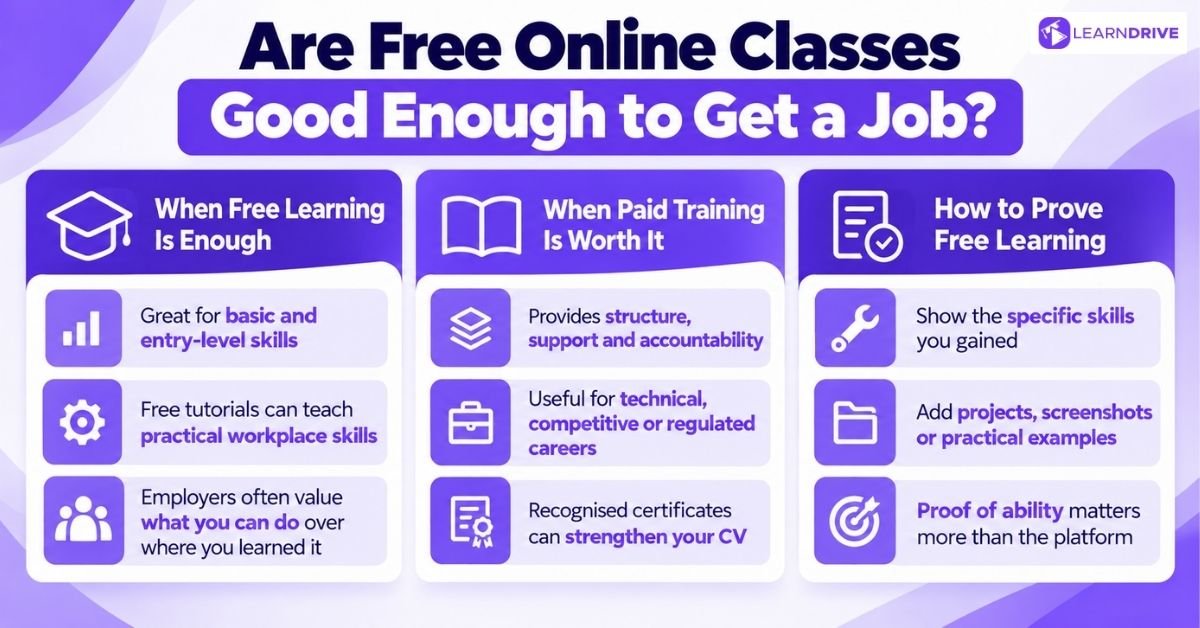
Free does not always mean lower quality, but it does mean you need to work harder to prove you finished what you started. This section looks at when free learning paths are genuinely enough, when paying makes sense, and how to prove skills you learned for nothing.
When Free Modules Can Be Enough
Some skills are simple enough that a free tutorial covers everything you actually need. Basic software skills, introductory marketing concepts, and general workplace knowledge often don’t need a paid programme behind them. If the job you want only asks for a working understanding, a free class can genuinely be all it takes.
Employers hiring for entry-level roles are usually more interested in whether you can do the basics confidently, not which platform you used to learn them.
When Paid Training May Be Worth It
Paying for tuition usually buys structure, support, and a stronger reason to actually finish it. Research published in the International Review of Research in Open and Distributed Learning found that free, open online classes have a median completion rate of just 12.6%. Paid options, with deadlines, tutors, or graded work, tend to see completion rates several times higher, which usually means better structured learning.
For roles that are competitive, technical, or regulated, a paid track with a recognised certification can carry real weight on a CV.
How to Show Skills Learned From Free Classes
A free class still counts for nothing on a CV if you can’t back it up with something concrete. List the specific skill you learned, not just the module title, and pair it with an example of how you used it. Screenshots, small projects, or a short write-up of what you built all work well as proof.
The platform matters far less than the evidence you bring to back up what it taught you.

How to Turn Digital Training Into Job-Ready Skills?
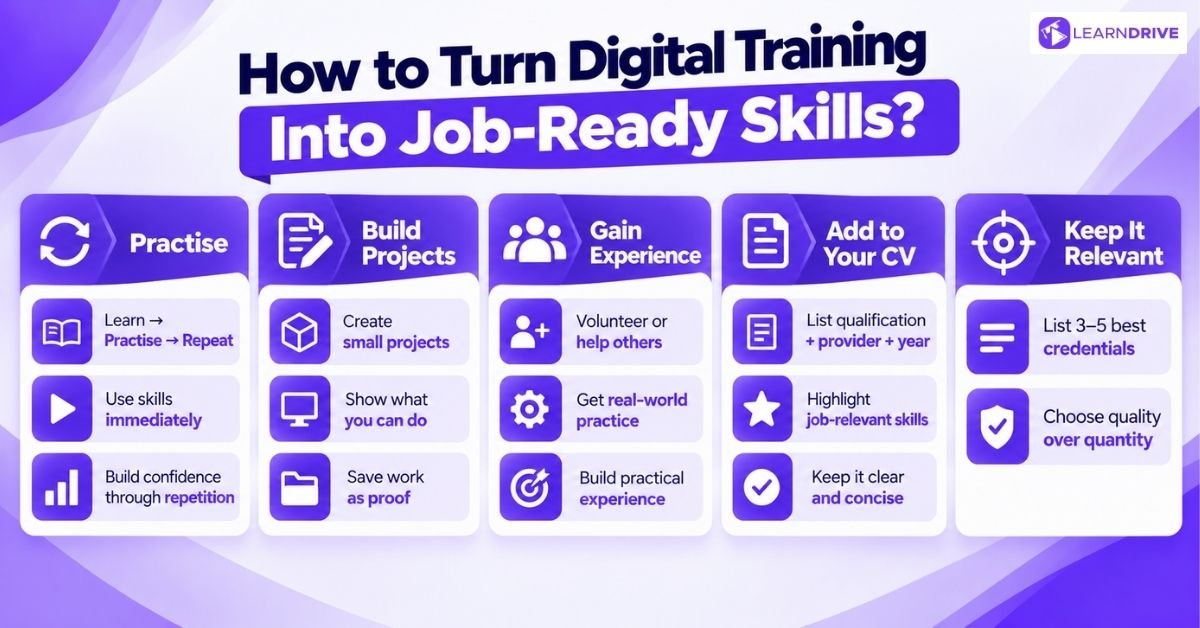
Finishing a program is the easy part, turning what you learned into proof an employer can see is where most people stop too soon. This section covers three ways to close that gap: practising deliberately, building real projects, and gaining hands-on experience wherever you can find it.
Practise What You Learn
Watching a video and understanding a skill are two very different things. Knowledge fades fast unless you use it straight away, ideally within a day or two of learning it. Repetition turns a skill you technically know into one you can actually rely on under pressure.
Set small, repeated tasks for yourself. Redo an exercise from a different angle, or explain what you just learned to someone else in plain words.
Build Projects or Work Samples
A finished project says more about your ability than any certificate ever will. Pick something small and realistic: a mock spreadsheet, a sample social media plan, a simple website, or a short written report. It doesn’t need to be original or impressive, it just needs to show what you can do.
Save everything, even early attempts, since employers often want to see how you approach a problem, not just the finished result.
Gain Practical Experience
Real experience, even unpaid or informal, carries weight that no single class alone can match. Offer to help a small business, a friend’s shop, or a local charity with a task related to your new skill. Volunteering for a short project gives you something specific to describe honestly in an interview.
Even a few hours of real practice can make an interview answer sound lived in rather than rehearsed.
How to Choose Online Training That Is Worth Your Time?
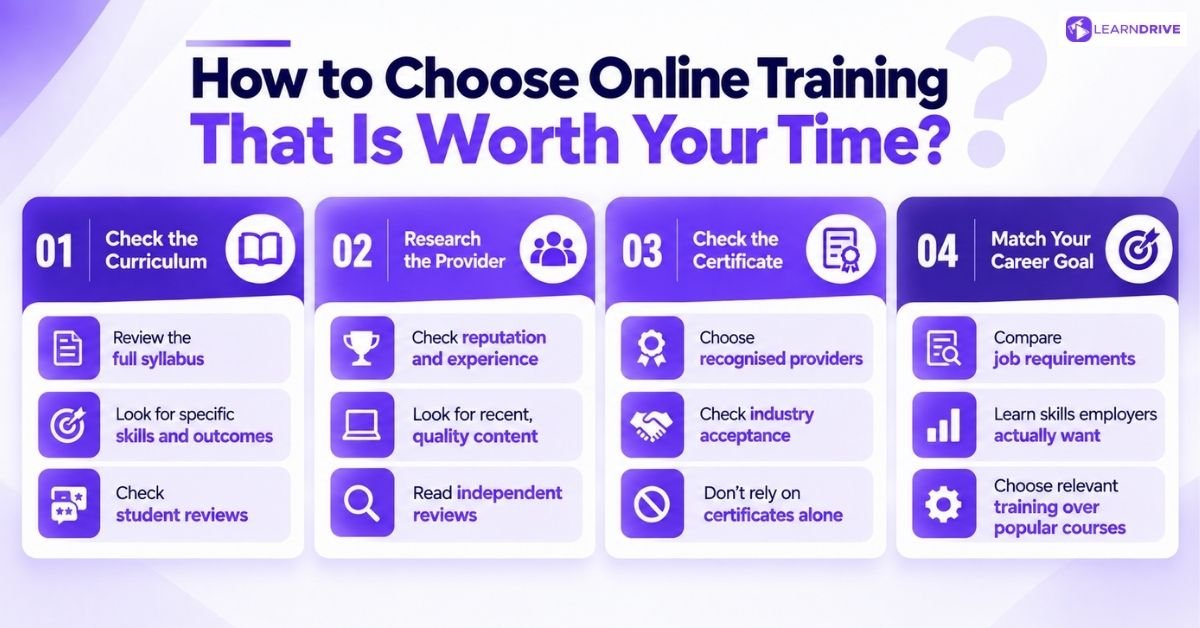
Not every program marketed as “career changing” actually changes anything, so a bit of checking before you enrol saves real time and money. This section walks through checking the content, researching the provider, judging the credential, and matching it all to the job you actually want.
Check the Curriculum
Before paying anything, look at the full syllabus, not just the course title and description. A vague outline full of buzzwords is usually a warning sign that the content itself is thin. Look for specific skills, tools, and outcomes listed clearly, ideally with a breakdown of what each section covers.
Reviews from past students are also worth reading closely, especially any that mention what they could actually do afterwards.
Research the Provider
A learning path is only as good as the organisation or person standing behind it. Check how long the provider has been running, and whether they specialise in the subject or simply cover everything at once. Established platforms and providers with a clear track record tend to produce more consistent, up-to-date content.
A quick search for the provider’s name alongside reviews usually reveals whether people found real value in it.
Look at the Certificate
Some certificates carry genuine weight with employers, and others are little more than a printable download. Certificates from well known providers, universities, or industry bodies tend to be recognised more widely by hiring teams. If you’re unsure, search whether the certificate has ever been mentioned in job adverts or LinkedIn posts within your target field.
A certificate with no real recognition can still be useful for learning, just don’t expect it to open doors alone.
Match It to Your Target Role
The best program is not the most popular one, it’s the one that fills a gap in the specific job you’re aiming for. Look at job adverts for the role you want and note which skills come up again and again. Choose training that teaches those exact skills, rather than a broad module that only touches on them briefly.
A course chosen this way earns its place on your CV instead of just filling space.