Certificate, Certification or Qualification: What’s the Difference?
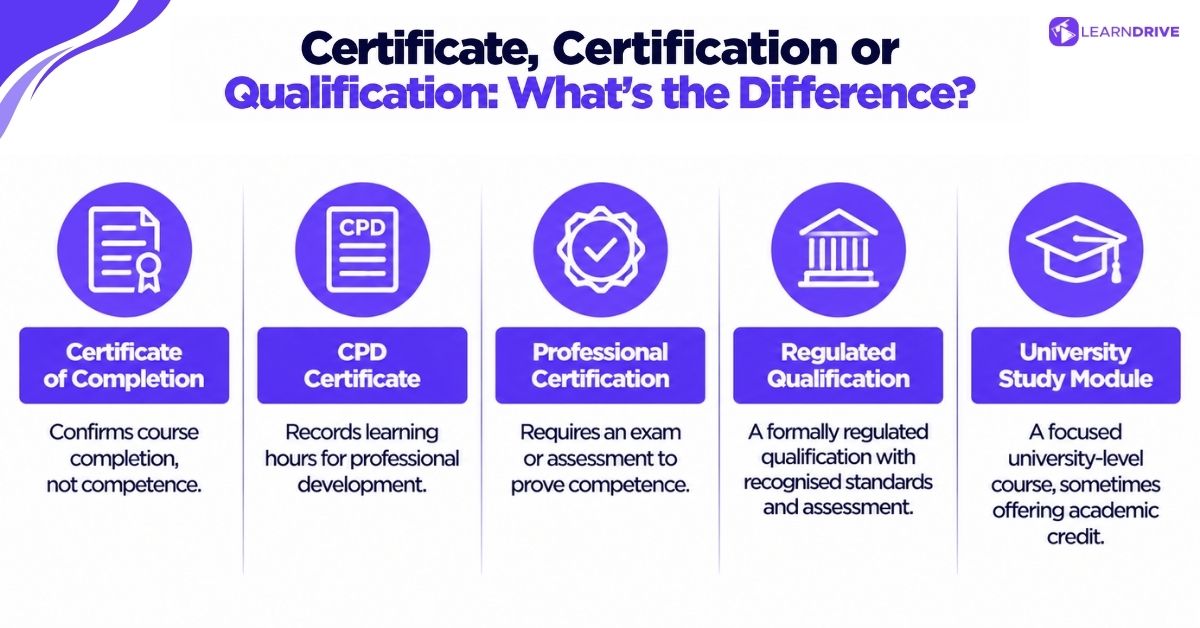
These three terms are frequently conflated, obscuring critical distinctions in educational standing. Below, we delineate what separates a basic certificate of completion from a CPD certificate, a professional certification, a regulated qualification, and a higher education study module.
Certificate of Completion
Finishing a learning pathway usually earns you this document. It serves as the lightest form of skill validation available.
This document confirms attendance, not competence. No exam, no external check, and no independent verification sits behind it. Providers can issue these freely, since nothing regulates the claim. Treat it as a record of effort, not evidence of skill.
CPD Certificate
Continuing professional development runs on documents like this one. A CPD certificate shows that specific learning hours counted towards your professional growth.
Many professional bodies accept CPD certificates as supporting evidence, provided the training links to an approved CPD provider. The certificate itself isn’t a qualification. It functions more as a log of learning hours completed.
Professional Certification
Industry bodies issue this type only after testing real competence. An exam or practical assessment usually comes before you receive one.
Bodies such as CIPD, ACCA, or PRINCE2 award certifications once you’ve proven you can apply a skill, not just sit through a lecture. Employers in relevant fields often treat these as strong, credible evidence.
Regulated Qualification
This is where formal legal weight comes in. Regulated qualifications sit on the Regulated Qualifications Framework.
Ofqual oversees the awarding organisations that issue these. Assessment, quality assurance, and external moderation all sit behind the badge. A regulated qualification carries standing that none of the categories above can match.
University Study Module
Higher education institutions package aspects of their academic domain expertise into focused, standalone educational offerings. Credit sometimes articulates toward a broader degree pathway, though policies vary across institutions.
Institutional prestige carries substantial weight here. A short study module from an established university typically commands greater employability value than an unaccredited provider’s full training program, primarily due to inherent institutional trust.
Side by side, the practical differences stand out more clearly than the definitions alone.
Do Employers Recognise Online Course Certificates?
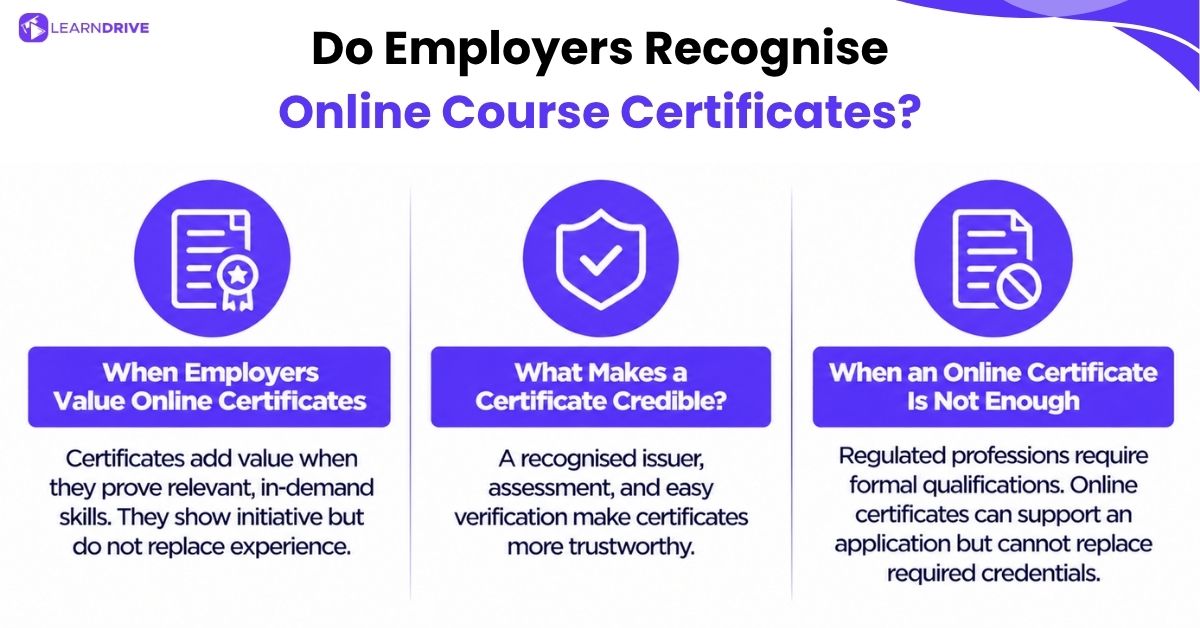
Some employers barely glance at a certificate. Others treat it as proof you can do the job. Now look at when certificates carry real weight, what makes one more believable, and where a certificate alone won’t be enough.
When Employers Value Online Certificates
Employers pay attention when a certificate fills a clear skills gap. A recognised issuer and a relevant subject area both raise its value instantly.
Fast-moving fields such as digital marketing, data analysis, and IT reward recent, specific training. A hiring manager checking CVs for a particular tool or platform often welcomes proof you’ve already learned it. Certificates work best as evidence of initiative, not as a replacement for experience.
What Makes a Certificate More Credible?
Credibility comes from details a fake certificate can’t easily copy. A named awarding body sits at the top of that list.
Assessment adds weight too. A certificate earned through a graded exam carries more trust than one handed out after a video finishes playing. Verifiable design matters as well.
Some providers now build verification directly into the certificate itself. WordPress plugins like Edutain Certificate Validator let a provider generate a live “Verified ✓” page inside a website for each certificate they issue. Anyone checking your CV can then confirm it in seconds, without emailing the provider. If your certificate includes a link like this, add it. It does more to build trust than the certificate design ever will.
When an Online Certificate Is Not Enough
Some roles simply won’t accept a certificate, no matter how credible it looks. Regulated professions sit firmly in this category.
Nursing, teaching, law, and accountancy all require a formal qualification recognised by a specific regulator. An online certificate can support your application in these fields, but it can’t replace the legal requirement. Always check the regulator’s own criteria before assuming a certificate covers the gap.
Top 10 Online Course and Certificate Providers in the UK
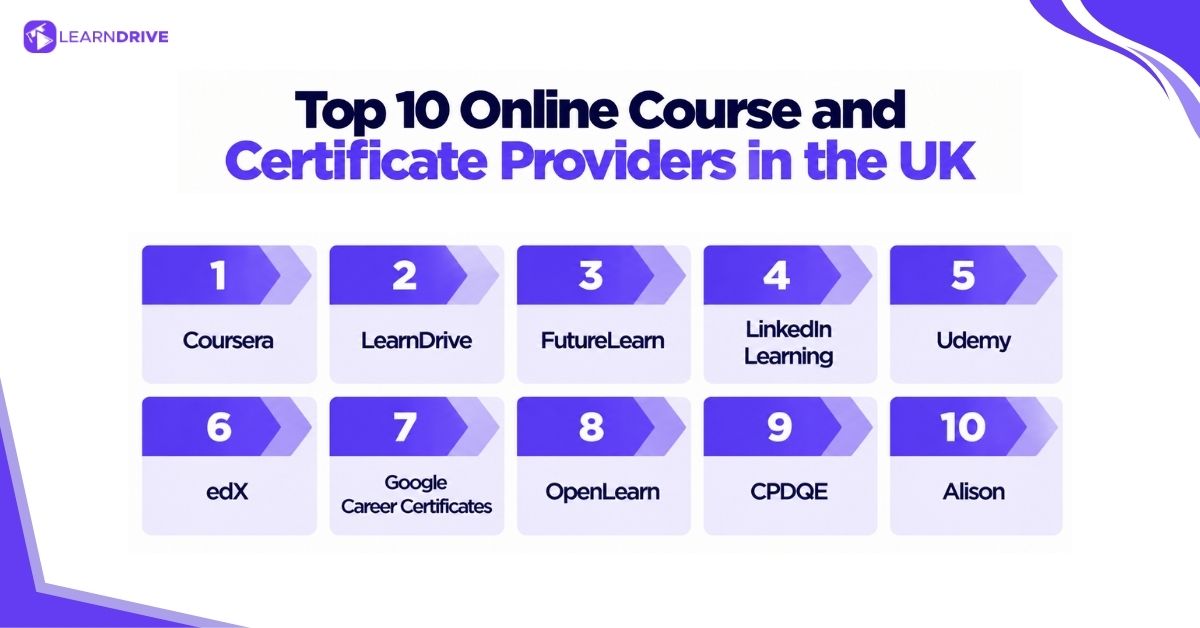
These ten providers feature prominently across online education searches, yet they represent distinct tiers of professional competency and recognition. Each platform fulfills a specific learning purpose, and accreditation bodies view them differently.
1. Coursera
Best for: University and industry-backed professional learning.
Coursera partners with well-known universities like Yale and Imperial College London to build their learning programs. Many study modules articulate into recognized Professional Certificates co-developed with industry leaders like Google and IBM, driving strong employability outcomes.
Recognised because: learning pathways are co-developed alongside esteemed accreditation bodies, academic institutions, and corporate enterprise partners.
2. LearnDrive
Best for: Career-focused online training and workplace skills.
Career-focused skill development forms the core of what LearnDrive delivers, spanning regulatory compliance to professional development sessions. Curricula are engineered for professionals balancing skill acquisition with employment responsibilities.
Recognised because: LearnDrive operates as a CPDQE Accredited provider and member of The CPD Group, ensuring individual educational offerings undergo independent quality assurance against CPD benchmark standards.
3. FutureLearn
Best for: UK higher education modules and professional development sessions.
Co-founded by The Open University, FutureLearn leverages UK higher education prestige. Short study modules feature partnerships with institutions like UCL and King’s College London, offering learners structured academic pathways created directly by university faculty.
Recognised because: its founding partner, The Open University, holds royal charter degree-awarding status, embedding formal academic oversight across its study modules.
4. LinkedIn Learning
Best for: Workplace and professional skills.
Corporate hiring managers actively utilize LinkedIn, granting credentialing activities on this network immediate visibility. Completing a professional development session automatically updates your profile, allowing talent acquisition teams to verify competencies during candidate search queries.
Recognised because: recognition here comes from employer visibility and platform trust rather than formal accreditation, worth knowing before you rely on it as a standalone credential.
5. Udemy
Best for: Practical, competency-based learning across diverse domains.
Instructional rigour varies across Udemy’s open-marketplace model. Nevertheless, for applied technical skills such as software engineering or digital design, these self-paced training initiatives often provide excellent project-based skill validation.
Recognised because: honestly, it mostly isn’t formally accredited. Value depends entirely on the individual instructor’s expertise, so check reviews and their professional background before enrolling.
6. edX
Best for: University-level study modules and executive education.
Established by Harvard and MIT, edX maintains rigorous academic standards across its curriculum offerings. Verified certificates incorporate identity verification and proctored assessments, yielding greater weight under employer scrutiny than basic attendance badges.
Recognised because: educational offerings are awarded directly by accredited universities, and MicroMasters programs can offer credit articulation within formal RQF-aligned degree frameworks.
7. Google Career Certificates
Best for: Job-focused digital and technology skills.
Landing a tech role without a degree gets far more realistic with this programme behind you. Google designed these certificates around specific in-demand roles such as IT support, data analytics, and cybersecurity, with real hiring partners built into the pathway.
Recognised because: a network of employer partners has committed to considering these certificates as equivalent to relevant experience during hiring, not just Google itself.
8. OpenLearn
Best for: Free learning and introductory professional development.
Delivered tuition-free by The Open University, this platform serves as an accessible entry point to evaluate subject matter before committing financial resources toward a regulated RQF qualification.
Recognised because: every study module is authored by academic staff at The Open University, granting free digital badges higher institutional credibility than many paid alternatives.
9. CPDQE
Best for: CPD-focused professional development.
Rather than hosting training directly, this organization functions as an independent quality assurance body. CPDQE evaluates educational activities against rigorous CPD benchmark criteria, ensuring accredited offerings satisfy formal professional development requirements.
Recognised because: it is the accrediting body itself. Its own recognition comes from being an independent, named CPD accreditor that other providers apply to join.
10. Alison
Best for: Free and low-cost online learning.
Financial constraints are minimized here, as the foundational learning material is freely accessible. Alison monetizes through optional premium documentation and diplomas, enabling learners to engage in professional development sessions without upfront capital investment.
Recognised because: Alison’s publishing process is accredited by the CPD Certification Service, so certificates can count towards a learner’s formal CPD hours.
Can Online Certificates Help You Get a Job or Change Careers?
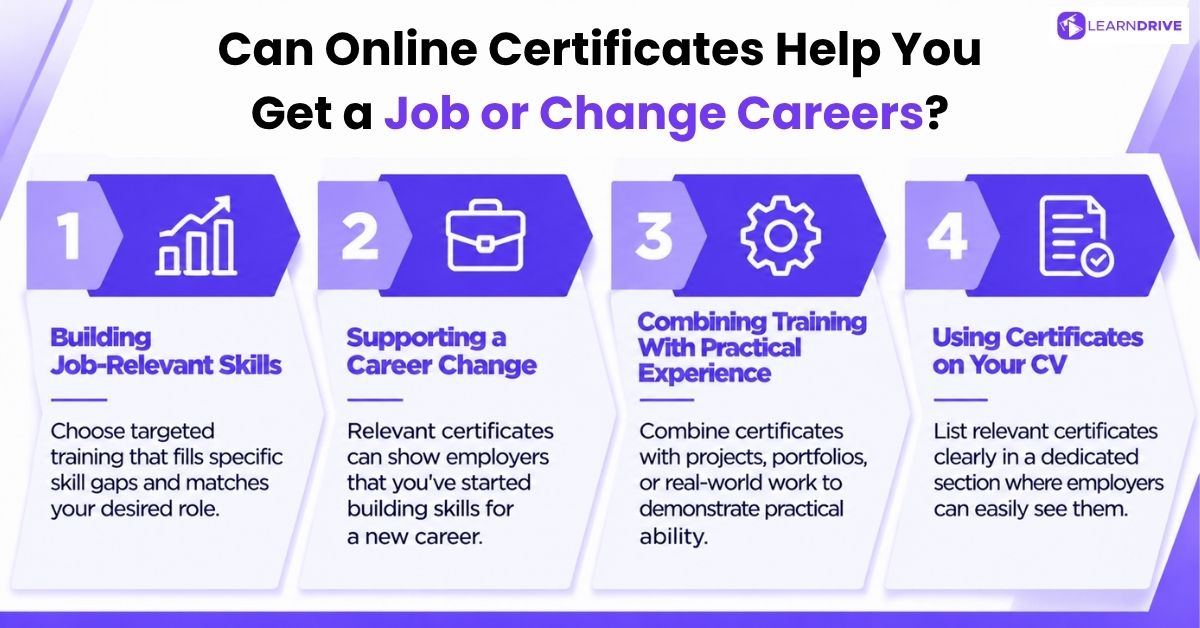
Digital credentials alone rarely secure employment, but they serve as critical proof of professional competency. Below, we examine how targeted skill acquisition supports career transitions, enhances employability, and strengthens professional profiles.
Building Job-Relevant Skills
Hiring teams prioritize practical capability over paper completion. A strategically selected training initiative bridges specific, verifiable competency gaps required by target roles.
For instance, an applicant transitioning into digital strategy gains far greater leverage from a specialized credential in a recognized analytical platform than a broad overview program. Targeted skill validation consistently outperforms generic study when employers evaluate candidate suitability.
Supporting a Career Change
Switching fields is where certificates earn their keep most convincingly. They give a hiring manager concrete proof you’ve already started building relevant knowledge before applying.
A structured career transition guide helps identify transferable competencies from your prior role while pinpointing exact knowledge gaps that a focused study module should address. Aligning strategic learning pathways with market demand ensures a smooth transition into new industry sectors.
Combining Training With Practical Experience
A certificate on its own tells an employer what you studied. It says nothing about what you can actually deliver under real conditions.
Practical application transforms theoretical study into demonstrated expertise. Open-source contributions, client projects, or portfolio case studies substantially enhance the impact of any completed training initiative. Hiring managers favor verified practical outputs over passive learning completion every time.
Using Certificates as Evidence on Your CV
Where and how you list a certificate changes how much weight it carries. Buried at the bottom of a CV, even a strong certificate gets skimmed past.
Position relevant professional development credentials in a dedicated section near the upper portion of your CV. A structured CV Writing Masterclass offers guidance on presenting skill validation to maximize employer engagement.
How Should You Add Online Certificates to Your CV and LinkedIn?
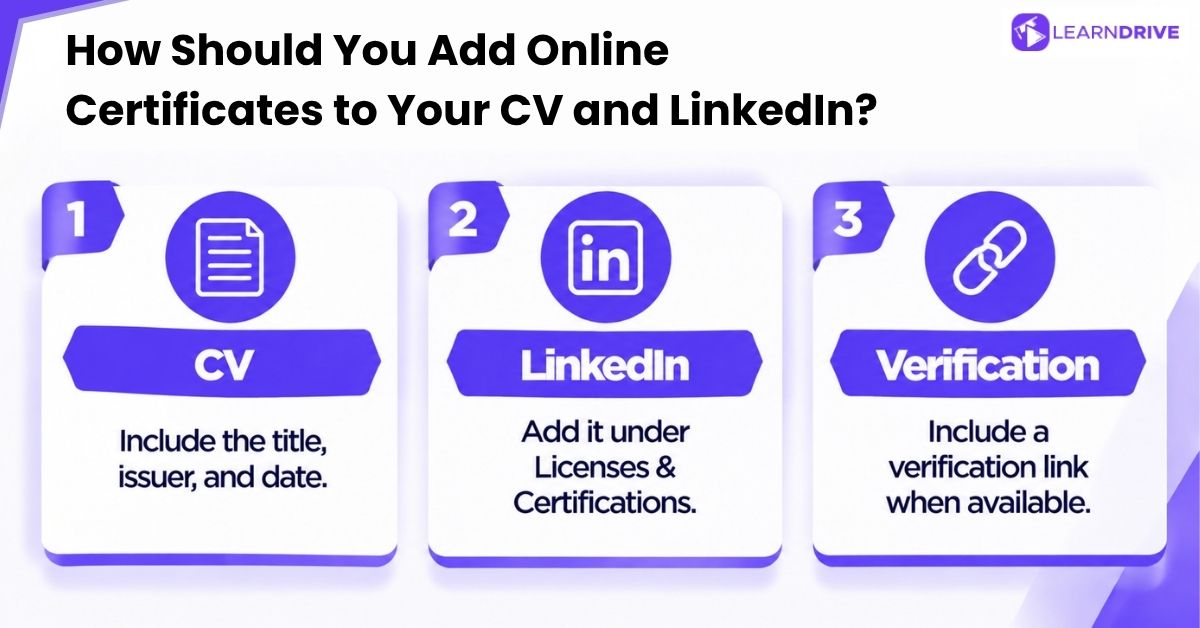
Most learners either bury their certificates or list them without enough detail to matter. This section covers what to actually include on your CV, where certificates belong on LinkedIn, and when a verification link genuinely strengthens your profile.
What to Include on Your CV
Document the exact title, issuing accreditation body or institution, and date of completion. Generic descriptions omit crucial trust markers that recruiters rely on to gauge candidate quality.
Keep entries concise and grouped under a clear “Certifications” or “Professional Development” heading, so a recruiter scanning quickly doesn’t miss them.
Where to Show Certificates on LinkedIn
LinkedIn treats certificates differently to a CV. The dedicated “Licenses & Certifications” section exists specifically for this content, and using it correctly matters.
Add the certificate there with the correct provider name and completion date, rather than mentioning it only in your summary or experience section. Recruiters searching LinkedIn’s skills filters are far more likely to surface profiles with certificates properly categorised.
When to Add a Verification Link
A verification link turns a claim into something checkable in seconds. Not every certificate offers one, but when it does, always include it.
Some providers now build this directly into the certificate itself, generating a live page that confirms authenticity the moment someone visits it. If your certificate includes a link like this, add it wherever the certificate is mentioned. It does more to build trust than the certificate design ever will.
What Warning Signs Should You Check Before Enrolling an Accredited Online Course?
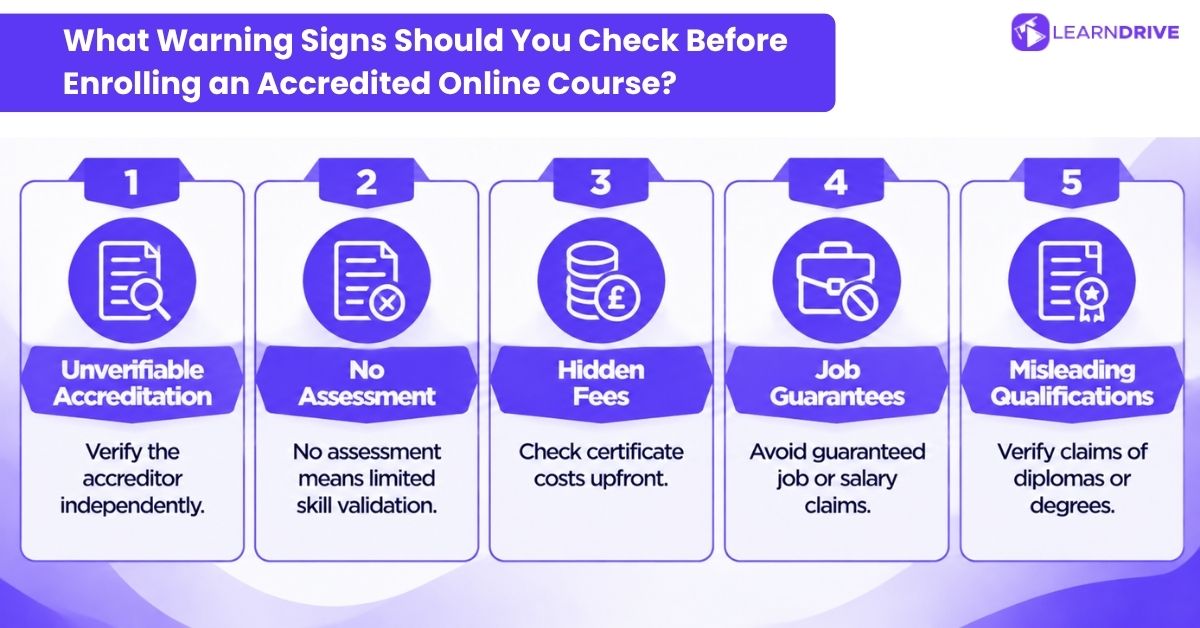
Certain commercial education providers exploit terminology ambiguity to market low-quality offerings. Review these five red flags before committing financial resources or personal data to any learning pathway.
1. Unverifiable Accreditation Claims
Legitimate training initiatives clearly identify their external accreditation bodies. Cross-reference named accreditors independently rather than relying solely on provider marketing claims.
If you can’t find the accreditor listed anywhere outside that one provider’s website, treat the claim as unverified.
2. No Meaningful Assessment
Learning without any test of understanding produces a certificate that proves attendance, nothing more. That’s not necessarily dishonest, but it does limit what the certificate can claim to demonstrate.
Educational offerings that issue completion certificates upon mere video playback—without quizzes, practical assignments, or proctored exams—provide negligible skill validation. Treat them as passive learning activities rather than verifiable professional credentials.
3. Hidden Fees
Free enrolment sometimes turns into a paywall right before you receive your certificate. This tactic catches learners who assumed the whole course, certificate included, was free from the start.
Check the certificate cost before enrolling, not after finishing every module. A provider that’s upfront about pricing throughout is generally more trustworthy than one that reveals it at the very last step.
4. Guaranteed Job or Salary Claims
No legitimate training organization can guarantee employment or specific salary tiers. Employability depends on multi-faceted factors beyond the scope of any single educational program.
Treat phrases like “guaranteed job” or “guaranteed salary increase” as a red flag rather than reassurance. Reputable providers describe potential outcomes and typical results. They don’t promise them.
5. Misleading Qualification Claims
Some providers blur the line between a certificate and a formal qualification deliberately, using language that implies more regulatory weight than actually exists.
Be cautious of provider literature using terms like “diploma” or “degree-equivalent” without identifying a regulated awarding organization. Verify formal regulatory status directly on the official Ofqual register before enrolling.

Selecting the Right Educational Pathway for Your Objectives
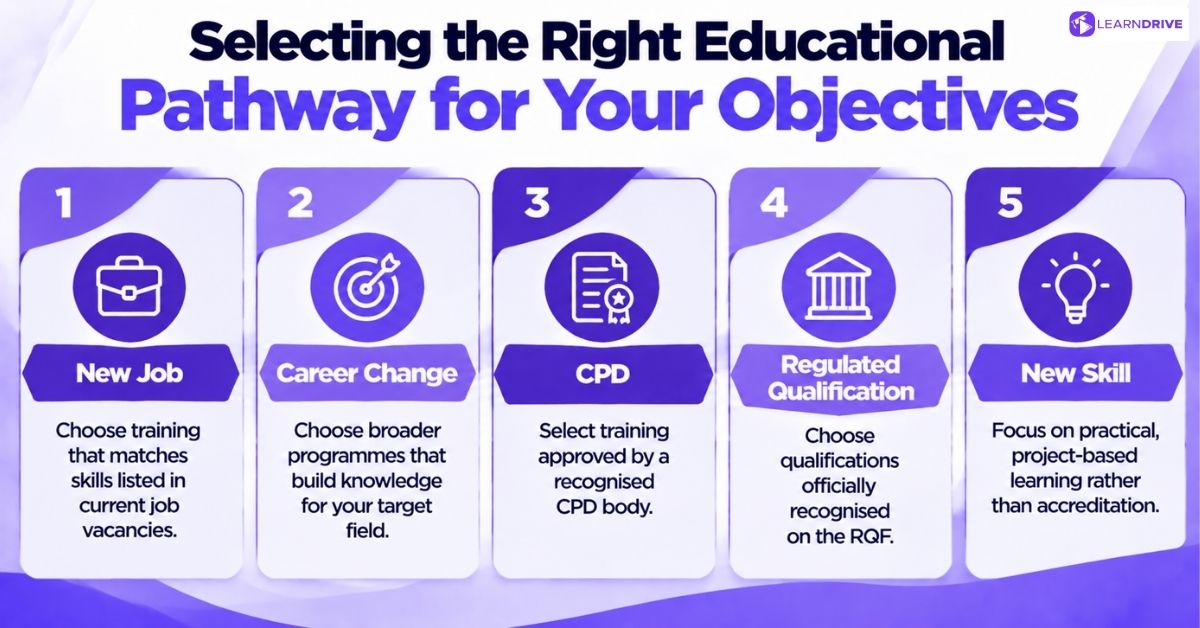
Distinct career goals require specific learning structures. Aligning your target outcome with the appropriate educational offering ensures optimal investment of time and capital across the five common pathways below.
1. If You Want a New Job
Prioritize targeted training initiatives designed around explicit technical competencies referenced in active job specifications. Generalized introductory programs rarely provide competitive advantage.
Map curriculum content against current vacancies to ensure alignment with market demands. Reviewing comprehensivejob search strategies helps identify high-priority skills that enhance immediate candidate employability.
2. If You Want to Change Careers
Comprehensive, multi-module study programs support major career transitions far better than brief single-topic sessions. Achieving a successful industry shift requires end-to-end domain knowledge.
Engaging with a specialized Career Planning training program assists in auditing current capabilities against target sector expectations, establishing a structured roadmap for professional development.
3. If You Need CPD
Ensure selected learning activities are formally accredited by recognized CPD oversight bodies, as non-accredited seminars may fail to meet annual professional registration criteria.
Utilizing a structured Personal and Professional Development bundle of 17 study modules provides an efficient mechanism to earn required CPD hours across multiple core competencies simultaneously.
4. If You Need a Regulated Qualification
Only qualifications positioned on the Regulated Qualifications Framework (RQF) fulfill statutory education mandates. Verify accreditation status via Ofqual registries prior to enrollment.
Formal diploma pathways, such as a Business Management Diploma at Level 5, deliver comprehensive academic rigour aligned with standard higher education credit frameworks.
5. If You Want to Learn a New Skill
When the goal is personal growth rather than career proof, formal accreditation matters far less than genuine engagement with the material.
Practical, project-centric learning initiatives, such as Graphics Design with Canva, Beginner to Expert, build applied competencies faster than purely theoretical lectures.