
What Is Business Administration?
Business administration is the practice of managing a company’s day to day operations. It covers how a business runs, how decisions get made, and how different departments work together to keep things moving.
This spans everything from setting a budget for the coming quarter to deciding how a new product gets launched, and it touches almost every part of a company at once.
At its core, it is about organisation. A well run business needs someone thinking about budgets, staff, processes, and strategy at the same time, often juggling all four in a single working day.
Without that coordination, even a business with great products or talented people can fall apart from the inside, simply because nobody is watching how the pieces fit together.
That is the role business administration plays. It sits behind the scenes, making sure the right people have the right resources, the right decisions get made at the right time, and the whole operation keeps moving forward without grinding to a halt.
6 Real-Life Applications of Business Administration

Business administration is not one single skill. It shows up across several areas of a company, each with its own focus and responsibilities. Here are six of the most common.
1. Business Management and Leadership
Someone needs to set goals, guide teams, and make sure everyone is working towards the same outcome.
Developing effective leadership skills is a key part of business education, with frameworks such as those promoted by the Chartered Management Institute (CMI) helping professionals strengthen their management abilities.
2. Finance and Accounting
Business administration graduates often move into roles that manage budgets, forecast spending, and keep the company financially healthy.
Understanding financial principles is essential for decision-making, and resources from bodies like the Association of Chartered Certified Accountants (ACCA) highlight the importance of strong finance skills in business.
3. Marketing and Sales
Getting a product or service in front of the right people takes planning. Business administration teaches the fundamentals of strategy that marketing and sales teams rely on daily.
4. Human Resources Management
HR teams keep a company’s most valuable asset, its people, running smoothly.
Professional development in this area is supported by organisations like the Chartered Institute of Personnel and Development (CIPD), which provides resources for HR and people management professionals.
5. Operations and Supply Chain Management
Behind every product or service is a chain of processes that need to work together. Operations roles focus on making sure that chain runs efficiently, without delays or waste.
6. Entrepreneurship and Business Development
Some graduates use their business administration knowledge to start something of their own. Understanding how a business works from the inside makes it much easier to build one from scratch.
Business Administration Degree: What You Need to Know
Studying the subject on paper is different from applying it in the real world. Here is what the degree itself actually involves.
A business administration degree is a structured programme that teaches the core principles behind running a business. It typically covers finance, marketing, management, operations, and human resources, giving students a broad foundation rather than a narrow specialism.
Most degrees also include practical modules, such as case studies or group projects, so students learn to apply theory to real business problems.
Key Skills Developed Through a Business Administration Degree
The real value of this degree often comes down to the skills it builds, not just the subjects it covers.
Graduates leave with a mix of practical and soft skills. These include financial literacy, project management, communication, leadership, and problem solving.
What makes this degree valuable is how transferable these skills are. A student who learns to manage a budget or lead a group project can apply that same skill in almost any industry, not just business roles.
Career Direction After a Business Administration Degree
With so many paths available, choosing the right direction after a business administration degree can feel overwhelming. The qualification does not lead to one fixed job title, which gives graduates flexibility but can also make the decision process more difficult.
Should you move into finance because of the strong earning potential, explore marketing because of its creative side, or build experience towards management and leadership roles?
The best approach is to focus on your interests, strengths, and preferred working style rather than choosing a path based only on salary or trends. Start by thinking about the parts of your degree you enjoyed most.
If you liked numbers, analysis, and forecasting, finance or business analytics may be a strong fit. If you enjoyed communication and working with people, areas such as human resources, sales, or marketing could suit you better.
Your working style also plays an important role. Some business careers reward structure and organisation, such as operations and project management. Others involve more creativity, change, and problem-solving, such as marketing, consulting, or entrepreneurship.
Long-term goals should also influence your decision. If your ambition is to lead teams or run organisations, management and strategy roles can help you develop leadership experience. If you value independence and flexibility, consulting or entrepreneurship may offer a better fit.
Once you understand your interests and career goals, the options become much clearer. The five main career areas below provide a roadmap of where business administration graduates commonly build their careers before exploring specific job roles and salaries later in this guide.
5 Main Areas of Business Management Careers

Most business administration careers fall into one of five broad areas. Understanding each one makes it easier to see where you might fit.
1. Management and Operations
Keeping a business running smoothly sits at the heart of this area. Roles here involve leading teams, managing budgets, and overseeing daily processes.
2. Finance and Business Analysis
Numbers drive everything in this category. You will analyse data, manage budgets, and help businesses make informed financial decisions.
3. Marketing and Customer Growth
Attracting and keeping customers is the focus here, blending creativity with strategy across everything from branding to digital campaigns.
4. Human Resources and Employee Development
People sit at the centre of this area, covering hiring, training, and supporting employees throughout their time at a company.
5. Consulting and Business Strategy
Problem solvers tend to thrive here. Consultants and strategists help businesses improve how they operate, often working across multiple companies or departments.
19 Best Business Careers for Graduates: Jobs and Salary Guide
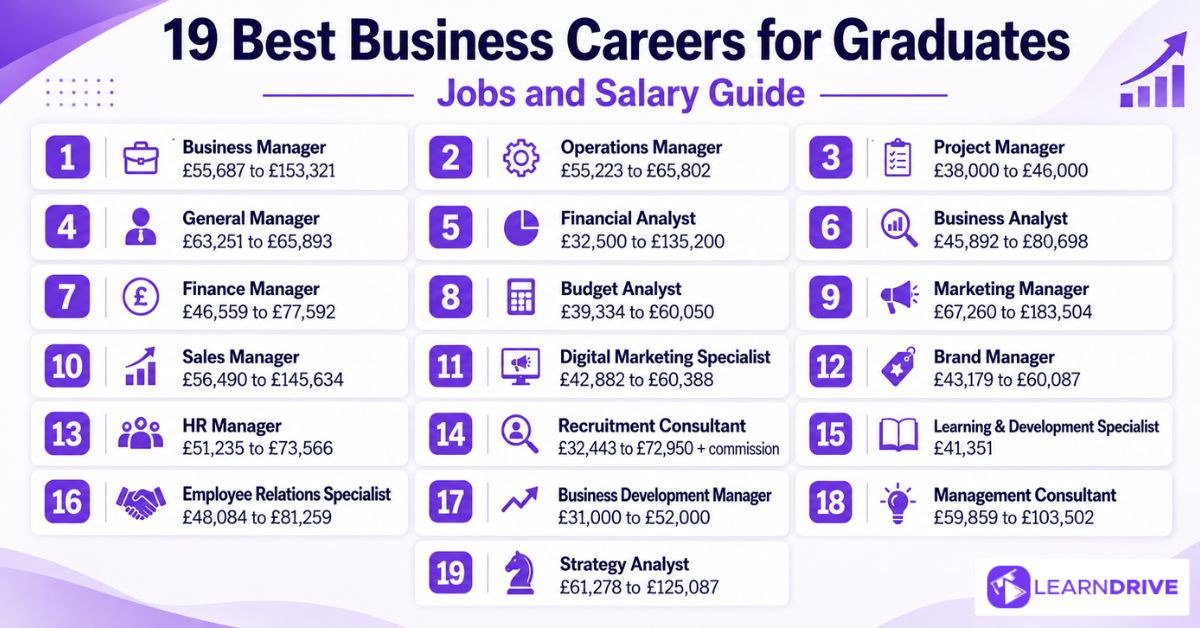
A business administration degree does not lead to one job title. It leads to a whole range of them, and the trick is knowing how they connect back to what you actually enjoy doing.
Each group also tends to attract a different kind of person. Management and leadership roles suit people who enjoy guiding others and making decisions. Finance and analysis roles suit people who like working with numbers and solving problems logically.
4 Management and Leadership Careers
Management roles sit at the centre of most businesses. If you like making decisions, guiding a team, and being accountable for results, this group is worth a closer look.
1. Business Manager
A business manager takes charge of a company or department’s daily operations, from overseeing staff to managing budgets and making sure targets get hit.
Juggling several priorities at once is part of daily life in this role, so organisation matters more than almost anything else. Many people move into it after a few years in a junior position, sometimes backed by a business management course to formalise that experience.
Salary: £55,687 to £153,321 per year (according to REED)
Requirements:
Strong organisational and leadership skills
Budget management experience
Clear communication
Problem solving ability
A business administration degree or equivalent experience
2. Operations Manager
Efficiency is the whole point of this role. Operations managers study how work flows through a business and look for ways to make each step faster or smoother.
Spotting a bottleneck before it slows everyone down is second nature to the people who thrive here. The work usually crosses several departments rather than staying in one.
Salary: £55,223 to £65,802 per year (according to REED)
Requirements:
Process improvement experience
Strong analytical thinking
Leadership and team coordination skills
Attention to detail
Comfortable working across departments
3. Project Manager
Timelines, budgets, and teams all fall under one person’s watch in this role. Project managers coordinate every moving part of a project from kickoff to completion.
Deadlines rarely stay fixed for long, so staying calm while plans shift is a big part of doing this job well. Strong communication keeps everyone aligned when priorities change, and a project management course covers exactly this kind of coordination from the ground up
Salary: £38,000 to £46,000 per year (according to REED)
Requirements:
Project management skills, certification helpful
Strong time management
Clear communication with multiple stakeholders
Problem solving under pressure
Budget and resource planning experience
4. General Manager
Few roles carry as much combined responsibility as this one. A general manager oversees an entire business unit or location, blending leadership, finance, and operations into a single position.
Being the final decision maker for an entire area is common at this level, which usually means several years of management experience beforehand. Broad knowledge matters more here than deep specialism in one area.
Salary: £63,251 to £65,893 per year (according to REED)
Requirements:
Broad business knowledge across departments
Strong leadership skills
Financial and budget management experience
Decision making under pressure
Several years of management experience
4 Finance and Business Analysis Careers
Finance roles suit people who enjoy working with numbers and using data to guide decisions. These careers sit at the heart of how a business stays profitable
1. Financial Analyst
Spotting patterns in financial data is what this role is built around. Financial analysts help businesses understand exactly where money is being made or lost.
Comfort with spreadsheets is practically a requirement, since most of the day involves digging through detail. Findings also need to be explained clearly to colleagues outside finance, so reporting skills carry real weight.
Salary: £32,500 to £135,200 per year (according to REED)
Requirements:
Strong analytical and numerical skills
Proficiency with spreadsheets and financial software
Attention to detail
Clear reporting and communication skills
A degree in business, finance, or a related field
2. Business Analyst
Bridging the gap between raw data and real decisions is the job here. Business analysts study how a company operates and recommend ways to improve it.
Working closely with different teams comes with the territory, since most projects start with gathering requirements from several departments at once. The findings then get turned into recommendations for management.
Salary: £45,892 to £80,698 per year (according to GLASSDOOR)
Requirements:
Strong analytical thinking
Good communication and presentation skills
Experience with data analysis tools
Ability to work across departments
Problem solving mindset
3. Finance Manager
Financial planning for an entire company rests on this role. A finance manager handles budgets, forecasting, and the overall financial health of the business.
Taking full ownership of financial decisions is a big shift from analyst level work, and it usually comes with managing a small team as well. Confidence in your own judgement matters just as much as technical skill.
Salary: £46,559 to £77,592 per year (according to GLASSDOOR)
Requirements:
Strong financial management experience
Budgeting and forecasting skills
Leadership and team management ability
Accuracy and attention to detail
Relevant finance qualification or degree
4. Budget Analyst
Every pound spent gets scrutinised in this role. Budget analysts review spending and help departments stay within their limits, catching problems before they grow.
Numbers that do not quite add up rarely slip past someone in this position, since the job is built on close attention to detail. Nearly every department in a company ends up interacting with this role at some point, and a business finance award covers the fundamentals well for anyone starting out.
Salary: £39,334 to £60,050 per year (according to GLASSDOOR)
Requirements:
Strong numerical and analytical skills
Attention to detail
Comfortable using financial software
Clear communication with other departments
A degree in finance, business, or accounting
5 Graduate-Level Business Jobs and Salary Guide

Not everyone starts at manager level, and that is exactly the point of this section. These roles give recent graduates a way in, building the experience needed to move up later.
1. Graduate Management Trainee
Structured training schemes like this rotate graduates through different departments, giving them a taste of several areas before settling into a specialism. It is one of the most common starting points for business administration graduates who are still deciding which path suits them.
Salary: £25,854 to £35,871 per year (according to GLASSDOOR)
Requirements:
A business administration degree or related field
Willingness to learn across multiple departments
Strong communication skills
Adaptability
Ambition to progress into management
2. Administrative Assistant
Supporting the smooth running of an office sits at the heart of this role, covering everything from scheduling to correspondence and general organisation.
Salary: £18,000 to £24,000 per year (according to national carers)
Requirements:
Strong organisational skills
Good written and verbal communication
Comfortable using office software
Attention to detail
Reliability and punctuality
3. Business Support Coordinator
Several departments often rely on one person to keep projects, schedules, and communication running smoothly, and that is exactly the gap this role fills.
Salary: £61,094 to £90,442 per year (according to GLASSDOOR)
Requirements:
Strong organisational and coordination skills
Comfortable working across departments
Good written communication
Problem solving ability
Attention to detail
4. Junior Business Analyst
Data gathering and basic analysis make up most of the early work here, laying the groundwork for a move into a full business analyst role further down the line.
Salary: £31,252 to £44,391 per year (according to GLASSDOOR)
Requirements:
Strong analytical thinking
Comfortable with spreadsheets and data tools
Good communication skills
Attention to detail
A degree in business or a related field
5. Marketing Assistant
Day to day support for a marketing team falls under this role, from helping run campaigns to managing social media and tracking basic performance data.
Salary: £22,000 to £30,000 per year (according to indeed)
Requirements:
Basic understanding of marketing principles
Comfortable with social media and content tools
Good written communication
Creativity
Willingness to learn on the job
9 Emerging Business Career Areas to Watch in the Future
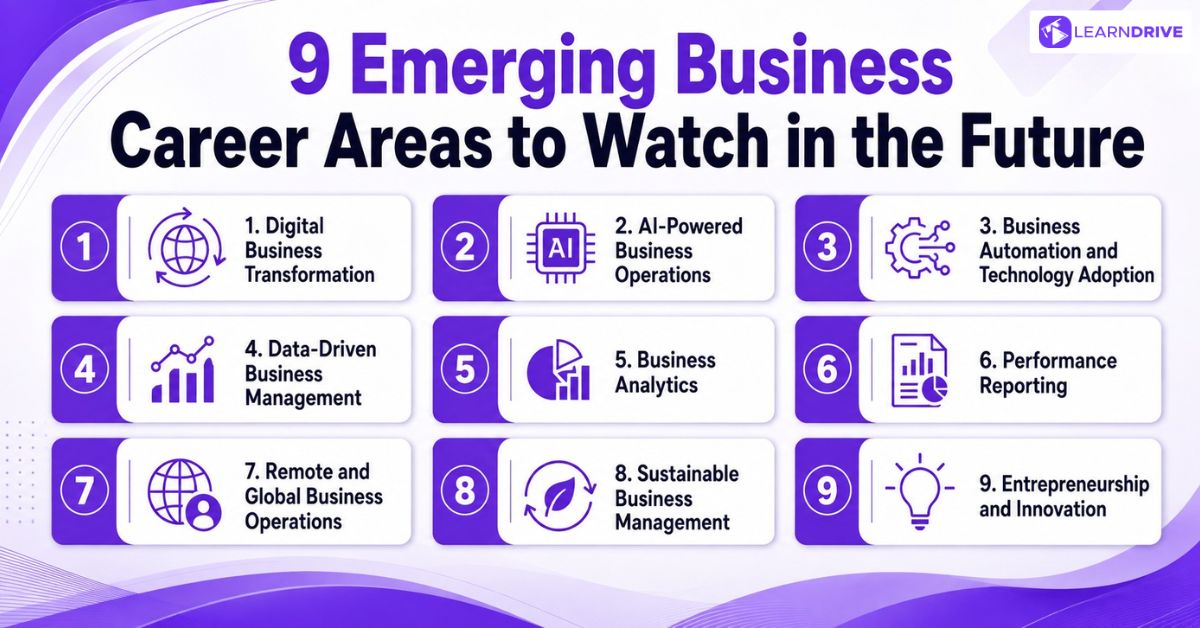
Business administration is changing fast. New technology and shifting work patterns are creating career paths that barely existed a decade ago.
1. Digital Business Transformation
Businesses across industries are changing how they operate by adopting digital tools, cloud platforms, and new technologies. This transformation is creating demand for professionals who can help organisations improve processes, manage change, and introduce more efficient ways of working.
Business administration graduates can play an important role in this area because they understand both business goals and operational challenges. Careers in this field often involve analysing existing processes, coordinating technology projects, supporting teams through change, and ensuring new systems deliver real business value.
Common roles include:
Digital Transformation Specialist
Business Transformation Consultant
Change Management Coordinator
Project Manager
2. AI-Powered Business Operations
Artificial intelligence is changing how companies handle everyday tasks, from customer service and reporting to forecasting and decision-making. Businesses are increasingly looking for professionals who can understand how AI tools can be applied effectively while keeping operations efficient.
A business administration background is valuable here because successful AI adoption requires more than technical knowledge. Companies need people who can identify business problems, improve workflows, manage implementation, and connect AI solutions with organisational goals.
Common roles include:
AI Business Consultant
Operations Analyst
AI Implementation Specialist
Business Process Manager
3. Business Automation and Technology Adoption
Automation allows businesses to reduce repetitive tasks, improve accuracy, and help employees focus on higher-value activities. As companies adopt automation tools, they need professionals who can identify opportunities for improvement and manage the transition.
Business administration graduates are well suited to this area because they understand workflows, productivity, and organisational processes. They can help departments decide which tasks should be automated, choose suitable tools, and measure whether changes are improving performance.
Common roles include:
Business Automation Analyst
Process Improvement Specialist
Operations Manager
Automation Project Coordinator
4. Data-Driven Business Management
Modern businesses increasingly rely on data to make decisions instead of relying only on assumptions or experience. Managers now need to understand performance data, customer behaviour, financial information, and market trends to make better strategic choices.
Professionals with business administration knowledge and data skills can help organisations turn information into practical decisions. They bridge the gap between raw data and business action by explaining what numbers mean and how they can improve performance.
Common roles include:
Business Manager
Data-Informed Operations Manager
Strategy Analyst
Business Intelligence Specialist
5. Business Analytics
Business analytics focuses on collecting, analysing, and interpreting data to help companies improve their decisions. From understanding customer behaviour to identifying areas where costs can be reduced, analytics has become a key part of modern business strategy.
This area is particularly suitable for graduates who enjoy problem-solving, numbers, and finding patterns. Combining business knowledge with tools such as spreadsheets, dashboards, and analytics platforms can create strong career opportunities.
Common roles include:
Business Analyst
Data Analyst
Marketing Analyst
Operations Analyst
6. Performance Reporting
Organisations need accurate reporting to understand whether teams, projects, and departments are meeting their goals. Performance reporting involves collecting information, creating reports, and presenting insights that help managers take action.
Business administration graduates can succeed in this field because they understand organisational objectives and how different departments contribute to overall success. Strong communication skills are especially valuable because reports must often be explained to decision-makers.
Common roles include:
Performance Analyst
Reporting Specialist
Management Information Analyst
Operations Coordinator
7. Remote and Global Business Operations
The rise of remote work has changed how companies manage teams, communicate, and deliver services. Many organisations now operate across different countries and time zones, creating demand for professionals who can coordinate people and processes effectively.
Business administration skills such as communication, organisation, project management, and leadership are highly relevant in this area. Professionals help maintain productivity, improve collaboration, and ensure teams remain connected despite working remotely.
Common roles include:
Remote Operations Manager
Project Coordinator
Global Business Coordinator
Virtual Operations Specialist
8. Sustainable Business Management
Sustainability has become an important part of modern business strategy. Companies are increasingly focusing on reducing environmental impact, improving social responsibility, and creating long-term value while remaining profitable.
Business administration graduates can contribute by helping organisations develop sustainable strategies, improve supply chains, manage compliance requirements, and balance business goals with environmental and social responsibilities.
Common roles include:
Sustainability Manager
ESG Analyst
Corporate Responsibility Coordinator
Sustainable Business Consultant
9. Entrepreneurship and Innovation
Entrepreneurship remains one of the most flexible career paths for business administration graduates. The knowledge gained in finance, marketing, operations, and strategy can help individuals build their own businesses or develop new products and services within existing organisations.
Digital platforms and online tools have made it easier for entrepreneurs to launch ideas, reach customers, and manage operations. However, success still requires planning, market research, financial awareness, and the ability to adapt quickly.
Common roles include:
Entrepreneur
Startup Founder
Innovation Manager
Business Development Specialist

5 Reasons Why Business Careers Are Worth Pursuing in 2026

If you are still weighing up whether this path is worth it, here are five reasons why business administration remains a strong choice heading into 2026.
1. Wide Career Opportunities Across Industries
Almost every industry needs people who understand how to run a business well. Healthcare, retail, tech, education, and manufacturing all rely on the same core skills this degree teaches, which means your options are rarely limited to one sector.
2. Strong Demand for Business Professionals
Companies consistently need managers, analysts, and coordinators to keep operations running. That steady demand makes business administration one of the more reliable degree choices available right now.
3. Competitive Salary Opportunities
Many roles on this list pay well above the UK average, especially once you move into management or specialist positions. Salaries also tend to grow quickly with experience, since so much of the value in these roles comes from judgement built over time.
4. Career Growth and Promotion Potential
Business administration roles rarely stay static. Someone starting as an administrative assistant can realistically work up to a management or director level position within a decade, provided they keep building relevant experience along the way.
5. Transferable Skills for Long-Term Success
The skills this degree builds, communication, leadership, financial literacy, and problem solving, stay useful even if you change industries entirely. That flexibility matters more than ever in a job market where career changes are increasingly common.