Should You Find a Job Before Moving?

Finding a job before moving is usually the safer choice, especially if you are relocating to a city where rent, transport, and daily costs are higher than what you are used to. A new city can bring better opportunities, but it can also bring unexpected pressure if you arrive without income, local contacts, or a clear job search plan.
That does not mean you must have a job offer before you move. Some people find work faster once they are already in the city because they can attend interviews, meet recruiters, and build local connections. However, if you can start your job search early, you give yourself a much stronger chance of moving with confidence instead of panic.
1. It Reduces Financial Pressure
One of the biggest benefits of finding work before moving is financial security. When you already have a confirmed job, you know how much you will earn and when your income will start. This makes it easier to plan rent, bills, food, transport, moving costs, and emergency savings.
Without a job, you may have to rely on savings for longer than expected. Even a few extra weeks without income can become stressful in a new city. A job offer helps you move with a clearer budget and less pressure.
2. It Makes Housing Easier
Finding a place to live can be much easier when you already have employment. Many landlords and letting agents ask for proof of income before approving a rental application. A written job offer can help show that you will be able to pay rent after moving.
This is especially important if you are moving to a competitive city where good accommodation gets taken quickly. When you can show stable income, you may look more reliable as a tenant.
3. It Helps You Choose Where to Live
When you know where your workplace will be, it becomes easier to choose the right area to live in. Instead of picking a random neighbourhood, you can think about commute time, transport links, rent prices, safety, and daily convenience.
For example, a cheaper flat may not be worth it if it adds two hours of travel every day. Knowing your job location first helps you make a smarter decision about where to settle.
4. It Gives You Peace of Mind
Moving to a new city already comes with enough uncertainty. You may need to adjust to a new routine, new people, new transport routes, and a different lifestyle. Having a job secured before you arrive can make the transition feel less risky.
It gives you a reason to move, a structure for your week, and a clear starting point in the city. Even if everything else feels new, your job can give you stability from day one.
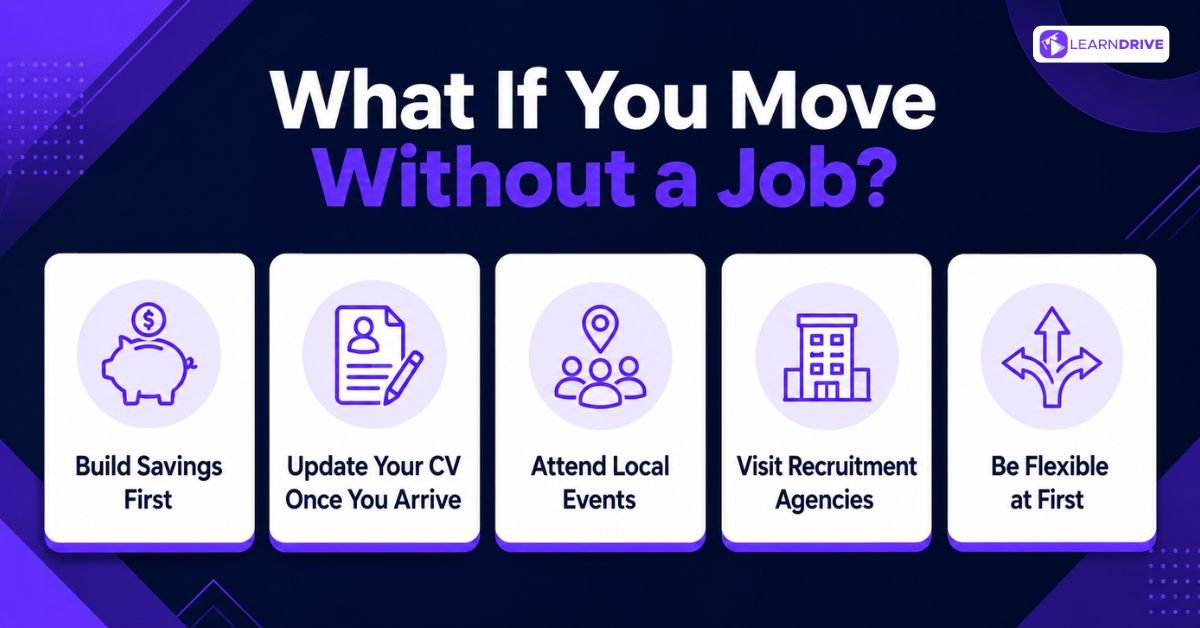
What If You Move Without a Job?
Moving without a job can feel risky, but it does not always mean you are making the wrong decision. Sometimes, being physically present in the new city can actually make your job search easier. Employers may take you more seriously when they see that you already live nearby, can attend interviews quickly, and are ready to start sooner.
However, you should not move without a plan. A new city can become expensive very quickly, especially when you are paying for rent, food, transport, bills, and job search costs at the same time..
1. Build Savings First
Before you move, try to save enough money to cover at least three to six months of essential expenses. This should include rent, deposit, bills, food, transport, phone costs, and emergency spending.
Having savings gives you breathing space. It means you do not have to accept the first job you find just because you are under pressure. You can search more carefully and choose a role that actually fits your skills and goals.
2. Update Your CV Once You Arrive
As soon as you move, update your CV with your new city or local area. This helps employers see that you are now available locally.
You do not need to include your full address. You can simply write something like:
Based in Birmingham
or
Available for roles in Manchester and surrounding areas
This small change can make your application look more relevant to local employers.
3. Attend Local Events
Once you are in the city, use your location as an advantage. Attend job fairs, business meetups, workshops, open days, career events, and industry networking sessions.
These events can help you meet recruiters, employers, and people already working in your field. Even one good conversation can lead to an interview, referral, or useful advice about companies that are hiring.
4. Visit Recruitment Agencies
Local recruitment agencies can be very useful when you are already based in the city. Visit agencies that specialise in your industry and register with them.
Bring an updated CV, explain what kind of role you are looking for, and tell them when you can start. Agencies often know about temporary, contract, and permanent roles that may not always appear on public job boards.
5. Be Flexible at First
Your first job in a new city may not be your dream role, and that is okay. You may need to consider temporary work, part-time jobs, freelance projects, contract roles, or a slightly different position while you settle in.
The goal is to create income, build local experience, and expand your network. Once you are financially stable and more familiar with the city, you can continue applying for better long-term opportunities.
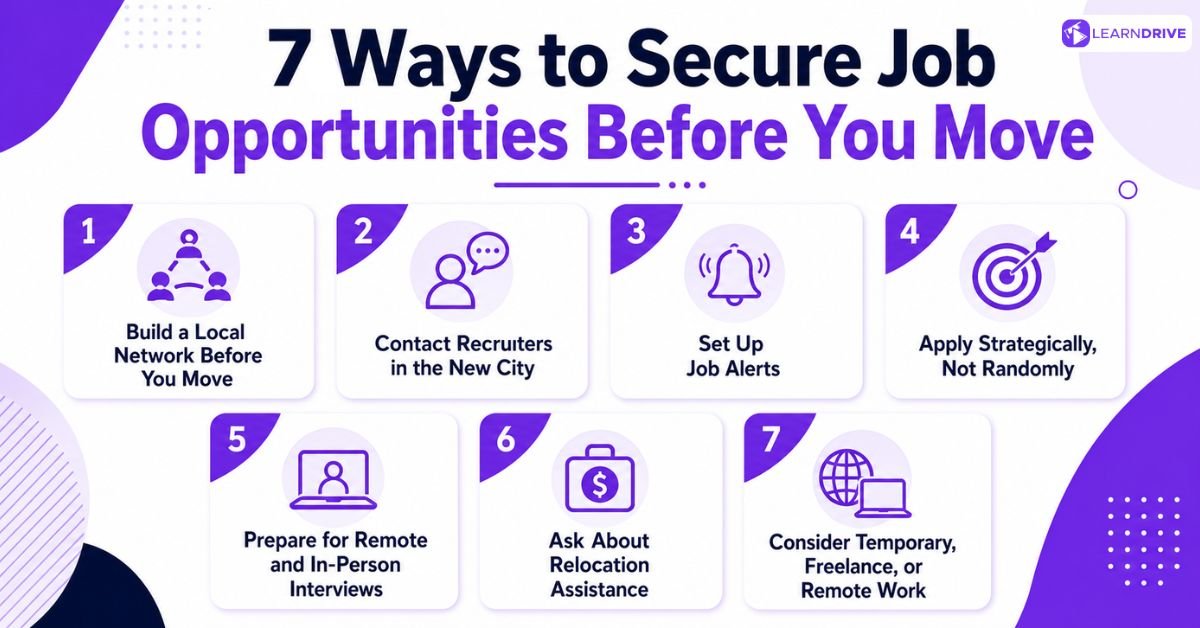
7 Ways to Secure Job Opportunities Before You Move
You do not have to wait until you arrive in a new city to start looking for work. In fact, the earlier you start, the more confident your move will feel. The goal is to create job leads before you relocate, so you are not starting from zero when you get there.
1. Build a Local Network Before You Move
Start connecting with people in your target city before you arrive. Use LinkedIn, Facebook groups, professional communities, alumni networks, and industry forums to meet people who already work there.
You do not need to ask for a job immediately. A better approach is to ask for advice, local market insight, or company recommendations. This feels more natural and can lead to useful connections.
For example:
Hi [Name], I’m relocating to [City] soon and noticed you work in [industry]. I’d really appreciate any advice on the local job market or companies worth following.
2. Contact Recruiters in the New City
Recruiters can help you understand which companies are hiring, what salaries are realistic, and which skills are in demand. Search for recruiters who specialise in your industry, not just general recruitment agencies.
Send them a short message with your target role, expected move date, salary expectation, and updated CV. Be clear about when you can interview and when you can start.
3. Set Up Job Alerts
Job alerts save time and help you apply early. Set up alerts on LinkedIn Jobs, Indeed, Reed, Glassdoor, Totaljobs, company career pages, local council job boards, NHS job boards if relevant, and industry-specific websites.
Use filters such as city, job title, salary range, remote or hybrid work, experience level, and contract type. This helps you avoid wasting time on roles that do not match your situation.
4. Apply Strategically, Not Randomly
Do not send the same CV to every employer. When applying from another city, your application needs to show three things: you match the role, you understand the location, and you have a clear relocation plan.
Tailor your CV to the job description, mention your move in the cover letter, and explain why you are interested in that company. A focused application is much stronger than ten rushed applications.
5. Prepare for Remote and In-Person Interviews
Many employers are open to video interviews, but some may still ask you to attend in person. Prepare for both.
For video interviews, check your camera, microphone, lighting, background, and internet connection. For in-person interviews, plan your travel budget in advance. Also prepare a clear answer to explain your relocation.
For example:
I’m relocating to Birmingham because I want to build my long-term career there. I have already researched the area, planned my move, and I’m available to start from [date].
6. Ask About Relocation Assistance
Some employers may offer relocation support, especially if the role requires specialist skills. This support could include moving cost reimbursement, temporary accommodation, travel expenses, remote onboarding, or start-date flexibility.
Do not ask about this too early. Wait until the employer shows serious interest or after you receive an offer.
You can say:
I’m very interested in the role. As I would be relocating for the position, I wanted to ask whether the company offers any relocation support or start-date flexibility.
7. Consider Temporary, Freelance, or Remote Work
If you cannot secure a permanent job straight away, temporary or freelance work can help you earn income while building local experience. Temp agencies, remote projects, freelance platforms, and part-time roles can all help bridge the gap.
This does not mean giving up on your ideal job. It simply gives you more stability while you continue applying for long-term opportunities.
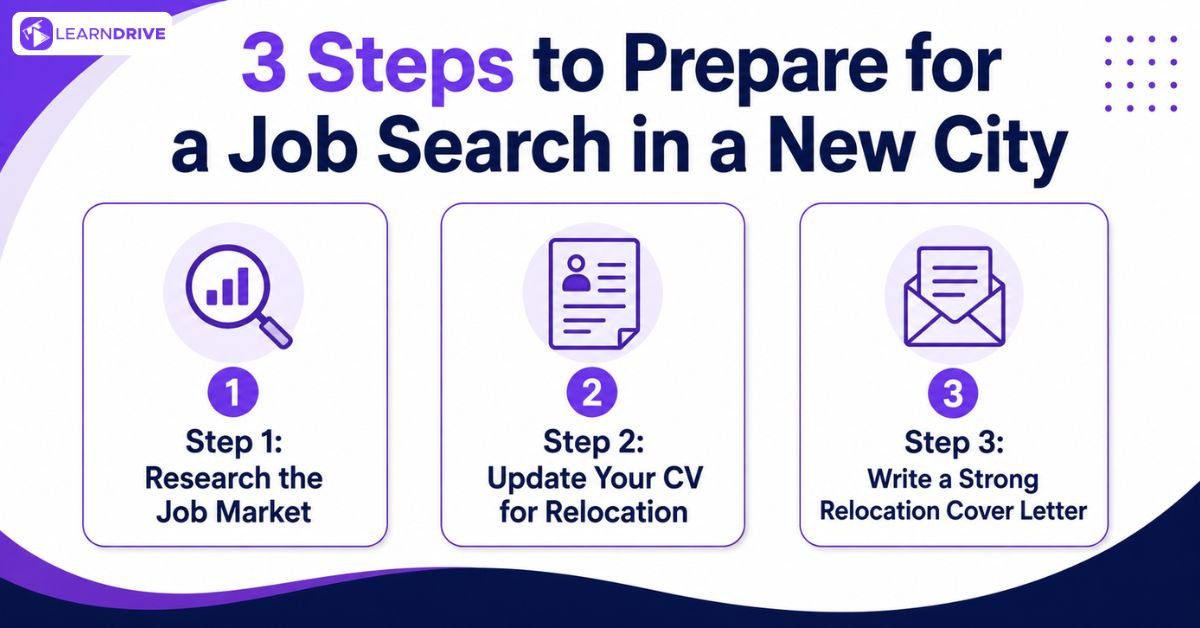
3 Steps to Prepare for a Job Search in a New City
Before you start applying, take a step back and prepare properly. A job search in a new city is different from a normal job search because you are not only selling your skills, you are also showing employers that your relocation is realistic. These three steps will help you look more confident, organised, and ready for the move.
Step 1: Research the Job Market
Start by learning what the job market looks like in your target city. Look at which industries are hiring, what roles appear often, and what skills employers are asking for. This helps you avoid wasting time on jobs that do not match your experience or goals.
Use job boards such as LinkedIn, Indeed, Reed, Glassdoor, Totaljobs, company career pages, and local recruitment websites. Search for your target job title in the new city and check how many roles are available. Also compare salary ranges with rent, transport, food, and other living costs.
You should also make a list of companies you would like to work for. Aim for 20 to 50 target companies. Follow them on LinkedIn, check their career pages, and set alerts so you know when they post new vacancies.
Step 2: Update Your CV for Relocation
Your CV should make your relocation plan clear. If you currently live in another city, you do not need to include your full address. Instead, add your phone number, email address, LinkedIn profile, and a short relocation line.
For example:
Relocating to Manchester in September 2026
or
Available to relocate to Birmingham within 4 weeks
This helps employers understand that you are serious about moving. It also reduces the chance of them ignoring your application because they think you are too far away.
You should also tailor your CV for each role. Use keywords from the job description and highlight your most relevant skills, achievements, qualifications, and tools. If you have remote work, hybrid work, or virtual meeting experience, include it because it shows you can work flexibly during the relocation process.
Step 3: Write a Strong Relocation Cover Letter
A relocation cover letter helps you explain your move in a professional way. Mention your relocation early so the employer does not have to guess your situation.
For example:
I am relocating to Leeds in October and am actively seeking opportunities in digital marketing within the area.
Keep your reason short and professional. You do not need to explain every personal detail. Instead, focus on why you are interested in the role, what skills you bring, and why you are ready to work in that city.
You should also reassure the employer that relocation will not create problems. Mention your availability for video interviews, possible in-person interviews, and your planned start date. A clear cover letter can make you look prepared, serious, and easier to hire.
8 Smart Application Tips for Getting Hired in a New City
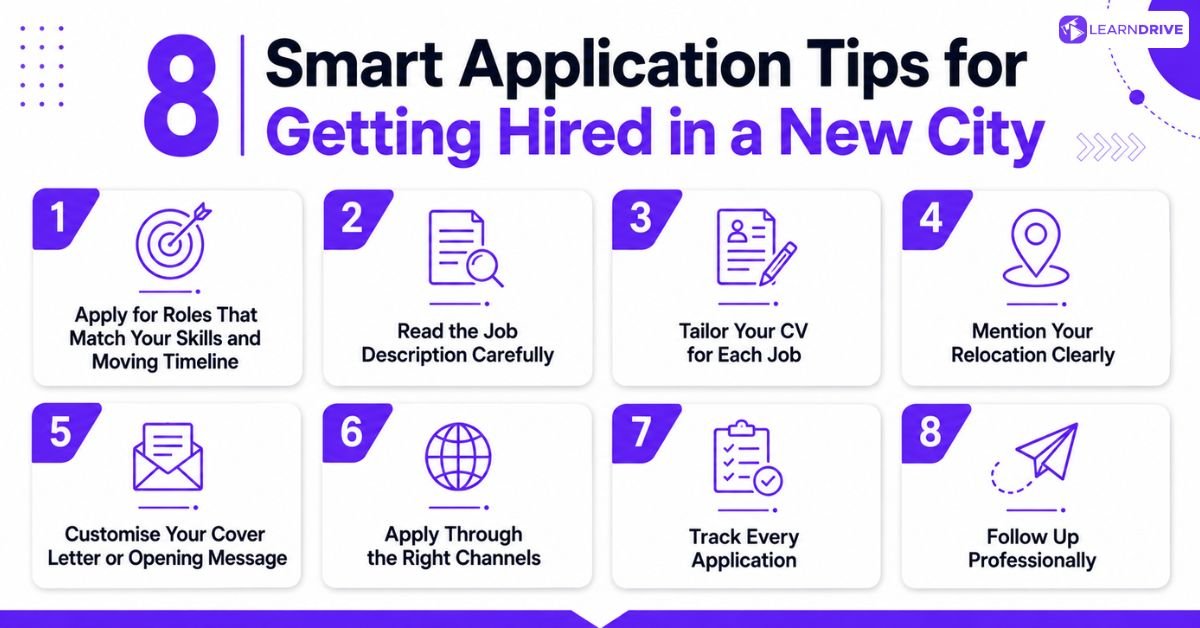
Applying for jobs in a new city needs more planning than a normal job search. You are not only showing that you can do the job, you are also proving that your relocation is serious, realistic, and well organised. Instead of sending the same CV everywhere, focus on quality applications that make employers feel confident about hiring you.
1. Apply for Roles That Match Your Skills and Moving Timeline
Start with jobs that match your experience, qualifications, salary expectations, and planned moving date. If a role needs someone to start immediately but you cannot move for two months, it may not be the right fit. Apply where your skills and availability make sense.
2. Read the Job Description Carefully
Before applying, check the required skills, experience level, working pattern, location, salary range, and start date. This helps you avoid wasting time on roles that do not match your situation. It also helps you understand what the employer really wants.
3. Tailor Your CV for Each Job
Do not send the same CV to every company. Update your CV based on the job description. Add relevant keywords, highlight matching skills, and place your strongest experience near the top. If the job asks for customer service, digital skills, admin experience, or leadership, make sure those points are easy to find.
4. Mention Your Relocation Clearly
Employers should not feel confused about your location. Add a short relocation line to your CV or cover letter, such as:
Relocating to Manchester in September 2026
or
Available to relocate within 4 weeks
This shows that you have a plan and are serious about working in that city.
5. Customise Your Cover Letter or Opening Message
Your cover letter should not sound generic. Mention the company name, the role, why you are interested, and why you are moving to that city. Keep it short, professional, and focused on your value.
For example:
I am relocating to Birmingham and am very interested in this role because it matches my experience in customer service, administration, and client communication.
6. Apply Through the Right Channels
Use more than one method. Apply through job boards, LinkedIn, company career pages, recruitment agencies, local job sites, and referrals. If you know someone connected to the company, ask politely whether they can guide you or refer you.
Applying directly through the company website can also help because your application goes straight into their hiring system.
7. Track Every Application
Keep a simple job application tracker so you do not lose control of your search. Include:
1. Company name
2. Job title
3. Date applied
4. Application link
5. Contact person
6. Status
7. Follow-up date
8. Interview date
9. Notes
This helps you follow up properly and avoid applying twice for the same role.
8. Follow Up Professionally
If you do not hear back after 5 to 7 working days, send a polite follow-up message. Keep it short and respectful.
Example:
Dear [Name], I hope you are well. I recently applied for the [Job Title] role and wanted to follow up on my application. I am very interested in the opportunity and would be happy to provide any further information. Kind regards, [Your Name].
A good follow-up shows interest without sounding pushy. It can also remind the employer to review your application.
6 Smart Ways to Use AI During Your City Job Search
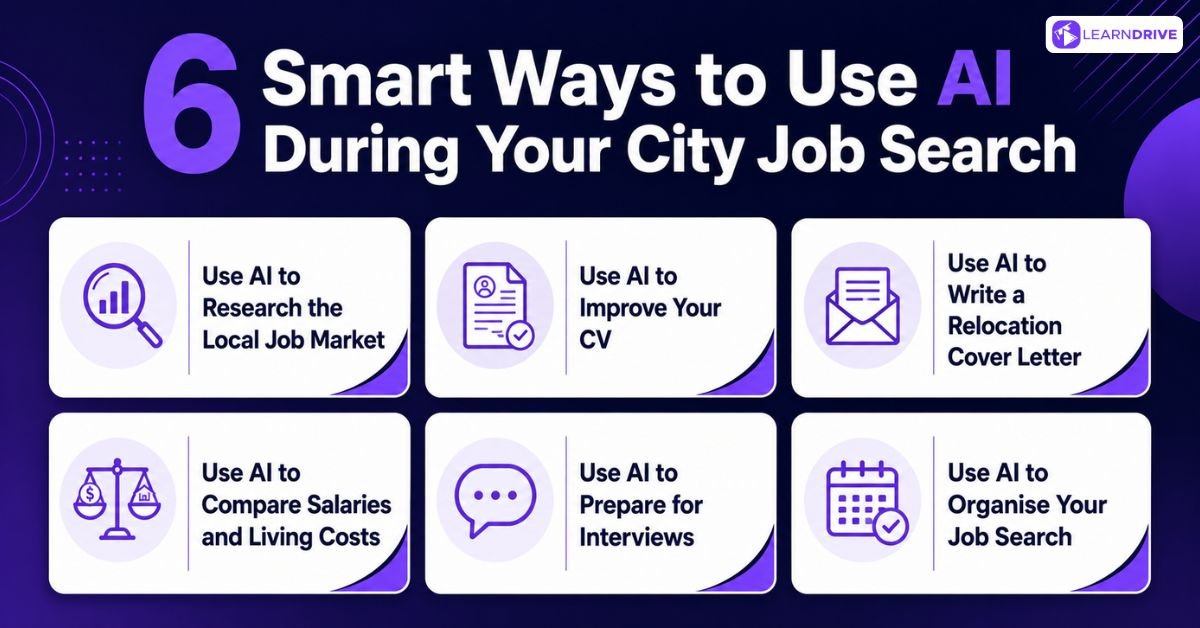
AI can make your job search faster, clearer, and more organised, especially when you are applying from another city. It cannot replace your effort, but it can help you research better, write stronger applications, and prepare with more confidence.
1. Use AI to Research the Local Job Market
Before applying, use AI to understand what the job market looks like in your target city. You can ask it to identify growing industries, popular job titles, in-demand skills, and common salary ranges.
AI tools to use: ChatGPT, Perplexity, Google Gemini
For example, you can ask:
“What are the most in-demand admin jobs in Manchester?”
or
“What skills do employers usually ask for in digital marketing jobs in Birmingham?”
This helps you focus on realistic roles instead of applying blindly.
2. Use AI to Improve Your CV
AI can help you rewrite your CV for a specific job. You can paste the job description and ask AI to highlight the skills, keywords, and experience you should include.
AI tools to use: ChatGPT, Claude, Jobscan, Teal, Grammarly
It can also help you make your CV sound more professional by improving weak bullet points. For example, instead of writing:
Worked with customers
AI can help you rewrite it as:
Handled customer enquiries professionally and supported clients with clear, timely information.
This makes your experience sound stronger and more relevant.
3. Use AI to Write a Relocation Cover Letter
When applying for jobs in a new city, your cover letter should explain your move clearly. AI can help you write a short, professional relocation paragraph that reassures employers.
AI tools to use: ChatGPT, Claude, Microsoft Copilot, Grammarly
For example:
I am relocating to Leeds in October and am actively seeking a long-term role where I can use my experience in customer service, administration, and communication. I am available for video interviews and can attend in-person meetings if required.
This shows that your move is planned and serious.
4. Use AI to Compare Salaries and Living Costs
A job offer may look good on paper, but it needs to match the cost of living in the new city. AI can help you list the main costs you should compare, such as rent, transport, bills, food, council tax, and commuting expenses.
AI tools to use: Perplexity, ChatGPT, Google Gemini, Microsoft Copilot
You can also ask AI to create a simple monthly budget based on your expected salary. This helps you decide whether the role is financially realistic before accepting an offer.
5. Use AI to Prepare for Interviews
AI can act like an interview coach. You can ask it to generate common interview questions for your target role and help you practise strong answers.
AI tools to use: ChatGPT, Claude, Google Gemini, Yoodli
It can also help you prepare for relocation-related questions, such as:
“Why are you moving to this city?”
“When can you start?”
“Are you available for in-person interviews?”
Practising these answers before the interview will make you sound more confident and prepared.
6. Use AI to Organise Your Job Search
A job search can quickly become messy if you are applying to many roles. AI can help you create an application tracker, weekly job search plan, follow-up email templates, recruiter messages, and LinkedIn networking messages.
AI tools to use: ChatGPT, Notion AI, Google Gemini, Microsoft Copilot, Teal
For example, you can ask AI to create a simple tracker with:
1. Company name
2. Job title
3. Date applied
4. Location
5. Salary
6. Application status
7. Follow-up date
8. Interview date
9. Notes
This keeps your job search organised and helps you follow up at the right time.
7 Ways to Build Professional Connections in Your Target City
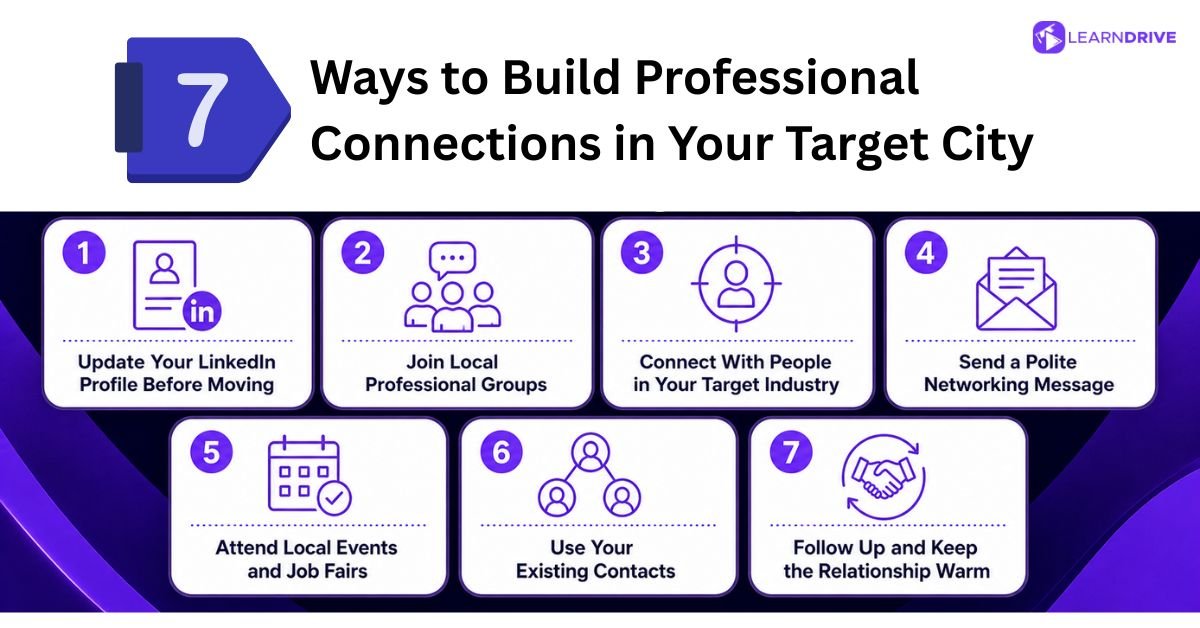
Finding a job in a new city becomes much easier when people know who you are before you arrive. You do not need a huge network. Even a few helpful connections can lead to job leads, referrals, interview tips, and local advice that you may not find on job boards.
1. Update Your LinkedIn Profile Before Moving
Before you start contacting people, make sure your LinkedIn profile looks ready. Add your target city to your headline or About section so people can see that you are serious about relocating.
For example:
Marketing Assistant | Relocating to Bristol | Open to Digital Marketing Roles
This makes your profile clearer for recruiters, hiring managers, and local professionals.
2. Join Local Professional Groups
Search for LinkedIn groups, Facebook groups, industry communities, alumni groups, and local networking groups in your target city. Look for groups related to your career field, business events, job opportunities, or professional development.
These groups can help you understand which companies are hiring, what skills are in demand, and what events are happening nearby.
3. Connect With People in Your Target Industry
Look for professionals who already work in the city you want to move to. This could include recruiters, hiring managers, company employees, business owners, or people with similar job titles.
Do not connect with everyone randomly. Focus on people who work in your industry or at companies you would genuinely like to join.
4. Send a Polite Networking Message
When you message someone, do not ask for a job straight away. Start by asking for advice, guidance, or local job market insight. This feels more natural and professional.
Example:
Hi [Name], I’m relocating to [City] soon and noticed you work in [industry]. I’d really appreciate any advice on the local job market or companies worth following.
A simple, respectful message can open the door to a useful conversation.
5. Attend Local Events and Job Fairs
If possible, attend career fairs, business meetups, workshops, webinars, open days, and industry events in the new city. These events help you meet people face to face and learn about opportunities that may not be advertised online.
Even if you do not get a job immediately, you can collect contacts, learn about employers, and understand the local job culture better.
6. Use Your Existing Contacts
Your current network may be more useful than you think. Ask friends, former colleagues, classmates, teachers, family members, or previous managers if they know anyone in your target city.
You can say:
I’m planning to move to [City] and looking for opportunities in [industry]. Do you know anyone there I could speak to for advice?
A warm introduction is often stronger than a cold application.
7. Follow Up and Keep the Relationship Warm
If someone replies or gives advice, thank them properly. Do not disappear after one message. Stay connected, engage with their posts, and occasionally update them on your move or job search progress.
Networking is not only about getting a job quickly. It is about building relationships that can help you settle into the city, understand the market, and find better opportunities over time.
8 Things to Do After Getting Hired in a New Location
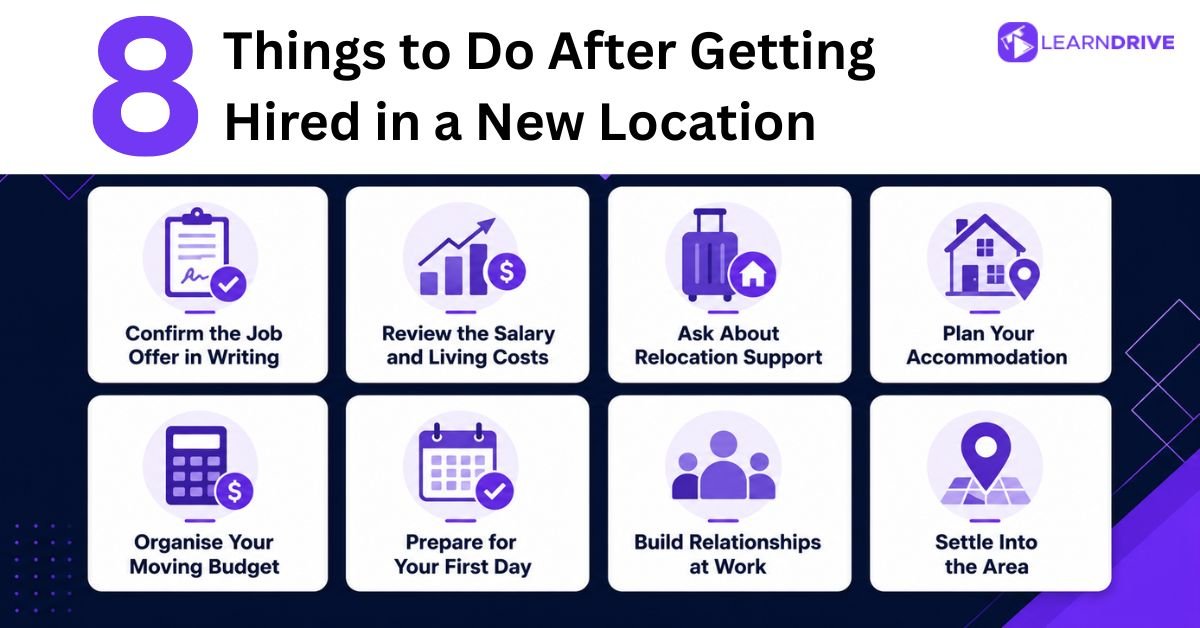
Getting the job offer is a big step, but your move is not finished yet. Once an employer says yes, you need to make sure the offer is clear, your budget works, and your relocation plan is realistic. The goal is to start your new role with confidence, not confusion.
1. Confirm the Job Offer in Writing
Before making any big decision, ask for the offer in writing. It should include your job title, salary, start date, working hours, workplace location, benefits, probation period, and any conditions attached to the offer.
2. Review the Salary and Living Costs
Check whether the salary will cover your rent, transport, food, bills, council tax, and personal expenses. A job may sound good, but it needs to match the real cost of living in that area.
3. Ask About Relocation Support
If you are moving for the role, ask whether the company offers relocation help. This could include moving cost support, temporary accommodation, travel expenses, remote onboarding, or start-date flexibility.
4. Plan Your Accommodation
Choose where to live based on commute time, rent, transport links, safety, and nearby services. Try not to choose a place only because it is cheap. A difficult commute can affect your energy and work performance.
5. Organise Your Moving Budget
Create a budget for your deposit, first month’s rent, travel, furniture, moving services, food, and emergency savings. Keep extra money aside in case the move costs more than expected.
6. Prepare for Your First Day
Confirm your start time, dress code, required documents, onboarding process, and who you should report to. This helps you avoid stress on your first day.
7. Build Relationships at Work
Introduce yourself professionally, ask questions, listen carefully, and learn how the team works. Good workplace relationships can help you settle faster and feel more confident in your new role.
8. Settle Into the Area
Take time to learn the local transport routes, shops, healthcare services, gyms, cafes, and community spaces. The more familiar the area feels, the easier it becomes to build a stable life around your new job.
10 Skills You Need to Find Work After Relocating
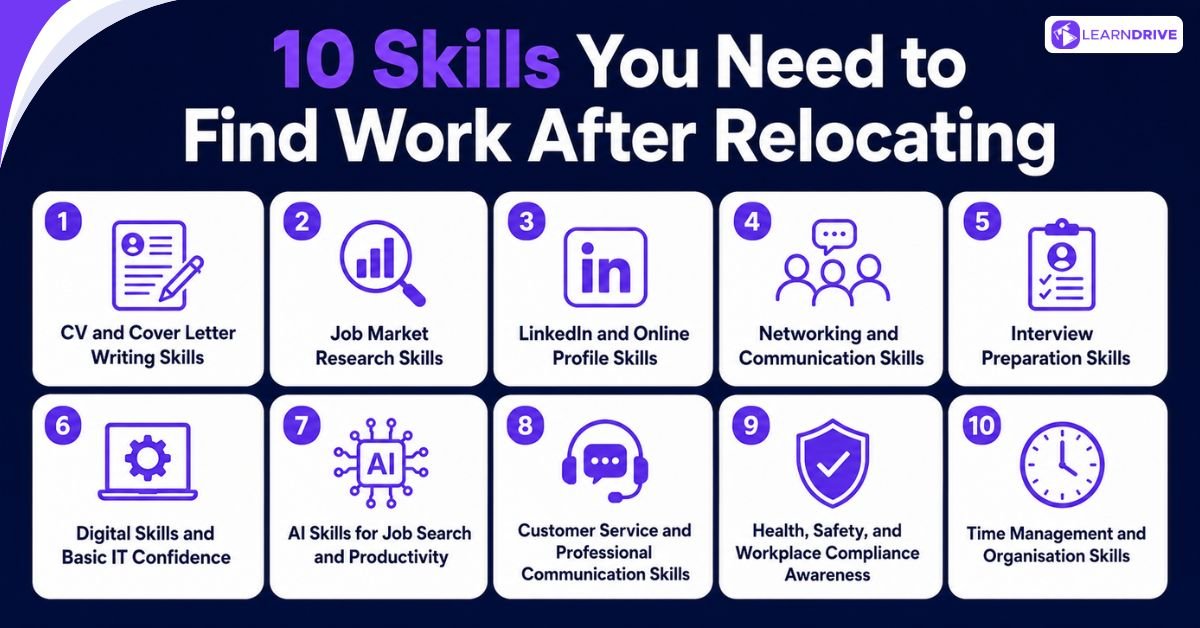
Finding work in a different city is not only about sending applications. You also need the right skills to present yourself well, communicate clearly, and compete with local candidates. These skills can help you look more confident, professional, and ready for the role.
1. CV and Cover Letter Writing Skills
Your CV and cover letter are often the first things an employer sees. You need to know how to highlight your experience, use the right keywords, and explain your relocation clearly. A strong CV should show what you can do, while your cover letter should explain why you are a good fit for the company.
2. Job Market Research Skills
Before applying, you should know how to research the local job market. This includes checking which industries are growing, what salaries are realistic, what companies are hiring, and which skills appear often in job descriptions. Good research helps you apply for better-matched roles.
3. LinkedIn and Online Profile Skills
Many recruiters check your LinkedIn profile before contacting you. Keep your profile updated with your skills, experience, target role, and relocation plan. A professional online profile can help employers understand who you are before the interview stage.
4. Networking and Communication Skills
Networking is one of the best ways to find hidden job opportunities. You should know how to introduce yourself, message people politely, ask for advice, and follow up professionally. Good communication can help you build trust with recruiters, professionals, and potential employers.
5. Interview Preparation Skills
You need to be ready for both online and in-person interviews. Practise common interview questions, prepare examples from your experience, and have a clear answer for why you are moving. The more prepared you are, the more confident you will sound.
6. Digital Skills and Basic IT Confidence
Most jobs now require some level of digital confidence. This may include using email, video meetings, spreadsheets, online job boards, company systems, and document tools. Even basic IT skills can make your job search and workplace adjustment much easier.
7. AI Skills for Job Search and Productivity
AI tools can help you improve your CV, write cover letters, prepare for interviews, research companies, and organise applications. Knowing how to use tools like ChatGPT, Claude, Gemini, Copilot, or Grammarly can save time and improve the quality of your job search.
8. Customer Service and Professional Communication Skills
Even if you are not applying for a customer service job, employers value people who can speak clearly, listen properly, solve problems, and deal with people professionally. These skills are useful in offices, healthcare, retail, hospitality, admin, sales, and many other roles.
9. Health, Safety, and Workplace Compliance Awareness
Basic awareness of workplace safety, data protection, equality, safeguarding, or compliance can make you more employable, especially in regulated sectors. It shows employers that you understand professional responsibilities, not just daily tasks.
10. Time Management and Organisation Skills
A job search can become stressful if you do not stay organised. You need to track applications, follow up on time, prepare for interviews, manage travel, and plan your move. Good organisation helps you stay consistent and avoid missing opportunities.
10 Essential Job Skills International Students Should Know
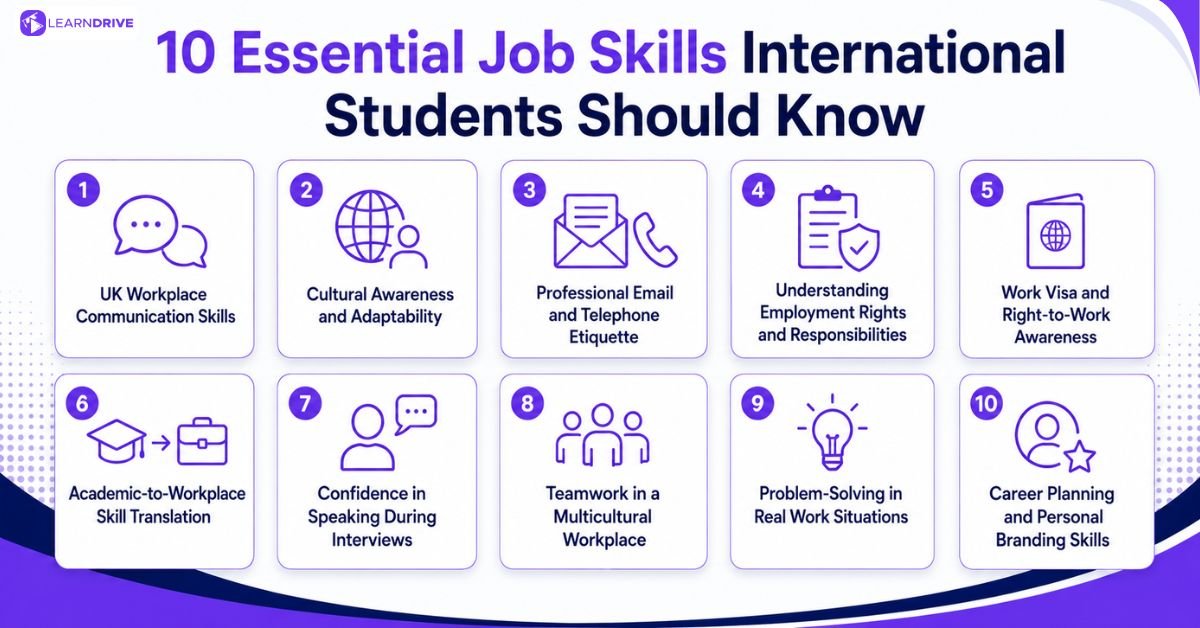
International students often face a different kind of job search. You may have the right degree, strong motivation, and useful experience, but employers also want to see that you understand workplace expectations in the country where you are applying. These skills can help you communicate better, show confidence, and turn your academic experience into real career value.
1. UK Workplace Communication Skills
Good communication is one of the most important skills for international students. You need to know how to speak clearly with managers, colleagues, customers, and recruiters. This includes using professional language, listening carefully, asking questions when needed, and understanding workplace tone.
2. Cultural Awareness and Adaptability
Every country has its own workplace culture. International students should learn how people communicate, solve problems, give feedback, and work in teams. Being adaptable helps you settle faster and avoid misunderstandings at work.
3. Professional Email and Telephone Etiquette
Many employers judge professionalism through small details. Knowing how to write a clear email, answer the phone politely, leave a voicemail, and follow up after an interview can make you look more confident and employable.
4. Understanding Employment Rights and Responsibilities
International students should understand basic employment rules, such as working hours, pay, contracts, holiday entitlement, workplace behaviour, and employee responsibilities. This helps you avoid unsuitable jobs and understand what employers expect from you.
5. Work Visa and Right-to-Work Awareness
You should know what type of work you are legally allowed to do, how many hours you can work, and what documents employers may ask for. Being clear about your right-to-work status can make the hiring process easier and more professional.
6. Academic-to-Workplace Skill Translation
Many international students have strong academic experience but struggle to explain it in workplace language. You should learn how to turn university projects, presentations, research, group assignments, and part-time work into skills employers understand.
7. Confidence in Speaking During Interviews
Interviews can feel harder when English is not your first language or when the interview style is different from your home country. Practising common questions, preparing examples, and speaking slowly can help you sound more confident.
8. Teamwork in a Multicultural Workplace
International students often work with people from many different backgrounds. Employers value candidates who can respect different opinions, communicate clearly, and contribute positively to a team.
9. Problem-Solving in Real Work Situations
Employers want people who can stay calm and think practically when challenges happen. Problem-solving skills show that you can handle customer issues, workplace pressure, mistakes, or unexpected tasks without panicking.
10. Career Planning and Personal Branding Skills
International students should learn how to build a strong CV, LinkedIn profile, and career direction. Personal branding helps employers understand who you are, what you can offer, and why you are a good fit for the role.
6 Common Mistakes to Avoid while Finding a Job in a New City
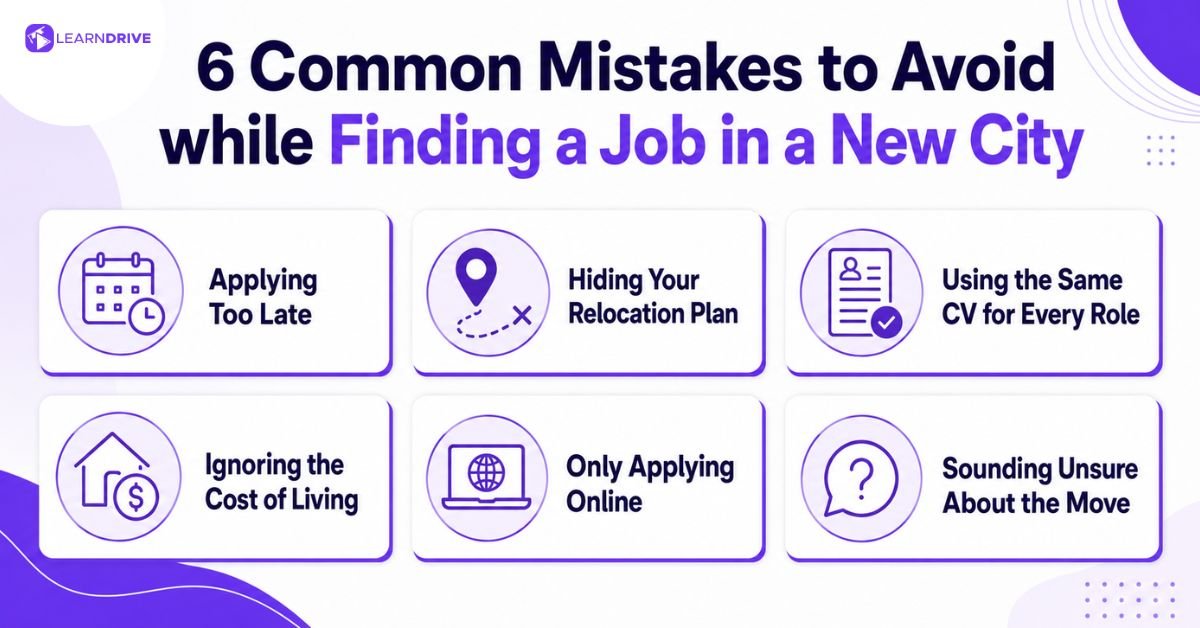
Even with a strong plan, small mistakes can make it harder to find a job in a new city. Many job seekers lose opportunities because they apply too late, hide their relocation plans, or send the same CV to every employer. Avoiding these mistakes can make your job search more focused and professional.
1. Applying Too Late
Do not wait until the last moment to start applying. Begin your job search a few months before your planned move, especially if you are applying for professional, graduate, or specialist roles. Starting early gives you more time to research companies, speak to recruiters, attend interviews, and compare offers.
2. Hiding Your Relocation Plan
Employers should not be confused about where you live or when you can start. If you are moving to the city soon, mention it clearly in your CV, cover letter, or interview. A simple line such as “Relocating to Bristol in September” can make your situation easier to understand.
3. Using the Same CV for Every Role
A generic CV rarely works well. Every job has different requirements, so your CV should reflect the role you are applying for. Use keywords from the job description and highlight the experience most relevant to that position.
4. Ignoring the Cost of Living
A higher salary does not always mean a better lifestyle. Before accepting a job, compare the salary with rent, transport, bills, food, and commuting costs in the new area. This helps you avoid moving for a role that may not support your living expenses.
5. Only Applying Online
Online applications are useful, but they should not be your only strategy. Use recruiters, LinkedIn networking, referrals, job fairs, company websites, and local professional groups. Many opportunities come through conversations, not just job boards.
6. Sounding Unsure About the Move
Employers may hesitate if you sound uncertain about relocating. Be prepared to explain why you are moving, when you plan to arrive, and how soon you can start. A clear and confident answer shows that you are serious about building your career in that location.
7 Things to Do If You Cannot Find a Job
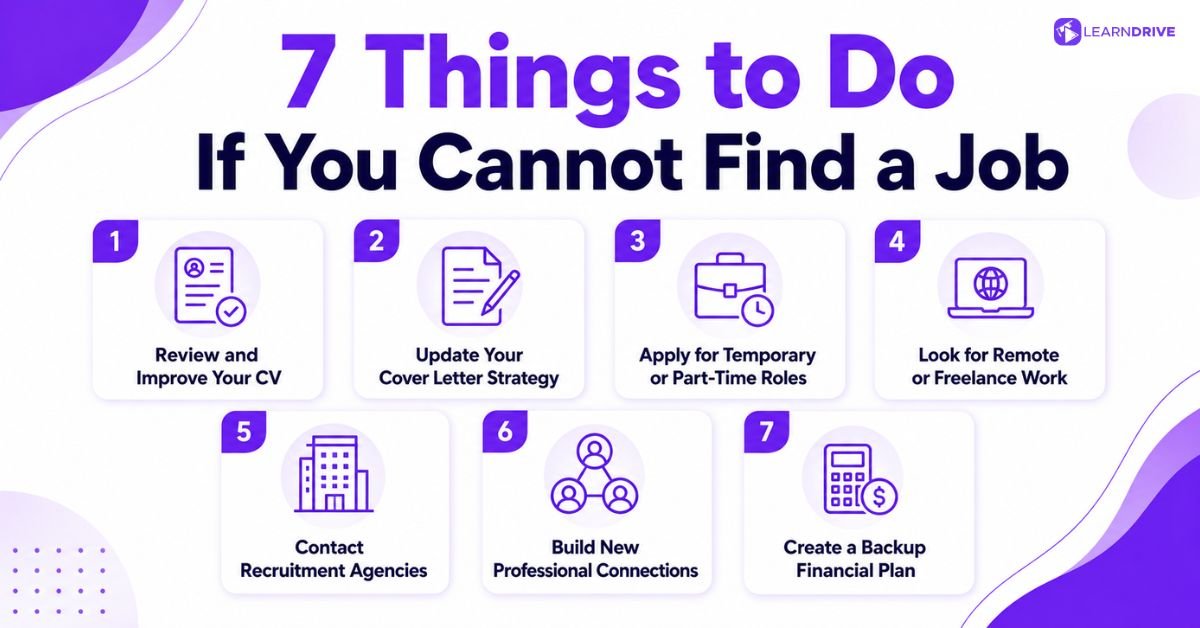
Not getting a job straight away can feel discouraging, especially when you are trying to settle into a different place. But a slow job search does not mean you are not good enough. It usually means you need to adjust your strategy, widen your options, and stay active until the right opportunity appears.
1. Review and Improve Your CV
Start by checking your CV carefully. Make sure it is clear, updated, and matched to the type of roles you want. If you are applying for many jobs but getting no replies, your CV may not be showing your strongest skills clearly enough.
Use keywords from job descriptions, add measurable achievements where possible, and remove anything that does not support your target role.
2. Update Your Cover Letter Strategy
If your cover letter sounds too generic, employers may ignore it. Instead of sending the same version every time, customise it for each role. Mention the company, the position, your relevant skills, and why you are interested.
Keep it short, focused, and professional.
3. Apply for Temporary or Part-Time Roles
Temporary or part-time work can help you earn money while you continue looking for a long-term position. It can also give you local experience, new contacts, and confidence.
This could include admin work, retail, hospitality, warehouse roles, customer service, care support, or event work.
4. Look for Remote or Freelance Work
Remote and freelance work can help you stay financially active while searching. You can look for online work in writing, virtual assistance, design, tutoring, social media support, data entry, customer service, or AI-related tasks.
Even short projects can help you build experience and reduce pressure.
5. Contact Recruitment Agencies
Recruitment agencies often know about roles that are not always listed publicly. Contact agencies in your target industry and send them your updated CV.
Be clear about the type of work you want, your availability, salary expectations, and whether you are open to temporary or contract roles.
6. Build New Professional Connections
If online applications are not working, focus more on people. Join local networking groups, attend job fairs, connect with professionals on LinkedIn, and ask for advice from people already working in your field.
A simple conversation can sometimes lead to a referral or interview.
7. Create a Backup Financial Plan
If your job search takes longer than expected, you need a backup plan. Review your savings, reduce unnecessary spending, and decide how long you can continue searching comfortably.
You may need to accept short-term work first while continuing to apply for better roles. This is not failure. It is a practical step that keeps you moving forward.