You have tried ChatGPT. You have read the headlines. Now you want proof that you can use AI properly.
AI is changing how we work, and it is moving fast. Employers want people who can use these tools well. A recognised certification can make your CV stand out. It shows that you use AI with confidence and care.
But the choice is huge. Some courses are free. Others cost hundreds of pounds. Many are built for coders, and you do not need to be one. It is easy to feel lost, and easy to waste money on the wrong course.
So where should you start? For most UK professionals, the free government-backed AI course is the best first step. It needs no technical background. Next, add one foundation certificate. The BCS Essentials Certificate in AI is a strong choice. If your workplace uses Microsoft, AWS or Google Cloud, finish with one of their entry exams.
One more thing matters. Certificates help, but proof of real work helps more. A small project finished with AI can say more than a long list of badges. Think of a report you sped up, a process you tidied or a client task you improved. Employers love seeing results like these.
In this guide, you will see what each option covers, who it suits and what it costs in pounds. You will also find the one that fits your role. By the end, you will know your next step. You can start building skills that last, without the hype. No coding. No jargon. Just a clear path to AI skills that employers value.
Table of Contents
What Is an AI Certification?
An AI certification is proof that you know a set of AI skills. You earn it by passing an exam or finishing an approved program. It gives employers a quick way to see what you can do. Some are free. Others cost money and need a test.
Certification, certificate and badge: what is the difference?
These words look alike, but they mean different things.
• Certification: You pass a test set by a trusted group, such as BCS, Microsoft, AWS or Google Cloud.
• Certificate: You finish a course and get a document that shows you completed it.
• Badge: A small digital award that you can share online. The government’s AI foundations badge is one example.
All three can help your CV. An exam from a respected group usually carries more weight. A certificate shows you took the time to learn.
What Types of AI Certifications Are There?
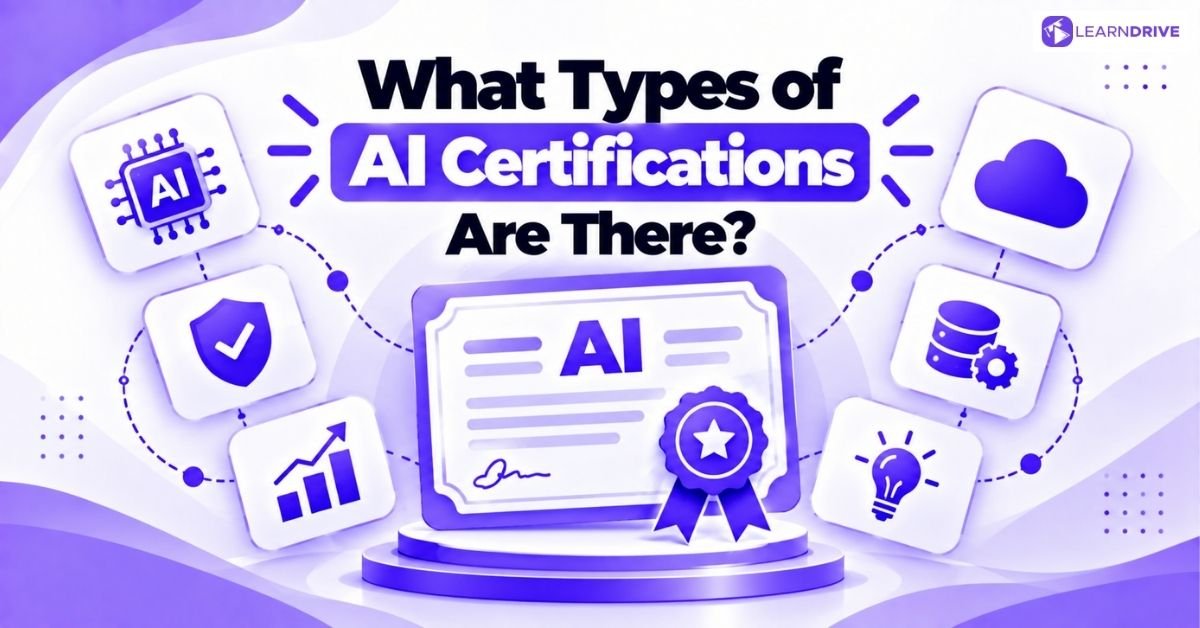
There are four main types. Beginner certifications teach AI basics. Cloud certifications cover AI on a platform such as Azure or AWS. Business certifications help managers plan AI use. Builder certifications are for people who create AI systems. Most office workers should start with the first type.
1. Beginner certifications. These explain what AI is and how to use it safely. They need no coding. Examples are the government indication, BCS Essentials and the Google AI Professional Certificate.
2. Cloud certifications. These test AI skills on one company’s tools. “Cloud” means services that run on the internet, not on your own computer. Examples are Microsoft Azure AI Fundamentals and AWS Certified AI Practitioner.
3. Business certifications. These suit managers and team leaders. They cover planning, risk and strategy. Examples are BCS Foundation and Google Cloud Generative AI Leader.
4. Builder certifications. These are for people who build and run AI systems. They need coding skills. Examples are Azure AI Engineer and Google Professional Machine Learning Engineer.
Pick your type first. Then pick the certification.
11 Best AI Certifications That Are in Demand
The best AI certifications that are in demand depend on your job. For most UK workers, the free government badge, BCS Essentials and the Google AI Professional Certificate are good first picks. Cloud quizzes from Microsoft, AWS and Google suit people who use those tools. Builder tests are for coders.
Here are 11 options, from free and simple to advanced. Each one shows who it suits and what it covers. You also see the cost and time, why it is good, and one thing to watch out for. Prices in pounds are rough. We use US prices at about $1.35 to £1.
1. Free UK Government AI Foundations Badge
Best for: Everyone who is new to AI. It suits office staff, small-business owners and job seekers.
What it covers: How to use simple AI tools at work. Examples are drafting text, making content and doing admin tasks.
Cost and time: It is free. Some courses take as little as 20 minutes.
Why it is good: The government backs these courses. The courses are checked against a Skills England standard for AI skills at work. Firms such as Google, IBM and Microsoft helped shape the courses.
Watch out: It is a badge, not an exam. It shows the basics only. Add something stronger when you can.
2. The Complete AI Skills Bundle 2026 by LearnDrive
Best for: Beginners, students, freelancers and busy workers who want practical skills at a low price.
What it covers: Nine courses:
• ChatGPT for Students
• ChatGPT for Content Creation 2026
• Work–Life Balance
• AI for Cybersecurity
• AI for Project Managers
• Vibe Coding Masterclass
• Claude AI Certification
• Notion for Complete Beginners
• Responsible AI Practices and Principles
Cost and time: At the time of writing, the bundle costs £20 instead of the usual £180. You get lifetime access and study at your own pace. There is a 14-day money-back promise.
Why it is good: You earn nine CPDQE-accredited certificates, one for each course. You can share them on LinkedIn. No AI experience is needed.
Watch out (Editorial Note): LearnDrive’s Complete AI Skills Bundle contains awards that are CPDQE-accredited certificates of completion, designed to verify structured professional development and applied skills. They serve a different purpose than proctored, vendor-certified quizzes (such as BCS, Microsoft, or AWS), which assess technical theory under monitored testing conditions.
If your goal is technical infrastructure or cloud architecture, consider pairing this bundle with an entry-level vendor exam later. (Disclaimer: This bundle is provided by LearnDrive, so consider your own learning goals and career path when weighing this option.)
3. BCS Essentials Certificate in AI
Best for: Complete beginners who want a UK-recognised certification.
What it covers: The basics of AI. You learn what it is, its benefits, its risks and how machine learning works. You do not need coding or maths.
Cost and time: A one-day online class with the exam included costs about £725 to £1,050 plus tax. The price depends on the provider. Self-paced options vary, so check the full price. You sit one online multiple-choice exam. An online monitor watches you during it.
Why it is good: BCS is the Chartered Institute for IT. Its AI certificates are known in the UK and abroad. Many providers also include one year of BCS membership when you pass.
Watch out: It costs more than most beginner options. Some self-paced versions give no personal tutor.
4. BCS Foundation Certificate in AI
Best for: People who will use or lead AI in their organisation.
What it covers: Everything in Essentials, plus more. You learn to judge AI systems, use them at work, handle ethics and understand generative AI.
Cost and time: Prices vary by provider. You sit one online multiple-choice exam. You do not need to pass Essentials first.
Why it is good: Passing can give you one year of MBCS membership. One UK guide calls BCS the most recognised AI credential in the UK.
Watch out: It has more theory than hands-on practice. Pair it with a real project.
5. Google AI Professional Certificate
Best for: Beginners who want hands-on practice with AI in daily work.
What it covers: Seven short courses and more than 20 activities. You learn to give AI clear instructions. You then use it for real tasks, such as research and content.
Cost and time: It takes about 8 to 10 hours. Coursera charges a monthly fee. The US price is $49, about £36. UK prices may differ. You also get three months of Google AI Pro free.
Why it is good: No experience is needed. It is short, practical and made by Google.
Watch out: It is a course certificate, not a monitored exam. Finish it quickly so you pay for fewer months.
6. Microsoft Azure AI Fundamentals (AI-901)
Best for: People whose workplace uses Microsoft Azure, or who want a well-known tech name.
What it covers: AI basics on Azure. Topics include machine learning, computer vision, language tools and generative AI.
Cost and time: The test costs $99, about £73. Plan for a few weeks of study.
Why it is good: Microsoft is a name that employers know. It also leads to more advanced Azure AI tests.
Watch out: Microsoft retired the old AI-900 test on 30 June 2026. AI-901 replaced it. The new exam expects basic Python and some Azure knowledge. That makes it harder for non-technical readers. Many older guides still list AI-900, so check the test code.
7. AWS Certified AI Practitioner
Best for: Business analysts, marketers, project managers and sales staff. It suits them most when their employer uses AWS.
What it covers: AI, machine learning and generative AI basics. It also covers prompt writing, responsible AI and security.
Cost and time: The exam has 65 questions and lasts 90 minutes. It costs about $100, or £74. Some sources list other prices, so check AWS. You can sit it online or at a test centre.
Why it is good: It is made for people who use AI but do not build it. AWS also offers free study plans.
Watch out: It focuses on AWS tools. It helps most when your workplace uses AWS.
8. Google Cloud Generative AI Leader
Best for: Managers and team leaders, or anyone in any job role. No coding is needed.
What it covers: Generative AI basics and Google Cloud’s AI products. It also covers ways to improve AI answers and plans for using AI in business.
Cost and time: The exam costs $99 plus tax, about £73. It has 50 to 60 multiple-choice questions and lasts 90 minutes. The certification stays valid for three years.
Why it is good: It has no prerequisites. It is built for business roles.
Watch out: It leans on Google tools. The lessons still help if your team uses other tools. The test just will not match your daily work.
9. DataCamp AI Fundamentals
Best for: Non-technical beginners who like to learn by doing.
What it covers: Core AI ideas, machine learning basics, generative AI and ethics.
Cost and time: DataCamp sells it with its paid plans. Check the current price on its site.
Why it is good: It is built for people with little or no tech background. It includes hands-on practice.
Watch out: DataCamp’s own guide ranks its own certification first. Treat that as the company’s view. Also check that employers in your field know the name.
10. IBM AI Courses and Certificates
Best for: Learners who want free lessons first. It also suits developers who want a stronger next step.
What it covers: IBM SkillsBuild offers free AI lessons. IBM also has Coursera programs and a paid exam called IBM Certified watsonx Generative AI Engineer, Associate.
Cost and time: The test costs about $200, or £148. Coursera programs charge a monthly fee. The free lessons cost nothing.
Why it is good: You can start free and move up in steps.
Watch out: The exam is for people who build with AI. One guide says IBM’s Coursera programs are less known to employers than big cloud quizzes. Check what your target employers prefer.
11. Builder Exams for Later
Best for: People who code and want to build AI systems.
What it covers: Azure AI Engineer Associate, AWS Machine Learning tests and Google Professional Machine Learning Engineer. They cover building, training and running AI models.
Cost and time: About $150 to $300 per exam, or roughly £111 to £222. Study time can be months.
Why it is good: One guide says cloud quizzes show the clearest return, because hiring managers know what they test.
Watch out: They need coding and cloud skills. Do not start here as a beginner.
Which AI Certification Is Best for Your Job?
Pick by your daily tasks, not your job title. Most office workers should start with a beginner option. Managers can add a business certification. Technical staff can choose cloud or builder exams. The table below gives a first pick and a next step for seven common roles.
Role | First pick | Next step | Why |
Office administrator | Government AI badge | Google AI Professional Certificate | Covers drafting, research and admin tasks |
Marketer | Google AI Professional Certificate | LearnDrive bundle (content course) or AWS AI Practitioner | Strong on content and research |
Educator or trainer | BCS Essentials | BCS Foundation | UK-recognised and covers ethics |
Freelancer or small-business owner | Government AI badge | LearnDrive bundle or Google AI Professional Certificate | Low cost and fast |
Manager or project manager | Google Cloud Generative AI Leader | BCS Foundation | Built for planning and strategy |
Job seeker | Government AI badge | BCS Essentials plus one small project | Gives proof for your CV |
IT worker or developer | AI-901 or AWS AI Practitioner | A builder exam | Matches technical roles |
These are starting points, not rules. If your employer uses one platform, pick that platform’s test first.
Are AI Certifications Really in Demand in 2026?
AI skills are in high demand. Upwork found that demand for AI-related skills more than doubled in a year. But no one tracks every certification the same way. Employers want people who can use AI well. A certification is one way to prove it, not the only way.
Do employers care about certifications?
A certification can help you pass the first CV check. Some firms use filters that look for key words and badges. But most guides agree on one point. A certificate alone rarely gets you hired.
One UK writer says employers hire for what you can do, not what you know in theory. So show your skills with real work.
Which AI certifications that are in demand matter most?
No official list ranks them. Industry hiring trends point to three distinct tiers. The first group is UK-recognised awards, such as BCS. The second is big tech quizzes from Microsoft, AWS and Google. The third is free, government-backed training. Pick the group that fits your job.
How Do You Choose the Right AI Certification?
Choose in three steps. Look at your job and the tools you use. Set a budget. Decide how much time you have. Start small and cheap. If the first certification helps, add a bigger one later. This saves money and stops you from collecting awards you never use.
1. Look at your job. Which AI tools does your team use? If it uses Microsoft, think about AI-901. If it uses AWS, think about the AWS AI Practitioner. If you are not sure, start with a beginner option.
2. Set a budget. Under £50 gives you the government award, the LearnDrive bundle or one month of the Google AI Professional Certificate. Around £75 buys one cloud exam. Over £700 is mainly the BCS classroom route.
3. Check your time. The government courses take minutes. Google’s program takes about 8 to 10 hours. Cloud assessments need a few weeks. Builder tests need months.
How Much Do AI Certifications Cost in the UK?
Costs range from free to about £220 for most exams. The government award is free. Beginner courses cost from £20 to a monthly fee of about £36. Entry cloud assessments cost about £73 to £74. BCS classroom courses cost more. Prices change, so check each official page.
Option | About (£) | What to know |
UK government AI foundations badge | £0 | Free for UK adults |
LearnDrive Complete AI Skills Bundle 2026 | £20 | Limited offer. Usual price £180. Nine CPD certificates |
Google AI Professional Certificate | £36 a month | US price $49. UK price may differ |
Microsoft AI-901 exam | £73 | US price $99 |
Google Cloud Generative AI Leader | £73 plus tax | US price $99 plus tax |
AWS Certified AI Practitioner | £74 | US price $100. Check AWS for the latest |
BCS Essentials or Foundation (one-day class) | £725 to £1,050 plus tax | Exam included. Price depends on the provider |
IBM watsonx Generative AI Engineer exam | £148 | US price $200 |
Builder exams (AWS, Azure, Google) | £111 to £222 | US prices $150 to $300 |
What extra costs should you expect?
• Study material: Many people use practice tests or books.
• Retakes: If you fail, you often pay the assessment fee again.
• Tax and fees: UK prices may add VAT. Card fees can add a little more.
• Membership: Some groups, such as BCS, give a free year. After that, you may pay.
Can You Get an AI Certification for Free in the UK?
The UK government offers free AI courses to every adult through its AI Skills Hub. You earn an AI foundations award when you finish. Some tech firms also offer free lessons. Most paid tests still charge a fee, but free lessons can help you prepare for them.
What is the AI Skills Hub?
It is a government website with free and paid AI courses. The free courses can take as little as 20 minutes. They teach simple tasks, such as drafting text and doing admin work. Finish a benchmarked course and you earn the certificate.
Where else can you learn for free?
• Microsoft Learn: Free study guides for the Azure AI Fundamentals assessment.
• AWS Skill Builder: Free test prep plans for the AI Practitioner exam.
• IBM SkillsBuild: Free AI lessons.
• Google Skills: Free learning paths on AI.
Free lessons are a smart way to test if AI is right for you. Try them before you pay for an exam.
Do You Need Coding Skills to Get Certified?
No, not for most beginner options. The government badge, BCS, the Google AI Professional Certificate and Google Cloud Generative AI Leader need no coding. The new AI-901 exam expects basic Python. Builder tests need real coding skills. Check the assessment guide before you book.
Which certifications need no coding?
• UK government AI foundations
• BCS Essentials and BCS Foundation
• Google AI Professional Certificate
• Google Cloud Generative AI Leader
• AWS Certified AI Practitioner, which is made for people who use AI but do not build it
Which ones need some coding?
AI-901 now expects basic Python. The builder tests need much more. If you do not code, skip these for now. You can still build strong AI skills without them.
How Do You Prepare for an AI Certification Exam?
Plan four to six weeks for an entry exam. Read the official test guide first. Study a little each day. Take practice tests in the last two weeks. Fix your weak areas, then book the assessment. A steady plan beats a last-minute rush.
1. Week 1: Read the official test guide. Note each topic and its weight.
2. Weeks 2 and 3: Study one topic at a time. Use free lessons from the exam provider.
3. Week 4: Take a practice test. Mark what you got wrong.
4. Week 5: Revisit weak topics. Take a second practice test.
5. Week 6: Book the exam. Rest the night before.
What should you know about exam day?
• Online tests use a monitor who watches you through your camera. BCS says its monitor records your screen and room.
• Use a quiet room and a working webcam.
• Have your photo ID ready.
• Test your computer and internet before the day.
How Do You Show AI Certifications on Your CV?
Put the certification in a short “Certifications” section on your CV. Add the full name, the group that awarded it and the year. Then add one line about what you did with the skill. Pair each certification with one piece of real work. This turns an award into proof.
What wording works well?
• “BCS Essentials Certificate in Artificial Intelligence, 2026.”
• “Google AI Professional Certificate, 2026. Used AI to speed up weekly reports.”
• “Microsoft Azure AI Fundamentals (AI-901), 2026.”
How do you add them on LinkedIn?
Use the “Licenses and certifications” section on your profile. Add the name, the issuer and the date. Add a link if the group gives you one. Many providers let people check your results online.
What is a good real-work example?
Pick one task you repeat each week. Use AI to improve it. Write down the steps and the time you saved. Add one line about it to your CV. Employers like clear proof.
What Mistakes Should You Avoid?
The biggest mistakes are collecting medals for no reason, studying old assessments and paying for unknown awards. Others are believing “easy AI career” promises and skipping real practice. Avoid these five mistakes and your money and time will go much further.
Collecting certificates like trading cards. More medals do not mean more skill. Pick one or two that fit your job. Then use the skills.
Studying retired exams. The AI-900 exam ended on 30 June 2026. AI-901 replaced it. Always check the assessment code on the official page.
Paying for unknown badges. Ask who awards it. Look for the group’s own website. Search for reviews. If you cannot find it, skip it.
Believing “easy AI career” promises. No certificate guarantees a job. Be careful with claims of fast money or instant jobs.
Skipping real practice. Reading is not enough. Use AI on real tasks every week.
Are AI Certifications Worth the Money?
They can be worth it if they match your job and you add real work. A certification may help you pass a CV check. It will not replace skills. Start with free or low-cost options. Pay for a big exam only when your job or target role asks for it.
When is it worth paying?
• Your employer uses Microsoft, AWS or Google Cloud and may pay for the exam.
• A job advert you want lists a named certification.
• You want a UK-recognised award on your CV.
When is it not worth paying?
Skip expensive tests if you only want to learn how to use AI tools. Free lessons and low-cost courses can teach this well. Also skip any certification that no employer in your field mentions.
What can you do instead?
Use AI on a real task. Write down what you did and what improved. Share it with your manager or on LinkedIn. Proof like this costs nothing and can help just as much.
Courses
FAQ
For most UK beginners, start with the free government AI foundations badge. Then try BCS Essentials or the Google AI Professional Certificate. All suit people with no tech background. Pick by your budget and by how much proof your job needs.
They can be worth it if they match your job and you add real work. A certification can help you pass a CV check. It will not replace skills. Start with free or low-cost options before you pay for big exams.
Yes. The UK government offers free AI courses to every adult, and you earn an AI foundations. Microsoft, AWS, Google and IBM also offer free lessons. Most paid tests still charge a fee, so free lessons help you prepare.
Not for most beginner options. The government badge, BCS, the Google AI Professional Certificate and Google Cloud Generative AI Leader need no coding. The new AI-901 expects basic Python. Builder exams need real coding skills. Always read the test guide before you book.
Claude writes cleaner code with clearer explanations. Gemini works best if you code inside Google Cloud or Android tools.
The government courses can take 20 minutes. The Google AI Professional Certificate takes about 8 to 10 hours. Cloud tests usually need a few weeks of study. Builder exams can take months. Your pace and past skills will change this.
BCS is a well-known UK name, and one UK guide calls it the most recognised AI credential in the country. Microsoft, AWS and Google are known worldwide. Recognition varies by employer, so check job adverts in your field and note which names appear most.
Microsoft retired AI-900 on 30 June 2026. The AI-901 test replaced it. You earn the same Azure AI Fundamentals certification. If you already passed AI-900, you do not need to retake it. AI-901 includes basic Python, so budget some time to learn it.
No beginner certification leads straight to an AI job. Builder assessments, such as AWS or Google machine learning, help most for technical roles. For other jobs, AI skills help you do your current work better. Always show real projects alongside any certificate.
Final Thoughts
AI certifications in 2026 can help you build confidence, strengthen your CV and show employers that you are ready to work with new technology. But the best certification is not necessarily the most expensive or the most advanced. It is the one that matches your career goals and helps you develop skills you can use in real situations.
If you are new to AI, start with the free UK Government AI Foundations course. Then consider a recognised option such as the BCS Essentials Certificate in AI or the Google AI Professional Certificate. If your role involves Microsoft Azure, AWS or Google Cloud, an entry-level certification from that platform may be a better investment.
You do not need to collect multiple certificates to prove your ability. Focus on learning how to use AI responsibly, solve everyday problems and improve your work. Apply what you learn to a real task, measure the results and include that experience on your CV or LinkedIn profile.
If you want an affordable way to develop practical AI skills across different areas, explore the Complete AI Skills Bundle 2026 by LearnDrive. It includes nine courses covering tools and applications such as ChatGPT, Claude, AI for cybersecurity, project management and responsible AI, with nine CPDQE-accredited certificates of completion.
Ultimately, your goal should be more than earning a certificate. It should be becoming a professional who knows how to use AI effectively, confidently and responsibly.
Our related blogs

Best Certifications for High-Paying Jobs in the UK (2026 Guide)

One Education vs LearnDrive: Which One to Choose for Lifetime Subscription?


10 AI Tools for Office Work: Your Ultimate Blueprint for Unstoppable Productivity


10 Signs You Will Get the Job After an Interview: How to Know You’re a Strong Candidate