How to Introduce Yourself So People Remember You

An elevator pitch is a short, natural summary of who you are and what you are looking for, delivered in about the time it takes to ride a lift with someone. You will use some version of it constantly, from events to LinkedIn messages to informational interviews.
A strong pitch usually has three parts. First, a quick anchor: who you are and what you currently do or have done.
Second, a specific strength or focus: the thing that makes you distinct, not a generic list of soft skills. Third, a clear direction: what you are looking for next, stated plainly enough that the listener knows how they might help.
For example: “I’m a marketing coordinator with three years’ experience running social campaigns for retail brands. I’m particularly good at turning customer data into content that actually converts. Right now I’m looking to move into a brand strategy role, ideally somewhere with a strong in-house creative team.”
That is specific, memorable, and gives the listener something concrete to think about. Avoid two common traps.
The first is making it too long and biographical, listing every job you have ever had. Nobody retains that much detail from a thirty-second introduction.
The second is making it too vague, saying something like “I’m looking for any opportunity in a good company.” That gives the listener nothing to grab onto.
Practise your pitch out loud, not just in your head. Say it to a mirror, a friend, or even your phone’s voice recorder.
The goal is not to memorise a script so tightly that it sounds robotic. It is to become comfortable enough with the content that you can say it naturally, adjusting the wording depending on who is listening.
Fix Your LinkedIn Before You Message Anyone
LinkedIn is where most professional networking now happens, and for good reason. It is where recruiters search, where former colleagues reconnect, and where a casual scroll can turn into a genuine opportunity.
But before you message a single person, make sure your profile itself is not working against you. Start with your photo.
A clear, friendly, reasonably professional headshot goes a long way. It does not need to be studio-quality, but it should be recent, well-lit, and show your face clearly.
Profiles with a photo receive dramatically more views and connection acceptances than those without one. Your headline matters more than most people realise.
LinkedIn defaults it to your current job title, but you can and should rewrite it to say more. Instead of just “Marketing Coordinator,” try something like “Marketing Coordinator | Social Strategy & Content for Retail Brands | Open to Brand Strategy Roles.”
This tells anyone glancing at your profile exactly what you do and, if relevant, what you are looking for next. Fill in your About section with a short, human summary rather than leaving it blank or copying your CV word for word.
Two or three paragraphs about your experience, what you are good at, and what excites you professionally, written in your own voice, does far more work than a bare list of job titles.
Finally, consider your visibility settings. LinkedIn has an “Open to Work” feature that can be shown publicly or privately to recruiters only.
If you are actively looking and comfortable with your employer potentially seeing it, the public setting increases how often recruiters find you. If discretion matters, the recruiter-only setting still puts you in front of the people who matter, without broadcasting your search.
How to Message Someone Without Sounding Awkward or Desperate

Cold or semi-cold outreach is where most networking attempts die. People either send something so generic it gets ignored, or something so long and needy that it feels uncomfortable to read.
The good news is that a few simple habits fix both problems. Keep it short.
Busy people skim. A message of three or four sentences, easy to read in ten seconds, will get more replies than a five-paragraph life story.
State who you are, how you found them or why you are reaching out, and what you are hoping for, in that order. Personalise it.
Reference something specific: a shared connection, a post they wrote, a talk they gave, or a role they recently moved into. This single detail is the difference between a message that reads as “copy-pasted to fifty strangers” and one that reads as genuine interest.
Be precise about the ask, and keep it small. Do not ask someone you have never met to “get you a job” or spend an hour on a call.
Ask for something low-cost, like fifteen minutes to hear about their experience, or their opinion on one specific question. Small, specific requests are far easier to say yes to than open-ended ones.
A workable template: “Hi [Name], I came across your profile while researching [company/industry] and saw you moved into [role] last year. I’m exploring a similar move myself and would value 15 minutes of your time to hear how that went, if you’re open to it. Completely understand if you’re too busy right now.”
Notice the last line gives them an easy, guilt-free out. That respect for their time is exactly what makes people more willing to say yes.
How to Ask Someone for 20 Minutes of Their Time
An informational interview is a short, informal conversation with someone working in a role, company, or industry you are interested in. It is not a job interview and should never be framed as an ask for a job.
The goal is simply to learn from someone’s real experience, and, as a natural side effect, to build a relationship with them. Requesting one follows the same rules as the messages above: keep it short, be specific about what you want to learn, and make the time commitment small.
Fifteen to twenty minutes is a reasonable, low-pressure request. Suggest a video or phone call if meeting in person is not practical, since either removes a lot of the scheduling friction.
Once someone agrees, prepare properly. Research the person and their company beforehand so you are not asking questions you could have answered with a two-minute search.
Bring three or four genuinely thoughtful questions: How did you get into this field? What does a typical week actually look like? What skills matter most that outsiders might not expect? What would you look for in someone trying to break in?
During the conversation, do more listening than talking. Let them tell their story. Take a few notes if it feels natural, but stay present rather than treating it like an interrogation.
Near the end, if it feels appropriate, ask a softer version of a networking question: “Is there anyone else you think it would be useful for me to speak with?” This is a gentle way to widen your network without directly asking for a job.
Afterwards, send a short thank-you message within a day or two. Mention one specific thing you found useful from the conversation.
This single follow-up habit, more than any script, is what separates people who build lasting networks from people who have one nice chat and are never heard from again.
How to Network for Jobs: 4 Proven Ways
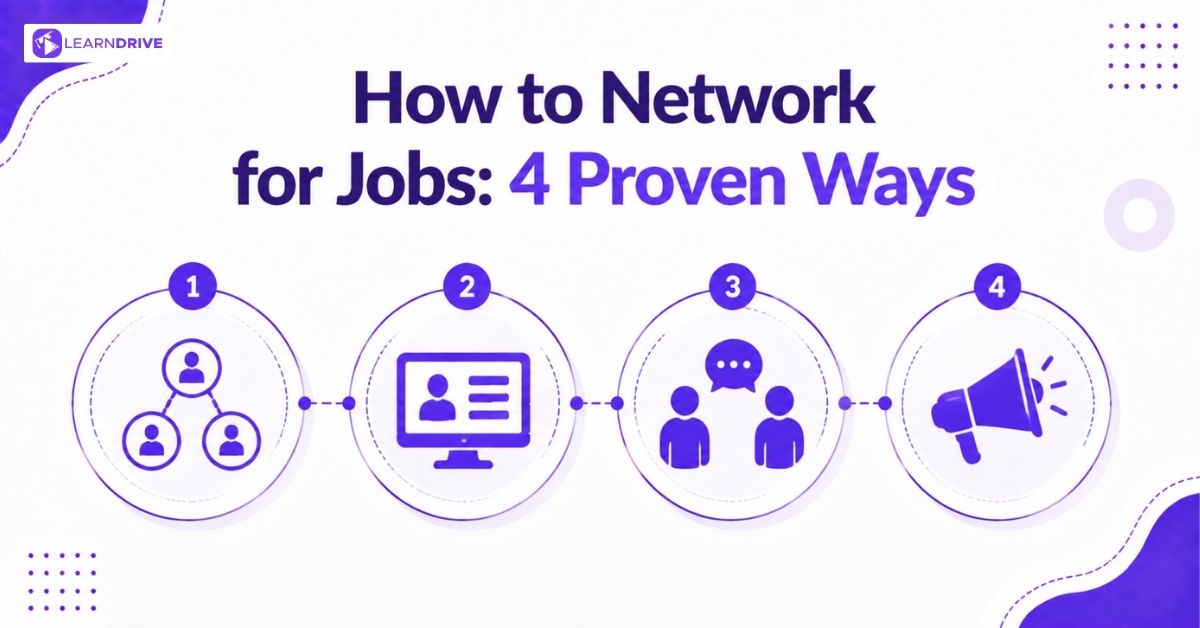
Now, we will see some powerful ways to help you easily network for jobs.
1. Start With the People You Already Know
Before reaching out to strangers, take stock of who is already in your corner. This is the fastest, lowest-friction way to start networking, because there is no cold-start awkwardness.
You already have a relationship, even if you have not spoken in a while. Begin with friends and family.
Even if none of them work in your target field, they know people who do. A casual mention at a family dinner that you are exploring a new career direction has, for many job seekers, led to an unexpected introduction.
Former colleagues and managers are another rich source, often underused because people feel awkward reaching out once they have left a company. Most people are happy to hear from someone they used to work with, especially if the message is warm rather than purely transactional.
A simple “How have things been since we last worked together?” followed by a mention of your current search reopens the door naturally. University alumni networks are worth taking seriously too.
This is particularly true in the UK, where many universities run dedicated alumni platforms, mentoring schemes, and LinkedIn groups for graduates. Alumni tend to be unusually willing to help fellow graduates, partly out of shared identity and partly because many remember exactly what job hunting felt like.
Do not overlook former professors, tutors, or mentors either. They often have wide networks built up over years, and a former student reaching out with a specific, respectful request is something most academics are glad to help with.
Map out this list properly: write down twenty to thirty names across these categories before you contact a single stranger. You will likely be surprised how much of your target network already exists.
2. Join Groups Where the Right People Already Hang Out
Individual outreach is powerful, but it is slow. Joining groups where your target industry already gathers multiplies your opportunities to meet people, because you show up in a room, physical or digital, already filtered to relevant people.
Professional associations and trade bodies exist for almost every field, from marketing and engineering to law, healthcare, and finance. Many UK-based associations offer student or early-career membership rates, run regular events, and provide access to members-only job boards that never appear on general job sites.
Joining one signals genuine commitment to the field, which recruiters and fellow members both notice. Online communities have become just as valuable as in-person associations, sometimes more so.
Industry-specific Slack groups, Discord servers, and LinkedIn Groups let you observe conversations, ask questions, and gradually become a recognisable, helpful presence, all without leaving your desk. Because these spaces are smaller and more focused than a general platform, the connections made there tend to be more genuine and durable.
The key is choosing focus over breadth. A large, generic “jobs in the UK” group with fifty thousand members will drown you out.
A smaller, niche community of two hundred people who all work in, say, sustainable fashion or public sector data analysis will let you actually be seen and remembered. Depth beats scale almost every time in networking.
Once you join a group, resist the urge to lurk silently or to post “looking for work, please help” on your first day. Spend a little time reading the community’s norms, then start contributing genuinely before making any kind of ask.
3. Making Events and Career Fairs Actually Worth Your Time
In-person events, from industry conferences to university career fairs, still matter, and for many people they remain the most intimidating part of networking. A little preparation turns them from a source of dread into something genuinely productive.
Research before you go. If you know which companies or speakers will be there, look up two or three you are most interested in, and prepare a specific question or comment for each.
This alone removes most of the panic of standing in front of someone with nothing to say. Set a small, achievable goal rather than an overwhelming one.
“Meet everyone in the room” is a recipe for exhaustion and shallow contact. “Have two genuinely good conversations” is realistic, and two solid connections will outperform twenty rushed handshakes almost every time.
Conversation starters do not need to be clever. Simple, open questions work well: “What brought you to this event?” or “How did you end up in this field?”
These questions are easy for the other person to answer and naturally lead into a real conversation rather than a stilted exchange. Afterwards, do not let the connection evaporate.
Within a day or two, send a short message referencing what you spoke about, so the person actually remembers who you are. Business cards and LinkedIn connections made at events that are never followed up on are, functionally, wasted effort. The follow-up is where the real value gets locked in.
4. Meet People Without “Networking” — Volunteer or Work on Projects
Not every useful connection needs to come from a deliberate networking activity. Some of the strongest professional relationships form sideways, while you are doing something else entirely: volunteering, freelancing, or working on a side project.
Volunteering with an organisation connected to your industry lets you demonstrate real skills and work ethic to people who might later vouch for you, without the pressure of an interview setting. A marketing hopeful who volunteers to run social media for a local charity is also meeting board members, trustees, and other volunteers with professional networks of their own.
Freelance or contract work, even small or unpaid pieces at the start, gives you a foot in the door and a track record you can point to. It also naturally introduces you to clients, collaborators, and industry peers who can become future references or connectors, as a by-product of doing genuinely useful work.
Side projects, whether contributing to an open-source tool, running a niche blog, organising a small meet-up, or building something in your spare time, attract attention from people with similar interests. These interactions tend to feel far less forced, because the relationship starts from shared enthusiasm rather than a job search agenda.
The advantage of this approach is that it removes the awkwardness some people feel about “networking” as an activity. You are simply doing good work, being visible while you do it, and letting relationships form naturally around that.
For many people, especially those who find direct self-promotion uncomfortable, this indirect route ends up being their most effective one.
Why Most Jobs Never Get Posted Online
Career advisers often talk about the “hidden job market,” referring to roles that are filled without ever being advertised publicly. Estimates vary by source and industry, but a large body of research puts the share of jobs filled this way somewhere between 60% and 85%.
Even the more conservative end of that range means a majority of opportunities simply never appear on a job board at all. There are practical reasons companies work this way.
Posting a role publicly, sorting through hundreds of applications, and running a formal process takes weeks and real money. Hiring through a referral or an existing relationship is faster, cheaper, and lower risk, because someone the employer already trusts is vouching for the candidate.
Many roles are filled through internal promotion, employee referral schemes, or a hiring manager simply remembering someone they met at an event, well before a job description is ever written. This has a direct, practical implication for how you search.
If you rely purely on job boards, you are competing for a slice of the market that is smaller, more crowded, and structurally harder to win, since everyone else is applying through the exact same channel. Meanwhile, a much larger set of opportunities is effectively invisible to anyone not already in the loop through some kind of relationship.
This does not mean job boards are worthless. They remain a legitimate and necessary part of a balanced search, particularly for roles that genuinely are posted publicly and for companies with formal, standardised hiring processes.
But treating them as your entire strategy leaves the larger part of the market completely untouched. The practical takeaway is straightforward: keep applying to posted roles, but treat networking as equally important, not as an optional extra.
Every conversation you have, every relationship you maintain, is a small chance to be remembered exactly when a role opens up that was never going to be advertised in the first place.
Why Casual Contacts Help More Than Close Friends
Here is a finding that surprises most people the first time they hear it: research going back to the 1970s consistently shows that job seekers are more likely to find work through casual acquaintances than through close friends and family.
The sociologist Mark Granovetter first documented this in a landmark study, describing it as “the strength of weak ties.” His explanation is intuitive once you see it laid out.
Your close friends and family tend to move in the same social and professional circles you do. They talk to the same people, hear about the same opportunities, and generally already know most of what you know, so they rarely have genuinely new information to offer.
Casual acquaintances, on the other hand, sit at the edge of different social circles entirely. A former colleague from a job three roles ago, or a distant contact you barely speak to, is far more likely to be plugged into a completely different set of people, companies, and openings.
The practical implication is not to ignore your close relationships, which remain valuable for support, encouragement, and introductions. It is to also make a deliberate effort to reach out to the people on the periphery of your network.
Think of the old coworker you have not spoken to in two years, or the LinkedIn connection you made once at a workshop. A useful habit is to periodically scroll through your LinkedIn connections specifically looking for these dormant, weaker relationships, rather than only messaging people you already speak to regularly.
It can feel a little unnatural at first to reconnect with someone you barely know. But this research suggests that discomfort is exactly where a lot of the genuinely useful, non-redundant opportunities are hiding.
Networking Tips for People Who Hate Networking
If the thought of a room full of strangers and forced small talk fills you with dread, you are far from alone. A large share of the working population identifies as introverted, and traditional networking advice is often written by and for extroverts, which leaves a lot of people feeling like networking simply is not for them.
It is, it just does not have to look the way you have been told it should. Play to your actual strengths.
Introverts often excel at written communication, focused one-on-one conversations, and genuine listening, three things that matter enormously in networking and are frequently more valuable than the ability to work a crowded room. Lean into these rather than forcing an extroverted style that will feel exhausting and inauthentic.
Prefer smaller, quieter formats over large ones. A one-on-one coffee or a fifteen-minute video call will almost always feel more manageable, and often be more productive, than a large networking mixer.
If you do attend a bigger event, give yourself permission to have two or three meaningful conversations rather than trying to “work the whole room.” Use written and asynchronous channels to your advantage.
A thoughtful LinkedIn message, a well-crafted email, or a considered comment on someone’s post lets you say exactly what you mean, without the pressure of thinking on your feet. Many introverts find they come across as far more articulate and confident in writing than in a live, unscripted conversation.
Manage your energy deliberately. Networking, even the enjoyable kind, can be genuinely draining for introverts, and pretending otherwise leads to burnout.
Build in recovery time after a big event or a string of calls. Quality consistently beats quantity: a handful of genuine, well-maintained relationships will do more for your job search than a hundred shallow contacts you never spoke to again.
Keep the Relationship Going (and Avoid the Mistakes That Kill It)
Networking does not end the moment a conversation ends. In fact, most of its value is created afterwards, in the follow-up, and most networking failures happen because people skip this part entirely.
Build a simple habit of staying in touch, even when you do not need anything. A short message every couple of months, congratulating someone on a work anniversary or asking how a project turned out, keeps a relationship alive without it feeling like you only appear when you want something.
This is the single biggest difference between a contact who genuinely wants to help you and one who has quietly forgotten you exist. Always say thank you, and be specific about it.
After an informational interview, an introduction, or any piece of advice, a short, genuine thank-you message goes a long way. People remember gratitude, and they remember its absence even more clearly.
Common Networking Mistakes to Watch For
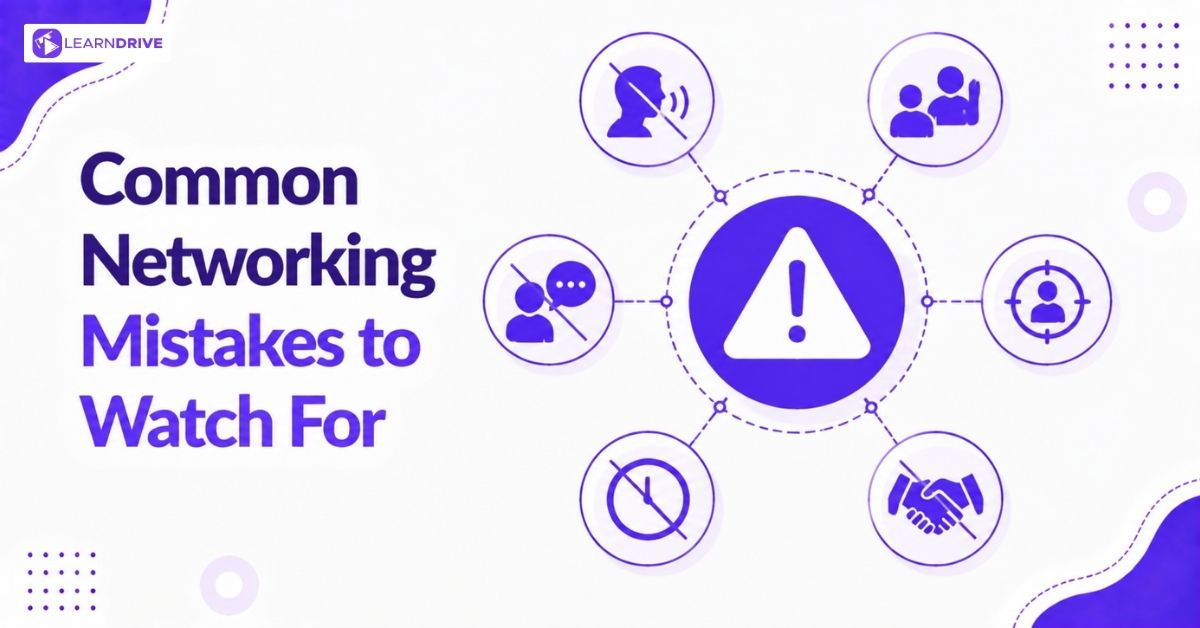
Here are some common networking mistakes
Vague asks: “Let me know if you hear of anything” gives people nothing to act on. Be specific about the roles, companies, or introductions you are actually hoping for.
One-and-done contact: Reaching out once, getting a reply, and then disappearing. Relationships need occasional upkeep, not a single transaction.
Chasing recruiters obsessively: Repeatedly following up with recruitment agents who barely know you rarely produces results. Your existing network is usually a better use of that time.
Only reaching out when you need something: If the only messages someone gets from you arrive during a job search, the relationship reads as transactional, and people notice.
Forgetting to close the loop: When you land a role, tell the people who helped along the way. It is a small courtesy that leaves the door open for years to come.