15 Purple Collar Jobs That Pay Well in the UK
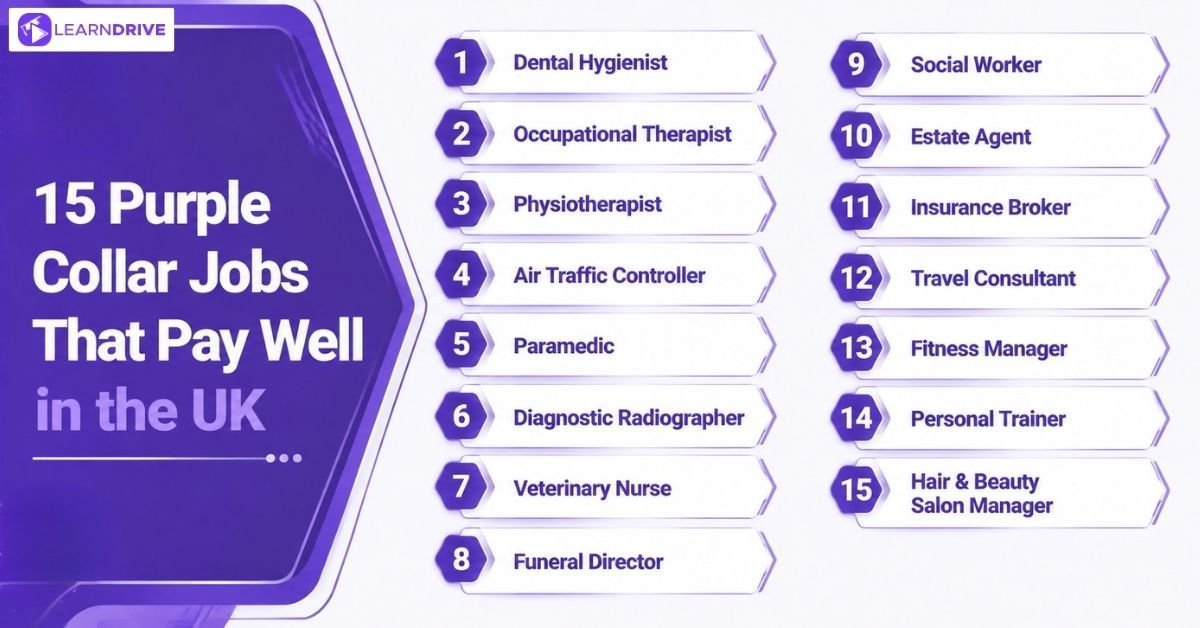
Salary in this category depends heavily on experience, location, qualifications, employer, and specialisation.
Roles requiring HCPC or professional body registration tend to sit within structured NHS pay bands, while service-based careers often reward performance directly.
1. Dental Hygienist
Preventing gum disease and tooth decay takes more than a quick clean. Dental hygienists carry out treatments that protect patients’ oral health long before problems require a dentist.
GDC registration is mandatory before anyone can practise. Private practice work tends to offer stronger earning potential than NHS-only roles once experience builds up.
Salary: £30,279 to £44,962 on the NHS Agenda for Change scale (NHS Pay Band, 2026/27)
Entry Requirements:
Approved dental hygiene qualification
GDC registration
Strong attention to detail
2. Occupational Therapist
Regaining independence after illness or injury rarely happens by accident. Occupational therapists assess what someone needs to manage daily life again, then build a plan around it.
Work spans hospitals, homes, and community settings. HCPC registration is required, and many therapists specialise in areas like mental health or paediatrics as their career develops.
Salary: £32,000 to £48,000 (National Careers Service)
Entry Requirements:
Approved occupational therapy degree or apprenticeship
HCPC registration
Strong communication skills
3. Physiotherapist
Movement problems caused by injury, illness, or age all fall under this role. Physiotherapists use hands-on treatment and exercise to help patients recover strength and mobility.
NHS pay follows Agenda for Change bands, though private and sports-based roles can pay considerably more. Specialising in areas like sports injury tends to increase earning potential.
Salary: £32,000 to £48,000 (National Careers Service)
Entry Requirements:
Approved physiotherapy degree or apprenticeship
HCPC registration
Physical stamina
4. Air Traffic Controller
Few jobs carry the weight of split-second decisions quite like this one. Air traffic controllers guide aircraft safely through takeoff, landing, and airspace, often under intense pressure.
Training is rigorous and highly selective. Security and medical checks are mandatory, but the pay reflects both the responsibility and the scarcity of qualified controllers.
Salary: average £51,943 on Indeed UK,
Entry Requirements:
Specialist training or Level 5 apprenticeship
Security clearance and medical checks
Sharp concentration under pressure
5. Paramedic
Emergency medical care often begins long before a patient reaches hospital. Paramedics make critical decisions on scene, sometimes with only minutes to act.
Shift work is standard, and the emotional demands can be significant. Specialist paramedic roles, such as critical care, offer clear routes to higher pay.
Salary: £32,000 to £48,000 (National Careers Service)
Entry Requirements:
Approved paramedic science degree or degree apprenticeship
HCPC registration
Calm decision-making under pressure
6. Diagnostic Radiographer
Imaging technology only helps patients if someone can operate it and read the results accurately. Diagnostic radiographers use x-ray, MRI, and ultrasound equipment to support diagnosis across the NHS.
The role blends technical skill with direct patient contact. Specialising in areas like CT or MRI imaging can lead to senior clinical positions.
Salary: £31,000 to £47,000 (National Careers Service)
Entry Requirements:
Approved radiography qualification
HCPC registration
Comfort working with technical equipment
7. Veterinary Nurse
Animals cannot explain what hurts, which makes this job as much about observation as treatment. Veterinary nurses support vets with everything from surgery preparation to aftercare.
RCVS registration is required to practise. Specialist areas like emergency care or referral practice tend to offer stronger pay than general small-animal clinics.
Salary: average £30,989 on Indeed UK
Entry Requirements:
Veterinary nursing qualification
RCVS registration
Calm, practical animal handling skills
8. Funeral Director
Supporting a family through loss requires equal parts organisation and empathy. Funeral directors coordinate every detail of a funeral while offering reassurance during one of the hardest periods someone can face.
Hours can be unpredictable, since death does not follow a schedule. Experience and reputation matter enormously in this trade, often more than formal qualifications alone.
Salary: average £25,733 on Indeed UK
Entry Requirements:
Funeral services training or apprenticeship
Relevant hands-on experience
Strong emotional resilience
9. Social Worker
Protecting vulnerable people, whether children or adults, sits at the heart of this profession. Social workers assess risk, coordinate support, and make decisions that genuinely change lives.
The emotional weight of this role is significant. Registration with Social Work England is mandatory, and specialising in areas like child protection can increase both pay and pressure.
Salary: average £41,591 on Indeed UK
Entry Requirements:
Approved social work degree or apprenticeship
Social Work England registration
Strong judgement under difficult circumstances
10. Estate Agent
Buying or selling a home is one of the biggest transactions most people make. Estate agents guide clients through that process, from valuation to closing the sale.
Commission structures mean strong performers can significantly outearn their base salary. Local market knowledge and negotiation skill matter more here than formal qualifications.
Salary: £23,000 to £40,000, with senior and commission-based agents earning considerably more, according to Indeed UK career advice
Entry Requirements:
Sales or customer service experience
Industry training or property-related qualification
Strong negotiation skills
5 Skills Can Increase Your Earning Potential
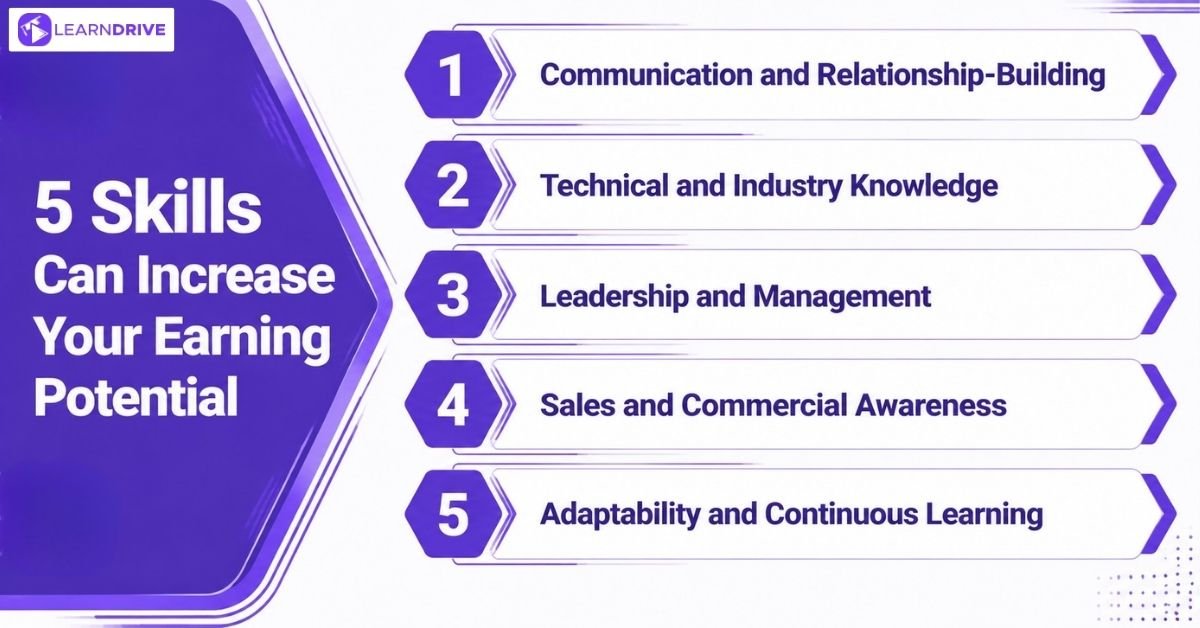
Qualifications get you into a purple collar career. What pushes pay upward afterward is a specific set of skills that most job descriptions never spell out clearly.
Five stand out: communication, technical knowledge, leadership, commercial awareness, and adaptability, many of which line up with the broader skills employers want in the future.
1. Communication and Relationship-Building
Nearly every purple collar role depends on trust built through Communication. A physiotherapist who explains a recovery plan clearly gets better patient buy-in than one who doesn’t.
This skill compounds over a career. Estate agents, insurance brokers, and social workers all rely on relationship-building to retain clients, referrals, and long-term trust, which directly affects earning potential.
2. Technical and Industry Knowledge
Depth matters more than breadth in most of these careers. A radiographer who understands the latest imaging technology stays more valuable than one working from outdated methods.
Staying current requires ongoing effort. Professional bodies often require continued learning to maintain registration, which keeps skills sharp but also demands real time investment.
3. Leadership and Management
Many purple collar careers open into management with enough experience. A salon manager or fitness manager who can lead a team well typically earns considerably more than a frontline colleague.
This shift changes the job significantly. Leadership means balancing people management with the technical skills that got someone into the role in the first place, something covered in our leadership and management course.
4. Sales and Commercial Awareness
Some purple collar careers reward commercial thinking directly. Estate agents and insurance brokers, in particular, see pay rise sharply when they understand how to close deals and retain clients.
This awareness matters even in less obviously sales-driven roles. Understanding budgets, targets, and business priorities helps professionals in healthcare and social care settings too, a skill covered in more depth through negotiation skills training.
5. Adaptability and Continuous Learning
Purple collar careers rarely stay static for long. New regulations, new technology, and shifting client expectations all require professionals to keep learning throughout their careers.
People who adapt quickly tend to progress faster. Those who resist change, even in skilled roles, often find their earning potential plateaus earlier than it should. Anyone weighing a move into one of these careers can find the practical steps laid out in this guide to changing careers
Can You Enter a Purple Collar Career Without University?
The honest answer is: it depends entirely on which career you’re aiming for. Some purple collar roles absolutely require a university degree, no way around it.
Others open up through vocational training instead, no degree needed. And a handful reward hands-on experience over any formal qualification at all. Which route applies to you comes down to which of these three paths your chosen career sits on.
1. Careers With Formal Professional Qualifications
Healthcare roles in this category almost always require university-level training. Physiotherapists, radiographers, and occupational therapists all need an approved degree before they can register with the HCPC.
There is no shortcut around this route. Regulatory bodies exist to protect patients, so formal qualifications remain non-negotiable in these professions.
2. Careers With Vocational or Industry Training
Other purple collar roles offer a more direct path in. Personal trainers, veterinary nurses, and hair and beauty managers can all qualify through vocational courses rather than a university degree.
Training still takes real commitment. Veterinary nursing, in particular, involves rigorous coursework and practical assessment before RCVS registration is possible.
3. Careers Where Experience Can Open Doors
A handful of purple collar careers value proven ability over paper qualifications. Estate agents, travel consultants, and funeral service workers often build their careers through hands-on experience and industry training.
This route suits people who learn best on the job. Reputation and results tend to matter more here than any certificate on a wall.
What Makes Purple Collar Work Different From Other Career Paths?

Purple collar work borrows something from nearly every other category, without fully belonging to any of them. Three comparisons make this clearest: how it differs from blue collar trades, from white collar office roles, and from gray collar work that blends technical and professional skills.
It sits alongside the wider spread of different types of collar jobs that shape how UK careers get categorised today.
1. Purple Collar vs Blue Collar
Blue collar work centres on practical, hands-on skill, often working with tools, machinery, or physical materials.
Purple collar careers can involve hands-on work too, but the focus shifts toward people rather than objects, much like the overlap seen in blue collar jobs for white collar workers making a similar career switch.
A veterinary nurse and an electrician both work with their hands daily. The difference lies in what they’re responding to. One reacts to a patient’s condition in real time, the other follows a technical specification.
2. Purple Collar vs White Collar
White collar work is traditionally office-based, professional, and often removed from direct public contact. Purple collar careers share the professional training but rarely offer that same distance from people, unlike the divide typically drawn between white collar and pink collar jobs.
A social worker and a solicitor might both hold formal qualifications and professional registration. But the social worker spends far more time face to face with the people their decisions affect.
3. Purple Collar vs Gray Collar
Gray collar roles typically blend technical skill with professional responsibility, often in supervisory or specialist positions. Purple collar work overlaps here more than anywhere else.
The distinction gets genuinely blurry. A diagnostic radiographer, for example, could reasonably sit in either category, since the role combines technical operation with direct patient responsibility.

The Advantages and Difficulties of Purple Collar Careers
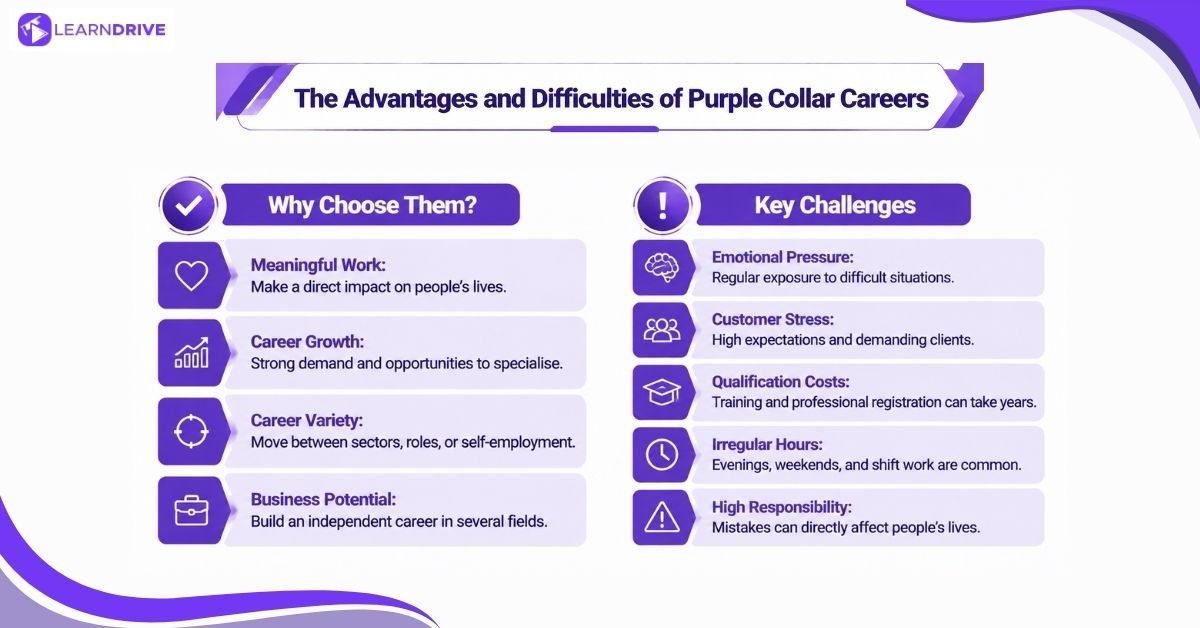
Purple collar work rewards people in ways that go beyond a payslip, but it also asks a lot in return. Understanding both sides helps set realistic expectations before committing to one of these careers.
Why These Careers Can Be Rewarding
Direct impact is hard to overstate here. Helping a patient walk again, finding a family their new home, or supporting someone through grief carries a weight that many desk-based jobs simply don’t offer.
Career variety runs through this category too. A physiotherapist can move between the NHS, private practice, and professional sport, while a personal trainer can build an entirely self-employed business around their own schedule.
Certain sectors show genuinely strong demand. Healthcare roles in particular face persistent shortages, which strengthens job security and gives skilled professionals real choice over where they work.
Specialisation opens further doors. A radiographer who focuses on MRI, or a social worker who specialises in child protection, often finds both pay and career options improve with that focus.
Self-employment is realistic in several of these roles. Personal trainers, estate agents, and salon managers can all build independent businesses once they’ve built enough experience and reputation.
The Real Difficulties of Purple Collar Work
Emotional demands run deep in many of these careers. Social workers, paramedics, and funeral directors face situations that would genuinely wear most people down over time, day after day, with little space to switch off.
Customer-facing pressure adds another layer of strain. Estate agents and travel consultants regularly deal with high-stakes decisions and frustrated clients, which takes a real toll even when the job looks straightforward from the outside.
Qualification requirements create a serious barrier for many people. Healthcare roles demand years of study and ongoing professional registration, and that commitment has to happen before any salary appears at all.
Working hours are rarely predictable or convenient. Paramedics, funeral directors, and fitness managers often work evenings, weekends, and irregular shifts that clash directly with normal family or social life.
Responsibility for other people is heavier here than in most careers. A mistake affects a patient, a client, or a vulnerable adult, not just a spreadsheet, and that weight does not lift once the shift ends.