White collar and pink collar are labels used to describe different types of work, based on the setting, the tasks involved, and, historically, who tended to do them. One points to office and professional roles. The other points to jobs built around care, service, and support.
Picture two people finishing work at 5pm. One has spent the day behind a desk, managing spreadsheets and emails. The other has spent it on her feet, comforting patients or teaching a classroom of nine year olds. Both are skilled professionals. Yet only one has traditionally worn the “white collar” label.
These terms started as a simple way to sort jobs by dress code and daily routine. Over time, they picked up assumptions about pay, status, and even gender. The pink collar label first appeared in the late 1970s. It described roles like secretarial, clerical, teaching, and nursing jobs.
These roles were seen as extensions of traditional domestic responsibilities. They were also marked by lower pay and limited career advancement.
That history still shapes how people talk about careers today.It sits alongside other job labels too, including how manual roles connect with white collar careers, which follows a similar logic.
But none of these boundaries are as fixed as they once were. Indeed points out that the old lines separating job types have changed a great deal since these labels first appeared.
So what actually separates a white collar career from a pink collar one, and does it still matter which label a job carries? This guide breaks down what each term means, how they compare on pay, skills, and progression, and whether these categories still hold up in today’s job market.
Table of Contents
What Are White Collar Jobs?
Think of the classic image of someone heading into an office, laptop bag over one shoulder, coffee in hand. That’s the shorthand version of white collar work, though the reality covers far more ground than a single stereotype.
Typical Features of White Collar Work
Most white collar roles share a few common traits, even across very different industries.
These jobs usually involve:
Desk based or office based tasks
Higher education or professional qualifications
A salaried structure rather than an hourly wage
Limited physical labour
Regular use of computers, reports, and communication tools
Pay tends to reflect these factors too. Salaried roles often come with structured progression paths, from junior positions through to management.
Common White Collar Industries
Finance, law, technology, and consultancy are among the sectors most closely tied to white collar work.
According to ONS labour market analysis, industries such as information and communication, professional and scientific services, financial and insurance activities, and real estate provide far more office based and flexible working arrangements than sectors built around physical work.
That flexibility is one reason these industries attract so many people early in their careers. Remote and hybrid working has become common in these fields, something that’s much harder to offer in physically demanding roles.
Examples of White Collar Jobs
Some roles fit the white collar label more clearly than others. Common examples include:
Accountant
Solicitor
Software engineer
Marketing manager
Financial analyst
HR manager
Civil engineer
Each of these careers involves specialist knowledge, formal qualifications, and a working environment built around information rather than manual output.
As of 2018, ONS data showed that 21% of UK workers were in professional occupations, the highest share of any job category that year. That gives a sense of just how large this segment of the workforce really is.
Courses
What Are Pink Collar Jobs?
Nursing a patient back to health, calming a classroom of restless six year olds, keeping a busy office running smoothly. Pink collar work covers all of this, and it rarely gets the recognition it deserves.
How the Pink Collar Term Started
The phrase has roots that stretch back further than most people expect. Writer Louise Kapp Howe popularised the term in her 1977 book on women’s work. She used it to describe jobs held mostly by women. These included secretarial, clerical, teaching, and nursing roles.
At the time, these positions were viewed as an extension of domestic duties. Pay was lower. Career progression was limited. Status, compared to white collar roles, was often minimal.
World War Two played a part in shaping this pattern too. As men left for war, women stepped into new roles. They became nurses, secretaries, midwives, and telephone operators.
Around five million women entered the workforce between 1940 and 1945. That shift gave many women financial independence for the first time. Even so, the jobs themselves stayed undervalued.
What Pink Collar Work Look Like Today?
The term has broadened well beyond its original meaning. It now covers a wide range of care, service, and support based roles, regardless of who holds them.
Modern pink collar work often includes:
Emotional labour and interpersonal skill
Direct contact with the public or vulnerable people
Shift patterns rather than fixed office hours
Hands on, people focused daily tasks
These jobs remain essential to how society functions. Healthcare, education, and social care would not run without them.
Examples of Pink Collar Jobs
Some careers sit firmly within the pink collar category. Common examples include:
Nurse
Primary school teacher
Teaching assistant
Receptionist
Childcare worker
Social worker
Beauty therapist
Roles like teaching assistant work show how varied this category can be. Some pink collar jobs need formal qualifications, while others rely more on hands on experience and people skills.
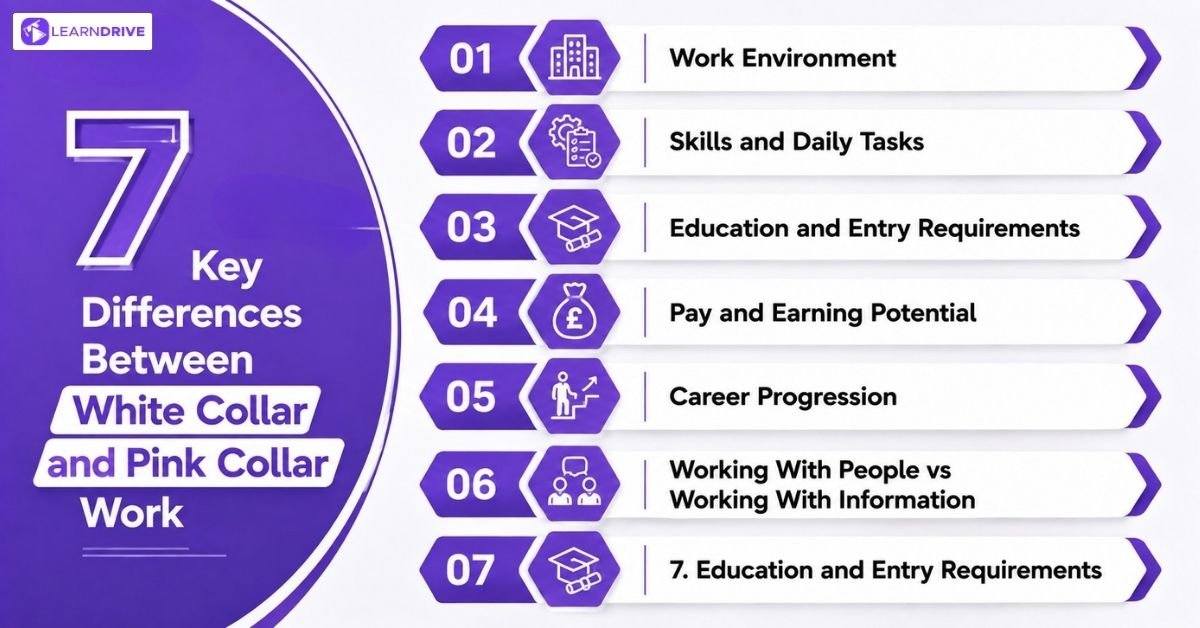
7 Key Differences Between White Collar and Pink Collar Work
Numbers rarely tell the full story, but they help. Here’s a quick side by side look before we break each difference down.
Factor | White Collar | Pink Collar |
Setting | Office based | Care, service or public facing |
Typical hours | Fixed, often 9 to 5 | Shift based, evenings and weekends common |
Entry route | Degree or professional qualification | Vocational training or on the job learning |
Core skill | Analysis and information handling | People skills and emotional labour |
Pay structure | Salaried | Often hourly or salaried, varies widely |
1. Work Environment
Desks, meeting rooms, and screens define most white collar days. Pink collar work looks very different. It often takes place in hospitals, schools, salons, or client facing spaces.
Physical presence matters more in pink collar roles. A nurse cannot work from home. A teacher needs a classroom. That single fact shapes almost everything else about the job.
2. Skills and Daily Tasks
White collar roles lean on data, reports, and strategic thinking. Tasks tend to happen at a desk, often alone or in small meetings.
Pink collar work asks for something different. Patience, empathy, and constant human interaction sit at the centre of the job. A single shift might involve dozens of face to face conversations, each one needing a different tone.
3. Education and Entry Requirements
A degree often opens the door to white collar careers. Fields like law, finance, and engineering usually expect one.
Entry into pink collar roles varies more widely. Some, like nursing, need a specific qualification. Others, like childcare or retail support, rely more on training and hands-on experience.
4. Pay and Earning Potential
Average salaries tend to sit higher in white collar careers, though this isn’t a fixed rule. Senior nurses, experienced teachers, and specialist care workers can out earn junior office staff.
Job title matters more than the collar label. A newly qualified accountant may earn less than an experienced NHS nurse. We’ll break this down properly in the pay section further down.
5. Career Progression
White collar careers often follow a clear ladder. Junior, then senior, then management, each step usually well defined.
Pink collar progression can look less linear. A teaching assistant might become a qualified teacher. A care worker might move into nursing or management. The path exists, but it often needs extra study along the way.
6. Working With People vs Working With Information
This is perhaps the clearest divide between the two. White collar work centres on processing information, whether that’s numbers, contracts, or code.
Pink collar work centres on people. Every task involves direct contact with someone who needs help, care, or guidance. Neither approach is easier. They simply ask for different strengths.
7. Education and Entry Requirements
A degree often opens the door to white collar careers. Fields like law, finance, and engineering usually expect one.
Entry into pink collar roles varies more widely. Some, like nursing, need a specific qualification. Others rely more on training and hands-on experience, and there are more options here than people expect: a good number of healthcare roles don’t actually require a degree to get started.
Courses
Advantages and Disadvantages of White Collar and Pink Collar Jobs
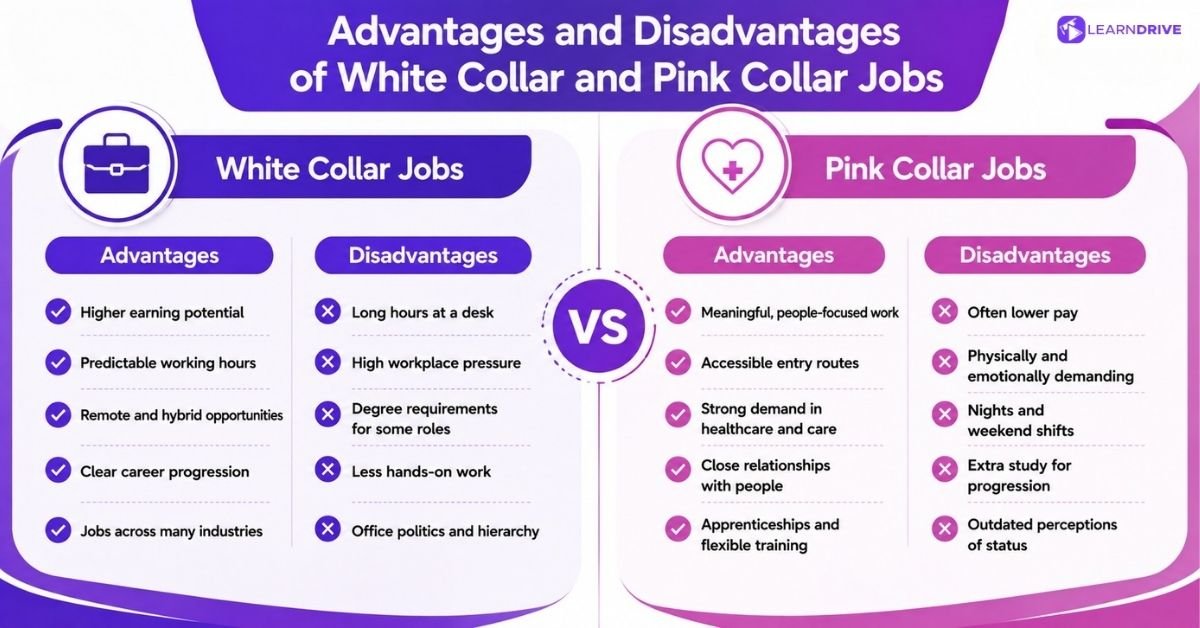
Both white-collar and pink-collar careers offer different benefits and challenges depending on a person’s skills, interests and career goals. Understanding the differences between career categories, such as types of collar jobs, can help people make more informed decisions about their future path.
5 Advantages of White Collar Jobs
White-collar careers offer several benefits that attract people looking for stability, flexibility and long-term growth. These roles can provide stronger earning potential, structured career progression and opportunities across many industries.
The advantages below explain why many people choose office-based careers and what makes them appealing compared with other types of work.
1. Often Higher Starting Salaries
Many white-collar roles offer competitive pay because they often require specialist knowledge, professional qualifications or technical skills.
A higher starting salary can provide greater financial security and help employees build their careers from a stronger financial position.
2. More Predictable Working Hours
Many office jobs follow regular schedules, making it easier for employees to plan personal time, family commitments and daily routines.
A consistent working pattern can support a better work-life balance for people who prefer structure.
3. Greater Access to Remote or Hybrid Work
Many professional roles can be completed using digital tools, allowing employees to work from home or combine remote and office-based work. This flexibility can reduce commuting time and give workers more control over their working environment.
4. Clear Structured Career Ladders
Many organisations provide defined promotion routes, helping employees understand how they can progress and develop new responsibilities.
Clear career pathways can motivate employees by showing what skills and experience are needed to move forward.
5. Wide Range of Industries to Choose From
White-collar skills are needed across industries such as finance, technology, healthcare, education and business services. This variety means professionals can explore different career paths, including gold collar jobs where specialised expertise and advanced skills are highly valued.
ese benefits explain why many graduates and professionals choose white-collar roles. The combination of stability, career growth and flexibility makes them attractive for people who prefer structured professional environments.
5 Disadvantages of White Collar Jobs
Although white-collar careers offer stability, professional growth and flexibility, they also come with certain challenges. Some people may enjoy the structured nature of office-based work, while others may find the pressure, limited movement and formal workplace environment difficult over time.
The following points highlight some common disadvantages of white-collar jobs, including workplace stress, entry barriers and the challenges of traditional office settings.
1. Long Hours Spent Sitting at a Desk
Many white-collar roles involve spending several hours each day working on computers, attending meetings and completing administrative tasks.
This limited physical activity may not suit people who prefer active or hands-on work.
2. High-Pressure Targets in Many Industries
Many professional roles involve strict deadlines, performance goals and business targets. While these challenges can encourage growth, constant pressure may increase stress levels for some employees.
3. Entry Often Requires a Degree, Which Limits Access
Some white-collar careers require university qualifications or professional certifications before people can enter the field. This can make certain roles less accessible for those who prefer practical training or alternative career routes.
4. Can Feel Disconnected From Real-World Impact
Some office workers spend most of their time analysing information, managing systems or preparing reports rather than seeing the direct results of their work. This can feel less rewarding for people who prefer visible outcomes.
5. Office Politics and Rigid Hierarchies
Large organisations often have formal structures, workplace rules and decision-making processes. Some employees may find internal politics, slow approvals or strict hierarchies frustrating.
Some people thrive in white-collar environments, while others prefer careers with more movement, direct interaction and practical results.
5 Advantages of Pink Collar Jobs
Pink-collar careers offer several benefits, especially for people who enjoy working directly with others and making a positive difference. These roles are often found in healthcare, education, social care and customer-focused services.
These benefits highlight why pink-collar careers attract people who value meaningful work, accessible entry routes and reliable job opportunities.
1. Strong Sense of Purpose and Impact
Many pink-collar jobs involve supporting, caring for or improving the lives of others. Workers can often see the direct results of their efforts, whether they are helping patients, supporting learners or assisting vulnerable people.
2. Lower Barriers to Entry in Many Roles
Some pink-collar careers offer entry routes through vocational training, apprenticeships or short professional courses rather than requiring a university degree. This makes these careers more accessible for people who want to start working sooner or change careers.
3. High Demand Across the UK, Especially in Healthcare
Many healthcare, care and support roles continue to experience strong demand across the UK. This can create more employment opportunities and provide greater job security for people entering these fields.
4. Opportunities to Build Close Relationships With the People You Help
Many pink-collar workers interact regularly with patients, students, customers or communities. These relationships can make the work more rewarding for people who enjoy communication, teamwork and helping others.
5. Flexible Entry Routes, Including Apprenticeships and Short Accredited Courses
Many roles allow people to gain skills through practical experience combined with recognised training. This flexibility gives workers different ways to develop their careers without always following a traditional university route.
For people who want work that feels meaningful day to day, this category often delivers exactly that. Someone considering childcare, for example, doesn’t always need a full degree to start. A recognised childcare and nannying course can be enough to build a genuine career path in this space.
5 Disadvantages of Pink Collar Jobs
Although pink-collar careers can be rewarding and meaningful, they also come with challenges that workers should consider. Many of these roles involve high levels of responsibility, direct interaction with people and demanding working conditions.
The following points highlight some common disadvantages, including pay differences, emotional pressure, working hours and career progression challenges.
1. Historically Lower Pay Compared to White Collar Roles
Some pink-collar sectors, particularly care and support roles, have historically received lower wages compared with many professional white-collar careers. This can affect earning potential, even when the work requires significant skills and responsibility.
2. Physically and Emotionally Demanding Shifts
Many roles in healthcare, childcare and social care require workers to support people in challenging situations. Long periods of standing, assisting others and managing emotional situations can make these careers demanding.
3. Unsociable Hours, Including Nights and Weekends
Many essential service roles operate beyond standard working hours. Healthcare and care workers may need to work evenings, weekends or night shifts to provide continuous support.
4. Career Progression Can Require Extra Study
While many pink-collar roles have accessible entry routes, moving into senior positions may require additional qualifications, professional training or further education.
5. Still Affected by Outdated Perceptions Around Status
Some pink-collar careers have historically been undervalued because of outdated views about care and service work. This can affect how these professions are perceived, despite their importance to society.
These challenges do not make pink-collar careers less valuable. They highlight the importance of considering working conditions, career goals and personal interests before choosing a role.
Recognising these downsides isn’t about discouraging anyone. It’s about going in with a clear picture of what the job actually involves.
Are Pink Collar Jobs Still Mainly Women’s Jobs?

Pink-collar jobs have historically been associated with women, especially in sectors such as healthcare, education and care services. However, the modern workplace is changing, and these career labels no longer fully describe who works in these roles today.
This section explores how gender patterns shaped pink-collar careers, why these perceptions are changing, and whether these jobs are still considered mainly for women.
How Gender Patterns Shaped Pink Collar Work
World War Two changed the shape of the UK workforce for good. Roles left behind by men going to war were filled by women. Nursing, teaching, and secretarial work became closely tied to female employment from that point on.
These patterns didn’t disappear once the war ended. Many women stayed in the workforce, and the jobs they held kept their reputation as “women’s work.” That label stuck for decades, shaping hiring, pay, and even career expectations.
Why These Career Labels Are Changing
Gender lines in the workplace have loosened considerably over recent decades. More men now work in nursing, teaching, and childcare than ever before. More women hold senior roles in traditionally white collar fields like law and finance.
Cambridge Dictionary still defines a pink collar job as one that is traditionally done by a woman. That word, traditionally, matters. It points to history, not a rule about who can or should do the work today.
Can Anyone Work in a Pink Collar Career?
Yes, without question. Nothing about nursing, teaching, or childcare limits these roles to one gender. The label describes a pattern from the past, not a barrier for the present.
Employers across the UK increasingly welcome men into care and service roles. Job adverts rarely specify gender, and qualifications matter far more than who has traditionally filled the position.
If you’re thinking about moving into a field like this from a completely different background, a career transition guide is worth reading first. It can help you plan the move properly instead of jumping in blind.
Which Roles Pay More: White Collar vs Pink Collar Jobs?

Salary comparisons between white-collar and pink-collar careers are not always as simple as one category earning more than the other. While some professional white-collar roles offer higher earning potential, many factors influence income, including the specific occupation, experience level, qualifications and industry.
Let’s look at how salaries differ between the two categories, why job titles matter more than labels, and which careers can offer stronger earning opportunities.
Why Job Title Matters More Than the Collar Label
A solicitor and a receptionist both sit under “white collar” and “pink collar” respectively, but comparing them tells you little on its own. The real comparison needs to happen between specific roles, not broad categories.
According to Indeed UK, the average solicitor salary in England sits at £51,581 per year. Compare that with the average nurse salary across the UK, which comes in at £40,171 per year, also according to Indeed. The white collar role pays more here, but the gap narrows once you factor in seniority.
Factors That Affect Salary
Several things shape pay far more than the collar category ever will.
Location, especially London weighting
Years of experience and seniority
Sector, public versus private
Specialism or additional qualifications
Demand for that specific role locally
A newly qualified teacher in England starts on a minimum of £32,916, according to GOV.UK, with typical earnings reaching at least £45,352 after five years. That’s a meaningful jump within a single role, and it shows why broad averages only tell part of the story.
Higher-Paying Careers in Both Groups
Some pink collar careers comfortably out earn entry level white collar jobs. Senior nurses, experienced midwives, and specialist teachers can all earn more than junior accountants or trainee solicitors.
On the white collar side, accountants earn an average of £39,446 per year across the UK, according to Indeed, a figure that sits close to average nurse pay.
Choosing between white collar and pink collar work isn’t really about the label. It’s about matching your strengths to how you like to spend your day.
Pink Collar vs White Collar Jobs: Which Career Type Could Suit You?

Choosing between white-collar and pink-collar careers depends on more than salary or job titles. Different roles suit different personalities, working styles and personal goals.
Some people enjoy analysing problems, working with systems and building professional expertise, while others prefer supporting people, creating relationships and making a direct impact.
The points below explore how your interests, strengths and preferred working environment can help you identify the career path that fits you best.
Analysis and Problem-Solving Appeal to You
Numbers, systems, and logical puzzles give some people real energy. If that sounds like you, white collar careers in finance, law, or engineering tend to fit well. These roles reward structured thinking and attention to detail.
Helping and Supporting Others Feels Rewarding
A different kind of satisfaction comes from helping someone through a difficult moment. Nursing, teaching, and social work all centre on this kind of impact. If work that helps people and communities appeals to you, pink collar careers are worth exploring closely.
Office-Based Structure Suits Your Style
Plenty of people value a predictable routine, and there’s nothing wrong with that. Fixed hours, a desk, and a stable structure suit those who prefer consistency over variety. White collar roles usually offer exactly that.
Daily Human Contact Keeps You Engaged
Constant human interaction, not just occasional meetings, defines many pink collar roles. Every shift brings new conversations, new needs, and new challenges to solve on the spot. This career type asks for that kind of energy daily.
Flexibility Is a Top Priority for You
Flexibility looks different depending on the field. White collar roles often offer remote or hybrid options. Pink collar roles, meanwhile, tend to offer flexible shift patterns and part time hours, which can suit parents or carers particularly well.
Neither path is better than the other. The right fit depends entirely on what kind of work actually energises you, not what a label suggests you should choose.

Do White Collar and Pink Collar Jobs Overlap?
The traditional boundaries between white-collar and pink-collar work are becoming less clear as modern careers continue to evolve. Many roles combine professional knowledge, leadership responsibilities and people-focused skills, making it difficult to place them into only one category.
The examples below show how different careers can include characteristics of both white-collar and pink-collar work.
1. Healthcare Professionals
Doctors and consultants often carry white collar status, given their education and pay. Yet nurses and midwives, working in the same hospitals, have traditionally been labelled pink collar.
Both groups require years of training and carry serious responsibility, despite the different labels attached to their work.
2. Education and Management
Headteachers manage budgets, staff, and strategy, tasks typically associated with white collar leadership. At the same time, classroom teaching itself still carries the pink collar label in many discussions. One person can move between both roles across a single career.
3. Administrative and Professional Roles
Executive assistants and office managers blur the line further. Their work involves scheduling, communication, and support, tasks once labelled pink collar. But the same roles now demand strategic thinking and decision making, qualities usually tied to white collar careers.
Why Do Modern Jobs Not Always Fit One Collar?
Technology has reshaped what most jobs actually involve day to day. A single role can now include desk based analysis, direct client contact, and hands on problem solving. Someone in customer support might handle data reports one hour and a difficult phone call the next.
Remote work has blurred the lines even further. Many pink collar roles, like counselling or virtual teaching, now happen from a laptop at home. That was once seen as a purely white collar arrangement, and it reflects a much broader shift in how the modern workplace actually operates.
Job titles have also multiplied and shifted in ways the old labels never accounted for. Roles like UX researcher, care coordinator, or client success manager didn’t exist when these terms were first used. They combine skills from both categories, and trying to force them into one box misses the point entirely.
These labels started as a simple shorthand decades ago. Employers needed a quick way to describe pay, dress code, and daily duties. That shorthand worked reasonably well for a mid twentieth century workforce.
Today, they describe a spectrum rather than two separate boxes. Most careers now sit somewhere between analysis and interaction, between office routine and hands on contact with people. Understanding that spectrum matters more than memorising which label a job technically carries.
Frequently Asked Questions
White collar jobs are typically office based, salaried, and require higher education, while pink collar jobs centre on care, service, or support work and were traditionally held by women.
Common white collar jobs include accountants, solicitors, software engineers, financial analysts, and marketing managers. These roles usually involve desk based tasks and require formal qualifications.
Common pink collar jobs include nurses, teachers, teaching assistants, receptionists, childcare workers, and social workers. These roles focus on direct contact with people rather than office based tasks.
The term pink collar started in the late 1970s to describe jobs traditionally held by women. It distinguished caregiving and service roles from blue collar manual work and white collar office work.
No, pink collar jobs are open to anyone. The label reflects a historical pattern in who held these roles, not a restriction on who can do the work today.
Yes, white collar jobs generally pay more on average. However, senior pink collar roles, such as experienced nurses or midwives, can out earn junior white collar positions.
Yes, many modern roles overlap both categories. Healthcare managers, senior teachers, and executive assistants often combine office based tasks with people focused, service oriented work.
They remain useful as a rough shorthand, but they no longer capture how varied modern jobs actually are. Most careers now blend elements from more than one category.
Final Thoughts
White collar and pink collar are useful shorthand, but they were never meant to define a person’s worth or potential. Both categories cover essential work that keeps society running.
The real question isn’t which label sounds more impressive. It’s which type of work actually fits your strengths, interests, and the life you want to build.
Pay, flexibility, and progression all vary within each category, not just between them. A senior nurse can out earn a junior accountant. A headteacher can carry as much responsibility as a company director.
So instead of chasing a label, focus on the role itself. Look at the daily tasks, the people you’d work with, and the skills you’d use. That tells you far more than any collar colour ever could.
Read Other blogs:

Best Certifications for High-Paying Jobs in the UK (2026 Guide)

One Education vs LearnDrive: Which One to Choose for Lifetime Subscription?