What Drives High Job Security in the UK?
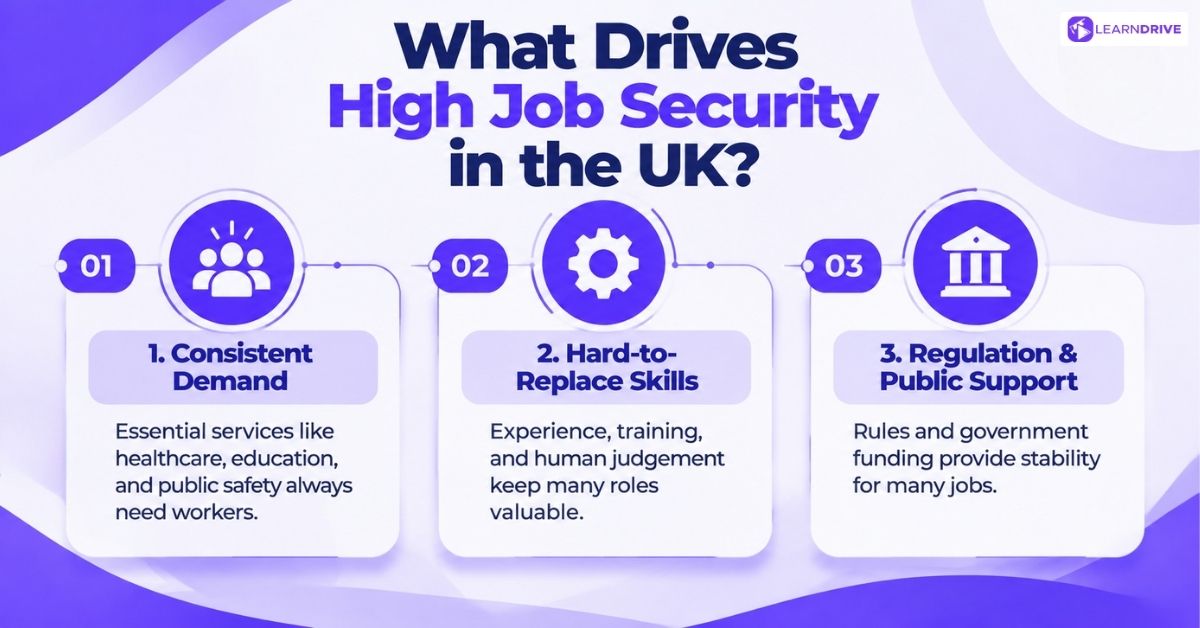
Three forces explain why some jobs barely notice a downturn: constant demand from essential services, skills that take years to build, and rules that keep certain professions tightly regulated.
Consistent Demand From Society
People need healthcare, schooling, electricity and policing whether the economy is growing or shrinking. NHS England had around 25,500 nursing vacancies in its most recent workforce data, according to the House of Commons Library, showing how demand for care keeps outpacing supply.
The same pattern shows up in adult social care, where Skills for Care projects the sector will need 410,000 more posts by 2040 to keep pace with an ageing population.
Essential services do not pause hiring just because other industries are cutting jobs.
Skills That Are Hard to Replace
Some jobs need years of training, professional judgement or hands-on expertise that cannot be automated overnight. A paramedic making split-second decisions, an electrician wiring a new build to safety standards, and an accountant interpreting tax law all rely on skills built through experience.
Employers increasingly value this kind of capability as automation reshapes other parts of the economy. If you are weighing up which skills to build next, it helps to look at which ones employers say they will need in the years ahead.
Regulation and Public-Sector Backing
Many secure roles sit inside regulated industries or public-sector budgets that do not disappear overnight. Nurses, social workers and compliance officers all work under professional bodies that control who can practise.
Police officers and civil servants draw on public funding that tends to be more stable than a single company’s revenue.
Regulation slows down how quickly a role can be automated or outsourced, adding another layer of protection on top of demand.
15 Jobs With High Job Security in the UK
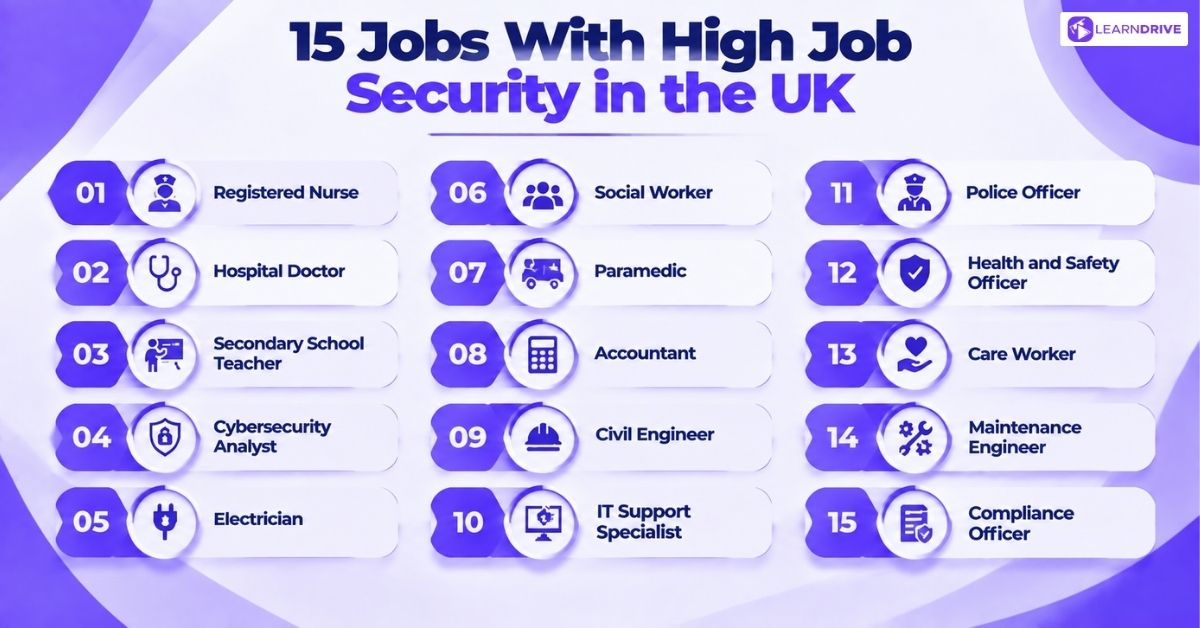
The roles below span healthcare, education, engineering, protective services and compliance.
Each one combines steady demand with skills or regulation that make the job difficult to replace. Salary ranges come from National Careers Service, Indeed UK and Prospects data, running from starting pay through to experienced level.
1. Registered Nurse
Registered nurses assess patients, administer treatment and coordinate care across hospitals, GP surgeries and community settings. Demand has stayed high enough that recruitment struggles to keep pace, even as training places expand.
Newly qualified nurses typically start in NHS Band 5, and pay rises steadily with experience and specialisation. Many nurses move into leadership, education or specialist clinical roles after a few years on a ward.
Salary: £31,000 to £47,000 a year (National Careers Service)
Requirement
1. an approved degree in adult, child, mental health or learning disability nursing
2. registration with the Nursing and Midwifery Council
3. clear communication and good organisational skills
4. resilience for physically and emotionally demanding shifts
2. Hospital Doctor
Hospital doctors diagnose and treat patients across every medical speciality, from emergency medicine to surgery. Training takes years, which keeps the pool of qualified doctors smaller than demand requires.
Pay climbs sharply with seniority, from foundation training through specialist registrar posts to consultant level. Many doctors combine NHS work with teaching, research or private practice later in their career.
Salary: £40,000 to £145,000 a year (National Careers Service)
Requirement
1. a medical degree recognised by the General Medical Council
2. completion of foundation and specialist training
3. registration with the General Medical Council
4. the ability to stay calm under pressure
3. Secondary School Teacher
Secondary school teachers plan lessons, mark work and guide pupils aged 11 to 18 through their exams. Every state school is legally required to keep classrooms staffed, which sustains demand even when recruitment targets are missed.
Pay progresses along a set scale, with faster increases available for those who take on leadership responsibilities. Teachers can move into pastoral roles, subject leadership or school management over time.
Salary: £34,000 to £53,000 a year (National Careers Service)
Requirement
1. a degree, plus qualified teacher status (QTS)
2. a postgraduate certificate in education, if entering via that route
3. solid subject knowledge in your chosen specialism
4. patience and confident classroom management
4. Cybersecurity Analyst
Cybersecurity analysts monitor networks for threats, investigate breaches and strengthen an organisation’s digital defences.
Nearly half of UK businesses admit to a basic technical skills gap in this area, according to the Department for Science, Innovation and Technology.
Analysts can specialise in incident response, penetration testing or governance as their career develops. Many organisations now offer training in cyber security fundamentals to help staff move into the field without a traditional computing degree.
Salary: £27,500 to £87,000 a year (Indeed UK)
Requirement
1. knowledge of networks, operating systems and security tools
2. relevant certifications, such as CompTIA Security+ or similar
3. sharp analytical thinking and attention to detail
4. willingness to keep learning as threats evolve
5. Electrician
Electricians install and maintain the wiring, lighting and power systems that keep homes and businesses running. UK construction needs an average of 41,200 extra workers a year to 2030, and electricians are among the hardest trades to recruit, according to CITB.
Net zero retrofit work, electric vehicle charging points and solar installations are adding to demand on top of routine maintenance. Experienced electricians often move into supervision, estimating or run their own business.
Salary: £26,000 to £45,000 a year (National Careers Service)
Requirement
1. a recognised electrical apprenticeship or qualification
2. knowledge of wiring regulations and safety standards
3. physical stamina for working in varied conditions
4. a methodical approach to fault-finding
6. Social Worker
Social workers assess the needs of vulnerable children and adults, then coordinate support to keep them safe. Local authorities have a statutory duty to provide this service, which means it cannot simply be cut when budgets tighten.
Many social workers specialise in child protection, mental health or adult social care as they gain experience. Progression routes lead towards senior practitioner, team management or policy roles.
Salary: £32,000 to £48,000 a year (National Careers Service)
Requirement
1. a degree in social work approved by Social Work England
2. registration with Social Work England
3. sensitivity and resilience for emotionally demanding cases
4. clear written reporting skills
7. Paramedic
Paramedics respond to 999 calls, assess patients on scene and deliver emergency treatment before hospital handover. Emergency care cannot be delayed, which keeps ambulance services recruiting even during wider public-sector cutbacks.
Experienced paramedics can move into critical care, specialist practitioner or clinical education roles. Some go on to work in urgent treatment centres or as advanced practitioners in GP surgeries.
Salary: £31,000 to £47,000 a year (National Careers Service)
Requirement
1. a paramedic science degree approved by the Health and Care Professions Council
2. a full driving licence, often including a C1 category
3. calm decision-making under pressure
4. physical fitness for demanding shifts
8. Accountant
Accountants prepare financial statements, manage tax returns and advise businesses on their finances. Every company, regardless of size or sector, has a legal obligation to keep accurate accounts, which sustains demand through economic cycles.
Qualified accountants can move into audit, forensic accounting or management, and many eventually become partners or finance directors. Professional qualifications from bodies like ACCA or ICAEW also open routes into wider business administration careers beyond traditional practice.
Salary: £25,000 to £60,000 a year (National Careers Service)
Requirement
1. a degree, though not necessarily in accounting
2. a professional qualification such as ACCA, ICAEW or AIA
3. sharp numerical and analytical skills
4. attention to detail and integrity
9. Civil Engineer
Civil engineers design and oversee the construction of roads, bridges, housing and flood defences. Ongoing investment in infrastructure and net zero projects keeps demand for qualified engineers consistently high.
Chartered status through the Institution of Civil Engineers opens up senior technical and project leadership roles. Many civil engineers move between contracting, consultancy and local authority work over their career.
Salary: £29,000 to £63,000 a year (National Careers Service)
Requirement
1. a degree in civil engineering, accredited by the ICE
2. solid maths and problem-solving skills
3. the ability to manage complex projects
4. willingness to work on-site in varied weather
10. IT Support Specialist
IT support specialists fix hardware and software problems, manage accounts and keep an organisation’s systems running smoothly. Every business now depends on working technology, which makes this a genuine entry point into the wider tech sector.
Support technicians commonly progress into network engineering, systems analysis or IT project management. The role also offers a practical route into cybersecurity or software careers without a computing degree.
Salary: £24,000 to £36,000 a year (National Careers Service)
Requirement
1. GCSEs including English and maths, or equivalent
2. practical knowledge of common operating systems and software
3. good customer service and clear communication
4. patience for troubleshooting under time pressure
11. Police Officer
Police officers respond to incidents, investigate crime and work with communities to prevent offending. Public safety is a statutory duty for every force in England and Wales, which keeps recruitment active even when budgets are squeezed.
New officers typically join through the Police Constable Entry Programme or a degree apprenticeship. Progression through the ranks, from sergeant to inspector and beyond, comes with structured pay increases.
Salary: £30,000 to £48,000 a year (National Careers Service)
Requirement
1. to pass fitness, medical and background checks
2. 2 A levels or equivalent for most entry routes
3. clear communication and sound judgement under pressure
4. resilience for dealing with distressing situations
12. Health and Safety Officer
Health and safety officers assess workplace risks and write policies to prevent accidents and ill health. UK law requires almost every employer to manage health and safety formally, which keeps this role in steady demand across industries.
Officers often start as assistants or advisers before progressing to senior or managerial positions. Professional membership with IOSH supports career progression and can lead to chartered status.
Salary: £23,000 to £48,000 a year (Prospects.ac.uk)
Requirement
1. a relevant degree or NEBOSH qualification
2. knowledge of health and safety legislation
3. good observation and report-writing skills
4. confidence advising senior managers
13. Care Worker
Care workers help people with daily tasks like washing, dressing and taking medication, supporting independence at home or in residential settings. Skills for Care projects the sector will need 410,000 more posts by 2040 to keep pace with the UK’s ageing population.
Many care workers move into senior carer, team leader or registered manager roles with further training. Others progress into healthcare roles that do not require a degree to start.
Salary: £20,000 to £25,000 a year (National Careers Service)
Requirement
1. a caring, patient approach and good communication skills
2. the Care Certificate, usually completed on the job
3. enhanced background checks
4. physical stamina for manual handling tasks
14. Maintenance Engineer
Maintenance engineers keep machinery, plant and building systems running by carrying out planned and reactive repairs. Facilities and manufacturing sites cannot operate with broken equipment, which keeps this role consistently in demand.
Multi-skilled engineers, who cover both mechanical and electrical work, tend to command the highest pay. Many progress into shift leader, reliability engineer or facilities management positions.
Salary: £33,000 to £55,500 a year (Indeed UK)
Requirement
1. an NVQ, apprenticeship or equivalent engineering qualification
2. practical fault-finding and repair skills
3. willingness to work shifts, including on-call cover
4. a methodical approach to preventative maintenance
15. Compliance Officer
Compliance officers make sure a business follows relevant laws, regulations and internal policies. Financial services, healthcare and other regulated sectors all need this function, which keeps demand broad-based across the economy.
Pay varies widely by sector, with financial services compliance roles typically paying more than general industry positions. Officers can progress towards corporate compliance and risk management leadership over time.
Salary: £22,000 to £65,000 a year (Prospects.ac.uk)
Requirement
1. a degree, often in law, business or finance
2. knowledge of relevant regulatory frameworks
3. confident analytical and report-writing skills
4. confidence challenging colleagues on compliance issues
How to Choose a Secure Career Path in the UK

Picking a stable career means looking past headline demand figures and checking four practical things: where demand is heading, what you need to qualify, how pay and progression compare, and which skills are worth building now.
Check Future Demand
Look beyond current vacancy numbers towards where an industry is heading over the next decade.
Ageing population trends point to sustained demand in health and social care, while construction shortages tied to housing targets suggest trades will stay in demand. Checking whether the UK job market currently favours job seekers gives useful context before committing to retraining.
Understand Entry Requirements
Some secure roles need years of study, while others accept apprenticeships, on-the-job training or short courses. Care work, IT support and some trades offer routes in without a degree, which matters if you cannot afford years out of paid work.
A look at well-paid roles that skip the degree requirement can help you compare accessible entry points.
Compare Salary and Progression
A secure job with a low ceiling can still leave you financially stretched. Compare starting pay against realistic progression, not just headline averages, since roles like accounting and compliance have far more room to grow than others.
Ask how long it realistically takes to reach the upper end of a salary range before ruling a career in or out.
Build Relevant Skills
Skills like data analysis, regulatory knowledge and hands-on trade expertise are hard to automate and transfer across several secure sectors. Building these alongside a formal qualification strengthens your position, whatever specific role you eventually choose.
If You’re Switching Careers
Many of the roles above welcome career changers, particularly in care, health and safety, and IT support. A structured career transition plan, including realistic timelines for retraining and a clear look at your transferable skills, makes switching sectors far less daunting.
Employers in shortage occupations are often more open to non-traditional candidates than the job adverts suggest.