
What Is a Phone Interview and Why Do Employers Use Them?
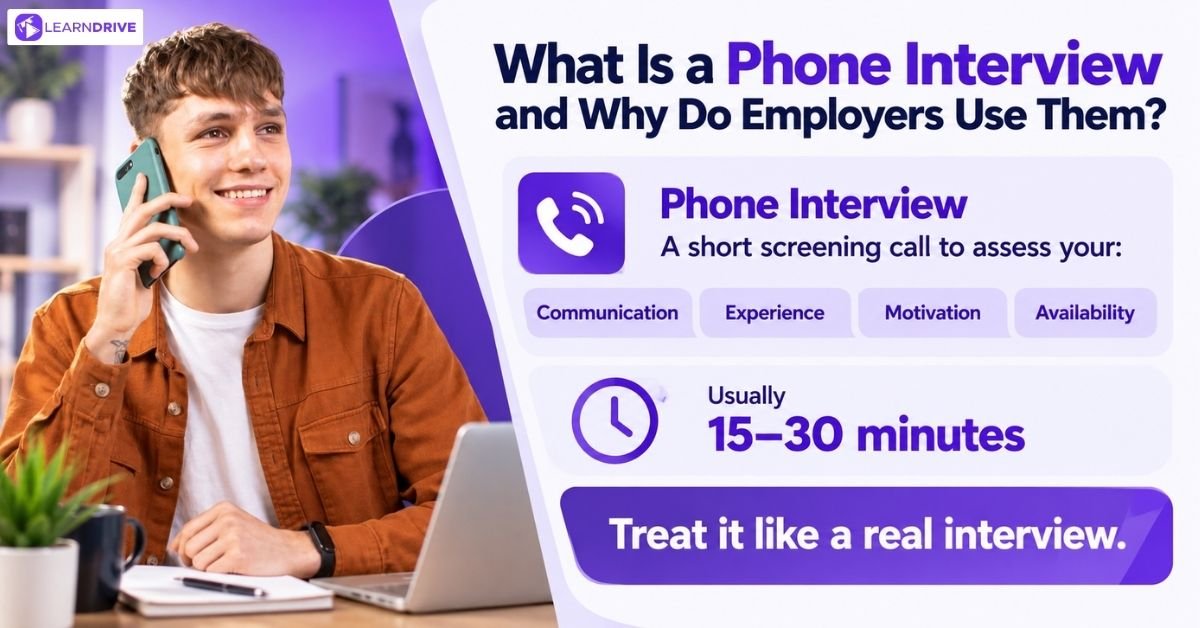
A phone interview is a screening call, usually run before any face to face or video stage, where an employer checks whether a candidate fits the basic requirements of a role.
Companies use this step to narrow down a large pool of applicants without spending time on a full interview for each one. It saves both sides time, since a short call can rule out mismatches early and protect the schedules of hiring managers.
A phone interview differs from a face to face meeting in a few clear ways. There is no body language to read, so everything rests on tone, clarity, and how well you answer.
The questions also tend to stay simple, focused on the basics rather than deep technical detail. Most calls last between 15 and 30 minutes, far shorter than a typical in-person interview.
During this call, recruiters are quietly evaluating four things:
Communication: how clearly and confidently you speak on the phone
Experience: whether your background matches the role’s requirements
Motivation: why you want this specific job, not just any job
Availability: when you could start and whether your schedule fits
Passing this stage usually leads to a longer interview, so treat it as a genuine first hurdle rather than a formality. If you have not brushed up in general recently, this is a good moment to do so before moving further.
How to Prepare for a Phone Interview Before the Call
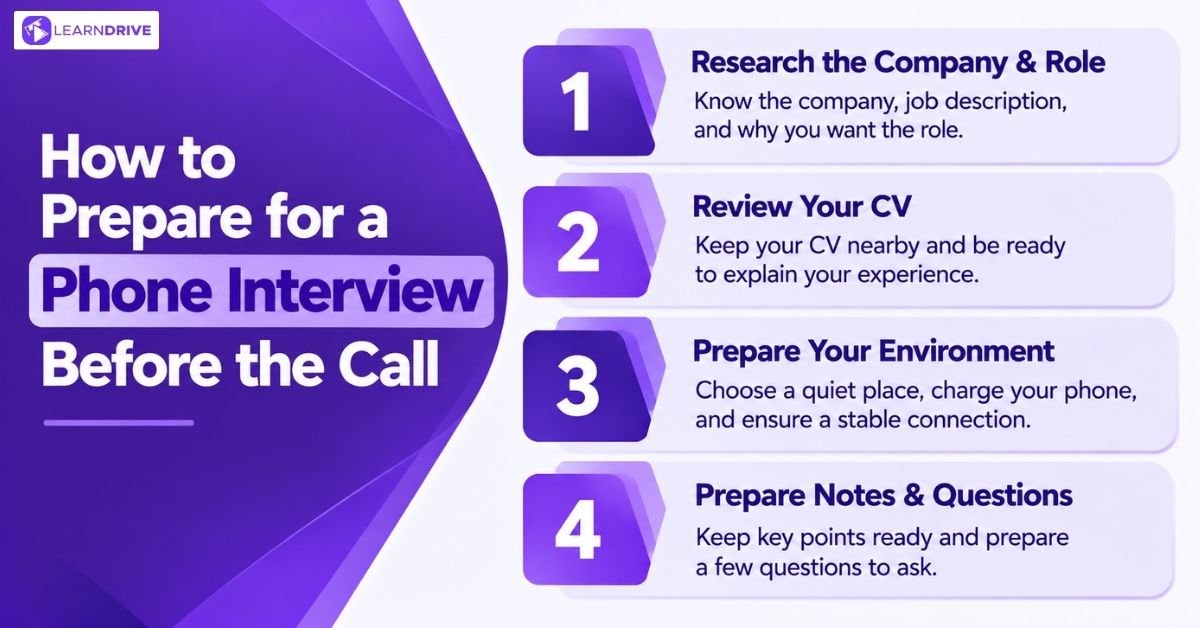
Most candidates focus only on rehearsing answers, then forget the groundwork that makes those answers convincing in the first place. Real preparation starts long before your phone rings, covering four key areas that shape how the call goes.
You will need to look into the company itself, revisit your CV with fresh eyes, and set up a space where nothing can interrupt you.
Alongside this, keeping a short set of notes ready helps you stay calm and answer with confidence when the call begins. Work through each area in order and you will walk into the call properly prepared, not just rehearsed.
1. Research the Company and Role
Walking into a call without knowing the company is one of the fastest ways to sound uninterested.Spend time on the company website, read the job description closely, and check for any recent news about the business.
Understanding the organisation and the role helps you give more relevant answers and show genuine interest during the interview. The Prospects interview guidance also highlights the importance of researching employers before interviews.
This research helps you answer “why do you want this job” with real detail instead of a vague, generic answer. It also lets you spot questions worth asking later, which shows genuine interest rather than a rehearsed script.
2. Review Your CV and Experience
Your CV should sit in front of you during the call, but only as a memory prompt, not a script to read from. Keeping your experience clear and relevant helps recruiters quickly understand your suitability for the role. The National Careers Service CV guidance explains how to structure and improve a CV.
Recruiters often ask you to expand on something listed on your CV, so vague entries can catch you off guard. A quick refresh through our CV Writing Masterclass can sharpen weak entries before you pick up the phone.
3. Prepare Your Interview Environment
Where you take the call matters as much as what you say during it. Choose a quiet room, charge your phone fully, and use headphones if background noise is likely. A stable connection avoids awkward gaps or dropped calls that can throw off your rhythm mid-answer. Good telephone etiquette starts before the call even connects, with a calm, distraction-free setup.
A stable connection avoids awkward gaps or dropped calls that can throw off your rhythm mid-answer. Small details like these remove distractions and let your answers carry the conversation instead.
4. Keep Notes and Questions Ready
Having notes nearby stops your mind going blank under pressure. Jot down a few points on your salary expectations, what you want to know about the role, and any questions about next steps. Thoughtful questions to ask at the end of an interview often make a stronger impression than perfect answers.
Thoughtful questions, prepared in advance, often make a stronger impression than perfect answers.
Phone Interview Preparation Checklist
A phone interview preparation checklist covers seven key steps: testing your phone, researching the employer, preparing answers, keeping your CV nearby, dressing professionally, removing distractions, and preparing questions.
Ticking off each point before the call removes guesswork and replaces nerves with a clear sense of readiness.
Test your phone: Check signal, battery, and call quality in the room you plan to use.
Research the employer: Read the company website, job description, and any recent news stories.
Prepare answers: Practise responses to common questions without memorising a rigid script.
Keep your CV nearby: Have it open or printed so you can reference dates and details quickly.
Dress professionally: Dressing properly for a voice-only call still helps you feel focused and alert.
Remove distractions: Silence other devices and let people in the house know you are not to be disturbed.
Prepare questions: Write down two or three thoughtful questions about the role or team.
Working through this list the night before takes only a few minutes but sharply reduces the chance of a last-minute scramble on the day.
5 Common Phone Interview Questions and Answers
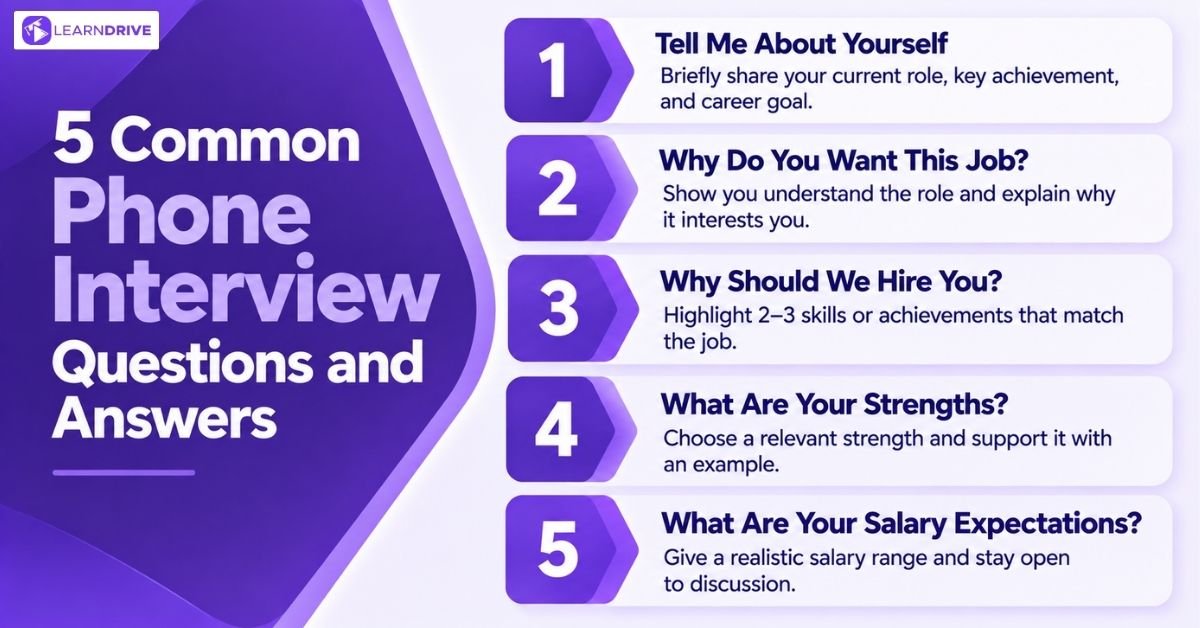
Certain questions come up in almost every phone interview, and knowing how to structure your answers matters more than memorising exact words. Below, you will find guidance on the five most common questions, from introducing yourself to discussing salary expectations.
Each answer works best when it stays short, specific, and focused on what the employer actually wants to know. Read through the structure for each question, then practise saying your own version out loud before the call.
1. Tell Me About Yourself
This question opens most calls, and a strong answer sets the tone for everything that follows. Structure your response in three parts: your current role, a relevant achievement, and why you are looking for this opportunity now.
Keep the whole answer under two minutes, since rambling here often loses the interviewer’s attention early.
2. Why Do You Want This Job?
Employers ask this to check whether you have actually researched the role, not applied on a whim. Mention something specific about the company or position that genuinely appeals to you, backed by a reason tied to your own career planning. Vague answers about “growth” or “new challenges” rarely stand out from other candidates.
Vague answers about “growth” or “new challenges” rarely stand out from other candidates.
3. Why Should We Hire You?
Treat this question as a chance to summarise your strongest match to the role in one tight answer. Pick two or three skills or achievements that line up directly with the job description, then explain the impact you had. Avoid listing every strength you have, since a focused answer lands better than a long one.
4. What Are Your Strengths?
Choose a strength that is genuinely relevant to the role, then back it up with a real example rather than a bare claim. If you are unsure how to frame this, our guide on strengths and weaknesses for job interviews breaks down how to pick the right ones. One clear example beats three vague ones every time.
5. What Are Your Salary Expectations?
Give a realistic range based on your research into typical pay for the role, rather than a single fixed number. Frame your answer around the value you bring, and stay open to discussing the full package, not just base salary. Some basic negotiation skills go a long way here, especially if the employer pushes back on your figure.
If you are unsure what to say, it is fine to ask what range the employer has budgeted before committing to a figure.
How to Answer Questions Successfully During a Phone Interview
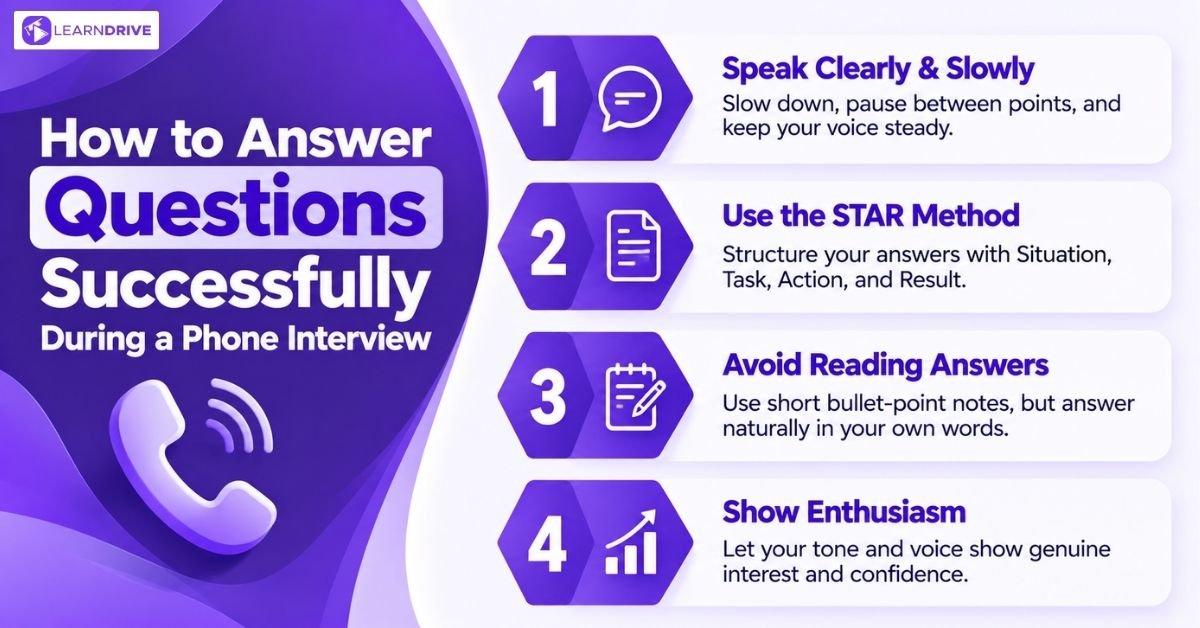
Knowing what to say only helps if you deliver it well over the phone, where tone carries far more weight than it does in person. Getting this right comes down to four habits: pacing your speech, structuring answers clearly, speaking naturally, and letting energy show through your voice.
Work through each habit below, then try practising a full answer out loud to hear how you actually sound on a call.
1. Speak Clearly and Slowly
Nerves often push people to speak faster than usual, which makes answers harder to follow over the phone. Slow your pace deliberately and pause briefly between points, giving the interviewer time to absorb what you are saying.
A steady voice also comes across as more confident, even if you feel nervous underneath.
2. Use the STAR Method
Structure longer answers using Situation, Task, Action, and Result, so your response has a clear beginning, middle, and end. This stops answers drifting into vague stories that never quite reach a point. Interviewers can follow STAR answers easily, which makes your experience far easier to remember afterwards.
3. Avoid Reading Full Answers
Written notes are useful as prompts, but reading full sentences from a script sounds flat and unnatural on a call.
Interviewers can usually tell when someone is reading, and it undercuts the impression of genuine, spontaneous conversation. Keep notes to short bullet points instead, then speak around them in your own words.
4. Show Enthusiasm Through Your Voice
Without facial expressions or body language, your tone becomes the main way you signal interest and energy. Building real confidence before the call makes this far easier, since forced enthusiasm rarely lands well over the phone. A flat, monotone delivery can make even strong answers sound disinterested.
Common Phone Interview Mistakes to Avoid
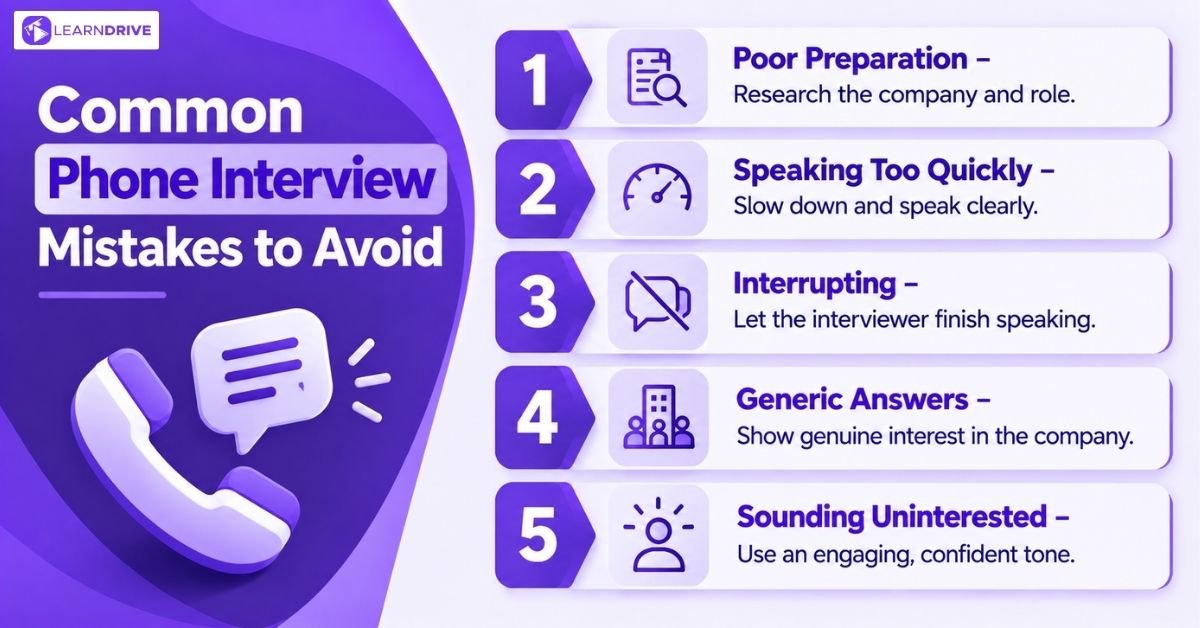
Even well-prepared candidates can lose ground through small, avoidable mistakes during the call itself. Five mistakes come up again and again, often without the candidate realising until afterwards.
Poor preparation: Skipping research into the company leaves answers vague and unconvincing when specific questions come up.
Speaking too quickly: Nerves push many candidates to rush, making answers harder to follow over the phone.
Interrupting the interviewer: Jumping in before they finish speaking can come across as impatient rather than engaged.
Not researching the company: Generic answers about “wanting a new challenge” rarely convince an interviewer you are genuinely interested.
Sounding uninterested: A flat, monotone voice can undo strong answers, since tone carries most of the impression on a call.
Avoiding these five issues costs nothing beyond a little awareness, yet it noticeably changes how the call comes across.
What to Do After a Phone Interview
A short thank you email, sent within 24 hours, is the single most useful thing you can do after the call ends. It reinforces your interest and keeps you fresh in the interviewer’s mind while other candidates are still being screened.
Keep the email brief, specific, and genuine rather than generic or overly formal. If email drafting doesn’t come naturally, brushing up on writing professional emails can help the tone land right.
Here is an example:
Subject: Thank you for the phone interview
Hi [Interviewer’s Name],
Thank you for taking the time to speak with me today about the [Job Title] role. I enjoyed learning more about the team and particularly appreciated hearing about [specific detail mentioned]. I’m excited about the opportunity and look forward to hearing about next steps.
Best regards,
[Your Name]