15 Benefits of Online Courses With Certificates
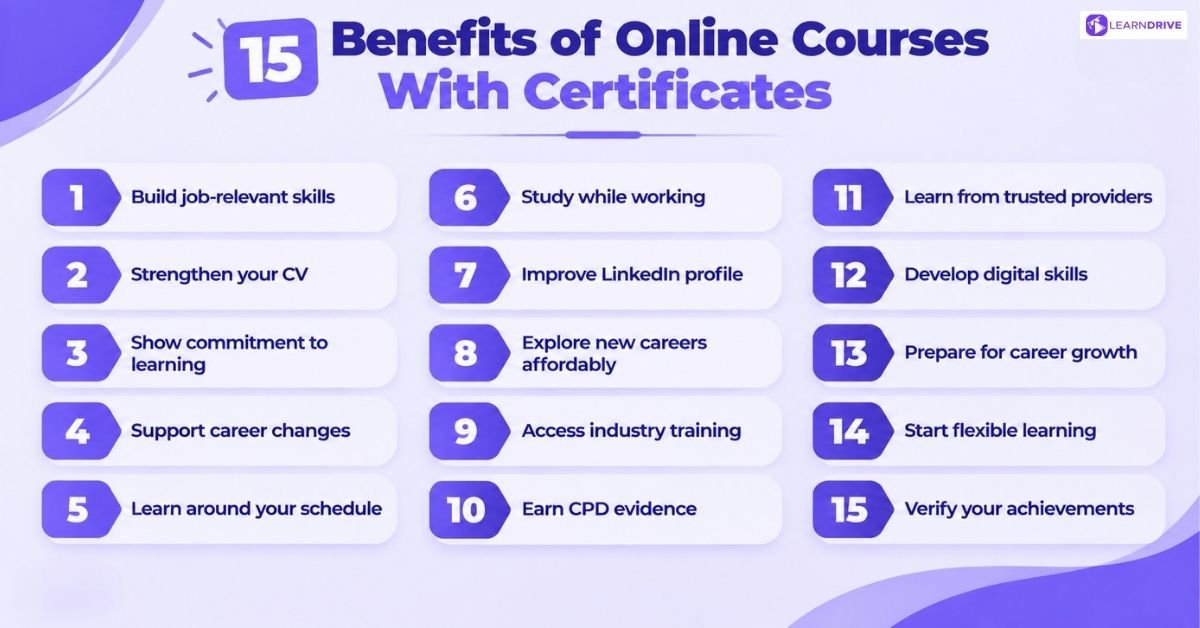
A few benefits show up on your CV. Others show up in your diary, your bank balance, and your confidence. These 15 cover the ones that matter most.
1. Build Job-Relevant Skills
Many courses teach tasks that real jobs need, such as spreadsheets, customer care, or fire safety. You can practise at work straight away, which helps the lesson stick. That practical edge is one of the clearest benefits of online certification programs.
2. Strengthen Your CV and Resume
A short work history can leave a recruiter with questions. A relevant certificate answers some of them. It names a skill, a provider, and a date in one line, so a busy reader sees your value fast. Do online certificates look good on a CV? They do when they match the job.
3. Demonstrate Your Commitment to Professional Development
Each finished course adds to a trail of steady effort. After a few years, that trail shows someone who keeps growing without waiting to be sent on training.
4. Support Career Changes
A certificate in the new subject shows your interest is real. It also lets you test the field before you leave a steady role, which is why many career changers start here.
5. Learn Around Your Existing Schedule
Self-paced courses fit into evenings, lunch breaks, and quiet weekends. Parents, carers, and shift workers can study when their day allows, instead of when a timetable says so.
6. Develop Skills Without Leaving Your Job
Studying alongside work means no career break and no lost income. Better still, you can try new ideas in your job the same week you learn them.
7. Add Evidence of Learning to LinkedIn
Recruiters often search by skill before they read a single job title. Adding your course to LinkedIn gives them another reason to click your profile. The name and provider are quick facts to scan, and they back up what you say about yourself.
8. Explore New Career Areas at Lower Cost
A short online course usually costs far less than a degree. If the subject turns out not to suit you, you have lost little money and only a few weeks.
9. Access Industry-Specific Training
Training exists for fields such as food hygiene, fire safety, care, and finance. Choosing one that employers already know can save you from explaining what it covers.
10. Earn CPD Evidence for Professional Development
CPD stands for continuing professional development. A CPD certified course logs your hours and topics, which many employers and professional bodies like to see.
11. Learn From Universities and Recognised Providers
University-backed and well-known providers bring checked content and familiar names. Employers may feel more at ease with them, although the skills still have to be real.
12. Build Technical and Digital Skills
Online coding and data science lessons let you learn tools at your own speed. Practice tasks can also give you small projects to show in an interview.
13. Prepare for Career Progression
Learning the skills for your next job early lets you step up with less catching up to do. Do online certificates help get promotions? They help you prepare, but no award promises a pay rise.
14. Create a Flexible Learning Path as a Beginner
Beginners can start with a short course and move up level by level. College students can add practical skills that a degree may not cover.
15. Gain a Verifiable Record of Your Learning
A certificate stores the course name, provider, and completion date in one place. Anyone can check what you achieved and when, which is a big reason people value these courses.
Can Online Course Certificates Help You Get a Job?

A certificate can help you get a job, but it works as support, not as a ticket. Employers still look at your skills, your story, and the role in front of them. The next three parts cover how employers judge certificates, when they help most, and what they cannot replace.
Do Employers Respect Online Certificates?
Most employers respect certificates that come with substance. Five things usually decide how much weight one carries:
Provider reputation: a known name is easier to trust than an unknown one.
Relevance: the topic should match the vacancy.
Assessment: quizzes or tasks show you learned something, not just watched videos.
Practical skills: real exercises count for more than theory alone.
Industry recognition: approval from a professional body or trade group adds trust.
A certificate that ticks several of these boxes gives a recruiter a reason to say yes.
When an Online Certificate Can Strengthen a Job Application
Certificates shine when they sit beside other proof. With experience, a course can fill a gap, such as a new software tool you have not used at work yet.
A portfolio pairs well with training too. Show the certificate, then show what you made with those skills. Graduates can add practical skills that a degree did not teach. People already skilled in a trade can use certificates to show that their knowledge is current.
What an Online Certificate Cannot Replace
Some jobs have rules that no online award can skip. Regulated qualifications are one example. Nursing in the UK needs registration with the Nursing and Midwifery Council, and gas work needs Gas Safe registration.
Work experience is another. A certificate shows what you studied, not how you handle a busy shift. Practical competence must be shown in real settings. Being honest about these limits makes your application more believable.
The Flexibility Benefits of Studying Online

Time is the biggest hurdle for most adult learners. Four freedoms make certificate study easier to finish: fitting it around work, setting your own pace, skipping the commute, and replaying lessons.
Study Around Work and Other Responsibilities
Self-paced certificate courses slot around shifts, school runs, and caring duties. You can watch a lesson at breakfast and complete the quiz that evening. For working professionals, studying while working means no time off and no lost pay.
Learn at Your Own Pace
Some people race through topics they already know. Others need extra time on new ideas. Online study lets both groups move at a comfortable speed, and your certificate arrives when you finish, not when a class calendar says so.
Avoid Commuting and Relocation Costs
Train fares, fuel, and parking can add up quickly. Learning from home removes those bills. It also means a strong provider in another city is still within reach, with no need to move house.
Revisit Lessons When You Need Them
Forgot a step? Replay the lesson. Many platforms keep videos and notes available after you finish, so you can refresh your memory before an interview or a new task at work.
How Online Courses with Certificates Support Different Career Goals

Not everyone studies for the same reason. Here is how the benefits change for workers, students, beginners, and teams.
1. Benefits for Working Professionals
The benefits of online courses with certificates for working professionals come down to time and proof. You keep your job, add a skill, and gain a record to show a manager.
2. Benefits for College Students
Degrees teach theory, while short certificates can add practical tools. The benefits of online certificates for college students include a stronger CV before graduation and a clearer story in interviews.
3. Benefits for Beginners
New learners often fear starting. The benefits of online learning with certificates for beginners include small steps, clear goals, and a finished award that builds confidence.
4. Benefits for Employees and Corporate Training
Companies use certificates to show that staff completed required training, such as health and safety. Employees gain a record they can keep, which supports the benefits of online training certificates for employees.
How to Choose an Online Course Certificate That Has Value

Six checks help you pick a certificate that is worth your money and effort. They cover the issuer, assessment, accreditation, career fit, employer recognition, and total cost.
1. Check Who Issues the Certificate
Look for a provider with a clear name, contact details, and real learner reviews. An unknown issuer gives an employer little to trust.
2. Look at the Course Assessment
Quizzes, tasks, or a final test show that you learned the material. A certificate handed out for simply pressing play carries less weight.
3. Check Whether It Is Accredited or CPD Certified
Accreditation means an outside body has checked the course. CPD certification means the learning meets a set standard for professional development. Ask the provider to name the body involved.
4. Match the Course With Your Career Goal
Pick a subject linked to the job you want next. A relevant short course beats a famous but unrelated one.
5. Check Whether Employers or Professional Bodies Recognise It
Search job adverts in your field. If employers mention a certificate or its awarding body, that is a good sign.
6. Compare the Total Cost
Add up course fees, exam fees, and certificate charges. Some providers charge extra for the certificate itself.