What is Artificial Intelligence in Education?
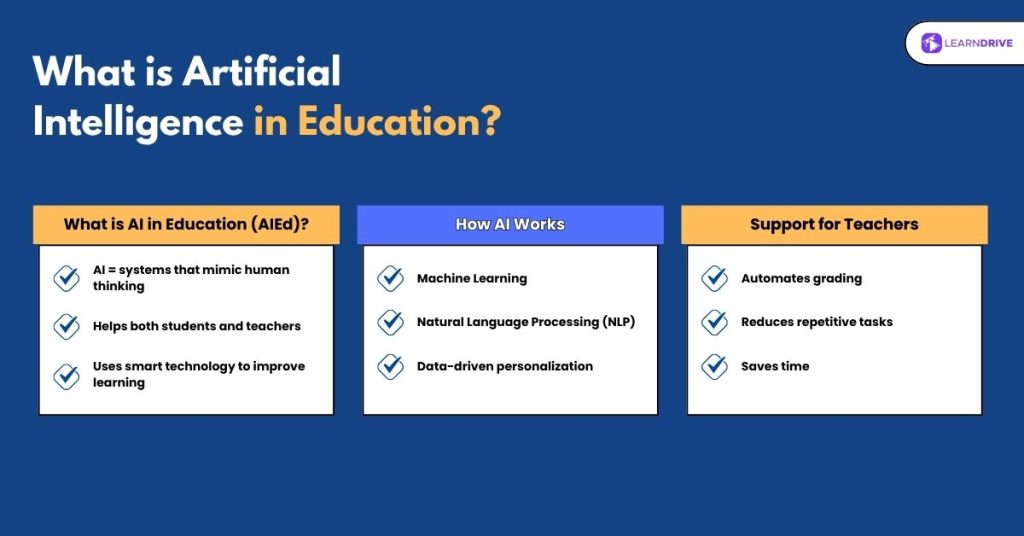
When we talk about Artificial Intelligence in education (AIEd), we’re referring to computer systems designed to perform tasks that typically require a human brain. These systems use machine learning and natural language processing to enhance your learning experience and help your teachers manage the “boring” administrative stuff.
Role of Artificial Intelligence in Education
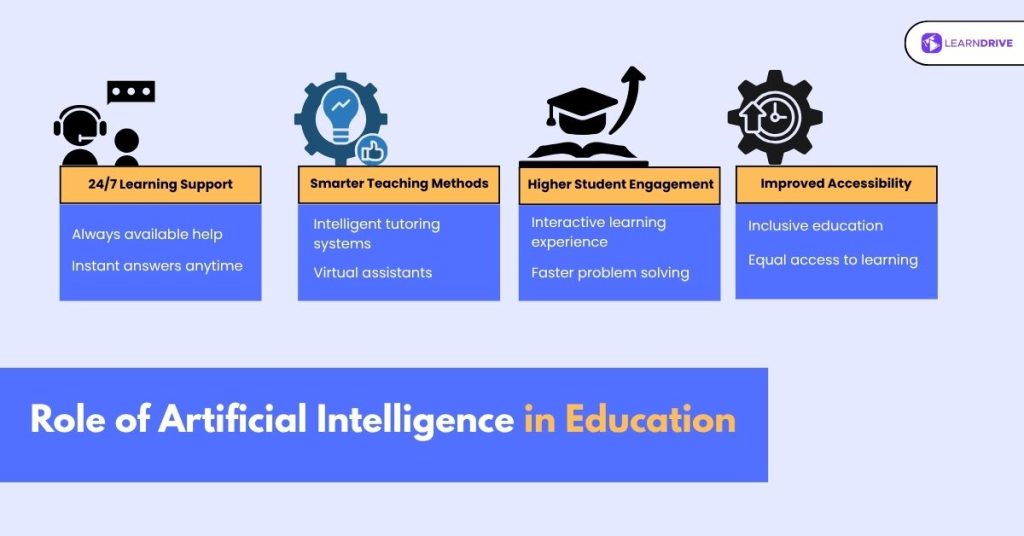
The role of AI is rapidly transforming the “how” of teaching. It acts as a 24/7 bridge between you and your educational goals. Through intelligent tutoring systems and virtual assistants, AI boosts your engagement and makes sure you aren’t waiting until Monday morning to get an answer to a tough question.
One of its most vital roles is improving accessibility. For students with disabilities, AI-driven platforms provide real-time translations and speech-to-text capabilities, creating a much more inclusive and equitable environment. For educators, AI provides deep data insights, showing them exactly where a student might be struggling long before a final exam happens.
Advantages And Disadvantages of AI for Students
15 Advantages of Artificial Intelligence in Education

AI isn’t just about efficiency; it’s about accuracy and safety. Here are the 15 core benefits that are revolutionizing the student experience:
1. Zero Risks
AI robots can take the “hit” for us in dangerous situations. Whether it’s exploring the surface of Mars or diving into the deepest parts of the ocean for research, machines can handle harsh environments without any risk to human life. For a student in a lab, AI simulations allow you to test “volatile” chemical reactions or engineering stresses with zero physical danger.
2. Always Available
Let’s be honest: humans are usually only at their peak productivity for about 3-4 hours a day. We need sleep, coffee breaks, and vacations to stay sane. AI, however, doesn’t get tired. It can multitask 24/7 with consistent results. If you’re stuck on a calculus problem at 2:00 AM, an AI-powered chatbot is there to help you immediately.
3. Digital Assistance
Modern organizations now use digital assistants to handle user queries, meaning you don’t have to wait in a long phone queue for help. Many e-learning websites use these assistants to find the content you need or answer FAQs instantly. Some of these advanced AI chatbots are so advanced now that it’s actually hard to tell if you’re talking to a machine or a real person!
4. New Inventions
AI is the “secret sauce” behind some of the most life-saving innovations of our time. For instance, AI advancements now allow doctors to detect breast cancer in its earliest, most treatable stages. From self-driving cars to personalized medicine, AI is helping us solve the world’s most complex problems faster than ever before.
5. Maximizing Potential
Did you know that the average teacher spends over 10 hours a week just on grading and administrative paperwork? Artificial Intelligence is changing that narrative by taking over the “grunt work,” allowing education to focus back on the student. It will allow teachers to help student to increase their potential.
6. Efficiency at Its Core
One of the most immediate benefits of AI is its ability to handle repetitive tasks without the “burnout” humans face. In sectors like manufacturing and hot work, robots perform high-precision welding and packaging at speeds no human could match. In your school life, this means AI can manage massive databases or organize your digital files instantly, reducing costs and boosting overall efficiency.
7. Personalized Learning
AI enables personalized learning by acting as a tailor for your education. Through adaptive technologies, it analyzes your unique strengths, weaknesses, and learning pace. Instead of a “one-size-fits-all” lecture, you get customized lesson plans that match your individual style. This ensures you can progress at your own speed, which significantly improves how much information you actually retain. Now-a-days, smart AI tools like Learndrive AI learning assistant make personalized learning for fun and engaging.
8. Immersive Learning Experiences
Why just read about the Pyramids when you can walk through them? AI-powered Virtual Reality (VR) and Augmented Reality (AR) create immersive experiences that traditional textbooks simply can’t touch. You can conduct “virtual” science experiments or practice a new language with AI avatars, making learning interactive, safe, and—honestly—a lot more fun.
9. Improved Student Engagement and Motivation
Let’s face it: staying motivated can be tough. AI helps by “gamifying” the classroom. By using platforms with rewards, challenges, and leaderboards, learning becomes a competitive and engaging experience. Plus, getting instant feedback from an AI means you aren’t left wondering if you are weak at maths and got a math problem right for three days—you know immediately, which keeps you focused and moving forward.
10. Cost-Effective and Scalable Learning
Education should be accessible to everyone, regardless of their budget. AI makes learning more cost-effective by automating routine tasks like grading and scheduling. Because AI platforms can reach thousands of students at once with minimal extra cost, high-quality education can now be delivered to a much broader audience worldwide.
11. Integrated Learning and Intelligent Tutoring Systems (ITS)
Think of an Intelligent Tutoring System as a private tutor that lives in your laptop. These systems use data to understand your specific progress and offer targeted recommendations. If you have a “knowledge gap” in fractions, the AI identifies it and suggests the exact resource you need to fix it, adjusting the difficulty level as you improve.
12. Continuous Evaluation for Long-Term Success
Traditional exams only show where you are on one specific day. AI, however, provides continuous evaluation. By tracking your progress in real-time, it highlights trends and areas for improvement over months or years. This allows your teachers to step in with the right help at the right time, ensuring you actually meet your learning goals.
13. Raising Academic Standards
Finally, the integration of AI is raising the bar for educational quality everywhere. It ensures consistency in grading and gives every student access to top-tier resources. By leveraging these technologies, schools can offer a more rigorous curriculum that truly prepares you for the complexities of the 21st-century workforce.
14. Risks Awareness
AI tools do more than just give answers—they help students develop crucial digital literacy. By interacting with AI, students naturally learn to spot “hallucinations,” question biases, and recognize the importance of fact-checking. This hands-on experience builds a healthy skepticism, teaching young learners how to navigate data privacy safely and critically evaluate online information, turning them into tech-savvy, responsible digital citizens.
15. Advanced Systems
Beyond basic chatbots, students now have access to sophisticated, enterprise-level AI ecosystems. These advanced systems integrate predictive analytics, complex data modeling, and immersive simulations directly into the learning process. By mastering these cutting-edge platforms early on, students gain a massive competitive edge, familiarizing themselves with the exact high-tier tech and automated workflows they will encounter in the modern workforce.
11 Critical Disadvantages of AI for Students

In this part of the blog, we’ll look at the most critical disadvantages students face when using AI. Understanding these drawbacks will help learners make smarter choices and strike the right balance between technology and personal effort.
1. Data Privacy Concerns
AI systems are “data-hungry”. To work well, they need access to your academic records, behavior patterns, and even biometric info. This creates a massive security risk. Without top-tier safeguards, sensitive student information could be exposed to hackers, leading to identity theft or misuse of personal data.
2. Growing Dependence on Technology
Are we becoming too dependent on the “on” switch? Relying on AI for everything from administrative tasks to solving complex problems makes educational systems vulnerable to technical failures or cyber-attacks. If the system goes down, do we still know how to learn without it?
3. The Dehumanized Learning Experience
Education is more than just downloading facts; it’s about mentorship. AI cannot replicate the emotional bond between a teacher and a student. This lack of human connection can lead to a “cold” learning environment, potentially hurting a student’s social development and long-term motivation.
4 . The Risk of Cheating
Let’s be honest—AI has made it easier to bypass academic integrity. Advanced tools can now generate essays that are sophisticated enough to trick traditional plagiarism detectors. This creates an “arms race” where schools must constantly update their tech just to ensure that a student’s work is actually their own.
5. Teacher Job Displacement
Finally, there is the very real fear that AI could lead to the devaluation of the teaching profession. As machines take over grading and tutoring, some worry that human educators will be seen as “obsolete” and they look for good jobs after teaching. It is vital to remember that while AI can support a classroom, it can never truly replace the moral guidance and inspiration a human teacher brings to the table.
6. The “Hallucination” Trap (Misinformation)
AI doesn’t actually “know” facts; it predicts the next likely word in a sentence. This leads to AI hallucinations, where the tool confidently presents false information, fake citations, or incorrect historical dates as absolute truth. Students who don’t cross-reference AI output risk learning—and submitting—entirely inaccurate content.
Fact: Studies have shown that even leading LLMs can have hallucination rates ranging from 3% to 25% depending on the complexity of the prompt.
7. Atrophy of Critical Thinking
When an AI provides a perfect summary or solves a calculus equation in seconds, the student skips the “productive struggle.” This struggle is where neural pathways are formed. Over-reliance can lead to cognitive atrophy, where a student’s ability to analyze, critique, and synthesize information without a digital prompt significantly declines.
8. Algorithmic Bias and Narrow Perspectives
AI models are trained on massive datasets that often contain inherent human biases regarding race, gender, and culture. If a student uses AI for research, they may unknowingly receive a one-sided or biased viewpoint that reflects the data the AI was fed, rather than a diverse, objective range of human thought.
9. The Digital Divide and Inequality
While some AI tools are free, the most powerful, high-speed, and accurate versions often require expensive monthly subscriptions. This creates a new tier of educational inequality. Students who can afford “Premium” AI have a massive advantage in speed and resource quality over those who cannot, widening the achievement gap between different socioeconomic groups.
10. Loss of Personal “Voice” and Creativity
Writing is a reflection of personality. Because AI mimics the “average” of all human writing, its output is often beige, formulaic, and devoid of unique flair. Students who use AI to draft their work may lose the ability to develop their own unique creative voice, leading to a generation of writing that feels processed rather than personal.
11. The Social Impact: Unemployment and Laziness
One of the most debated issues is job displacement. In countries like Japan, we already see robots replacing human workers in manufacturing. In education, there is a growing fear that over-reliance on AI could make us “mentally lazy”. If an app always solves the puzzle for you, you might stop exercising your own critical thinking skills. However, if you learn AI and prompt engineering properly, you can get many AI jobs without any previous experience.