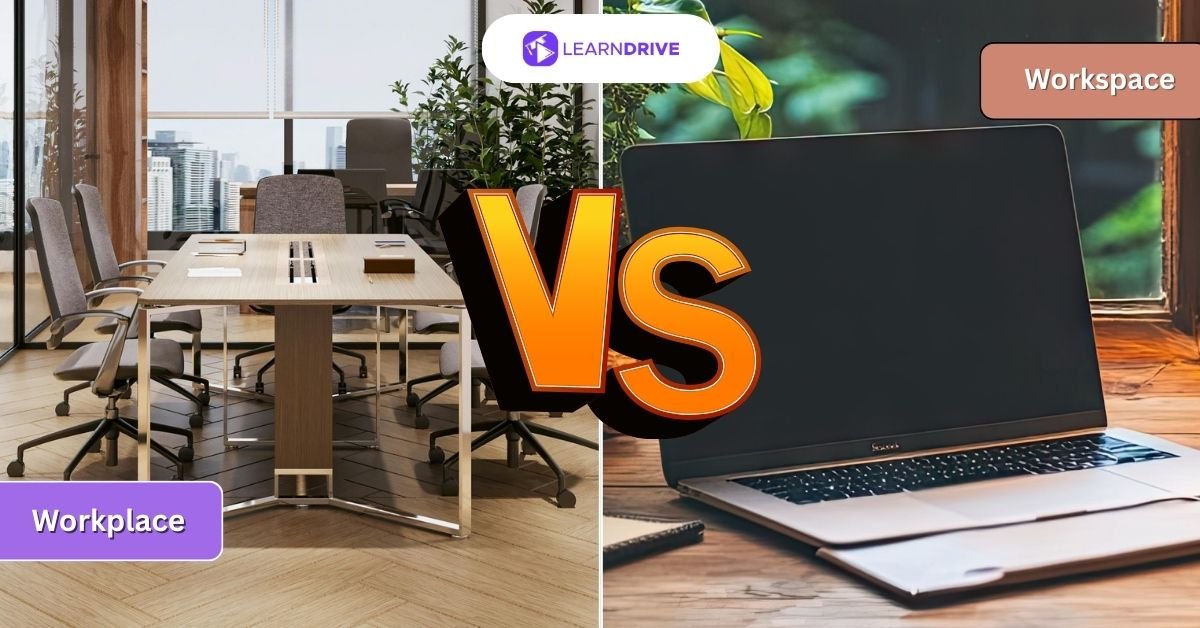
Defining Workplace and Workspace

Before we dive deeper, let’s clarify the basic definitions of “workplace” and “workspace” to ensure we’re on the same page.
Workplace: This refers to the overall environment where work takes place. It includes the physical space, the culture, the policies, and the infrastructure that collectively support employees in completing their tasks.
Workspace: This is the specific area or setting within the broader workplace where an individual performs their work. A workspace can be a physical desk or even a virtual environment filled with the tools and resources needed to get the job done.
What is a Workplace?
A workplace is more than just a physical space—it encompasses everything that influences how work is done. Traditionally, this meant an office building where employees commuted daily to a shared space.
But as the nature of work has evolved, especially with the rise of remote and hybrid work models, the term “workplace” has expanded to include various environments.
Today, a workplace can be:
A physical office that employees visit regularly.
A remote work setting, like a home office, where employees work from anywhere.
A hybrid environment, where employees move between home and office spaces.
A virtual workspace, supported by digital tools and systems that allow remote collaboration.
The workplace isn’t just about where employees work—it also includes the company culture, processes, and policies that shape how they interact with each other and perform their duties. It’s a strategic, organisational environment that enables collaboration, creativity, and productivity.
What is a Workspace?
While the workplace refers to the broader environment, a workspace is much more specific. It’s the individual area or setting where a person performs their tasks within that environment. Think of it as the personal space that caters to the specific work an employee does.
In a physical setting, a workspace could be:
A desk or a workstation that an employee owns or shares with others.
A meeting room where teams collaborate on projects.
A quiet area where employees focus on independent tasks.
In a digital setting, a workspace could be:
A virtual desktop filled with tools like cloud storage, communication apps, and project management software.
A customised dashboard that gives an employee quick access to the resources they need.
Defining Digital Workplace and Digital Workspace
In today’s technology-driven world, the terms digital workplace and digital workspace are becoming increasingly common. While they share similarities, they serve different purposes.
Digital Workplace
A digital workplace refers to the entire virtual ecosystem where employees access everything they need to perform their jobs. It goes beyond just tools and software; it’s a unified online environment that integrates multiple aspects of a company’s operations, enabling seamless collaboration and communication.
Examples of tools within the digital workplace include:
Collaboration platforms like Microsoft Teams or Slack.
Cloud storage solutions like Google Drive or Dropbox.
Project management tools such as Asana or Trello.
Communication channels including email and video conferencing platforms like Zoom.
The digital workplace brings everything together in one cohesive environment, making it easier for employees to stay connected, share resources, and manage tasks—regardless of location.
Digital Workspace
A digital workspace, however, is more specific. It refers to the virtual environment where individuals interact with the tools, data, and applications they need to do their work. It’s the personalised “home base” where each employee accesses their relevant software and resources.
The digital workspace is designed to streamline specific workflows, making it easier for employees to complete tasks efficiently. It can be customised to suit the needs of different roles, ensuring that individuals have exactly what they need to perform their job effectively.
Digital Workplace vs Digital Workspace: The Main Difference
5 Tips for Managing a Digital Workplace Smoothly

Managing a digital workplace requires a thoughtful, strategic approach to keep employees engaged, productive, and connected. Here are some essential tips for optimising the management of a digital workplace:
1. Invest in the Right Tools
The foundation of any successful digital workplace lies in the tools employees use daily. Choose platforms that encourage collaboration, communication, and seamless workflow integration. These tools should be:
Intuitive: Easy to use so employees can adopt them quickly.
Secure: Protect company data and ensure privacy.
Scalable: Support company growth and changing needs.
Popular tools to consider include:
Project management platforms like Trello or Asana,
Communication tools such as Slack or Microsoft Teams, and
File-sharing services like Google Drive or Dropbox.
2. Prioritize Cybersecurity
As digital tools become integral to workplace operations, cybersecurity should be a top priority. Protecting company data from breaches, hackers, and cyber threats is essential. Implement strong security measures, including:
Encryption to safeguard sensitive data,
Multi-factor authentication to add an extra layer of security, and
Compliance with data protection laws to ensure legal safeguards are in place.
3. Create a Strong Communication Culture
Clear communication is vital in a digital workplace. Without face-to-face interactions, it’s easy for messages to get lost or misinterpreted. Encourage transparency and consistency in communication:
Hold regular virtual meetings to keep everyone aligned.
Ensure that information flows smoothly and reaches everyone who needs it.
Use video conferencing tools like Zoom to maintain human connection and foster a collaborative environment.
4. Foster Collaboration and Teamwork
While digital tools can help facilitate communication, it’s equally important to actively encourage collaboration. Use shared documents, virtual brainstorming sessions, and cross-functional teams to bring people together. These tools help teams work cohesively, even if they’re physically apart. Collaboration shouldn’t just happen—it needs to be actively cultivated.
5. Monitor Employee Engagement and Productivity
In a remote or hybrid work setup, it’s essential to monitor employee engagement and productivity, but not at the cost of autonomy. Use analytics tools to track employee activity, participation in virtual meetings, and overall productivity.
However, focus on outcomes, not on micromanaging employees. Empower your teams by emphasising results rather than enforcing rigid work habits.
Why Are Workspaces Revolutionary?

Over the past decade, workspaces have undergone a massive transformation, largely driven by advances in technology and shifts in workplace culture. The rise of remote work, hybrid models, and digital transformation has revolutionized the way work is done and how employees interact with their environment.
1. Remote and Hybrid Work Models
The widespread adoption of remote and hybrid work models has made the need for fully functional digital workspaces more critical than ever. These workspaces are essential for maintaining productivity outside of traditional office settings. Employees can now access all the tools they need—whether in the office or at home—ensuring that they can stay connected and continue contributing to the team, no matter where they are.
2. Increased Collaboration
Digital workspaces have dramatically enhanced collaboration. Employees no longer need to be in the same physical space to work together.
Whether it’s sharing documents in real time, holding virtual meetings, or using communication platforms, digital workspaces have made collaboration smoother, faster, and more efficient. Teams can now communicate instantly, share ideas, and solve problems together, regardless of location.
3. Enhanced Flexibility
One of the key benefits of digital workspaces is the flexibility they offer. Employees can now work from virtually anywhere and at any time, allowing them to manage their schedules around personal commitments.
Moreover, the customization options in digital workspaces enable individuals to choose the best tools and strategies for their personal productivity, empowering them to work smarter, not harder.
4. Cost-Effectiveness
From a business perspective, digital workspaces are often more cost-effective. Companies can save on office space, utility costs, and other overhead expenses.
Employees, in turn, benefit from the freedom to work from home or other remote locations, reducing commuting time and associated costs. This not only cuts down on physical office expenses but also contributes to a healthier work-life balance for employees.
This shift in how we view workspaces has led to a fundamental reevaluation of work-life balance, productivity, and collaboration.
The Revolution of Optimised Workspaces
The evolution of workspaces—especially digital workspaces—has significantly impacted how businesses and employees operate. The rise of remote work and hybrid work environments has made it clear that an optimized workspace is critical for employee success.
If a workspace doesn’t meet the basic requirements for a job role, employees will inevitably struggle to meet expectations. An optimized workspace removes these obstacles, enhancing productivity and creativity. And when combined with a digital workspace, businesses can expand their operations virtually anywhere in the world.
For example, companies like Microsoft have embraced hybrid workspaces, experimenting with a mix of remote and in-person collaboration. The result? Improved productivity, a stronger sense of work-life balance, and a more adaptable workplace culture.
It’s important to note that not all workspaces are created equal. For a larger, corporate business, a workspace may need to focus on providing high-performance equipment for specialized tasks.
On the other hand, a start-up or small business may place a higher emphasis on fostering collaboration, communication, and flexibility within the workspace.
Workplace and Workspace Strategy

While these terms are often used interchangeably, they each play a unique role in shaping employee experiences and productivity. A workplace strategy focuses on creating an environment that motivates and engages employees, whether it’s physical or digital, while a workspace strategy hones in on the specific areas and tools employees use to complete their tasks.
With the rise of hybrid and remote work, companies must adapt their approach to optimize both their workplace and workspace.
Now, we’ll explore the key differences, benefits, and strategies for improving your company’s workspaces and workplaces to enhance employee satisfaction and overall business performance.
What’s the Definition of ‘Workplace Strategy’?
Let’s start by breaking down the term workplace strategy.
In essence, a workplace strategy is a comprehensive, holistic approach to creating a productive, engaging environment for employees—whether physical or digital.
It’s about designing a workplace that motivates your team, aligns with company goals, and fosters long-term employee satisfaction.
A strong workplace strategy focuses on key elements such as:
Company culture and core values,
Flexible working policies that cater to diverse employee needs,
Employee benefits packages that promote well-being and engagement, and
The physical workspace—how it’s designed and how employees interact with it.
Without a clear workplace strategy, a company risks losing direction. There’s no shared vision, no clear objectives, and no compelling reason for employees to stay.
In a world where top talent is always in demand, a weak workplace strategy makes it much easier for employees to look elsewhere for better opportunities. So, a solid workplace strategy is essential—it’s the foundation of a thriving, sustainable business.
What’s the Definition of ‘Workspace Strategy’?
Now, let’s turn our attention to workspace strategy.
In simple terms, a workspace strategy refers to how a company organizes, manages, and optimizes its physical spaces to support employees. These workspaces may vary depending on the needs of the business, but they typically include:
The company headquarters, which could be a large office in a central city location,
Employees’ home offices, and
Flexible workspaces, such as coworking spaces, private day offices, or hourly meeting rooms.
Each of these types of workspaces serves a distinct purpose, depending on the workspace strategy chosen by the company. The goal is to create environments that align with the company’s culture, promote collaboration, and support individual productivity. More on this later as we explore how to create an effective workspace strategy.
How to Improve Your Company’s Workspaces and Workplaces?
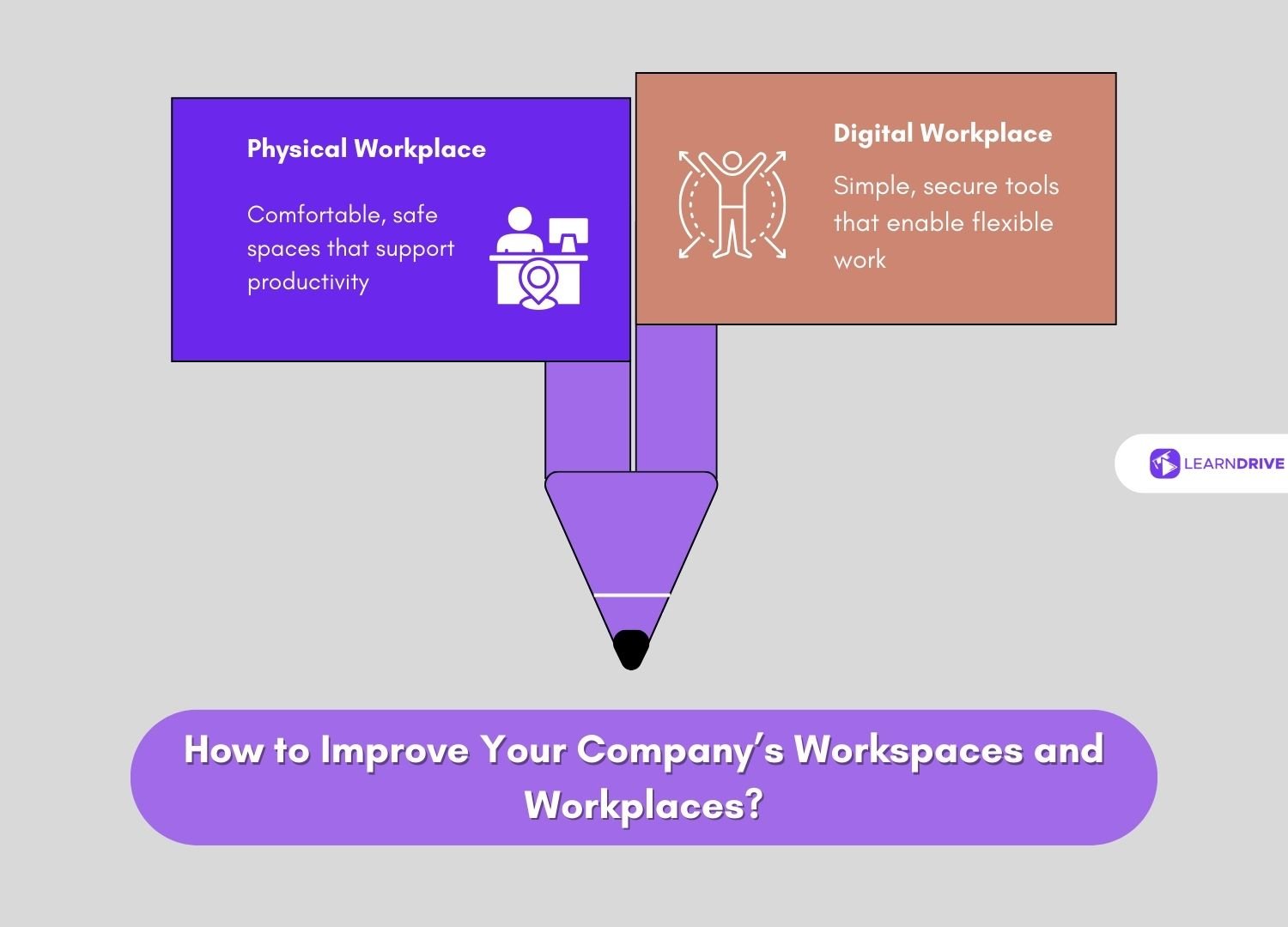
We’ve established that both workplaces and workspaces have a direct impact on productivity, employee satisfaction, and overall business performance.
So, how can you ensure your company’s spaces—whether physical or digital—are optimized to support your workforce? Here are a few practical strategies:
1. Be Open to Multiple Ways of Working
Employees need different kinds of spaces to thrive—focus, collaborate, learn, and socialise.
To accommodate these varied needs, modern companies must design flexible work environments. These environments should be adaptable, able to shift between modes of work. Here’s how:
Physically, offices should have:
Private spaces where employees can focus and work independently,
Open, collaborative areas that encourage brainstorming and teamwork,
Small meeting rooms for team discussions,
Relaxation zones to help employees recharge.
Digitally, workspaces should allow employees to easily switch between:
Collaboration zones for group work,
Private time to concentrate on individual tasks.
Creating spaces that support these four essential modes of working helps employees be more productive and engaged.
2. Gather Data on How Your Employees Work
To optimize workspaces, it’s crucial to understand how your employees use them. The best way to gather this insight is to ask them directly. Pulse surveys, questionnaires, or group discussions can provide valuable feedback about what’s working and what’s not.
For example, Mars Drinks took it a step further by using sensors to monitor how often employees’ desks were actually being used. The data revealed that employees preferred to move around the office rather than remain at their designated workspaces, leading the company to redesign their office to better accommodate the various ways employees work.
By gathering data on how employees use spaces, companies can identify pain points and adjust their workspace designs accordingly.
Which Does the General Population Prefer Between Workplace vs Workspace?
When it comes to whether people prefer workspaces or workplaces, the answer isn’t one-size-fits-all. Preferences can vary widely depending on factors like generational differences, job roles, and the industry.
Here’s what we know:
Workspaces are often ideal for people who value flexibility. Creatives, entrepreneurs, and younger generations tend to thrive in these dynamic environments. Workspaces are usually designed for collaboration, with open areas that encourage interaction across different industries and professions.
Workplaces, on the other hand, offer more stability. Traditional businesses may prefer a workplace structure because it provides all the necessary resources in one place. Companies that want to build a strong company culture and provide specialised equipment may find that a traditional workplace is more effective.
The best approach for most organisations? A balanced strategy that combines the stability of a workplace with the flexibility of hybrid workspaces. This allows businesses to provide the structure employees need while embracing the growing demand for flexible, remote work options.

How Technology Has Advanced the Development of Workspaces?

Technology plays a pivotal role in the evolution of both physical and digital workspaces. The tools and innovations available today have dramatically reshaped how employees engage with their work environments, whether in the office or remotely. Here’s a breakdown of how technology has transformed modern workspaces:
1. Cloud Computing and Collaboration Tools
Cloud technology has been a game-changer for digital workspaces. With cloud-based tools like Google Drive, Microsoft 365, and collaboration platforms such as Slack and Zoom, employees can access essential files, documents, and applications from virtually anywhere in the world.
These tools enable real-time collaboration, making it easier for teams to communicate, share resources, and work together effectively, even if they are miles apart. This shift has created seamless, flexible virtual environments that encourage teamwork and efficiency, regardless of location.
2. Virtual Reality (VR) and Augmented Reality (AR)
Looking ahead, immersive technologies like Virtual Reality (VR) and Augmented Reality (AR) are set to redefine the concept of workspaces. These technologies will enable employees to engage in fully interactive, virtual environments where they can collaborate with colleagues in real-time within simulated spaces.
Whether it’s for remote team meetings or accessing virtual versions of physical office spaces, VR and AR will revolutionize how teams interact and work together, bringing new dimensions to remote and hybrid work models.
3. Automation and Artificial Intelligence
Automation and Artificial Intelligence (AI) are increasingly transforming digital workspaces by handling repetitive, time-consuming tasks. AI-powered tools such as scheduling assistants, chatbots for customer support, and automated data analysis can streamline processes, allowing employees to focus on more strategic, high-value work.
This shift not only improves productivity but also reduces the mental load on employees, making them more efficient and effective in their roles.
4. Workplace Analytics
Advanced workplace analytics tools track how employees use both physical and digital workspaces. By analysing employee behaviour and workspace utilisation, businesses can gain valuable insights into how work environments are being used.
This data can guide decisions on office layouts, digital workflows, and tool access, helping to create a more engaging and efficient workspace. This constant feedback loop allows companies to continuously optimize their environments for better employee performance and satisfaction.
5. Remote Access and Mobility Solutions
The rise of remote work has been supported by advances in remote access technology. Solutions like secure Virtual Private Networks (VPNs) and mobile apps have made it easier for employees to connect to company networks and access work tools securely, no matter where they are.
With cloud-based software and multi-device compatibility, employees can seamlessly transition between work locations—be it from home, a co-working space, or while travelling—creating truly mobile work environments that support flexibility and productivity.
7 Benefits of the Digital Workplace and Digital Workspace
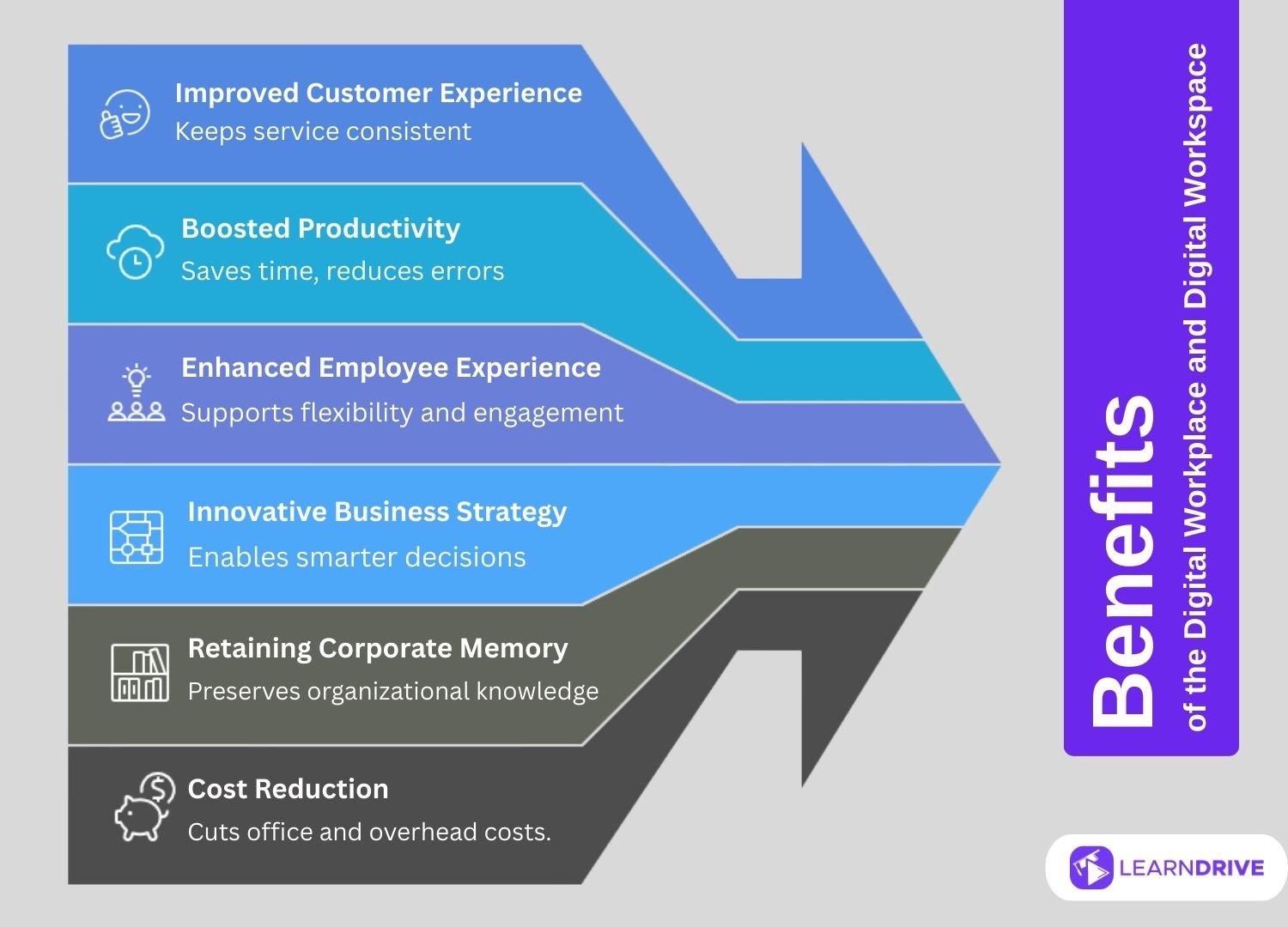
The digital workplace offers a wealth of benefits for both businesses and employees. By leveraging the right tools and technologies, companies can foster a more flexible, efficient, and engaging work environment. Here are the key benefits:
1. Improved Customer Experience
With a digital workplace, businesses can provide a more seamless experience for their customers. By streamlining workflows and centralizing data, customer knowledge stays within the organization, even when employees transition out of the company. This ensures that customer service remains consistent and that businesses can build stronger, long-lasting relationships with their clients.
2. Boosted Productivity
A digital workspace reduces time spent on repetitive tasks, allowing employees to focus on high-priority projects. With integrated tools and automated workflows, employees can accomplish more in less time, reducing errors and duplication of effort.
3. Enhanced Employee Experience
Today’s employees are increasingly prioritizing flexibility, with many choosing employers that offer remote or hybrid work options. A digital workspace not only facilitates this flexibility but also boosts employee engagement by providing a more personalized and satisfying work experience.
When employees feel that their environment supports their work style, they’re more likely to stay engaged and satisfied with their jobs.
4. Innovative Business Strategy
The digital workplace fuels innovation by providing businesses with the tools and insights they need to make informed decisions. With access to real-time data, employees can generate new ideas, collaborate more effectively, and deliver valuable insights that help shape business strategies and maintain a competitive edge.
5. Retaining Corporate Memory
When an employee leaves, they often take valuable institutional knowledge with them. A digital workplace ensures that this knowledge is captured, shared, and retained across the organization.
With centralized platforms, new employees can quickly access essential information, while companies continue to build and maintain a corporate memory that informs future projects and decisions.
6. Cost Reduction
By reducing the need for extensive office space and physical infrastructure, digital workplaces help companies save money on real estate and overhead costs.
According to Global Workplace Analytics, companies can save over $11,000 per employee per year by embracing a digital-first strategy, including savings from reduced office space requirements and lower utility costs.
7. Increased Collaboration
With the right digital tools, employees can communicate and collaborate more efficiently with the right people at the right time. Tools like Slack, Microsoft Teams, and Zoom create an environment where collaboration happens instantly, promoting teamwork across departments and time zones.
5 Challenges of the Digital Workplace and Digital Workspace

While the digital workplace offers numerous advantages, there are also several challenges that businesses must address to maximize its potential. Some of the common difficulties include:
1. Engagement
Maintaining employee engagement can be difficult, especially when teams are working remotely. Ensuring that employees feel connected and motivated while working in isolation requires strong communication practices and consistent engagement strategies.
2. Slow Adoption
Many companies struggle to realise the full potential of their digital tools. Even with powerful platforms like Microsoft 365, businesses may face slow adoption rates or fail to fully integrate these tools into their workflows.
3. Data Sprawl
As more digital tools are introduced, companies risk creating data silos—fragmented data storage that makes it harder to access information across platforms. This can lead to confusion, inefficiencies, and gaps in knowledge sharing.
4. Too Many Apps
With the rise of multiple productivity and collaboration tools, employees often struggle to navigate between apps. According to RingCentral, the average person uses between 60-90 apps and wastes up to an hour per day switching between them. This complexity can lead to inefficiencies and frustration.
5. Communication Silos
When communication tools aren’t properly integrated, teams may struggle to collaborate effectively. In fact, inefficient communication can cost organisations up to £8,000 per person per year.
Conclusion
The concepts of workplace and workspace are more important than ever as organisations embrace new ways of working. With the rise of digital tools, companies are increasingly adopting digital workplaces and workspaces to foster greater flexibility, enhance collaboration, and drive efficiency.
To make the most of these environments, companies must understand the unique needs of their employees and invest in the right tools and strategies. By balancing flexibility with structure, and by leveraging technology, organisations can create workspaces and workplaces that maximise employee productivity, satisfaction, and well-being.
As businesses continue to evolve, understanding the difference between a workplace and a workspace will be critical for developing strategies that meet both organisational goals and employee needs in today’s fast-paced, ever-changing world.