What Is a Communication Style?
A communication style is the way a person naturally expresses themselves when interacting with others. It is the combination of how you share ideas, handle disagreement, respond to feedback, and listen to others.
Importantly, communication styles include both verbal and non-verbal cues — your words, your tone, your facial expressions, your body language, and even how you write emails.
Research Findings: Approximately 93% of effective communication is non-verbal. The actual words we choose account for only about 7% of how a message is received. (Simon & Simon Research, 2025)
Why Do Communication Styles Exist?
No two people communicate in exactly the same way — and that is completely normal. Your communication style is shaped by many factors that have built up over your entire life:
• Your family and upbringing — how conflict, praise, and emotion were handled at home
• Your culture and background — some cultures value directness, others value harmony
• Your industry and professional training — doctors, lawyers, and designers communicate very differently
• Your personality type — introvert vs. extrovert, thinker vs. feeler
• Your past experiences — especially with authority, feedback, and conflict
The key insight here is that there is no ‘correct’ communication style. Every style has genuine strengths. Every style also has blind spots. The goal is not to become someone you are not — it is to understand yourself well enough to adapt when the situation calls for it.
Why It Matters in the Workplace
In the workplace, communication style mismatches are one of the top causes of conflict, low morale, missed deadlines, and even employee turnover. When people do not understand why a colleague communicates the way they do, they fill in the gaps with assumptions — and those assumptions are almost always negative.
• You assume your quiet colleague is uninterested — when they are actually a thoughtful passive communicator who needs time to process.
• You assume your direct manager is aggressive — when they are actually an assertive communicator who values efficiency.
• You assume your team member is incompetent — when they simply prefer a different format for receiving information.
When teams learn to recognize and respect different communication styles, the entire work environment transforms. Productivity goes up. Conflict goes down. People feel seen, heard, and valued.
The 4 Core Types of Communication Styles
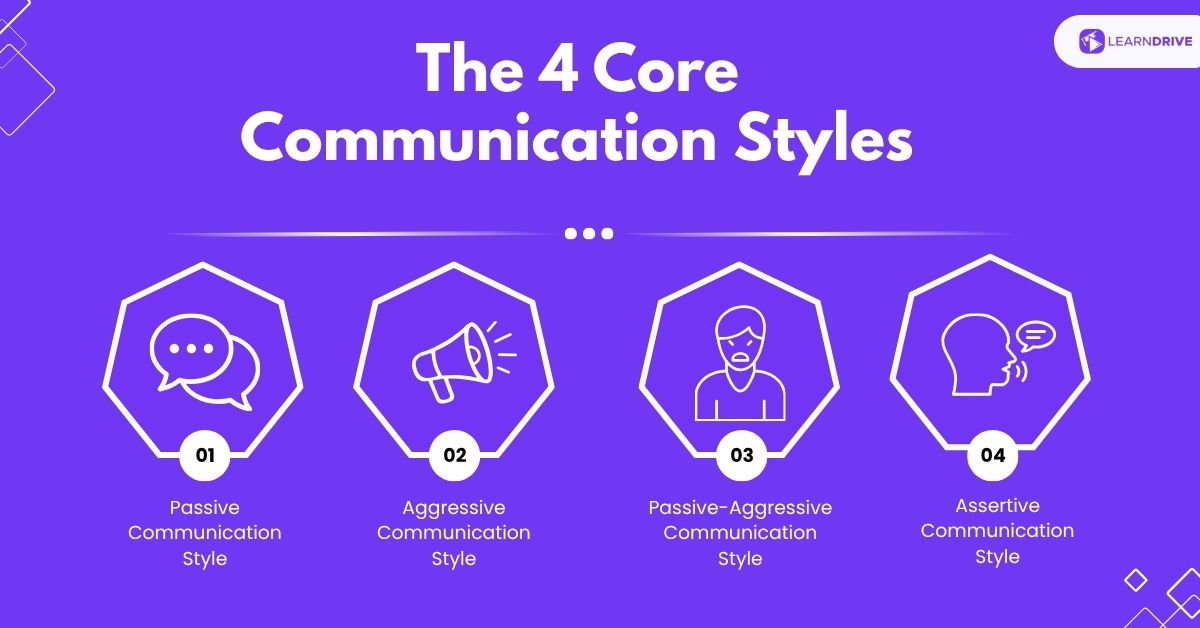
These are the four foundational communication styles recognized across virtually every workplace communication framework. They describe how people handle self-expression, conflict, and emotional situations at work. Think of these as the ’emotional blueprint’ of communication.
Quick fact: A global survey by the Niagara Institute found that 75.3% of professionals primarily use an assertive communication style, while smaller percentages lean passive (10.5%), passive-aggressive (8.7%), or aggressive (5.5%).
1. Passive Communication Style
Motto: ‘Whatever you think is fine with me.’
Who They Are
Passive communicators are the quiet ones in the room. They avoid confrontation, rarely volunteer opinions, and often go along with decisions even when they privately disagree. They tend to suppress their own needs and feelings to keep the peace.
How to Recognize a Passive Communicator
• Rarely speaks up in group meetings or large discussions
• Uses vague, non-committal language: ‘Sure,’ ‘Whatever works,’ ‘I don’t mind’
• Agrees to things they are uncomfortable with to avoid conflict
• Body language is often closed or withdrawn — avoiding eye contact
• Difficult to read — you may not know when they are struggling
Strengths
• Excellent listeners — they absorb more than most
• Thoughtful and measured — they rarely react impulsively
• Create low-conflict environments — easy to work alongside
• Often notice things others miss because they observe quietly
Watch Out For
• Their real needs go unmet, and resentment can build slowly beneath the surface
• They may agree in meetings and then not follow through — not out of dishonesty, but because they felt pressured to agree
• Important ideas and concerns get lost because they never voice them
How to Work With a Passive Communicator
• Use one-on-one settings rather than group meetings — they open up much more in private
• Directly ask for their opinion: ‘I really want to know what you think about this’
• Give them advance notice before asking for their input — they need time to prepare
• Create a genuinely safe space where speaking up is celebrated, not punished
2. Aggressive Communication Style
Motto: ‘My way or the highway.’
Who They Are
Aggressive communicators are dominant, forceful, and often loud — in words, tone, and body language. They express their views strongly, sometimes at the expense of others. Their goal is to win, to be heard, and to get results — and they often do not notice (or care) if they leave damage in their wake.
How to Recognize an Aggressive Communicator
• Speaks over others, interrupts frequently
• Uses intense eye contact, leans into personal space
• Uses blaming language: ‘You always,’ ‘You never,’ ‘This is your fault’
• Raises their voice when challenged or frustrated
• Reacts quickly without thinking through the impact
Strengths
• Decisive and confident — they get things done
• Take control quickly in a crisis when others freeze
• No ambiguity about where they stand
Watch Out For
• Damages team morale and psychological safety over time
• Discourages others from sharing ideas or speaking up
• Can create a culture of fear — team members comply rather than collaborate
How to Work With an Aggressive Communicator
• Stay calm and do not match their energy — reacting with equal force escalates things
• Keep conversations task-focused and factual, not personal
• Set clear professional boundaries respectfully but firmly
• Do not capitulate just to end the confrontation — it reinforces the behavior
3. Passive-Aggressive Communication Style
Motto: ‘Fine. Whatever. I am totally fine.’
Who They Are
The passive-aggressive communicator is arguably the most complex and frustrating to navigate. On the surface, they appear cooperative and agreeable. Underneath, they are expressing frustration, resentment, or disagreement — just indirectly. This style is often developed by people who have been passive for years and have never felt safe to be direct.
How to Recognize a Passive-Aggressive Communicator
• Says ‘Fine’ or ‘Sure’ — but nothing is actually fine
• Uses backhanded compliments: ‘Wow, you actually finished that on time!’
• Procrastinates on tasks assigned by people they disagree with
• Uses sarcasm or subtle put-downs disguised as jokes
• Gives the silent treatment when upset instead of addressing the issue
Strengths
• They often notice real problems — their frustration is usually rooted in a genuine concern
• Can provide an unspoken check on overconfidence or group think
Watch Out For
• Creates hidden tension that is very difficult to address directly
• The indirect nature of their communication makes it nearly impossible to resolve
• Poisons team culture over time — other team members pick up on the tension even if they cannot name it
How to Work With a Passive-Aggressive Communicator
• Do not take the bait in their indirect jabs — respond to the content, not the tone
• Create a consistently safe environment for direct, honest feedback
• When addressing issues, focus on specific behaviors, not character or personality
• Sometimes, naming what you observe gently can open a real conversation: ‘I noticed some hesitation — is there something you want to share?’
4. Assertive Communication Style (The Gold Standard)
Assertive communicators are the gold standard of workplace communication. They are confident and direct, but also genuinely respectful. They say what they mean, mean what they say, and do so without steamrolling others or retreating into silence. They can say no, give difficult feedback, and disagree — all while maintaining a positive relationship with the person they are talking to.
How to Recognize an Assertive Communicator
• Uses ‘I’ statements: ‘I think,’ ‘I need,’ ‘I feel,’ ‘I disagree because…’
• Listens actively and genuinely considers others’ points before responding
• Says no when needed, without guilt or excessive apology
• Maintains confident but open body language — eye contact, upright posture, calm tone
• Addresses issues directly rather than letting them fester
Strengths
• Encourages open dialogue and genuine collaboration
• Builds trust quickly — people know exactly where they stand
• Resolves conflict effectively and fairly
• Creates environments where others feel safe to speak up too
How to Become More Assertive
• Replace ‘You always do this’ with ‘When this happens, I feel…’
• Practice saying no — clearly and kindly, without over-explaining
• Combine confidence with curiosity: state your view, then genuinely ask for theirs
• Remember that being assertive is not about winning — it is about being honest and respectful simultaneously
The 4 Thinking-Based Communication Styles
 Beyond emotional expression, people also communicate differently based on how they think and what kind of information they prefer. These styles, developed by leadership researcher Mark Murphy, are especially visible in meetings, presentations, and collaborative projects.
Understanding these four styles explains why two equally smart, equally well-intentioned people can sit through the same presentation and walk away with completely different reactions.
The Analytical Communicator
Analytical communicators do not just want to know the result — they want to know how you got there, what the data says, what the margins of error are, and what assumptions were made along the way. ‘Trust me’ is not good enough for them. Show them the numbers.
• Best suited for: Finance, research, engineering, quality control
• In meetings: They ask deep, specific questions that might feel like interrogation — but it is just due diligence
• Watch out for: They can get lost in analysis and delay decisions
• Tip for working with them: Lead with data. Skip the storytelling. Come prepared with evidence.
The Intuitive Communicator
Intuitive communicators hate getting bogged down in details. They want the overview — fast. They think in leaps rather than steps, which makes them great innovators but sometimes frustrating collaborators for detail-oriented colleagues.
• Best suited for: Strategy, innovation, entrepreneurship, creative roles
• In meetings: They get impatient with step-by-step walkthroughs — they already see the destination
• Watch out for: They can be spectacularly wrong because they skip important details
• Tip for working with them: Lead with the bottom line. Save the process for later — or skip it entirely.
The Functional Communicator
Functional communicators want a roadmap. They need to understand every step from A to B before they feel comfortable moving forward. Like analytical communicators, they value details — but what they really care about is process and sequence.
• Best suited for: Project management, operations, logistics, compliance
• In meetings: They want a clear agenda, clear next steps, and clear ownership
• Watch out for: They can be frustratingly methodical when speed is needed
• Tip for working with them: Give them a structured plan. Never leave timelines vague.
The Personal Communicator
Personal communicators are the emotional heart of any team. Before they can do business, they need to feel connected. They use emotional language naturally and often pick up on how others are feeling before anyone else does.
• Best suited for: HR, counseling, customer service, team-building, coaching
• In meetings: They notice when someone is disengaged or upset and will address the human dimension others miss
• Watch out for: They can struggle in environments where everything is purely task-focused
• Tip for working with them: Build rapport before diving into business. Ask how they are doing — and mean it.
The Complete Guide to 36 Communication Models
 Now we go deeper. Below you will find every major communication framework used by professionals, coaches, HR teams, and organizations worldwide — organized into 8 clear categories so you can find exactly what you need, when you need it.
Think of these models as tools in a toolbox. You do not need to memorize all of them. You need to know which tool to reach for in which situation.
Category A: Core Personality & Style Models
These models help you understand the fundamental personality-based communication tendencies of yourself and others. They are widely used in team assessments, coaching, and leadership development.
Model 1: The DISC Model
The DISC model is one of the most widely used personality communication frameworks in the business world. It categorizes people into four primary styles based on how they approach tasks and relationships.
Best used for: Team assessments, hiring decisions, leadership development programs, and adapting your management style to each team member.
Model 2: The PACE Model
The PACE model is a softer, relationship-focused framework often used in coaching and interpersonal communication training.
Model 3: The Social Styles Model (Wilson Learning)
Used extensively in sales training and leadership development, the Social Styles model categorizes communication along two axes: assertiveness and responsiveness.
Category B: Psychological & Self-Awareness Models
These models go deeper into the psychology of communication, helping individuals understand not just how they communicate but why — and how to build greater self-awareness for more effective interactions.
Model 4: Transactional Analysis — The PAC Model (Eric Berne)
Developed by psychiatrist Eric Berne, Transactional Analysis describes three ‘ego states’ that determine how we communicate in any given moment. Understanding which state you and others are operating from can transform difficult conversations.
The healthiest workplace communication happens Adult-to-Adult. When a manager communicates Parent-to-Child, it creates resentment and dependence. Aim for Adult state whenever possible.
Model 5: The Johari Window Model (Luft & Ingham)
The Johari Window is a self-awareness tool developed by psychologists Joseph Luft and Harry Ingham. It maps what you know about yourself against what others know about you — revealing the gaps that create communication breakdowns.
Workplace application: The goal is to expand your Open Area as much as possible through honest feedback, self-disclosure, and trust. The bigger your Open Area, the less room there is for misunderstanding.
Category C: Practical Workplace Communication Frameworks
These are the hands-on, everyday models that professionals use to structure conversations, give feedback, and communicate with clarity. Bookmark this section — you will use it often.
Model 6: The 7 Cs of Communication
The 7 Cs are the gold standard checklist for any professional communication — emails, presentations, meetings, or conversations. If your communication checks all 7, it is virtually impossible to misunderstand.
Model 7: The CUDSA Model
CUDSA is a powerful framework for navigating conflict and difficult conversations. It moves both parties from ‘the argument’ to ‘the solution’ through five structured steps.
Model 8: The PALM Model
A simple, powerful framework for communicators who tend to react before they think. PALM is especially useful for those who communicate aggressively or passive-aggressively under stress.
Model 9: The SBI Feedback Model (CCL)
Developed by the Center for Creative Leadership, the SBI model is the cleanest, most effective framework for giving feedback. It eliminates blame, focuses on observable behavior, and keeps feedback objective.
Why SBI works: It focuses on behavior, not personality. You are not saying ‘you are rude’ — you are saying ‘when you did X, it had Y effect.’ Almost impossible to argue with. Highly effective.
Model 10: Nonviolent Communication — NVC (Marshall Rosenberg)
NVC is a communication approach developed by psychologist Marshall Rosenberg. It is rooted in empathy and compassion, and is especially powerful for high-stakes or emotionally charged conversations.
Category D: Active Listening & Dialogue Models
Great communication is 50% speaking and 50% listening — and most people are far better at the former than the latter. These models turn listening into a structured, active skill.
Model 11: The LASER Model
The LASER Model is a simple communication framework designed to improve understanding, trust, and problem-solving in conversations. By following five clear steps — Listen, Acknowledge, Speak, Engage, and Resolve — it helps create respectful, productive, and solution-focused discussions.
Model 12: The CLEAR Model (Coaching Conversations)
The CLEAR Model is a practical framework for effective coaching conversations and meaningful guidance. By focusing on connection, active listening, thoughtful exploration, clear action steps, and regular follow-up, it encourages growth, accountability, and supportive communication.
Model 13: The SOLER Model (Gerard Egan) — Active Listening Body Language
SOLER is the gold standard for active listening body language. It is used in counseling, coaching, and leadership training to show the speaker that you are fully present.
Model 14: The LEAPS Model (De-escalation & Empathy)
The LEAPS Model is a simple yet powerful communication framework used to build trust, reduce conflict, and improve understanding during difficult conversations. By focusing on active listening, empathy, and clear communication, LEAPS helps create calm, respectful, and productive interactions.
Model 15: The HEAR Model (Conflict & Complaint Resolution)
The HEAR Model is an effective approach for handling conflicts and customer complaints with professionalism and care. It focuses on understanding the issue, showing empathy, taking responsibility when needed, and providing clear solutions to resolve situations positively.
Category E: Workplace & Leadership Communication Models
These models are designed specifically for professional and leadership contexts — briefing up the chain, giving feedback assertively, managing conflict, and communicating with clarity under pressure.
Model 16: The SBAR Model
Originally developed in healthcare, SBAR has become a go-to framework for any situation where you need to brief someone quickly and ensure nothing important gets lost.
Model 17: The DESC Model (Assertive Confrontation)
DESC is ideal when you need to address a problem assertively without being aggressive. It structures a difficult conversation so it stays calm and focused on resolution.
Model 18: The AID Model (Forward-Focused Feedback)
The AID Model provides a constructive way to give feedback by focusing on actions, their impact, and better future outcomes. It encourages clear, solution-oriented conversations that support growth and improvement without creating defensiveness.
Model 19: The REACH Model (Leadership Communication)
The REACH Model highlights the key qualities of strong leadership communication, including respect, empathy, clarity, and humility. It helps leaders build trust, inspire teams, and communicate with confidence and purpose.
Model 20: The AEIOU Model (Conflict Mapping)
The AEIOU Model is a practical framework for resolving disagreements through open dialogue and shared understanding. By encouraging calm discussion and mutual goals, it helps create collaborative and respectful solutions.
Model 21: The STAR Communication Model
STAR is best known as an interview technique, but it is equally powerful for structured storytelling in presentations, case studies, and leadership communication.
Category F: Classic & Foundational Communication Models
These are the theoretical foundations that shaped everything we know about communication today. While they are older, they remain deeply relevant for understanding why communication succeeds or breaks down.
Model 22: The Shannon-Weaver Model (1948)
The Shannon-Weaver model, developed by mathematician Claude Shannon and scientist Warren Weaver, was the first formal model of communication. Originally designed for telecommunications, it became the foundation for all communication theory.
• Flow: Sender → Encoder → Channel → Decoder → Receiver
• Key innovation: Introduced the concept of ‘noise’ — anything that interrupts or distorts a message
• Types of noise in the workplace: Physical (a loud office), semantic (jargon), psychological (bias), cultural (different norms)
Workplace application: Before any important communication, ask yourself — what ‘noise’ might be affecting how my message is received? Then address it proactively.
Model 23: Berlo’s SMCR Model (1960)
David Berlo expanded on Shannon-Weaver by emphasizing that both the sender AND receiver bring skills, attitudes, and knowledge to every interaction.
Model 24: Aristotle’s Communication Model (Ancient Greece)
More than 2,000 years old and still the most relevant model for leadership communication and public speaking. Aristotle argued that all persuasive communication rests on three pillars:
• Ethos — Credibility: Do they trust and respect you? Are you the right person to deliver this message?
• Pathos — Emotion: Does the message connect emotionally? Does the audience care about what you are saying?
• Logos — Logic: Is your argument logical and well-supported? Do the facts back you up?
Workplace application: Every great presentation, pitch, or difficult conversation should balance all three. Logos without Pathos are cold and disconnected. Pathos without Logos is manipulative. Ethos without both is hollow authority.
Model 25: Lasswell’s Model (1948)
Harold Lasswell’s model reduces communication to five essential questions — a simple but powerful audit tool for any failed communication.
Who says What, in Which Channel, to Whom, with What Effect?
Workplace application: When communication fails, run it through Lasswell’s five questions. Did the wrong person send the message? Was it sent through the wrong channel? Was the message itself unclear? Did the receiver miss it? Did it have an unintended effect?
Model 26: The Osgood-Schramm Circular Model
This model was a revolutionary update to the linear Shannon-Weaver model. Osgood and Schramm argued that communication is not one-way — it is a continuous loop where both parties are simultaneously sending and receiving.
• Both people are always encoding AND decoding at the same time
• Communication is never truly finished — every response creates a new message
Workplace application: This is why listening is an active skill, not a passive one. While someone is speaking to you, you are already decoding, interpreting, and preparing your response. Slow that process down. Truly listen before you react.
Category G: Team & Collaboration Communication Models
Communication within teams is uniquely complex. These models address the dynamics of group communication, conflict within teams, and the stages that teams go through as they learn to work together.
Model 27: The Tuckman Model — Stages of Team Communication
Developed by psychologist Bruce Tuckman, this model describes the five stages every team goes through — and how communication changes at each stage.
Communication styles shift dramatically at each stage. What works in Forming (structured, directive) will suffocate a Performing team. Great leaders adapt their communication at every stage.
Model 28: The CRIB Model (Conflict Resolution)
The CRIB Model is a collaborative approach to resolving conflict by encouraging respect, curiosity, and teamwork. It helps individuals move beyond arguments and focus on understanding each other while working toward solutions that benefit everyone involved.
Model 29: The BIFF Model (Written Communication)
BIFF is specifically designed for emotionally charged written communication — the kind of email you are tempted to send in the heat of the moment. Before you hit send, run it through BIFF.
Model 30: The SAUCY Feedback Model
The SAUCY Feedback Model is a practical framework for delivering feedback in a clear, constructive, and results-driven way. By keeping feedback specific, actionable, and easy to understand, it helps encourage positive change and better performance.
Category H: Customer Service & Professional Communication Models
These models are essential for anyone in client-facing, service-oriented, or external communication roles. They also apply broadly to any professional situation where clarity, empathy, and professionalism matter.
Model 31: The AWARE Model
The AWARE Model promotes mindful and effective communication by encouraging active attention, thoughtful responses, and continuous reflection. It helps individuals better understand others, respond with intention, and improve the quality of conversations.

How to Identify Your Communication Style?
 Knowing communication styles intellectually is one thing. Knowing your own style — truly, honestly, with all its strengths and blind spots — is what actually changes how you show up at work.
Here is a practical roadmap for discovering your authentic communication style.
Step 1: Self-Reflection Questions
Start by answering these questions honestly:
• When you disagree with your manager or a colleague, what do you typically do?
• In a group meeting, do you tend to speak first, wait your turn, or rarely speak at all?
• What happens to your communication style when you are under stress or a deadline?
• When someone gives you feedback, is your first reaction to defend yourself, agree quickly, or explore it?
• Do people often misunderstand what you meant to say? If so, in what types of situations?
Step 2: Watch for Patterns
• Notice your body language during conflict — do you lean in, cross your arms, or avoid eye contact?
• Track how often you interrupt others versus how often you are interrupted
• Pay attention to how many times per week someone asks you to clarify something you said or wrote
• Notice which type of communication makes you most uncomfortable — giving feedback, receiving it, saying no, or being confronted?
Step 3: Ask for Honest Feedback
This is the most powerful step — and the most uncomfortable. Ask people you trust:
• ‘When do you feel I communicate really well? Can you give me a specific example?’
• ‘Is there a situation where you felt misunderstood by me or unsure of what I needed?’
• ‘What is one thing about my communication style that you would want me to be aware of?’
The goal is not to change who you are — it is to understand how your natural style lands on others, and to have more tools available when the situation calls for adjustment.
Step 4: Take a Validated Assessment
• DiSC Assessment — discprofile.com (excellent for workplace contexts)
• Niagara Institute Communication Styles Quiz (free, workplace-focused)
• High Strengths Assessment — strengths-based, positive framing
• Myers-Briggs Type Indicator (MBTI) — broader personality, includes communication tendencies
When Styles Clash — and How to Bridge the Gap
 Even in the healthiest workplaces, communication style clashes happen. Here are the most common ones — and exactly what to do about them.
Common Communication Clashes
Common communication clashes often happen when people have different communication styles, priorities, or ways of processing information. Understanding these differences and adapting communication approaches can reduce misunderstandings, improve collaboration, and create more productive relationships in both personal and professional settings.
The Communication Flex
Here is the most important mindset shift: you do not need to change your communication style. You need to flex it.
Flexing means temporarily adapting how you communicate to meet someone else where they are — not abandoning who you are, but stretching to include their preferences.
• An intuitive communicator preparing a report for an analytical manager: Lead with data, include detailed appendices, reference sources.
• An analytical communicator presenting to the executive team: Lead with the conclusion, not the methodology. Executives are usually intuitive communicators.
• A personal communicator giving feedback to a D-style colleague: Get to the point faster. They will respect it.
The golden rule of workplace communication: Communicate to be understood, not just to be heard.
Communication Styles in Different Workplace Contexts
 Let’s see various communication styles according to different workplace contexts.
1. In Meetings
Meetings are where communication style differences show up most visibly. A single meeting room can contain every style simultaneously.
• Passive communicators: Never speak up unless directly asked. Create structured ’round the room’ check-ins so everyone contributes.
• Aggressive communicators: Dominate discussions. Use a facilitator who can redirect: ‘Let us hear from someone who has not spoken yet.’
• Assertive communicators: Keep things productive. Leverage them to model the tone you want.
• Analytical communicators: Send the agenda and supporting data before the meeting — never spring information on them cold.
• Intuitive communicators: Get to the point fast. Put the conclusion in slide 1, not slide 15.
2. In Email and Digital Communication
Email is where communication style clashes cause the most long-term damage — because tone is almost impossible to convey accurately in text.
• Use the BIFF Model before sending any emotionally charged email: Brief, Informative, Friendly, Firm
• Run every important message through the THINK filter: True, Helpful, Inspiring, Necessary, Kind
• Apply the 7 Cs to every professional email — especially Clear and Concise
• Remember: 65% of remote employees say they need more social interaction — do not let digital communication become purely transactional
3. In Leadership and Management
Effective leadership communication is fundamentally about adapting to the person in front of you, not communicating the same way with everyone.
• Use DISC profiles to understand each team member’s style before your next 1:1
• Use SBAR for briefing upward — it respects your leader’s time while ensuring nothing important is missed
• Use SBI or AID for performance feedback — never give feedback without a clear structure
• Model assertive communication — show your team what it looks like to be direct and kind at the same time
4. In Remote and Hybrid Teams
Remote work has introduced an entirely new layer of communication complexity. Every style is magnified — passive communicators become invisible, aggressive styles become even more overwhelming in a text-only channel.
• Personal communicators suffer most in remote settings — build in deliberate social connection time
• Analytical communicators thrive — written communication gives them the paper trail they love
• Establish explicit communication norms for your team: which channels for what, expected response times, meeting protocols
5. In Conflict and Feedback
Different situations call for different models. Here is a quick guide:
How to Build a Communication-First Workplace Culture?
 Individual communication skills matter enormously. But they can only take you so far if the culture around them does not support open, honest, respectful communication. You can be the most assertive communicator in the world — but if your organization punishes people for speaking up, your skills will not save you.
Here are some practical steps for building a communication culture inside your organization.
For Teams
• Run a DISC or communication styles assessment as a team — and share the results openly
• Create explicit communication norms: how you run meetings, how you give feedback, how you handle conflict
• Practice the 7 Cs in all written communication — make it a team standard
• Normalize feedback using SBI or AID — make giving and receiving feedback a regular rhythm, not a special event
• Create psychological safety explicitly: celebrate questions, protect dissenting views, never punish honest mistakes
For Managers
• Adapt your communication style to each team member — not the other way around
• Model the behavior you want: be assertive, use SOLER body language, give structured feedback
• Hold regular 1:1s where the primary purpose is listening, not updating
• When things go wrong, use CUDSA or CRIB to resolve — never shut down conflict by force
• Invest in communication training before people lead teams, not after
For Organizations
• Make communication style awareness part of onboarding
• Invest in manager communication training — the ROI is enormous
• Build feedback loops at every level: upward, downward, and peer
• Measure communication effectiveness — employee surveys, engagement scores, and turnover data all tell the story
The goal is not a workplace where everyone communicates the same way. It is a workplace where every style is understood, respected, and given the space to contribute its unique strengths.
Quick Reference — All 36 Models at a Glance
Use this table as your go-to reference guide. Bookmark it, print it, pin it above your desk.