10 Signs You Will Get the Job After Interview
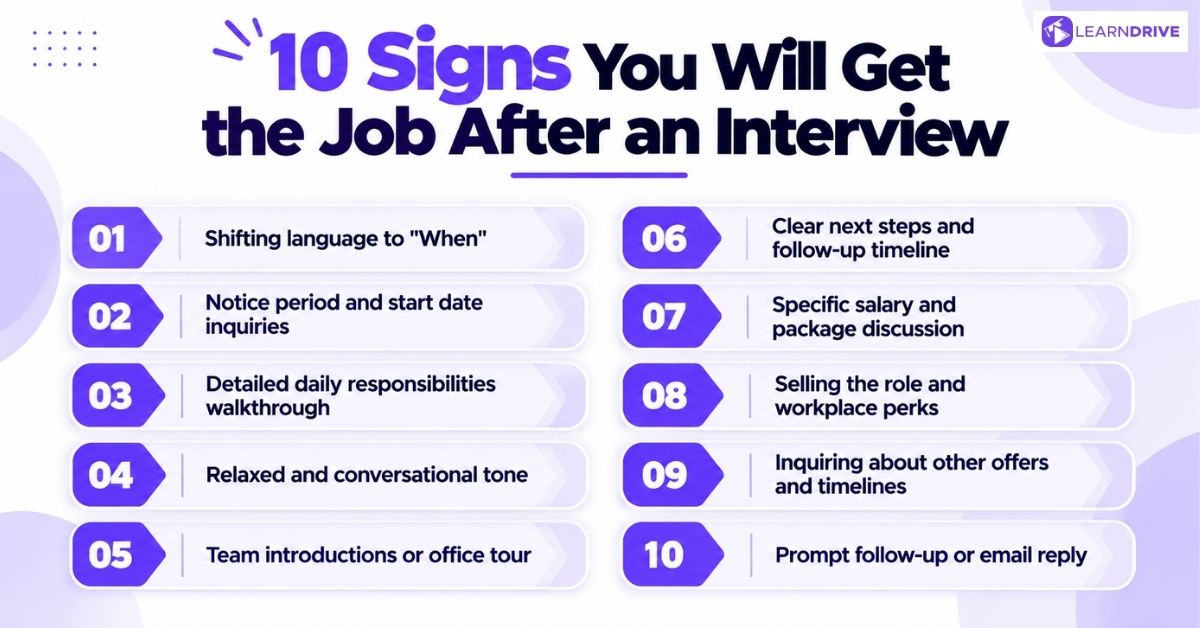
Observing how an interview unfolds provides valuable clues about your standing. Below are ten practical signs that indicate an employer is leaning toward making an offer, along with real-world scenarios illustrating how they typically sound in practice.
1. The Interviewer Uses “When” Instead of “If”
When an interviewer shifts from conditional phrasing to presumptive language, they are mentally placing you in the position. Instead of asking, “If you were offered the post, how would you approach the audit?”, the panel chair says, “When you start in October, your first priority will be leading the compliance review with our regional directors.”
This subtle linguistic slip often reveals that the panel is already envisioning your day-to-day contribution.
2. They Ask About Your Notice Period and Start Date
Inquiries regarding your contractual notice period show that the panel is evaluating practical start dates rather than general availability. The hiring manager notes your current employment and asks: “Your CV mentions you are currently with an NHS trust.
What is your required contractual notice period under your current agreement, and could you join us for our team training on the first of the month?” Discussing calendar dates means the team is preparing onboarding timelines.
3. They Discuss Your Daily Responsibilities in Detail
Walking through day-to-day duties in depth suggests the interviewer is testing your fit for real operational challenges.
Rather than sticking to the generic job description, the team lead opens their project management board: “On Monday mornings, you will manage our sprint standups, and by Wednesday, you will present the KPI figures directly to the operations director.” This level of specificity helps both sides establish a concrete picture of daily performance.
4. The Conversation Becomes Relaxed and Conversational
An interview that moves beyond a formal question-and-answer exchange indicates strong interpersonal rapport.
After standard competency questions conclude, the lead interviewer sets their notes aside, laughs about a common industry challenge, and spends ten minutes discussing team dynamics, workplace culture, and shared experiences. A relaxed atmosphere suggests the interviewers feel comfortable with your professional presence.
5. They Introduce You to Colleagues or Give You an Office Tour
Unplanned introductions to team members indicate that the hiring manager wants to validate cultural fit before making a decision. At the end of the meeting, the interviewer remarks: “We have five minutes before our department catch-up.
Let me walk you over to the desk pods so you can meet Sarah and James, who manage the accounts you would be working on.” Broadening the evaluation to colleagues shows high confidence in your candidacy.
6. They Outline Next Steps and Schedule a Follow-Up Interview
Providing an exact timeline for subsequent stages reflects serious momentum in the recruitment process. Rather than closing with a generic remark, the hiring lead specifies: “Our panel meets this Thursday to score all candidates, and our talent partner will ring you on Friday morning to book your second-stage presentation with our managing director next Tuesday.” Specific calendar dates indicate you are advancing through the selection funnel. This clarity often follows thoughtful questions to ask at the end of an interview, demonstrating strong candidate engagement before closing the discussion.
7. They Discuss the Specific Salary and Package Details
Detailed discussions about your compensation expectations indicate that the employer is assessing whether your package fits their approved budget. The HR lead asks: “Our advertised band is £45,000 to £50,000 with an 8% employer pension contribution and 28 days of annual leave. Does that structure align with your requirements, or are you seeking specific relocation allowances?” Breaking down package specifics suggests the team is preparing figures for a potential proposal.
8. They Actively Sell the Role and Workplace Perks to You
When an interviewer spends considerable time promoting company benefits and growth prospects, they are competing for your commitment.
The manager shifts the focus to your career goals: “Beyond our hybrid policy and private healthcare, we provide an annual professional development bursary and structured progression into senior associate roles within two years.” Persuasive positioning occurs when an employer wants to ensure you accept if selected.
9. They Inquire About Other Job Offers and Interview Timelines
Asking about your activity in the job market shows the employer wants to avoid losing you to a competitor. As the session wraps up, the recruiter asks directly: “Are you currently interviewing elsewhere, and do you have any offers or decision deadlines on the horizon that we need to consider?”
Gauging external pressure helps hiring managers accelerate internal approvals to secure their preferred candidate.
10. They Follow Up or Reply Promptly After the Interview
A rapid, detailed response to your follow-up note or an early phone call from HR signals that your application has top priority. You send a concise thank-you email two hours after leaving, and the hiring manager replies within the hour: “Thank you for coming in today; the team was very impressed with your presentation.
We are concluding final interviews tomorrow and will be in touch directly on Thursday afternoon.” Swift communication demonstrates proactive engagement.
Signs That Can Be Routine (And Why Context Matters)
In structured competency panels, public sector interviews (such as the Civil Service and NHS), and large corporate assessment centers, asking about notice periods, salary brackets, and providing office tours are frequently mandatory requirements applied equally to all candidates. It is important not to overinterpret these procedures without supporting behavioural signals.
Understanding UK Hiring and Job Offer Stages
Under UK employment law, an unconditional verbal offer can form a legally binding contract once accepted (see Acas guidance on job offers). However, most initial offers in the UK are made conditionally. A formal employment contract sets out key terms—which vary across different types of employment contracts—standardly arriving as a conditional job offer subject to references and statutory checks.
Standard UK reference checks and right-to-work checks typically occur after a conditional job offer has been issued. Standard DBS checks apply to regulated sectors (such as healthcare, education, and social care), whereas financial roles typically undergo regulatory screening under the FCA and PRA rather than standard DBS checks.
Candidates should wait until they hold a signed, unconditional written offer before resigning from their current position. Once formal terms are finalized, knowing how to accept a job offer promptly confirms your start date and locks in your agreed package. In practice, hearing back with final paperwork usually takes between a few days and a couple of weeks.
4 Signs Your Interview May Not Have Gone as Expected
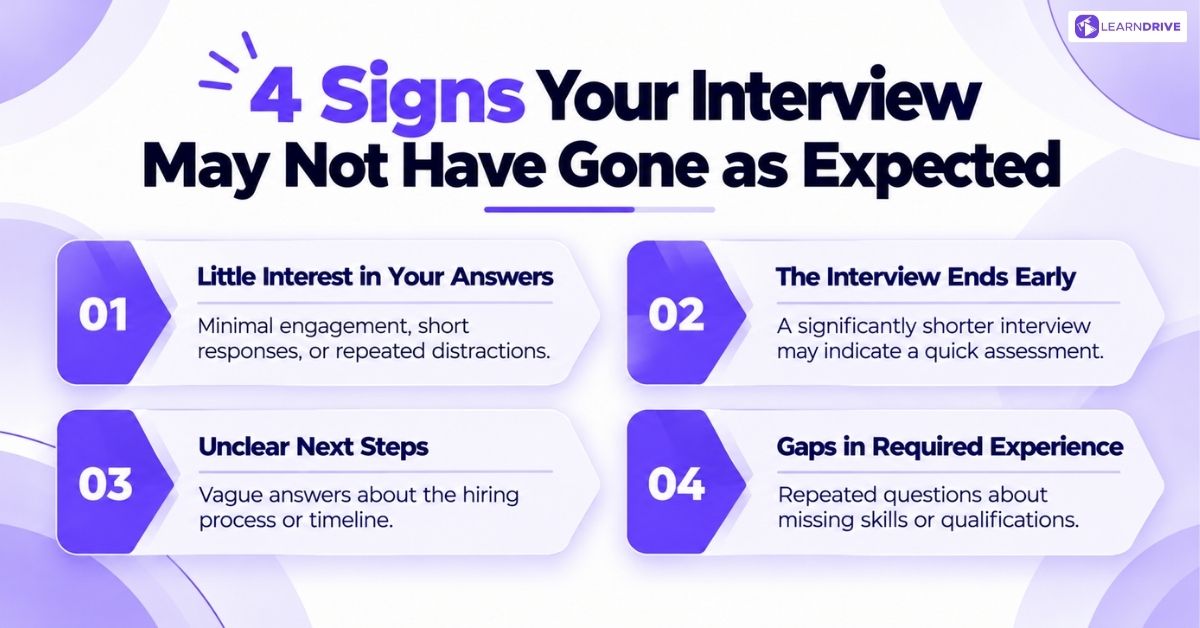
Not every interview goes smoothly, and some signals point the other way. Recognising them early helps you manage expectations and plan your next move.
1. The Interviewer Shows Little Interest in Your Answers
Short responses, minimal eye contact, or checking the time repeatedly can signal disengagement. This does not always mean rejection, but it rarely feels encouraging in the moment.
A distracted interviewer may simply be having a busy day, so weigh this sign alongside others rather than in isolation.
2. The Conversation Ends Much Earlier Than Expected
A short meeting may reflect an interviewer’s tight timetable or efficient competency scoring rather than an automatic rejection. However, wrapping up significantly early can sometimes suggest the interviewer made a swift assessment.
3. They Cannot Explain the Next Steps
Vague or dismissive answers about what happens next can indicate limited investment in your candidacy. Strong candidates usually receive clear, specific information about the process ahead.
If the interviewer seems reluctant to commit to any timeline, treat that hesitation as a mild warning sign.
4. Your Experience Does Not Match the Main Requirements
If questions repeatedly circle back to gaps in your background, the employer may be testing your fit. Persistent focus on missing skills can be a warning sign. In future interviews, preparing well-structured answers around your strengths and weaknesses for job interviews can help address potential doubts before they influence the panel’s decision.
Use these questions as useful information too, since they highlight exactly which skills might be worth developing next.