Low-Stress Jobs for Autistic Adults

11 Low-Stress Jobs for Autistic Adults: Careers That Fit, Support, and Empower

Ever felt like the workplace just wasn’t built with your brain in mind?
If you’re autistic, you’re not alone. For many autistic adults, traditional jobs can feel overwhelming—packed with sensory distractions, unpredictable demands, and unclear social expectations. But here’s the good news: the right job can exist. In fact, some careers are especially well-suited to the strengths and preferences of autistic individuals.

In this blog, we’ll explore what makes a job truly low-stress for autistic adults, the key features to look out for, and how to align your career path with your comfort, skills, and wellbeing.

Table of Contents

What Makes a Job Low Stress for Autistic Adults?

What Makes a Job Low Stress for Autistic Adults

Let’s start with the basics. What does “low stress” actually mean for someone on the autism spectrum? The answer is different for everyone, but certain stress triggers come up consistently, like sensory overload, unpredictable routines, vague communication, and forced social interaction.

The most suitable jobs avoid these triggers and instead offer an environment where autistic professionals can thrive.

Here’s what to look for:

1. Predictability and Routine

The autistic brain often craves structure. A low-stress role is one where your tasks, hours, and responsibilities are clearly defined and consistent. Having the same start and finish times, recurring responsibilities, and a stable daily rhythm builds confidence and reduces anxiety.

2. Autonomy Over Workflow

Micromanagement rarely helps anyone—but for autistic employees, it can be especially draining. Jobs that allow for independent work and self-paced task management are often ideal. Autonomy also reduces the social pressure of constant collaboration or small talk.

3. Clear and Explicit Communication

Ambiguity is a major source of stress. Many autistic adults do best in environments where instructions are direct, expectations are spelt out, and feedback is constructive. Clarity in communication fosters trust and boosts performance.

4. Sensory-Friendly Workspaces

Loud, bright, chaotic environments can quickly lead to overwhelm. Look for jobs with minimal noise, natural lighting, and fewer distractions. A calm sensory environment helps you stay focused and comfortable throughout the day.

5. Flexibility and Remote Options

Flexible working hours and the ability to work from home aren’t just perks—they can be essential. Flexibility supports better energy regulation, reduces commuting stress, and gives you more control over your sensory space.

Together, these features don’t just reduce stress—they help create a workplace where autistic individuals can excel.

Only £1  £249
All-Access Course Bundle
Unlock 100+ CPD-accredited courses for just £1. Industry-recognised certificates. Learn at your own pace.

Key Characteristics of Low-Stress Jobs

Key Characteristics of Low-Stress Jobs

So, what do low-stress jobs actually look like in practice? While every person is different, the best roles for autistic adults tend to share a few common traits:

  • Clear expectations: You know what’s expected, how to do it, and when it’s due.

  • Routine and repetition: The tasks follow a familiar pattern, reducing mental load.

  • Limited social demands: Less emphasis on team lunches or spontaneous calls—more focus on the work itself.

  • Detail-oriented tasks: Whether it’s spotting errors or organising data, your focus is a strength.

  • Quiet, orderly settings: Peaceful environments support sustained attention and comfort.

By understanding these traits, you can start identifying jobs that fit you, rather than trying to squeeze yourself into a workplace that doesn’t.

11 Best Low-Stress Jobs for Autistic Adults
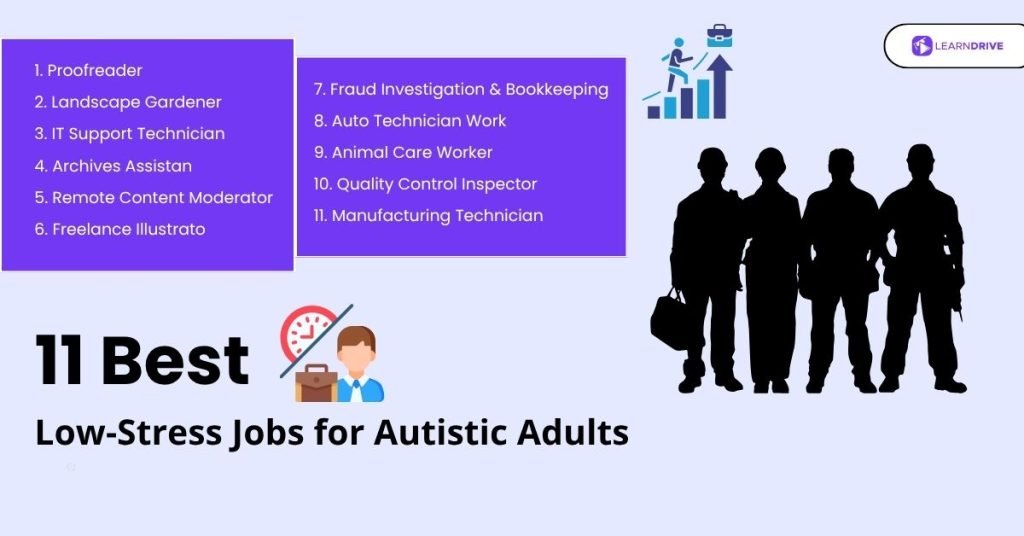
Low-Stress Jobs for Autistic Adults

Let’s dive into real-world examples of jobs that suit the unique strengths and preferences of autistic adults. These roles are low in sensory overload, require minimal social interaction, and often follow structured routines, making them practical, rewarding, and mentally manageable.


1. Proofreader

Are you someone who notices every typo in a blog or spots double spaces instantly? Then proofreading might be your calling.

Proofreaders review written content for errors in grammar, punctuation, and formatting. The role is solitary, quiet, and highly detail-focused—an ideal match for autistic individuals who excel in precision-based work. It’s also typically deadline-driven, not time-sensitive by the minute, giving you control over your workflow.

 Why it’s low-stressed:

  • Minimal social interaction

  • Predictable, structured tasks

  • Strong alignment with detail-oriented thinking

2. Landscape Gardener

Prefer the outdoors to an office cubicle? Landscape gardening could offer the perfect balance of structure and peace.

This role involves planting, pruning, and maintaining outdoor spaces—sometimes following formal designs, sometimes based on ongoing upkeep. Working alone or in small teams, often outdoors in calm, green environments, brings natural sensory relief and space to focus without interruption.

Why it’s low-stressed:

  • Repetitive, grounded physical tasks

  • Reduced sensory overload in natural settings

  • Independence with minimal verbal demands

3. IT Support Technician

If you enjoy solving puzzles and fixing tech glitches, IT support might be a great fit.

As an IT Support Technician, you help maintain systems and troubleshoot hardware or software issues. Much of the communication today happens through ticketing systems or email, meaning clear, written exchanges instead of phone calls or meetings. The logical, step-by-step nature of tech troubleshooting also suits analytical, hyper-focused minds.

 Why it’s low-stressed:

  • Clear, structured problem-solving

  • Remote or asynchronous communication

  • Growth path into specialised technical roles

4. Archives Assistant

Love order, history, and quiet spaces? Consider becoming an archives assistant.

In this role, you help organize and preserve historical records in libraries, museums, or corporate archives. It’s a behind-the-scenes job with a peaceful atmosphere and methodical processes—ideal for someone who values predictability and order.

 Why it’s low-stressed:

  • Quiet, low-stimulation environments

  • Repetitive, well-defined tasks

  • Independent and focused work routines

5. Remote Content Moderator

If you prefer working behind a screen with clear rules and guidelines, content moderation could be an ideal option.

Content moderators review user submissions on websites and platforms, ensuring they align with community standards and legal requirements. The job is typically remote and task-oriented, with little face-to-face communication and a strong rules-based structure.

 Why it’s low-stressed:

  • Remote, asynchronous workflow

  • Clear, policy-driven decisions

  • Minimal unpredictable interaction

6. Freelance Illustrator

Got an artistic side? Freelance illustration lets you turn your creativity into a flexible, independent career.

From children’s books and marketing visuals to game design, illustrators create custom artwork for a wide range of clients. As a freelancer, you choose your projects, set your schedule, and work from a sensory-friendly space. It’s a role that combines autonomy, focus, and creative expression.

 Why it’s low-stressed:

  • Control over your workspace and hours

  • Focused solo work

  • Opportunities to express personal interests through art

7. Forensic Accounting and Bookkeeping

Do you find satisfaction in spotting patterns, balancing numbers, or diving into financial puzzles? For many autistic individuals, careers in accounting offer the structure and precision that make work enjoyable—not overwhelming.

Forensic Accountant

This role involves investigating financial discrepancies, analysing complex data, and helping detect fraud. Forensic accountants must be detail-obsessed and able to focus for extended periods—traits that many autistic professionals excel at. It’s a highly structured job with minimal social interaction and a clear sense of purpose.

Bookkeeper

Bookkeeping involves tracking financial transactions, managing records, and ensuring everything adds up perfectly. If you enjoy working with spreadsheets or budgeting tools, this job can offer a predictable, low-pressure daily routine. Many bookkeeping roles are also remote or freelance-friendly, adding to their flexibility.

 Why these are low-stressed:

  • Numbers-based, logic-driven tasks

  • Minimal ambiguity and social demands

  • Repeatable, consistent workflows

8. Auto Technician Work

Love figuring out how things work or solving mechanical problems? Auto technician roles combine structured environments with clear task objectives and hands-on focus—perfect for autistic individuals who enjoy practical challenges.

As an auto technician, you’ll diagnose, repair, and maintain vehicles, often using systematic diagnostic tools and manufacturer protocols. The step-by-step nature of the work suits those who prefer logical problem-solving and clear procedures.

Why it’s low-stressed:

  • Structured problem-solving and workflow

  • Low pressure for social communication

  • Focused, tactile tasks in a technical setting

9. Animal Care Worker

If you feel more comfortable with animals than people, this path may be exactly what you’re looking for. Animal care roles involve predictable daily routines and tangible responsibilities like feeding, cleaning, and monitoring animal well-being.

Whether in shelters, clinics, farms, or wildlife sanctuaries, this job is rooted in purpose and calm repetition. Many employers value reliability and compassion over formal qualifications, and it’s common to start with volunteering before transitioning into full-time roles.

 Why it’s low-stressed:

  • Task-based, hands-on routines

  • Meaningful work with minimal social pressure

  • Clear daily structure in sensory-friendly environments

10. Quality Control Inspector

If you’re detail-oriented and enjoy following structured procedures, quality control might be a perfect match. Quality inspectors evaluate products to ensure they meet strict standards before they’re released to customers or used in production.

From electronics to pharmaceuticals, this role relies on consistency, precision, and documentation—making it ideal for autistic adults who thrive in routine and accuracy-based environments. Social communication is minimal, and tasks are often checklist-driven.

Why it’s low-stressed:

  • Methodical, consistent daily tasks

  • Emphasis on precision over speed

  • Minimal decision-making pressure or distractions

11. Assembly Line or Manufacturing Technician

If you’re someone who finds comfort in routine and thrives in hands-on, structured tasks, working on an assembly line could be an excellent fit.

Assembly Line Technicians follow a set of defined procedures to assemble, test, or package products as part of a larger production process. The tasks are usually repetitive and well-documented, offering a high degree of predictability. For autistic adults who prefer minimal social interaction and clear expectations, this kind of work environment can be both calming and productive.

The communication is direct and task-oriented, often following checklists or safety protocols. While industrial settings may involve some sensory challenges like noise or lighting, many modern facilities are equipped with ergonomic layouts and noise-reduction strategies—and often make reasonable accommodations when requested.

Why it’s low-stressed:

  • Highly structured tasks with little deviation

  • Minimal decision-making and clear instructions

  • Low reliance on social communication

  • Opportunities for specialisation and growth through on-the-job training

 
Learndrive.org
100+ Free
Courses
Enhance your skills — no spending required. CPDQE Accredited.

Advice for Autistic Job Seekers

Advice for Autistic Job Seekers

Finding a well paying low-stress job that supports your mental health and career aspirations is possible, but it starts with knowing yourself.

Here are some key steps to help you navigate your job search with confidence and clarity:


1. Define What “Low Stress” Means to You

Take stock of your sensory, social, and cognitive preferences. Think about past roles where you felt focused and at ease—and what triggered stress or burnout. This reflection helps you filter out work environments that don’t align with your needs.

2. Use Neurodiversity-Friendly Platforms

Look for job boards and organisations that specialise in inclusive hiring, such as Auticon, Specialisterne, or Evenbreak. These platforms work with employers who understand the value of neurodiverse talent and provide supportive onboarding.

3. Know Your Rights—and When to Disclose

In the UK, the Equality Act 2010 protects your right to request reasonable adjustments at work. While disclosure of your diagnosis is optional, being transparent—when you feel safe—can open the door to accommodations like quiet spaces, flexible hours, or alternative interview formats.

4. Seek Roles That Match Your Strengths

Whether it’s detail-oriented work, solo projects, or logic-based problem-solving, aim for roles that reflect your cognitive style—not just your qualifications. Autistic strengths are often underutilized in general hiring practices, but they can shine in the right job.

5. Practice Self-Advocacy & Support Building

Whether it’s working with a job coach or joining a neurodiverse peer group, don’t hesitate to seek guidance and encouragement. Navigating the workplace is easier when you’re not doing it alone.


Limited Offer Start Learning for just £1
49 Premium Short Courses Buy Now →
Autism & Careers – Blog Sections | LearnDrive

The Hidden Business Case for Hiring Autistic Adults

Despite accounting for more than 2% of the global population, autistic adults remain one of the most overlooked talent pools in the workforce. Studies consistently show that 70–90% of autistic adults are unemployed or underemployed — not because of a lack of talent, but because traditional hiring processes rarely accommodate the way they communicate and present themselves. That gap is a missed opportunity for businesses everywhere.

70–90%
of autistic adults are unemployed or underemployed
$25B
potential GDP boost if 1% more disabled adults joined the US workforce
↓ Turnover
autistic employees show higher loyalty in supportive workplaces

When companies invest in neurodiverse hiring, they don't just do social good — they gain a measurable edge. Here's what research and real-world data show employers actually gain:

🎯

Exceptional Attention to Detail

Autistic employees frequently excel in roles requiring precision and consistency, often catching errors that others miss.

🔍

Fresh Problem-Solving Angles

Autistic thinkers consider a broader range of possibilities and are less likely to make assumptions, uncovering solutions that neurotypical teams overlook.

📊

Higher Productivity in Structured Tasks

Research suggests autistic employees often outperform neurotypical colleagues in logic-based, data-driven, or systematic work.

🤝

Stronger Employee Retention

In supportive environments, autistic employees display remarkable loyalty, reducing the costly cycle of hiring and retraining.

💡

Workplace Innovation

Neurodiverse teams consistently generate more creative and robust ideas by bringing different cognitive styles to the table.

🌍

Stronger Brand & CSR

Consumers and job seekers increasingly choose companies that champion inclusion — making neurodiversity a competitive differentiator.

Workplace Superpowers: Skills Autistic Adults Bring to the Job

The word "disability" can be misleading. Many traits associated with autism are not weaknesses in a professional context — they are valuable, trainable, and often extraordinary strengths. The key is placing autistic adults in roles and environments where those strengths naturally shine.

Below are core competencies that autistic adults commonly demonstrate in the workplace — and why they matter:

  • Focus Deep, sustained concentration on complex or repetitive tasks without distraction — ideal for data analysis, research, quality control, or coding.
  • Pattern Recognition A natural ability to detect patterns, inconsistencies, and anomalies in data — highly valuable in finance, cybersecurity, and scientific research.
  • Honesty Autistic individuals often communicate directly and transparently, reducing workplace politics and miscommunication.
  • Reliability A preference for routine and structure translates into consistent, dependable output — particularly in rule-governed environments.
  • Memory Strong long-term memory for facts, procedures, and technical knowledge, making onboarding faster and expertise deeper over time.
  • Precision A low tolerance for ambiguity and a drive for accuracy mean fewer errors in tasks where correctness is critical.
  • Dedication When working in areas of deep interest, autistic professionals often go far above and beyond what is expected of them.
  • Creative Thinking Unconventional neural pathways often produce entirely novel approaches to problems that others haven't considered.

It's worth noting that autism is a spectrum — every individual's profile of strengths and challenges is unique. The most successful workplaces treat autistic employees as individuals first, providing tailored support such as written instructions, sensory accommodations, and clear communication structures that allow these skills to flourish.

Can Artificial Intelligence Make Work Less Stressful for Autistic People?

Work-related stress for autistic adults often stems not from the work itself, but from the surrounding environment — unexpected social demands, ambiguous instructions, sensory overload, and the exhausting effort of masking neurotypical behaviors. This is exactly where AI tools, used thoughtfully, can act as a genuine equalizer.

How AI Is Changing the Game

A growing number of autistic professionals and their advocates are turning to AI-powered tools not to replace human connection, but to reduce the cognitive load that makes many jobs unnecessarily difficult. Here's how:

  • 1
    Communication Support. AI writing assistants (like ChatGPT or Grammarly) help autistic employees draft emails, meeting summaries, or reports in socially appropriate language without the mental energy of translating their natural communication style.
  • 2
    Task Structuring & Prioritization. AI productivity tools can break down complex or vague project instructions into clear, step-by-step tasks — reducing the anxiety of ambiguity.
  • 3
    Meeting Transcription & Summaries. Tools like Otter.ai automatically transcribe meetings, letting autistic employees focus on the content rather than worrying about missing social cues or taking notes simultaneously.
  • 4
    Routine Automation. Repetitive administrative tasks — scheduling, reminders, data entry — can be automated via AI, freeing cognitive bandwidth for deeper work where autistic professionals often excel.
  • 5
    Interview & Social Preparation. AI roleplay tools allow autistic job seekers to rehearse interview scenarios, receive feedback, and build confidence — on their own schedule, without the pressure of human judgment.
  • 6
    Sensory-Friendly Remote Work Enablement. AI-powered remote collaboration tools reduce the need for open-plan offices, daily commutes, and in-person small talk — environments that are often the primary source of sensory and social stress.

AI is not a replacement for proper workplace accommodations or neuroinclusive management practices. But for autistic adults navigating a world designed for neurotypical communication norms, it offers a powerful set of scaffolding tools that can make even demanding jobs significantly more manageable.

10 Remarkable Autistic Individuals Who Reached the Top of Their Fields

One of the most powerful ways to reframe how we think about autism in the workplace is to look at what autistic people have already achieved — not in spite of their neurology, but often because of it. The following ten individuals span science, entertainment, activism, sport, and business, proving that autism is no ceiling.

01

Dr. Temple Grandin

Animal Science & Advocacy

Perhaps the world's most recognized autistic advocate, Grandin revolutionized livestock handling practices through her visual thinking style. A professor, author, and Time magazine "100 Most Influential People" honoree, she showed the world that autistic minds can reshape entire industries.

02

Elon Musk

Technology & Entrepreneurship

The CEO of Tesla and SpaceX publicly disclosed his autism diagnosis on Saturday Night Live. His obsessive focus on engineering problems and unconventional thinking are often cited as core drivers behind building companies that have redefined multiple industries.

03

Greta Thunberg

Climate Activism

The Swedish climate activist who galvanized a global youth movement has described her autism as a "superpower" — giving her the laser focus and fearlessness to say what others in the room won't, directly and without diplomatic softening.

04

Sir Anthony Hopkins

Acting & Arts

The Academy Award-winning actor received his autism diagnosis later in life, describing it as the explanation for his extraordinary memory and solitary, deeply immersive approach to character study — qualities that made him one of cinema's most celebrated performers.

05

Dan Aykroyd

Comedy & Entertainment

The Ghostbusters star and original Saturday Night Live cast member has spoken openly about his Asperger's diagnosis. His obsessive fascination with ghosts and law enforcement directly fuelled the creative concepts behind some of his most beloved films.

06

Daryl Hannah

Film & Environmental Activism

Known for iconic roles in Blade Runner and Kill Bill, Hannah was diagnosed in childhood and has spoken candidly about navigating Hollywood as an autistic woman — her intense focus and dedication driving a captivating and unconventional career.

07

Susan Boyle

Music

Before she became a worldwide sensation on Britain's Got Talent, Boyle struggled for decades without an explanation for the challenges she faced. Diagnosed with Asperger's syndrome in 2012, she has since become an inspiring example of talent that defies expectation.

08

Satoshi Tajiri

Game Design & Technology

The creator of Pokémon — one of the highest-grossing media franchises in history — is widely reported to be on the autism spectrum. His childhood obsession with collecting insects became the creative seed for an entire gaming universe loved by hundreds of millions.

09

Tim Burton

Film Direction & Visual Arts

The visionary director behind Edward Scissorhands and The Nightmare Before Christmas is widely associated with autistic traits. His former partner Helena Bonham Carter noted that his singular focus and imaginative perception — traits central to autism — are precisely what make his work unforgettable.

10

Alan Turing

Mathematics & Computing

The father of modern computing and the man whose work cracked the Enigma code during World War II is widely believed to have been autistic. His singular way of thinking — deeply systematic, unswayed by social convention — produced breakthroughs that continue to underpin the digital world.

Your Questions About Autism & Employment Answered

What kinds of jobs are generally best suited to autistic adults?
The "best" job is always the one that aligns with an individual's specific strengths and interests — but autistic adults often thrive in roles with clear structure, predictable routines, and limited sensory overload. Common good fits include software development, data analysis, graphic design, accounting, library science, laboratory research, writing, and animal care. That said, autistic people can and do succeed across virtually every field — the key is finding an environment with appropriate support and accommodation.
Are employers legally required to accommodate autistic employees?
In the United States, autism spectrum disorder is covered under the Americans with Disabilities Act (ADA), which requires employers with 15 or more employees to provide "reasonable accommodations" — unless doing so would cause undue hardship. Similar protections exist in the UK (Equality Act 2010), Canada (Canadian Human Rights Act), and across most of the European Union. Accommodations can include flexible scheduling, remote work options, written rather than verbal instructions, noise-canceling headphones, or modified interview formats.
How can an autistic adult disclose their diagnosis at work?
Disclosure is entirely a personal choice — no one is legally obligated to disclose an autism diagnosis to an employer. However, disclosing can be beneficial if you need specific accommodations. Many autistic adults choose to disclose to HR or a direct manager rather than the whole team, framing it in terms of what support would help them do their best work. Working with a career counselor or disability employment specialist before disclosing can help you plan the conversation.
Can autistic adults work in high-social or customer-facing roles?
Yes, absolutely — though it may require more support and energy management. Some autistic adults are naturally warm and enjoy helping people; others develop strong professional communication scripts that work well in structured customer interactions. The key difference from neurotypical colleagues is that social interaction is often more cognitively draining for autistic people, making recovery time, clear social scripts, and reduced "masking" pressure important parts of a sustainable job design.
Is remote work better for autistic adults?
For many autistic adults, remote or hybrid work is significantly less stressful — it removes open-plan sensory noise, reduces commute exhaustion, eliminates unpredictable social encounters, and allows a personally tailored workspace. However, it isn't universally better: some autistic adults benefit from the routine and social structure of an office environment, and isolation can increase anxiety for others. The ideal setup varies from person to person.
What is "masking" and why does it matter in the workplace?
Masking refers to the effort many autistic people make to suppress or hide autistic behaviors in order to appear neurotypical — maintaining eye contact, mimicking social scripts, suppressing stimming, or forcing small talk. While masking can help autistic people blend in, it is cognitively and emotionally exhausting and is associated with significantly higher rates of burnout, anxiety, and depression. Workplaces that reduce the need for masking — by accepting different communication styles and not penalizing autistic traits — tend to retain autistic employees far longer and see better performance outcomes.
How can AI tools specifically help autistic employees day-to-day?
AI tools can reduce the "social translation" tax that many autistic employees pay daily. Practical examples include using AI writing assistants to help draft appropriately-toned emails, AI scheduling tools to structure the workday into clear blocks, meeting transcription tools to reduce note-taking cognitive load, and AI-powered task managers to break vague project goals into concrete steps. These tools don't replace human support or good management — but they can meaningfully reduce daily friction.
Where can autistic adults find job support and resources?
Several organizations specialize in employment support for autistic adults, including Autism Speaks' Workplace Inclusion Now (WIN) program, the Autism Society of America, the National Autistic Society (UK), Remploy, and Specialisterne — a global consultancy that actively recruits autistic professionals. Many countries also have state vocational rehabilitation programs that offer job coaching, resume help, and supported employment services specifically for people with disabilities.
One-Time Payment  Best Value
The All-Access Professional Vault
1,100+ Premium Courses  |  £180 One-Time Payment

Conclusion: You Deserve a Job That Works For You

The working world isn’t always built with autistic minds in mind, but that’s changing. As awareness of neurodiversity grows, so do the opportunities for autistic adults to find meaningful, low-stress careers that empower rather than exhaust.

From proofreading and IT support to animal care and assembly line roles, there’s no shortage of jobs that offer structure, autonomy, and comfort. The key is understanding your personal preferences, playing to your strengths, and choosing environments that support, not challenge, your well-being.


More Blogs-

Our Popular Courses

Picture of Noah Miller
Noah Miller
[social_share_buttons]