
What is the Law on Working Hours in the UK?
The Working Time Regulations (WTR) 1998 govern the legal working hours in the UK, setting out minimum rights for all workers. These regulations were designed to protect workers’ health and safety by limiting excessive work hours and ensuring adequate rest. The WTR was established in alignment with the EU’s Working Time Directive, which was introduced in 1993 and continues to be upheld in UK law after Brexit.
The aim of these regulations is clear: to ensure that workers do not overextend themselves, allowing for the right balance of work and rest. By law, the WTR stipulates maximum weekly working hours and mandates regular breaks during and between shifts.
Standard Working Hours
Typically, employees in the UK work standard hours from Monday to Friday, with a typical schedule of 8:00 or 9:00 am to 4:00 or 5:00 pm, with a 1-hour lunch break, making up a total of 40 hours per week.
However, with the growing trend of flexible working arrangements, these hours can vary significantly depending on the industry, organisation, and job role.
In an employee’s statement of employment particulars, the regular working hours, along with the days worked each week, should be clearly defined. If these hours are flexible or variable, this must also be stated explicitly. Transparency is essential to avoid disputes and ensure both parties understand the working time expectations.
Working Time: What Employers Need to Know

Under the Working Time Regulations, employees are legally restricted from working more than 48 hours per week on average, calculated over a 17-week period. This limit is vital to ensure the health and safety of employees by preventing excessive working hours.
However, employees can opt out of this limitation if they agree to work more than 48 hours per week.
To opt out, the agreement must be in writing and signed by the employee. This arrangement is called a Working Time Regulations Opt-Out Agreement, and it is entirely voluntary. The opt-out cannot be imposed upon employees, and they must have the option to revoke it with appropriate notice.
It is important to note that these regulations also apply to young workers, who face stricter limits. For example, they are generally not allowed to work more than 8 hours per day or 40 hours per week, and they cannot opt out of these limitations.
Night-Time Workers
The regulations are particularly strict for night workers, who face different restrictions due to the unique demands of night shifts. Night workers are defined as those who work at least 3 hours between 11 pm and 6 am. Employers must ensure that these workers do not exceed 8 hours on average per 24-hour period.
Additionally, night workers are entitled to a health assessment before starting their night shifts and regularly thereafter, to ensure they are fit for this type of work. This ensures that their health is not adversely impacted by working unsociable hour aaASDFGHJKLs.
Can Night Workers Opt-Out of Night Working?
Night workers cannot opt out of the restrictions on night working hours. The limitations are in place due to the inherent risks to health and safety associated with working during the night. However, the WTR do provide exceptions for certain types of work, such as those in emergency services or jobs that require round-the-clock staffing.
If a night worker feels their working hours are unfair or their legal entitlements are being denied, they may raise the issue with an employment tribunal. For instance, if a night worker is not given the required health assessments or is working beyond the permitted limits without an agreement, they have the right to challenge this legally.
Maximum Working Hours & Overtime Laws in the United Kingdom
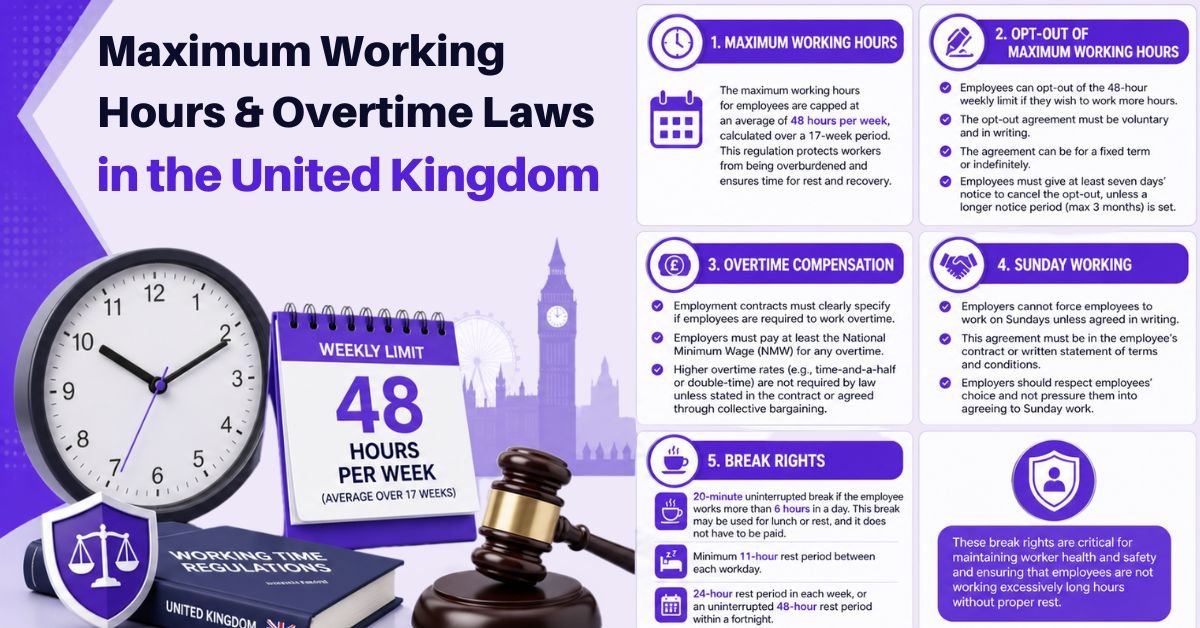
In the UK, the maximum working hours for employees are capped at an average of 48 hours per week, calculated over a 17-week period. This regulation is designed to protect workers from being overburdened, ensuring they have sufficient time for rest and recovery. However, there are provisions that allow employees to opt-out of this limit if they choose to work longer hours.
Opt-Out of Maximum Working Hours
Employees can opt-out of the 48-hour weekly limit if they wish to work more hours. This opt-out agreement must be voluntary and in writing. While it is lawful to include an opt-out clause in the employee’s contract, it’s considered best practice to use a separate opt-out agreement to ensure clarity and fairness.
The opt-out agreement can be set for a fixed term or indefinitely. If an employee decides to cancel the opt-out, they are required to give at least seven days’ notice, unless the agreement stipulates a longer notice period (which cannot exceed three months). This ensures that employees have the flexibility to revoke the opt-out if their circumstances change.
Overtime Compensation
When employees are required to work beyond their standard hours, employers must ensure that the employment contract clearly specifies this requirement. While employers are not legally obligated to pay overtime, they must pay employees at least the National Minimum Wage (NMW) for any additional hours worked.
It’s important to note that the agreement should clearly outline the conditions for overtime work, including whether it will be compensated at a higher rate. For instance, some employers may offer time-and-a-half or double-time pay for overtime hours, but this is not mandated by law unless specified in the contract or agreed upon in a collective bargaining arrangement.
Sunday Working
Employers cannot force employees to work on Sundays unless the employees have agreed to it in writing. This agreement should be included in the employee’s contract of employment or written statement of terms and conditions. This ensures that Sunday work is voluntary and that the terms are transparent.
Employers should respect employees’ right to choose whether they wish to work on Sundays and should not pressure them into agreeing to Sunday work unless it is clearly outlined in the contract.
Break Rights
Employees are entitled to certain rest breaks to ensure they are not overworked and can maintain their productivity and well-being. The Working Time Regulations provide the following break entitlements:
A 20-minute uninterrupted break if the employee works more than 6 hours in a day. This break may be used for lunch or rest, and it does not have to be paid.
A minimum 11-hour rest period between each workday. This ensures that employees have sufficient time to recover from the physical and mental demands of the workday.
A 24-hour rest period in each week, or alternatively, an uninterrupted 48-hour rest period within a fortnight. This guarantees that employees have enough time for rest and personal activities each week.
These break rights are critical for maintaining worker health and safety and ensuring that employees are not working excessively long hours without proper rest.
How to Manage Working Hours for Your Staff?

Effectively managing working hours is crucial for both employee well-being and business success. Ensuring that employees do not exceed the maximum legal working hours is an essential part of responsible workforce management.
Let’s explore how to manage your staff’s working hours efficiently and fairly.
Offer Normal Working Hours
The first step for any employer is to offer normal working hours that do not exceed the 48-hour weekly limit. If you need your staff to work less than this, be sure to calculate the hours carefully to avoid any potential legal issues. If an employee feels their working hours are not being treated fairly, they may choose to leave or file a discrimination claim.
In situations where employees are asked to work more than 48 hours per week, ensure that the opt-out rights are clearly communicated. Employees must fully understand why they are working more hours and how the opt-out process works.
Provide Proper Rest Breaks
Proper rest breaks are essential to employee well-being and productivity. Employers should always ensure that employees receive the following breaks as required by law:
20-minute rest breaks for employees working over 6 hours.
An 11-hour break between shifts to ensure employees get sufficient rest.
A 24-hour rest period within a week, or an uninterrupted 48-hour break every two weeks.
Providing these breaks not only complies with the law but also helps prevent burnout and improves overall productivity.
Change Work Hours Properly
There may be occasions when changing an employee’s working hours becomes necessary. Employers can only modify work hours if the change complies with the Working Time Regulations and other relevant employment laws. Changes to work hours should be made with agreement from the employee and ideally in writing.
Employers can introduce changes through:
Workforce agreements, which are made between the employer and employee representatives.
Collective agreements, which are negotiated between employers and trade unions.
Employment contracts, where any modifications to hours should be mutually agreed upon and documented.
Properly handling changes to work hours is crucial to maintaining transparency and trust with employees.
Create an Opt-Out Agreement
Some businesses may require employees to work longer than the 48-hour limit, especially in industries that operate 24/7 or during busy periods. If this is the case, it is important to create an opt-out agreement.
A written opt-out agreement should clearly document the employee’s consent to work beyond the legal 48-hour limit. It should also outline the protections in place to safeguard their health, safety, and well-being while working these longer hours.
Employers cannot enforce opt-out agreements, and employees have the right to cancel them at any time. To do so, they must give at least seven days’ notice, unless the agreement specifies a longer notice period.
Employee Time Tracking Obligations in the United Kingdom?
In the UK, time tracking is a critical responsibility for employers to ensure compliance with the Working Time Regulations (WTR). The Health and Safety Executive (HSE) requires employers to maintain adequate records of their employees’ working hours, including weekly work hours, overtime, and night shifts. These records help verify that employees do not exceed the legal limits on working hours.
It’s important to note that while the HSE mandates that records be kept, they do not specifically require all hours worked to be recorded. For instance, daily or weekly rest periods and breaks are not subject to the same record-keeping obligations.
Employers can often rely on existing records, such as payroll data, to fulfill their time tracking responsibilities. However, these records should be maintained for a minimum of two years to ensure that any inspection by health and safety officials can be adequately supported.
How to Calculate Average Weekly Working Hours?

One of the key aspects of time tracking is determining whether employees are working within the 48-hour weekly limit. To calculate a worker’s average weekly hours, including any overtime, the total number of hours worked over a specific period (usually 17 weeks) must be averaged.
The formula used to calculate the average working hours is:
A = The total number of hours worked during the reference period.
B = The total number of hours worked in the period after the reference period ends, until the number of days worked equals the number of excluded days (such as holidays, sick leave, or maternity leave).
C = The total number of weeks in the reference period.
To calculate:
Add the total hours worked by the employee over a 17-week period.
Divide the total by 17 to get the average weekly working hours.
If the employee has worked for fewer than 17 weeks, calculate based on the number of weeks worked. This will ensure that employers remain within the legal limit of 48 hours per week on average.
Calculating Holiday Pay for Casual and Seasonal Employees
Starting from 6 April 2024, new rules were introduced to determine how holiday pay should be calculated for casual employees (those with non-fixed hours) and seasonal workers (those employed only part of the year). These employees have their holiday pay calculated at 12.07% of the hours they work during each pay period.
The calculation works as follows:
For every hour worked, the employer should calculate 12.07% of that hour as the worker’s holiday entitlement.
This holiday pay is then paid on the last day of the pay period (whether weekly, bi-weekly, or monthly).
For instance, if an employee works 40 hours in a week, their holiday pay would be 12.07% of 40 hours, which equals approximately 4.83 hours of paid holiday. If the employee’s contract provides more holiday than the statutory minimum, this percentage should be adjusted accordingly.
In the event that an employee’s holiday entitlement includes part of an hour, the following rounding rules apply:
Round down if the entitlement is less than 30 minutes.
Round up if the entitlement is 30 minutes or more.
It’s important for employers to track holiday pay accurately, ensuring that all seasonal and casual workers receive their full entitlement as required by law. The maximum statutory holiday entitlement for these workers is 28 days per year if they work full time.
Rolled-Up Holiday Pay
Rolled-up holiday pay refers to the practice where employers pay an additional sum on top of an employee’s regular wages throughout the year, rather than paying it as a lump sum when the employee takes time off. While this practice was common, it is not legal under UK law.
ACAS (Advisory, Conciliation and Arbitration Service) has explicitly advised that this practice should be avoided. Instead, employers must ensure that employees receive their holiday pay separately and at the time the holiday is taken, rather than accumulating it in their regular pay.
Employers should also ensure that they provide a written statement of employment outlining these arrangements.
Opting Out of the Limit on Legal Working Hours in the UK
Under Regulation 5 of the WTR, employees can opt out of the legal 48-hour weekly limit on working hours. To do so, the employee and employer must enter into a written agreement where the employee agrees to work beyond the 48-hour cap. This agreement can apply for a specific period or indefinitely.
However, employees who have opted out retain the right to cancel the opt-out at any time by providing the employer with written notice. The notice period should be at least seven days, but it could be longer if specified in the agreement (up to a maximum of three months).
Employers must keep detailed records of workers who have opted out, including:
The specific terms of the opt-out agreement.
The working hours completed by the employee during each reference period since the opt-out was agreed upon.
These records must be retained for up to two years, and employers must provide access to them if requested by health and safety officials or relevant authorities.
Additionally, under Regulation 9 of the WTR, employers are legally obligated to maintain adequate records showing whether the working time limits for each employee are being followed. This includes keeping records for two years regarding each worker’s hours. However, there is no specific requirement to track or record rest periods, such as daily or weekly breaks.
What is the Reference Period?
In the UK, the reference period is the time frame used to calculate whether an employee is working within the legal limits on working hours. According to Regulation 4(3) of the Working Time Regulations (WTR) 1998, the standard reference period is 17 weeks. This means that an employee’s average working hours must not exceed 48 hours per week over this 17-week period.
For employees who have worked for less than 17 weeks, the reference period will be the duration of time since they began employment with that specific employer. In cases where there is a collective agreement or other workforce agreements in place, a different reference period may apply. For example, trainee doctors have a 26-week reference period, and offshore workers in the oil and gas industry may have a 52-week reference period.
Although the general rule is that an employee cannot work more than 48 hours in a week, there is an allowance for employees to exceed this limit on a weekly basis as long as their average working hours over the reference period do not surpass 48 hours. The one exception to this rule applies to workers under the age of 18, whose working hours cannot be averaged. These young workers are limited to a maximum of 40 hours per week, and this limit cannot be exceeded in any given week.
Exceptions to the Legal Working Hours Rules

Under the Working Time Regulations 1998, there are certain exceptions to the 48-hour weekly working time limit where employees may be required to work more than 48 hours per week. These exceptions generally apply in specific industries or roles where round-the-clock coverage or high levels of autonomy are necessary.
Some common exceptions include:
24-hour staffing roles, such as in hospitals, prisons, or care homes.
Security and surveillance jobs, such as caretakers or security guards.
Emergency services, including police, fire, and ambulance services.
Armed forces personnel.
Domestic workers in private households.
Transport sectors, including road, rail, air, and sea transport.
Workers in specific industries such as seafarers, fishermen, or those employed on vessels operating in inland waterways.
Managing executives or others in positions of significant decision-making power where the measurement of working time is not feasible due to the nature of their responsibilities.
These exceptions are put in place because these roles require flexibility, often around-the-clock coverage, or involve significant decision-making autonomy. However, despite these exceptions, employees in these roles are still entitled to adequate rest breaks and health protections, as we’ll explore further.
Working Time Regulations (WTR) Rules on Rest Breaks

One of the primary goals of the Working Time Regulations is to protect workers’ health and safety by ensuring they receive adequate rest breaks. The regulations specify minimum break entitlements for employees working long hours or under physically demanding conditions.
Here are the key rest break entitlements:
Daily Rest: Adult workers must receive at least 11 consecutive hours of rest within a 24-hour period. For workers under 18, the rest period increases to 12 hours.
Weekly Rest: Workers are entitled to one uninterrupted 24-hour rest period every week. Alternatively, employees can opt for 48 hours of rest over a fortnight. For workers under 18, this period must be 48 hours each week.
Break During Shifts: Any worker who works more than 6 hours in a shift must be given a 20-minute uninterrupted rest break. This break can be used for lunch or a brief period of relaxation. Workers under 18 are entitled to a 30-minute rest break during shifts longer than 4.5 hours.
These rules help ensure that employees have enough downtime to recover from the demands of their jobs and are not exposed to fatigue, which could impair their health or performance.
Even for employees in roles where the 48-hour limit doesn’t apply (e.g., those working in essential services like healthcare or emergency roles), adequate rest breaks must still be provided.
WTR Rules for Night Workers
The rules for night workers are particularly stringent due to the potential health risks associated with working late hours. Regulation 6(1) of the WTR states that a night worker’s average working hours over a reference period should not exceed 8 hours per 24-hour period.
In addition to the general working hours restrictions, night workers are also subject to additional provisions if their work involves hazards or heavy physical or mental strain. If night work is identified as a potential health hazard, the employer must ensure that workers do not work more than 8 hours per day within a 24-hour period. This includes identifying risks through risk assessments and ensuring that measures are in place to reduce or eliminate these risks.
Employers must also offer free health assessments to night workers before they begin working night shifts and provide regular assessments thereafter to monitor their health and fitness for night work. If the assessments reveal that a worker is experiencing health issues related to night work, employers should offer alternatives, such as daytime shifts, if possible.
Risks for Employers
For employers, understanding and adhering to the legal rules around working hours is crucial to avoid serious legal and financial consequences. Failing to comply with the Working Time Regulations (WTR) 1998 can lead to significant penalties. Employers found in violation of these regulations may face fines upon conviction, and workers can lodge complaints with an employment tribunal for potential compensation.
Employers must take proactive steps to ensure compliance. If there is a risk that employees may work more than the legal limit of 48 hours per week, it’s important to either ask them to sign an opt-out agreement (where permissible) or adjust their hours to stay within the legal limits. However, opt-out agreements should always be voluntary—employers cannot force employees to opt out, nor can they dismiss or treat workers unfairly for refusing to sign an agreement.
While it is common for employers to request employees to opt out of the 48-hour weekly working time limit, there are exceptions for certain workers, such as night workers or those in industries where extended hours could compromise safety. For these workers, the regulations must be strictly followed, ensuring that excessive working hours do not jeopardize health or safety.

Record-Keeping: A Key Responsibility

For employers managing staff working overtime or long, complex shift patterns, it’s easy to lose track of the total hours worked. However, maintaining accurate and up-to-date records is critical. Proper documentation helps employers ensure that they remain within the legal limits and comply with statutory obligations under the WTR.
In addition to helping meet legal requirements, accurate time tracking also helps prevent disputes regarding overtime or unpaid hours. Employers must maintain records of hours worked, particularly if employees have opted out of the 48-hour weekly working time limit. These records should be kept for a minimum of two years, as they may be requested during an inspection or legal proceeding.
Changes in Record-Keeping Requirements
The administrative burden related to record-keeping under the WTR 1998 has recently been reduced through amendments introduced by the Employment Rights (Amendment, Revocation, and Transitional Provision) Regulations 2023, effective from 1 January 2024. These changes make it clear that employers are no longer required to record each worker’s daily hours if they can demonstrate compliance through other means.
The revised regulations state that employers have the flexibility to maintain records in a format that suits their business needs, provided that these records are sufficient to prove that the working time limits are being adhered to. Although the new rules ease some of the record-keeping burdens, employers are still required to be able to provide documentary proof of compliance with the legal working hours at any time.