What Is AI in Healthcare? A Quick UK Primer
Before getting into the advantages and disadvantages, it’s worth being clear about what “AI in healthcare” actually refers to, because it covers a fairly wide spread of technology, not one single tool.
Machine learning is the foundation underneath most of it: systems trained on large volumes of past data to spot patterns and make predictions, whether that’s flagging a scan as suspicious or predicting which patients are at higher risk of readmission.
Computer vision is machine learning applied specifically to images, this is what powers AI tools reading mammograms, X-rays, and CT scans, looking for patterns that might be easy for a human eye to miss, especially across a high volume of scans.
Natural language processing (NLP) is what lets a computer make sense of human language, spoken or written. It’s the technology behind tools that can read a GP’s clinical notes, or listen to what’s said in a consultation, and turn it into structured, usable information.
Ambient voice technology, often referred to as “AI scribes,” is a rapidly expanding application of natural language processing in healthcare. With patient consent, these systems listen to clinical consultations to automatically produce accurate transcripts and summaries. This process significantly reduces the time clinicians spend on manual documentation tasks, allowing healthcare providers to focus more directly on patient care.
Predictive analytics uses historical and real-time data to forecast what’s likely to happen next: which patients might deteriorate, which services might see a surge in demand, or which treatment pathway is statistically likely to work best for a given patient profile.
None of this exists in a vacuum inside the NHS, there’s now a fair amount of institutional scaffolding around it. The NHS AI Lab runs a knowledge repository specifically to help NHS organisations adopt AI responsibly, gathering case studies and shared learning in one place.
Separately, the AI in Health and Care Awards programme, running since 2019, exists specifically to speed up the testing and rollout of AI tools that can improve diagnosis speed and accuracy and help chip away at the backlogs and waiting lists that built up during and after the pandemic.
And as of early 2026, there’s a national, self-certified registry of ambient voice technology suppliers, 19 of them at last count, designed to make it easier and safer for individual NHS trusts to procure this kind of tool without each one having to start from scratch.
It’s also worth flagging early on why the UK is a genuinely different case study to the US, where most “AI in healthcare” coverage originates. As a largely public, single-payer system, the NHS faces unique economic and political dynamics regarding AI adoption compared to the fragmented US private sector.
Furthermore, medical AI in the UK is regulated by the MHRA rather than the FDA, operating under distinct rules. The government’s transparent approach to both its ambitions and concerns provides a robust, UK-specific evidence base, eliminating the need to rely on US statistics.
5 Advantages of AI in Healthcare
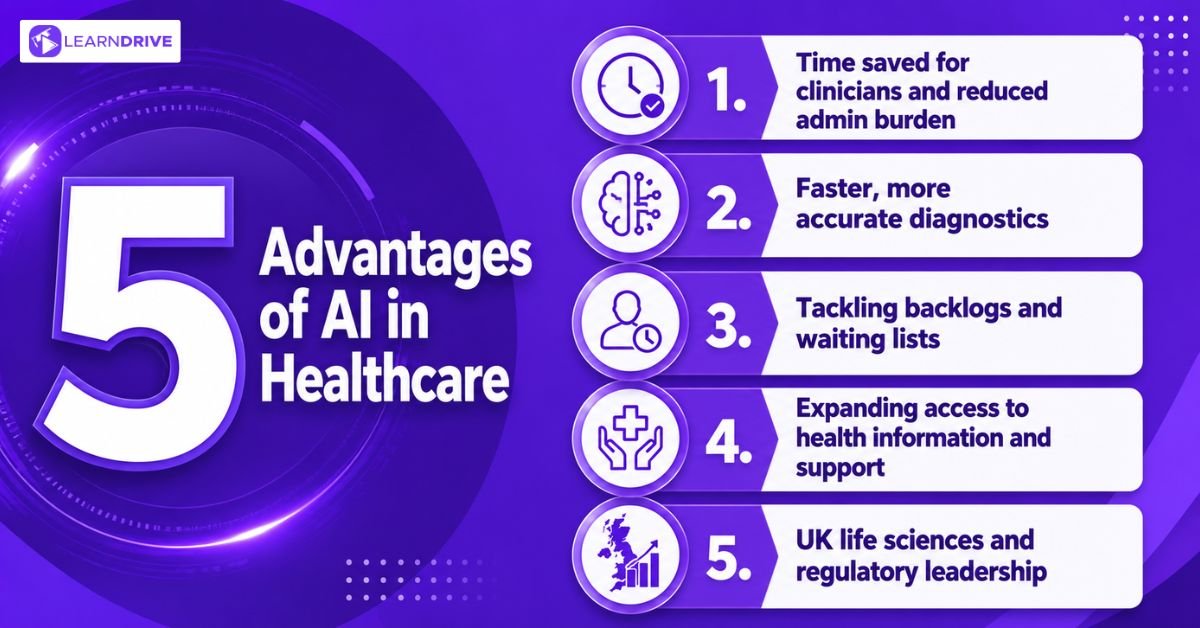
Here are 5 advantages of AI in the Healthcare
1. Time saved for clinicians and reduced admin burden
If there’s one advantage of AI in healthcare that’s already measurable, rather than promised, it’s time.
The headline figure from the NHS’s own Microsoft Copilot trial is stark: an average of 43 minutes saved per staff member, per day. Multiply that across a working year and you land at roughly five working weeks, per person, handed back. When that trial is being scaled to 505,000 staff, the theoretical time saved across the system runs into millions of hours.
That figure isn’t an outlier. The Philips Future Health Index 2026 UK report, gathering feedback directly from clinicians already using AI-enabled tools, found that 42% of them are saving 132 hours or more a year, north of three full working weeks.
Dr Qaiser Malik, Clinical Director of Radiology at Mid and South Essex NHS Trust, made the point that what matters now isn’t proving AI can save time in principle, but building the regulation and workforce readiness to actually use that time well.
Ambient voice technology is where a lot of this time-saving is concentrated in practice. Oxford University Hospitals NHS Foundation Trust ran a pilot of ambient voice tech that listens to patient-clinician conversations and automatically generates a transcript and clinical summary.
Eight in ten users of the tool reported reduced time spent on documentation, freeing up somewhere between one and ten minutes per appointment, which sounds modest until you consider that’s minutes back, appointment after appointment, day after day, across an entire trust.
What does that actually mean for patients, rather than for spreadsheets? In theory, more face time during appointments rather than a clinician half-typing notes while trying to listen. Fewer clinicians staying late or working through evenings just to catch up on paperwork, directly relevant to a workforce that consistently cites burnout as one of its biggest pressures.
Time saved on admin doesn’t automatically become time spent with patients, but it’s the raw ingredient that makes that possible, and right now, the NHS’s own data says that ingredient is genuinely there.
2. Faster, more accurate diagnostics
Beyond admin, the area where AI is generating the most genuine excitement inside the NHS is diagnostics, and cancer screening specifically.
In 2026, the NHS launched what’s been reported as the world’s largest AI-led breast cancer screening trial. The urgency behind it isn’t abstract. Health Secretary Wes Streeting, a bladder cancer survivor, has been direct about the high stakes involved.
He highlights record cancer diagnosis numbers and data showing that UK survival rates lag behind comparable countries. That’s the backdrop against which a trial of this scale makes sense: not “AI because it’s new,” but AI because the current system isn’t catching cancers early enough, fast enough.
Before that trial reached its current scale, NHSX and Public Health England ran an earlier, smaller validation pilot through the OPTIMAM Breast AI programme, using mammography data from 26,000 women across NHS screening centres.The OPTIMAM Breast AI pilot yielded encouraging results, with AI performance nearing that of human radiologists for standard cases.
However, its most valuable finding was that the AI identified different cancers than human readers, demonstrating that it does not merely replicate human judgment. Consequently, researchers emphasized that these tools require rigorous testing across diverse, non-standard cases before they can be trusted for widespread clinical use. That’s a genuinely useful, unglamorous finding, the kind that makes the eventual rollout safer.
The financial commitment behind this is real, too. The government has put nearly £30 million into expanding proven AI diagnostic tools to every NHS trust in England, not a pilot in a handful of hospitals, but a commitment to universal access. On top of that, a further £8.1 million is going into piloting the next generation of AI and digital tools across 13 NHS sites, targeting faster diagnosis and care for heart failure, stroke, lung cancer, lung infections, and tic disorders.
If those pilots succeed, the government’s own framing is that they could mean faster, better care, and, in the most serious cases, save lives.
3. Tackling backlogs and waiting lists
It’s easy to talk about AI diagnostics in the abstract, but the reason the NHS has been so willing to invest at this scale comes down to a very concrete, very unglamorous problem: waiting lists.
The AI in Health and Care Awards programme, running since 2019, was explicitly built with this in mind, its stated purpose includes helping tackle the backlogs that built up during COVID and reducing NHS waiting lists more broadly. That’s a different framing to “AI will revolutionise medicine”, it’s closer to “AI is one practical lever the NHS has for clearing a queue that’s been growing for years.”
The logic is straightforward, even if the execution is hard: if an AI tool can help a radiologist read a scan faster, or flag the scans most likely to need urgent attention, that compounds across a system handling millions of appointments.
A few minutes saved per scan, multiplied across every NHS trust in England, is the difference between a waiting list that keeps growing and one that starts to shrink. It’s not a single dramatic fix, it’s a lot of small, repeated efficiencies stacked on top of each other, which is exactly the kind of problem AI tends to be genuinely good at solving.
4. Expanding access to health information and support
Not all of the AI story in UK healthcare happens inside hospitals and GP surgeries, a lot of it is happening on people’s own phones, often without any NHS involvement at all.
The scale of this shift is easy to underestimate. OpenAI has publicly announced plans for a dedicated “ChatGPT Health” product, aimed at an estimated 230 million people globally who are already asking ChatGPT health- and wellness-related questions every single week.
This initiative reflects a massive global trend where millions of users turn to AI for medical inquiries. While these figures are international, there is no evidence to suggest that UK patients are an exception to this widespread pattern.
Consequently, a significant amount of informal, AI-assisted health-seeking behavior is occurring independently of the NHS. This trend persists regardless of whether healthcare providers or individual GPs are currently aware of its scope.
For patients outside major cities, or those who struggle to get a timely GP appointment, this kind of always-on access to health information, however imperfect, fills a real gap. These AI tools should not be treated as a substitute for a professional medical diagnosis. Instead, they serve as a helpful first stop for patients to better understand their symptoms or check if an issue requires urgent attention.
They can also assist users in interpreting complex medical letters or diagnoses they have already received. Ultimately, this represents a significant new form of access to health information that was not available just a few years ago..
Inside the system, there are also more targeted, clinically-supervised tools doing something similar. Decently’s AI-powered tool, Melo, is currently used in UK hospitals to assist clinicians in managing care for patients with complex conditions like dementia and autism.
Unlike diagnostic AI, Melo functions as an assistive tool that does not make treatment decisions. Instead, it provides consistent support for tracking and assessing patient needs, offering a more reliable alternative to manual processes. This demonstrates the practical value of assistive AI in supporting ongoing patient care.
5. UK life sciences and regulatory leadership
There’s a knock-on benefit to all of this that’s easy to overlook if you’re only thinking about individual patients: the UK’s position in the global AI-in-healthcare landscape.
In June 2025, the MHRA became the first regulator in the world to join the HealthAI Global Regulatory Network, an international coalition of health regulators focused specifically on the safe, effective use of AI in healthcare. That’s not a symbolic gesture. It puts the UK at the table shaping how AI in healthcare gets regulated globally, rather than simply adopting rules written elsewhere.
That ambition is stated explicitly by the government: the UK wants to become what one official framing calls a “world-leading authority” in AI healthcare regulation. Practically, this involves positioning UK life sciences and health-tech companies to develop and export tools under a robust regulatory framework.
This strategy aims to create a global model that others may eventually adopt, presenting a significant economic opportunity alongside clinical benefits. However, the success of this initiative depends on the underlying regulations being high-quality and effective, rather than merely being first to market.
5 Disadvantages and Risks of AI in Healthcare
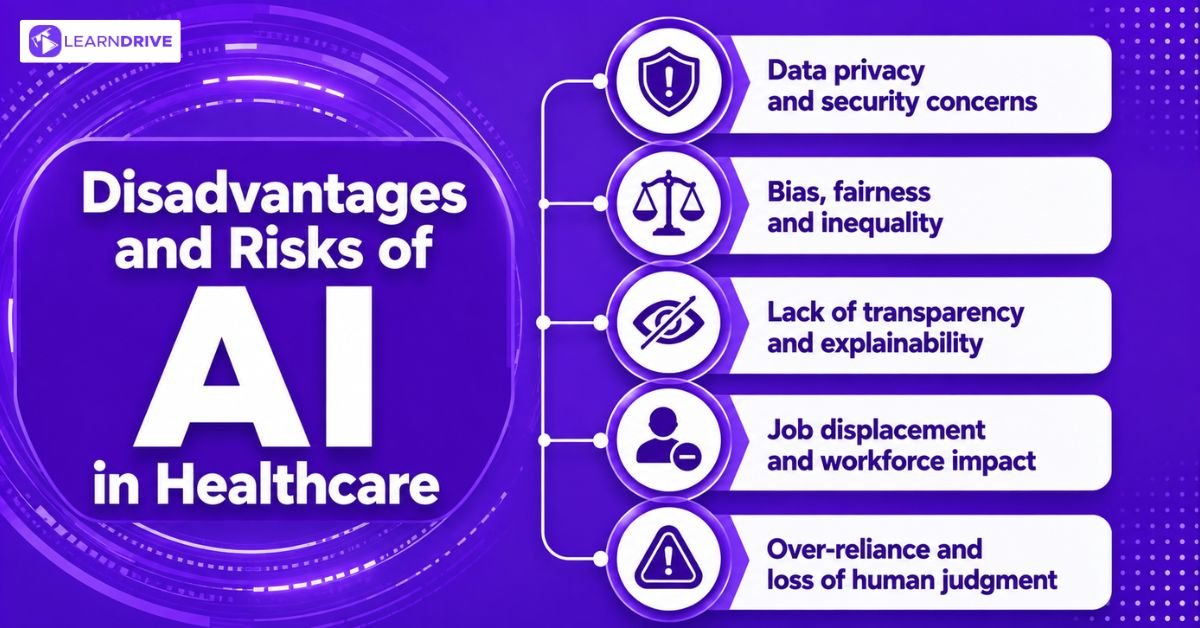
Here are 5 disadvantages and risks of AI in healthcare
1. A striking trust gap, starting with doctors themselves
If you wanted a single fact to puncture any assumption that AI adoption in the NHS is a smooth, universally welcomed rollout, this is it: according to Medscape UK’s Doctors and AI report, roughly one in two UK doctors say they will not use AI to treat patients.
That’s not scepticism from patients, or caution from regulators, that’s the clinical workforce itself, the people actually expected to use these tools day to day, splitting close to fifty-fifty on whether they’ll use AI clinically at all.
The concerns driving this hesitation are quite specific, particularly regarding patient trust and the quality of clinical outcomes. A vast majority of doctors, roughly 82%, expressed worry that patients who self-diagnose using AI tools might prioritize those results over professional medical advice.
This creates a challenging clinical dynamic where patients may receive conflicting information, potentially undermining the doctor-patient relationship and the effectiveness of prescribed treatments.
There’s also a clear appetite among doctors for more oversight, not less: 83% said there should be government and/or medical association oversight of AI use in healthcare. One-third of surveyed doctors doubt that government or medical associations can effectively safeguard patient confidentiality in an AI-integrated environment.
This uncertainty reflects a broader confidence gap that threatens the core of the doctor-patient relationship. These concerns highlight the necessity for robust oversight to maintain trust in clinical interactions.
Why does this matter more than a generic “some people are hesitant about new technology” observation? Because doctors aren’t a passive audience for AI tools, they’re the people whose judgement, licensing, and legal liability sits behind every clinical decision AI might inform. A rollout that outpaces the confidence of the workforce meant to use it isn’t a rollout that’s actually working, no matter how impressive the underlying technology is on paper.
2. Bias in medical devices, documented by the UK government, not hypothetical
It might be tempting to dismiss AI bias as an abstract issue primarily affecting the US, given that many high-profile cases of algorithmic unfairness originated there.
However, the UK has its own government-commissioned evidence confirming that similar risks of bias exist within medical devices and tools currently used across the NHS.
The Equity in Medical Devices: Independent Review, commissioned by the UK government and published in 2024, provided sobering evidence of this systemic issue. The report found that minority ethnic people, women, and those from deprived communities face a genuine risk of receiving poorer healthcare due to deep-seated bias in existing tools.
These inequities are not merely theoretical concerns for the future but are built into devices currently in clinical use. One of the most concrete and alarming examples identified was the pulse oximeter, a device used across the NHS to measure blood oxygen.
The review confirmed that these clips can significantly overestimate oxygen levels in patients with darker skin tones. This specific finding highlights how a lack of diversity in device testing can lead to inaccurate data for certain patient groups. Ultimately, the report positions pulse oximeter inaccuracies as a clear symptom of broader, systemic biases that threaten patient safety and health equity.
The review went further than pulse oximeters, too, specifically naming risks tied to AI-based medical devices:
● The potential to worsen under-diagnosis of cardiac conditions in women, a group already historically under-diagnosed for heart problems
● A risk of discrimination based on a patient’s socioeconomic status
● A likelihood of under-diagnosing skin cancers in people with darker skin tones, because the AI systems involved are trained predominantly on images of lighter skin
There’s also a subtler, easy-to-miss finding buried in the review: polygenic risk scores, tools that estimate someone’s individual disease risk based on their genetics, rely on major genetic datasets that are overwhelmingly built from people of European ancestry.
Professor Enitan Carrol of the University of Liverpool, quoted in the review, made the point plainly: these datasets may simply not be applicable to people of other ancestries.
For a country as ethnically diverse as the UK, that’s not a minor technical caveat, it’s a real question about whether some of the newest, most promising AI-driven diagnostic tools work equally well for everyone the NHS serves.
Even attempts to fix bias can introduce new problems, the review noted, race-based correction factors historically applied to spirometer readings (used to assess lung function) have themselves been found to carry their own biases. There’s no easy, one-off fix here; it’s an ongoing process of testing, correcting, and re-testing.
3. Patients want transparency the system doesn’t yet guarantee
Set aside doctors and devices for a moment, what do patients themselves actually want from AI in their care? The MHRA went out and asked, and the answer came back remarkably consistent: people want to know when AI is involved, and they want a say in whether it is.
The MHRA conducted an extensive engagement programme, utilizing public polling and partnerships with organizations like the Health Foundation to gather diverse perspectives on healthcare technology.
Feedback consistently showed that rather than opposing AI, the public prioritizes clear consent and active involvement in how these systems affect their care. Consequently, transparency has emerged as a fundamental requirement for maintaining trust in AI-integrated clinical environments.
A separate, smaller survey run by the Patients Association, specifically gathering patient views in response to the MHRA’s call for evidence, reinforced the same point with 243 patients: the majority said it’s very important to know when AI is being used in their care.
Patients clearly view AI as a tool to support, not replace, healthcare professionals. Furthermore, they are concerned that AI must properly represent diverse populations to avoid exacerbating existing health inequalities.
Perhaps the most revealing finding from that survey is about liability, because it exposes just how unclear the accountability picture currently is, even to the people most affected by it.
Asked where responsibility should sit if AI contributes to a poor outcome, patients most frequently pointed to healthcare providers, followed by individual clinicians , and only then manufacturers of the AI tools themselves.
Many assume that AI companies are automatically liable if their tools fail, but this belief is not shared by the patients themselves. Patients are uncertain about where accountability truly lies when AI contributes to a poor medical outcome.
Furthermore, the current regulatory framework fails to provide a clear and simple answer to this critical question of responsibility.
4. Regulation is openly, officially not yet fit for purpose
Here’s the part of this that should reassure anyone worried the UK is sleepwalking into AI adoption without scrutiny: the regulator itself has said, in public, that the current rules aren’t good enough.
AI in UK healthcare is currently regulated under the country’s existing medical device regulation (MDR), with relevant tools classified as either software-as-a-medical-device (SaMD) or, more specifically, AI-as-a-medical-device (AIaMD).
In September 2025, the MHRA launched a National Commission to modernize AI regulation in healthcare, acknowledging that current frameworks are outdated. The Commission’s subsequent consultation, which ran into early 2026, generated over 700 responses from various stakeholders.
This feedback was overwhelmingly critical, with roughly seven in ten respondents calling for a substantial revision or complete overhaul of the existing rules. These results highlight a significant consensus that current medical device regulations are insufficient for managing AI-specific risks. Ultimately, this initiative underscores the urgent need for a regulatory environment that matches the speed of technological adoption.
That’s roughly seven in ten respondents saying the current rulebook isn’t fit for purpose, from a group that includes the very organisations building and deploying these tools.
One piece of analysis covering the consultation’s findings summed up the underlying dynamic bluntly: trust, not technology, is the primary barrier to AI adoption in UK healthcare. It’s a genuinely important distinction, the limiting factor isn’t whether the tools work, in many cases; it’s whether patients, clinicians, and the wider public trust the system around those tools enough to accept them.
Timing poses a significant challenge for AI implementation in the UK. The National Commission’s final recommendations were not expected until the summer of 2026. This delay means that the official regulatory framework for AI health tools was still being rewritten. While widespread adoption projects, such as Copilot rollouts and breast cancer screening trials, were already scaling up.
Current medical device regulations primarily govern whether a specific AI tool can be marketed and used. However, these rules often fail to address complex downstream issues like patient liability. Additionally, they do not provide clear guidance on how hospitals should manage AI tools that may perform inconsistently across diverse patient populations.
5. The core clinical risks that show up wherever AI is used
Beyond the UK-specific findings above, there’s a set of risks that shows up in essentially every serious study of AI in healthcare, anywhere it’s deployed, and the NHS is not exempt from any of them.
Overreliance and automation bias is the tendency for clinicians, particularly less experienced ones, to defer to an AI’s output even when their own judgement points somewhere else. It’s a subtle risk precisely because it doesn’t look like an error at the moment; it looks like trusting a tool that’s usually right.
The “black box” problem sits alongside it: many AI systems, particularly the more advanced ones, can’t fully explain why they reached a particular conclusion. That’s a genuine problem in clinical settings, where being able to explain a decision isn’t just good practice, it’s often a legal and ethical requirement.
Data privacy is a pressing, practical concern that directly correlates with the lack of confidence among many UK doctors regarding the ability of regulators or medical associations to ensure confidentiality when using AI tools.
This hesitation underscores the critical need for robust governance to protect sensitive patient information as AI becomes more integrated into clinical workflows. Every ambient scribe recording a consultation, every chatbot logging a symptom query, is a new store of sensitive health data that needs proper governance.
And finally, cost and access: there’s a real risk that better-resourced NHS trusts, the ones with more capacity to pilot, procure, and integrate new technology, end up adopting (and benefiting from) AI faster than trusts that are already stretched thin.
Poorly managed AI adoption risks widening care gaps within the NHS, potentially creating a two-tier system between well-resourced and struggling trusts. This outcome would undermine the fundamental principle of the service, which is to provide an equal standard of care to all patients regardless of their location.