NOTICEWe're upgrading our learning platform. You may notice temporary changes or brief interruptions while the migration is completed. Thank you for your patience! For any urgent query, contact info@learndrive.org
NEWThe Complete AI Skills Bundle 2026 — 9 courses, 9 CPD certificates, one price. Explore the bundle →
15 Best Jobs for Ex Military officer in the UK_ Civilian Careers After Service

15 Best Jobs for Ex Military officer in the UK: Civilian Careers After Service

According to a report by The Telegraph. , around 15,000 people leave the UK armed forces every year, and most face the same problem: explaining years of military experience to an employer who has never worn a uniform.

Civilian job adverts ask for project management, risk assessment and team leadership, exactly what military service builds, just described in language that never quite lines up. That mismatch is often the real barrier to a veteran’s next career, not a lack of ability.

UK employers are short on the qualities forces life produces as standard: staying composed under pressure, deciding with incomplete information, leading a team through hard tasks. 

Sectors like policing, border security, aviation, cybersecurity, emergency services and government actively recruit ex-forces personnel for this reason, often through dedicated veteran entry routes.

Below are 15 of the best jobs for ex-military personnel in the UK, with salary, day-to-day duties and how steep the transition tends to be.

Table of Contents

Only £1  £249
All-Access Course Bundle
Unlock 100+ CPD-accredited courses for just £1. Industry-recognised certificates. Learn at your own pace.

What Jobs Can Ex-Military Personnel Do After Leaving the Forces?

The barrier isn’t ability, it’s translation. Military training builds a specific, transferable skillset that most industries are short of, but the language used to describe it rarely matches what a civilian recruiter is scanning for. Once you know where those skills map across, the range of jobs open to you widens considerably.

Employers across sectors consistently look for people who bring:

  1. Reliability under pressure, showing up and delivering even when circumstances change

  2. Sound decision-making, often with incomplete information and real consequences

  3. Risk management, spotting problems before they escalate

  4. Clear communication, especially across ranks, teams or departments

  5. Training ability, passing on knowledge and bringing others up to standard

Here’s how that experience typically lines up with civilian career paths:


Military Skill

Civilian Career Area

Potential Industries/Roles

Leadership & Command

Management

Project Manager, Operations Director, Site Manager

Security Training

Security & Intelligence

Cybersecurity Analyst, Private Security, Intelligence Officer

Logistics & Distribution

Supply Chain

Logistics Coordinator, Warehouse Manager, Distribution

Technical & Mechanical

Engineering

Civil Engineer, Renewable Energy, Systems Technician

Emergency Response

Public Services

Police Officer, Firefighter, Paramedic, Border Force


With that mapping in mind, here are 15 of the best jobs for ex military personnel in the UK right now.


Fifteen Best Jobs for Ex Military in the UK
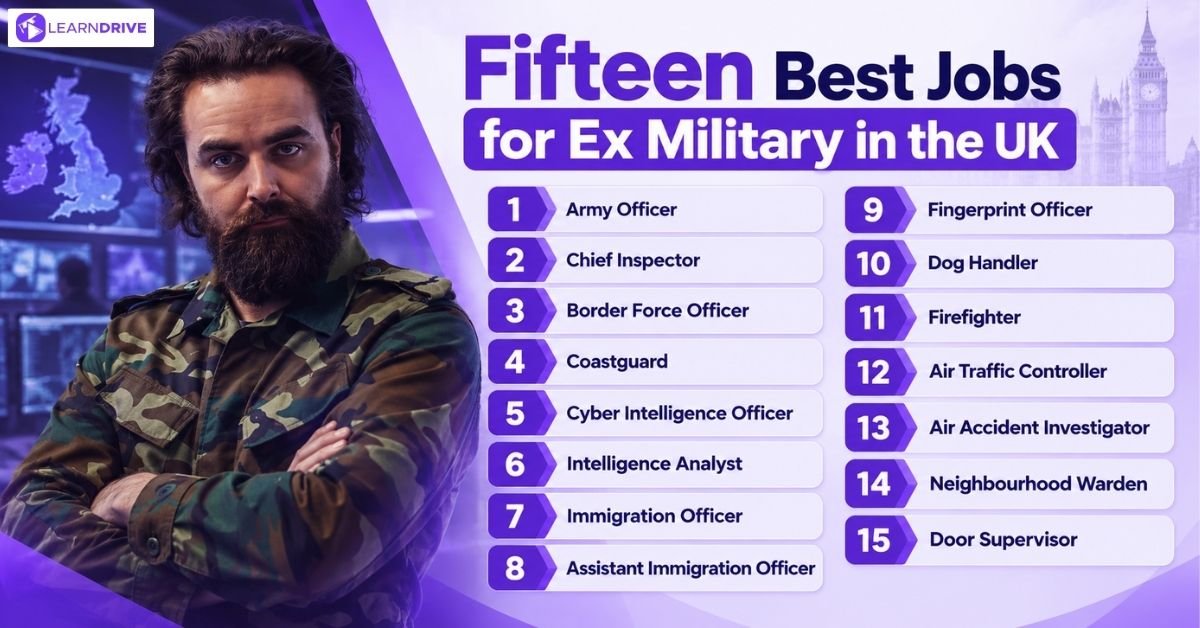
Fifteen Best Jobs for Ex Military in the UK

Every role on this list comes from an industry that already understands what military service is worth, so you won’t be walking in as an unknown quantity. 

These aren’t jobs where you have to convince someone your background is relevant, recruiters are actively trained to spot ex-forces experience and know exactly what to do with it.

The range is wide on purpose. Some, like Door Supervisor, are fast routes you could be working in within weeks. Others, like Chief Inspector, sit at the senior end and reward years of experience. What ties them together is the same thing that made you good at your last job: discipline, sound judgement, and being reliable when it counts.

For each role below, you’ll find what it involves, the salary on offer, and what’s needed to get in the door.


1. Army Officer

Officers plan and lead military operations, taking responsibility for troops across a huge range of environments and situations, often with very little notice to adapt.

Why this job: it offers a direct transfer of leadership and command experience straight into civilian management roles. The strategic planning skills built through operational command are exactly what employers in operations and logistics struggle to find elsewhere, and the ability to make high-stakes decisions under pressure isn’t something most candidates can claim, but you can.

Salary: £36,000 to £65,000 ( according to national careers service )

Requirements:

  1. Proven leadership experience

  2. A degree (typically required for officer entry)

  3. Strong physical and mental fitness

2. Chief Inspector

Chief Inspectors sit at the senior end of police operations, managing large teams and coordinating the response to complex or high-pressure incidents.

Why this job: the same command presence and accountability required to lead large military units carries straight into this role. Your ability to maintain discipline and make critical decisions during high-pressure incidents is exactly what the police service needs for its senior operational leads, which is why direct entry and accelerated programmes into policing leadership exist for ex-forces candidates.

Salary: £61,000 to £70,000 ( according to national careers service )

Requirements:

  1. Significant team management experience

  2. Strong problem-solving skills

  3. Completion of police training or a direct entry programme

3. Border Force Officer

Border Force Officers work the frontline of UK borders, enforcing immigration and customs regulations while dealing directly with the public.

Why this job: military personnel excel here because the vigilance and threat-detection skills developed during guard duties and operational deployments transfer directly. Applying strict regulations with total integrity while staying composed in a busy, public-facing environment is second nature after years of service.

Salary: £28,000 to £37,000 ( according to national careers service )

Requirements:

  1. Ability to pass security vetting

  2. Strong communication skills

  3. A high level of personal integrity

4. Coastguard

Coastguards coordinate search and rescue operations at sea, working to protect life in some of the most physically demanding conditions a job can offer.

Why this job: the “service before self” mindset and physical resilience required for maritime or field operations transfer directly. Coordinating complex search and rescue tasks while staying calm in life-or-death situations is a core military competency this role leans on heavily.

Salary: £25,000 to £37,000 ( according to national careers service )

Requirements:

  1. Good physical fitness

  2. Ability to stay calm under pressure

  3. Strong communication skills

5. Cyber Intelligence Officer

Cyber Intelligence Officers gather and analyse information to identify digital threats before they become real damage to an organisation’s systems.

Why this job: the technical precision and information security mindset ingrained in military communications and signals roles are exactly what this career demands. Experience protecting sensitive data and spotting vulnerabilities underpins the discipline needed to defend national or corporate digital infrastructure.

Salary: £25,000 to £50,000 ( according to national careers service )

Requirements:

  1. Strong IT background

  2. Analytical mindset

  3. Ability to obtain high-level security clearance

Learndrive.org
100+ Free
Courses
Enhance your skills — no spending required. CPDQE Accredited.

6. Intelligence Analyst

Intelligence Analysts collect, interpret and analyse data to inform strategic decision-making, often shaping how an organisation plans its next move.

Why this job: the analytical rigour used in mission planning and tactical debriefing maps directly onto this career. Military veterans are highly valued for their ability to filter through complex noise to find actionable intelligence, ensuring decision-makers have the clearest possible picture.

Salary: £20,000 to £52,000 ( according to national careers service )

Requirements:

  1. Excellent research and critical thinking skills

  2. Strong attention to detail

  3. Ability to interpret complex datasets

7. Immigration Officer

Immigration Officers process entry into the UK and enforce immigration law, working within a structured, policy-driven environment.

Why this job: a high degree of personal discipline and comfort operating within a rigid legal and policy framework are exactly what this role rewards. The consistency and attention to detail military life demands ensure complex immigration cases are handled fairly and by the book.

Salary: £30,000 to £44,000 ( according to national careers service )

Requirements:

  1. Strong interpersonal skills

  2. High personal integrity

  3. Ability to interpret and apply complex regulations

8. Assistant Immigration Officer

Assistant Immigration Officers support processing and administrative tasks at UK entry points, working closely alongside full Immigration Officers.

Why this job: teamwork and procedural adherence are the primary drivers of success in this structured entry point, both of which service already trained into you. The collaborative skills and reliability built during basic training make you a dependable asset in a fast-paced, high-volume environment.

Salary: £25,000 to £30,000 ( according to national careers service )

Requirements:

  1. Good communication skills

  2. Strong organisational ability

  3. Ability to work effectively as part of a team

9. Fingerprint Officer

Fingerprint Officers collect, analyse and match forensic evidence to support criminal investigations, working at a level of precision most jobs don’t demand.

Why this job: the extreme attention to detail and methodical approach found in technical inspection or armoury roles carries straight across. Veterans bring the patience and focus forensic analysis needs, where the precision of your work can have a real impact on the justice system.

Salary: £24,000 to £43,000 ( according to national careers service )

Requirements:

  1. A keen eye for detail

  2. Patience with methodical, repetitive work

  3. Ability to learn complex identification technology

10. Dog Handler

Dog Handlers work alongside trained dogs in security, detection or search and rescue settings, often in public-facing or emergency environments.

Why this job: operational discipline combines naturally with the specialised capability of working alongside service animals. Experience maintaining high standards of kit, animal welfare, and situational awareness keeps you and your canine partner an effective detection or deterrent unit.

Salary: £23,000 to £34,000 ( according to national careers service )

Requirements:


  1. A strong rapport with animals

  2. Good physical fitness

  3. Professional training in handling techniques

11. Firefighter

Firefighters respond to fires, rescues and a wide range of emergencies, working as part of a tightly coordinated team under genuine physical risk.

Why this job: the tight-knit team dynamics and crisis-management focus of a combat or rescue section mirror this role closely. The bravery, physical fitness, and trust in your colleagues that firefighting demands are the exact same qualities that define a successful military career.

Salary: £28,000 to £42,000 ( according to national careers service )

Requirements:

  1. High level of physical fitness

  2. Ability to remain calm in life-threatening situations

  3. Genuine commitment to public service

12. Air Traffic Controller

Air Traffic Controllers direct aircraft movement to keep increasingly busy airspace safe, often making split-second calls with zero room for error.

Why this job: sustained concentration and rapid-fire decision-making, the same skills used in military aviation or operations rooms, are the backbone of this career. Processing multiple data streams while staying absolutely focused during high-stakes manoeuvres is a natural fit for anyone who’s done it before under fire.

Salary: £48,000 to £100,000 ( according to national careers service )

Requirements:

  1. Exceptional concentration over long periods

  2. Ability to stay calm under intense pressure

  3. Completion of technical air traffic training

13. Air Accident Investigator

Air Accident Investigators examine the causes of aviation incidents, working to identify what went wrong and prevent it happening again.

Why this job: deep technical expertise and a safety-first mindset, both hallmarks of military engineering or flight crew experience, are exactly what this role rewards. Conducting objective, evidence-based reviews is essential for identifying systemic failures and improving safety standards across the aviation industry.

Salary: £75,000 to £100,000 ( according to national careers service )

Requirements:

  1. Extensive aviation experience

  2. Strong analytical skills

  3. Relevant technical qualifications

14. Neighbourhood Warden

Neighbourhood Wardens work at community level to improve local safety, reduce anti-social behaviour and support residents day to day.

Why this job: conflict de-escalation and community engagement skills, often built during peacekeeping or civil-military operations, are put to direct use here. A visible presence and professional authority help instil confidence in local residents and resolve issues before they escalate into serious disorder.

Salary: £21,000 to £32,000 ( according to national careers service )

Requirements:

  1. Good communication skills

  2. Strong problem-solving ability

  3. A genuine commitment to improving the local area

15. Door Supervisor

Door Supervisors are responsible for safety and order at licensed venues, managing everything from ID checks to conflict on the door.

Why this job: situational awareness and robust conflict management techniques learned in service translate directly to the door. Veterans are often the preferred choice for this role because they can maintain a calm, professional demeanor in volatile environments, prioritising safety and order at all times.

Salary: £25,000 to £30,000 ( according to national careers service )

Requirements:


  1. A valid SIA licence

  2. Strong conflict management skills

  3. A calm, professional demeanour

Learndrive.org
100+ Free
Courses
Enhance your skills — no spending required. CPDQE Accredited.

Comparison table of Jobs for ex military officers


Job

Salary

Best Fit / Transferable Skill

Army Officer

£36,000–£65,000

Leadership and strategic planning

Chief Inspector

£61,000–£70,000

Command and decision-making

Border Force Officer

£28,000–£37,000

Security awareness and vigilance

Coastguard

£25,000–£37,000

Emergency response and teamwork

Cyber Intelligence Officer

£25,000–£50,000

IT and information analysis

Intelligence Analyst

£20,000–£52,000

Research and critical thinking

Immigration Officer

£30,000–£44,000

Discipline and regulatory judgement

Assistant Immigration Officer

£25,000–£30,000

Organisation and teamwork

Fingerprint Officer

£24,000–£43,000

Precision and attention to detail

Dog Handler

£23,000–£34,000

Discipline and situational awareness

Firefighter

£28,000–£42,000

Physical fitness and crisis management

Air Traffic Controller

£48,000–£100,000

Concentration and rapid decisions

Air Accident Investigator

£75,000–£100,000

Aviation knowledge and investigation

Neighbourhood Warden

£21,000–£32,000

Communication and conflict resolution

Door Supervisor

£25,000–£30,000

Security and conflict management

Training professional
Online Teams Training
Scale Your Team's Skills
with top-notch training
Contact Now!

 How to Translate Military Skills Into a Civilian CV

This is the part most veterans get wrong, not because the skills aren’t there, but because the words hiding them are still in military language.

Recruiters reading your CV have never sat through a mission briefing and won’t know what “operational readiness” means for their business, even if it’s exactly what they need. The fix isn’t exaggerating your experience, it’s translating it into terms a hiring manager already understands and is actively searching for.

Here’s how some of the most common military experience maps onto civilian CV language:

Military Experience

Civilian CV Language

Led a platoon

Managed a team

Mission planning

Project planning

Operational readiness

Risk management

Training recruits

Staff development

Equipment management

Asset management


The principle applies everywhere on your CV, not just these five examples. Wherever you find yourself writing something a civilian recruiter wouldn’t recognise, ask what that responsibility would be called in a normal workplace, then use that word instead.

Companies and Organisations That Support Ex Military Recruitment

You don’t have to do job hunting blindly. A whole support network already exists specifically to connect veterans with employers who understand exactly what military service is worth.

Official transition services, charities and accredited employers are all set up for this. Knowing where to look from the start saves months of guesswork and wasted applications. Here’s where to begin. 

Official transition and advice services:

  1. Career Transition Partnership (CTP) — the MOD’s official resettlement service, offering personal support for service leavers moving into civilian employment, further education or retirement

  2. Op ASCEND — a free Office for Veterans’ Affairs programme run by the Forces Employment Charity, connecting veterans and their families to a network of veteran-friendly employers in high-demand sectors

  3. Royal British Legion Employment Support — advice on putting your skills to good use, plus referrals to partner organisations for further support

Employer Schemes That Support Ex-Military Personnel 

Plenty of employers also back this up publicly, through the Armed Forces Covenant and the Defence Employer Recognition Scheme (ERS). The ERS awards Bronze, Silver and Gold status to businesses that genuinely support the armed forces community, so it’s a good way to spot employers worth your time. A few Gold-level names to know:

  1. BAE Systems, which has a dedicated veterans and reservists network called VetNet

  2. Babcock International, which guarantees an interview to any service leaver meeting a role’s minimum requirements

  3. Network Rail, where roughly a tenth of the workforce comes from an armed forces background

  4. Amazon, which has run a dedicated military programme since 2011 covering operations, engineering, logistics and cloud computing

Sector-specific support:

The NHS recruits veterans directly through its Step Into Health programme, connecting the armed forces community to NHS roles, placements and training, a strong option if you’re eyeing the healthcare or emergency services routes covered earlier in this guide.

Beyond these, keep an eye out for job adverts that explicitly welcome military experience, companies running their own veteran employee networks, and specialist recruiters who focus solely on ex-forces placements. Veteran-specific careers fairs are also worth attending, since every employer there already understands your background before you say a word.

One-Time Payment  Best Value
The All-Access Professional Vault
1,100+ Premium Courses  |  £180 One-Time Payment

How Difficult Is It to Move From Military to Civilian Work?


How Difficult Is It to Move From Military to Civilian Work


Not every job on this list takes the same effort to land. Some you could walk into within weeks of leaving service, others need years of extra training or a specific technical background before you’re even eligible to apply.

Here’s a rough guide to how each role stacks up:


Career

Transition Difficulty

Door Supervisor

Easy

Neighbourhood Warden

Easy

Immigration Officer

Easy

Assistant Immigration Officer

Easy

Dog Handler

Easy

Army Officer

Moderate

Chief Inspector

Moderate

Border Force Officer

Moderate

Coastguard

Moderate

Firefighter

Moderate

Cyber Intelligence Officer

Challenging

Intelligence Analyst

Challenging

Fingerprint Officer

Challenging

Air Traffic Controller

Challenging

Air Accident Investigator

Challenging

If you’re looking for fast, practical employment straight after leaving, the “Easy” roles are the sensible starting point. 

If you’ve got time, CTP funding, or a technical background already, the “Challenging” roles are worth aiming for. They tend to pay more and make full use of specialist skills most civilians simply don’t have. 


Frequently Asked Questions

What are the best jobs for ex-military members in the UK?

Roles in policing, border security, aviation, cybersecurity and emergency services consistently rank among the best.

They reward leadership, discipline and composure under pressure, qualities military service already builds. Army Officers, Air Traffic Controllers and Cyber Intelligence Officers are strong examples covered in this guide. 

What careers are a good fit for ex-military skills?

Careers built around structure, teamwork and high-stakes decision-making tend to fit best. This includes management roles, security and law enforcement, logistics, engineering and any position where reliability under pressure genuinely matters to the employer.

Can ex military personnel get government jobs?

Yes. The civil service, Border Force, immigration services and policing all actively recruit veterans. Several even run direct entry or accelerated schemes built specifically for ex-forces candidates. 

What jobs can I do after leaving the army?

The civil service, Border Force, immigration services and policing all actively recruit veterans. Several run direct entry schemes. Some offer accelerated routes built specifically for ex-forces candidates. 

Do employers value military experience?

Very much so. Many UK employers, including ERS Gold holders like BAE Systems, Babcock International and Network Rail, actively seek out veterans because leadership, discipline and problem-solving under pressure are difficult qualities to find elsewhere.

Can I get a job after leaving the military with no civilian experience?


Yes. Roles like Door Supervisor, Neighbourhood Warden and Assistant Immigration Officer are accessible entry points. Organisations like the CTP and Forces Employment Charity exist to translate your experience for employers, regardless of civilian work history. 

Closing thoughts

Leaving the military doesn’t mean starting from zero. It means translating everything you’ve already built into language civilian employers understand and can act on.

Whether you take a fast route like Door Supervisor or aim for a specialist path like Air Traffic Controller, the skills that carried you through service are exactly what UK employers are short of right now.

Use the support that’s already out there. The CTP, Op ASCEND and the Forces Employment Charity all exist purely to make this transition easier.

ERS Gold employers like BAE Systems, Babcock and Network Rail are actively looking for people with your background, not just tolerating it. Proving you’re capable was never really the hard part. Finding the right door to walk through usually is.


Our related blogs 


Our popular courses

Picture of John Paul
John Paul
[social_share_buttons]

Sensational Offer!

Sign up and get access to 49

Premium Short Course just for £1