Understanding Computer Science Before Choosing a Career
Before jumping into job titles, it’s worth understanding what this field actually covers, since that clarity makes every career decision afterward far easier.
What Is Computer Science?
At its core, computer science is the study of how computers process information, and how that processing can be used to solve real world problems.
It covers everything from the theoretical foundations of algorithms and data structures to the practical skills of writing software that actually works. It’s less about one narrow skill and more about a way of thinking, breaking complex problems down into logical, solvable steps.
6 Examples of Computer Science Industry Applications
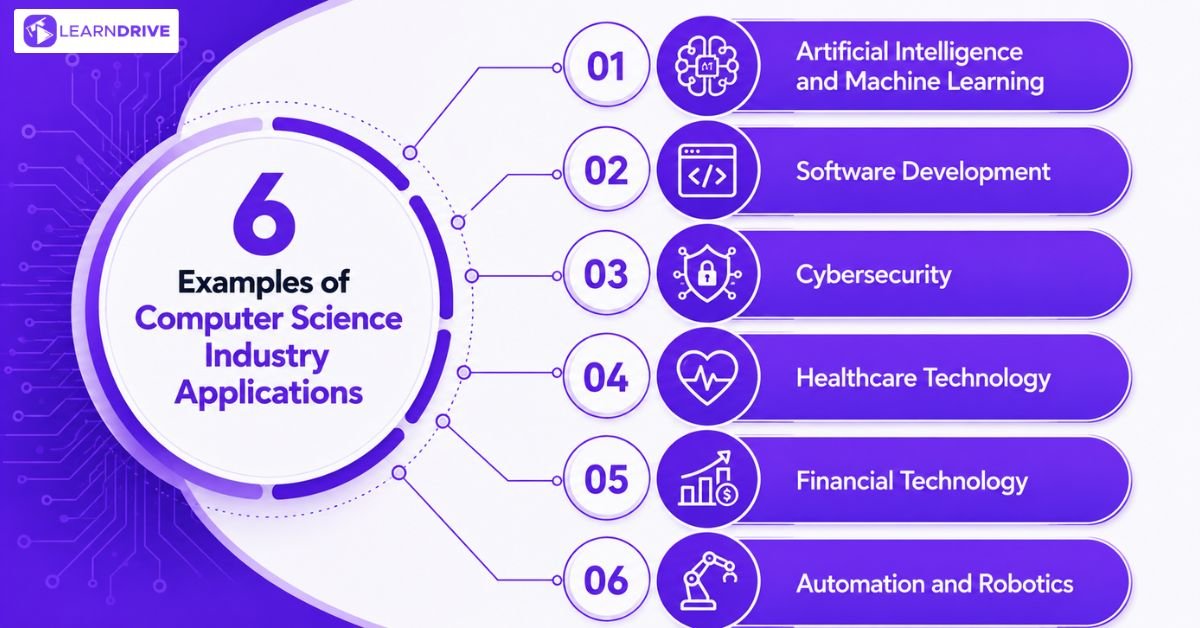
Computer science rarely stays confined to a screen, it shapes entire industries in ways that aren’t always obvious at first glance.
1. Artificial Intelligence and Machine Learning
Systems that learn from data and improve over time now power everything from recommendation engines to medical diagnostics, all built on computer science foundations.
2. Software Development
Every app, website, and piece of business software in existence was written by someone applying computer science principles to solve a specific problem.
3. Cybersecurity
As more of daily life moves online, protecting systems and data from attack has become one of the most critical applications of computer science skills.
4. Healthcare Technology
From electronic patient records to AI assisted diagnostics, computer science is quietly transforming how healthcare is delivered and managed.
5. Financial Technology
Banking apps, fraud detection, and algorithmic trading all rely on computer science expertise to keep financial systems fast, secure, and reliable.
6. Automation and Robotics
From warehouse robots to self driving vehicles, automating physical tasks depends entirely on the software and systems computer science graduates build.
What Is a Computer Science Degree?
A computer science degree trains you in the theory and practice behind how software, systems, and data actually work, covering areas like programming, algorithms, databases, networks, and increasingly, artificial intelligence.
It blends academic problem solving with hands on technical skill, giving graduates both the theoretical grounding and the practical ability to build real, working systems.
Skills You Gain From a Computer Science Degree
Beyond the technical knowledge, a computer science degree builds a set of skills that transfer across nearly every career path in this guide, programming ability, logical problem solving, analytical thinking, and the patience to debug something until it actually works.
These skills are exactly what makes graduates so versatile, since the same problem solving mindset applies whether you’re building software, securing a network, or managing a technical team.
Career Direction After a Computer Science Degree
A computer science degree does not lead to one fixed career path. It gives graduates a foundation in programming, problem-solving, data, and technology that can be applied across almost every industry. Some graduates move directly into software development, while others explore areas such as cybersecurity, artificial intelligence, cloud computing, data science, or technology management. The right direction depends on your interests, strengths, and the type of problems you want to solve.
How to Choose the Right Computer Science Career Path
Narrowing down your direction comes down to understanding how you actually like to work and the type of problems you enjoy solving.
Do you enjoy building things from the ground up, writing code, and watching a product take shape, or are you more interested in analysing data, finding patterns, and developing systems that can make predictions?
Perhaps cybersecurity appeals to you more, where protecting systems and solving security challenges becomes the focus. Or maybe you prefer the bigger picture, managing projects, leading teams, and shaping technical strategy rather than coding every day.
HESA Graduate Outcomes data highlights that graduates move into different employment pathways after university, showing that degrees can support multiple career directions rather than one fixed role. For computer science graduates, this flexibility creates opportunities across areas such as software development, artificial intelligence, cybersecurity, data, and technology management.
There is no wrong answer here. Computer science offers well-paid careers built around different interests, strengths, and ways of working.
5 Main Career Areas in Computer Science
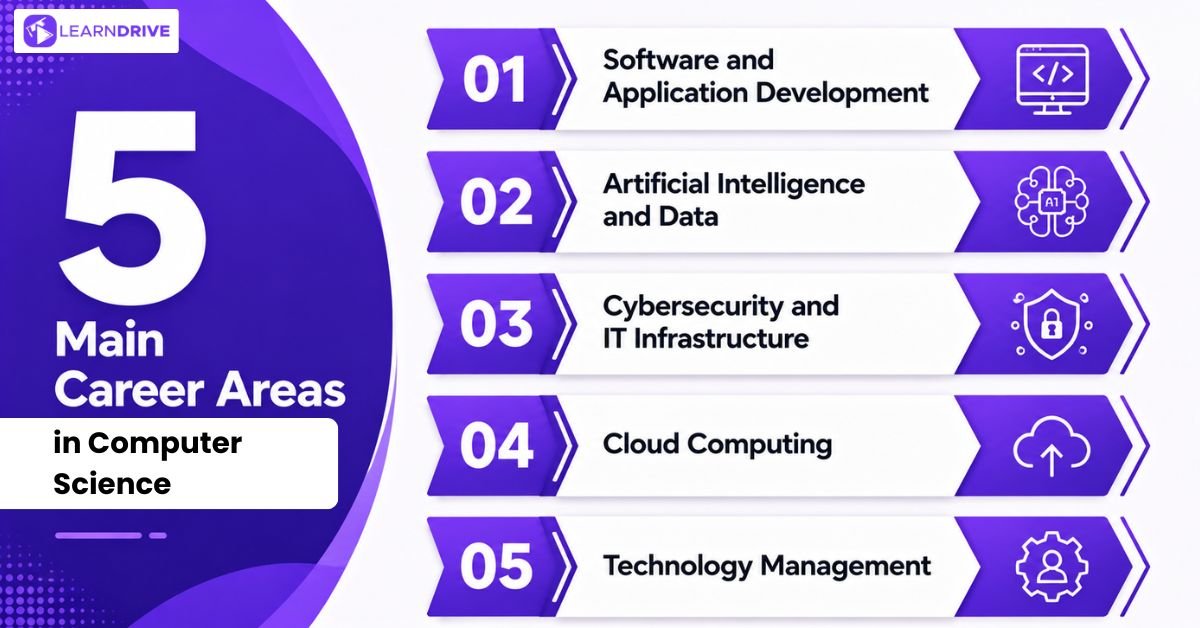
Nearly every computer science career falls into one of five broad areas, each pulling on the same core degree in a different direction.
1. Software and Application Development
Building the apps, websites, and programs that people and businesses use every single day.
2. Artificial Intelligence and Data
Working with data, algorithms, and machine learning models to extract insight or build intelligent systems.
3. Cybersecurity and IT Infrastructure
Protecting systems, networks, and data from threats while keeping everything running securely.
4. Cloud Computing
Designing and managing the online infrastructure that businesses increasingly rely on instead of physical servers.
5.Technology Management
Overseeing technical projects, teams, and strategy, bridging the gap between technical work and business decision making.
20 Top Computer Science Careers, Jobs List and Salary Guide
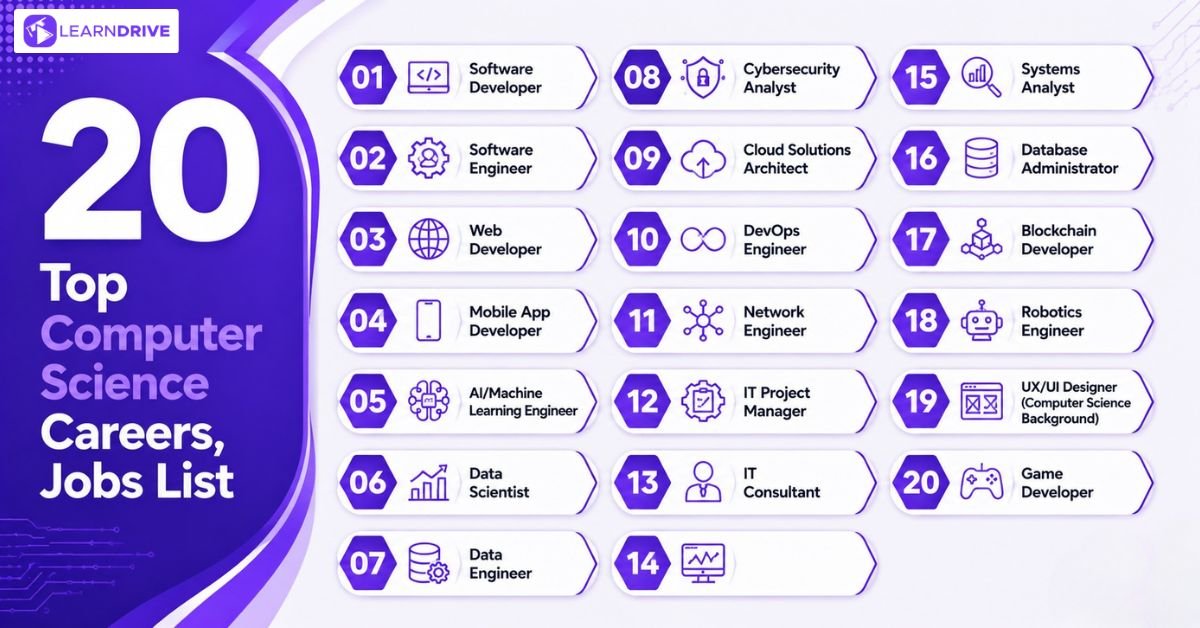
Twenty careers is a lot to take in at once, so this list is broken into five clear categories, each covering four roles that share a similar skill set and career direction.
1. Software Development Careers
Software development is the most recognisable branch of computer science, and often the first thing people picture when they hear the degree title. These roles focus on actually building the products, apps, and systems that businesses and everyday users rely on, turning ideas into working code.
It’s hands on, logic driven work, and it remains one of the most consistently in demand paths for computer science graduates, whether you’re drawn to full scale software architecture or the visual, immediate satisfaction of building a website from scratch.
1. Software Developer
Software developer means designing, writing, and testing the code that powers applications and systems used by businesses and individuals every day. It involves working through the full development process, from planning a solution to writing clean, functional code and fixing issues as they arise.
It’s one of the most direct applications of a computer science degree, rewarding strong logical thinking and genuine patience for problem solving over long stretches of focused work.
Salary: £44,587–£64,900 per year ( according to glassdoor )
Requirements:
Strong programming skills (e.g. Python, Java, C++)
Problem solving and logical thinking
Understanding of software development lifecycle
Attention to detail
Ability to debug and test code effectively
2. Software Engineer
A software engineer job goes well beyond writing individual features. The real focus is designing and building larger, more complex systems with scalability and long term reliability in mind, often working across the full architecture of a product alongside larger teams handling real world scale.
Graduates who enjoy thinking about how systems fit together as a whole, rather than solving one isolated coding problem at a time, tend to thrive here.
Salary: £44,489 to £296,112 per year (according to Glassdoor)
Requirements:
Strong software architecture knowledge
Advanced programming skills
Experience with version control and collaborative development
Analytical and systems thinking
Strong communication for cross team collaboration
3. Web Developer
Websites and web applications are the entire focus for a web developer, covering everything from visual layout to backend functionality. Front end and often back end technologies come together here to create fast, functional, user friendly sites.
Seeing immediate, visual results from your work is a real draw for many graduates, since the impact of good web development is usually visible straight away.
Salary: £24,000 to £45,000 per year (according to Glassdoor)
Requirements:
Proficiency in HTML, CSS, and JavaScript
Familiarity with web frameworks
Understanding of responsive design principles
Problem solving skills
Attention to detail and visual accuracy
4. Mobile App Developer
Smartphones and tablets are where a mobile app developer’s work lives, operating within platforms like iOS or Android to create apps people use daily. Intuitive interfaces have to sit alongside functional code, with performance, usability, and device limitations all balanced throughout development.
A mix of technical and user focused thinking suits this role well, since a great app depends as much on smooth user experience as it does on solid code underneath.
Salary: £38,640 to £66,697 per year (according to Glassdoor)
Requirements:
Proficiency in Swift, Kotlin, or cross platform frameworks
Understanding of mobile UI/UX principles
Problem solving and debugging skills
Attention to performance and device compatibility
Familiarity with app store deployment processes
2. AI and Data Careers
If software development is about building things, AI and data careers are about making those things smarter, using information to predict, recommend, and automate decisions that used to require a human eye.
This is one of the fastest growing corners of computer science right now, driven by how much data businesses generate and how badly they want to actually use it. These roles suit graduates who enjoy pattern recognition, statistics, and the quiet satisfaction of watching a model get more accurate the more it learns.
1. AI/Machine Learning Engineer
Systems that learn from data and improve their performance over time are the entire purpose of this role, powering everything from recommendation engines to predictive tools. Training models, testing their accuracy, and refining them until they perform reliably in real world conditions makes up the daily work.
One of the highest demand, highest paid directions in computer science right now, this role suits graduates who enjoy the mathematical and experimental side of the field.
Salary: £68,704 to £170,704 per year ( according to glassdoor )
Requirements:
Strong understanding of machine learning algorithms
Proficiency in Python and ML frameworks
Solid mathematics and statistics foundation
Analytical and experimental mindset
Patience for iterative model testing
2. Data Scientist
Large datasets hide patterns, trends, and insights that genuinely inform business decisions, and uncovering them is exactly what a data scientist does. Cleaning data, building models, and communicating findings clearly enough that non technical stakeholders can actually act on them rounds out the role.
Graduates who enjoy a blend of technical analysis and storytelling tend to do well here, since the real value lies in turning raw numbers into a decision someone can actually make.
Salary: £75,985 to £105,778 per year ( according to reed )
Requirements:
Strong statistical and analytical skills
Proficiency in Coding
Data visualisation ability
Clear communication of technical findings
Understanding of Python, machine learning, & data science basics
3. Data Engineer
The infrastructure that allows data to be collected, stored, and processed at scale needs someone building and maintaining it, and that responsibility falls to the data engineer. Designing data pipelines, ensuring systems run efficiently, and making sure data scientists and analysts downstream have clean, reliable data to work with all fall under this role.
Infrastructure and systems thinking appeal more than the analysis itself for people suited to this path, since the value here is in building the plumbing that makes everything else possible.
Salary: £35,000 to £60,000 per year
Requirements:
Strong database and data pipeline skills
Proficiency in SQL and programming languages like Python
Understanding of cloud data platforms
Problem solving for large scale systems
Attention to data quality and reliability
4. AI Engineer
Turning machine learning models into real, deployable products that businesses can actually use at scale is the core job of an AI engineer. Integrating AI systems into existing software, optimising performance, and ensuring models keep working reliably once they’re live all sit within this remit.
The practical, engineering side of AI appeals more than pure research to people drawn to this role, bridging the gap between a working model and a genuinely usable product.
Salary: £64,017 to £132,265 per year (according to glassdoor )
Requirements:
Strong programming and software engineering skills
Understanding of machine learning deployment
Familiarity with cloud and AI infrastructure
Problem solving for production level systems
Collaboration skills across technical teams
5 Entry-Level Computer Science Jobs and Salary Guide
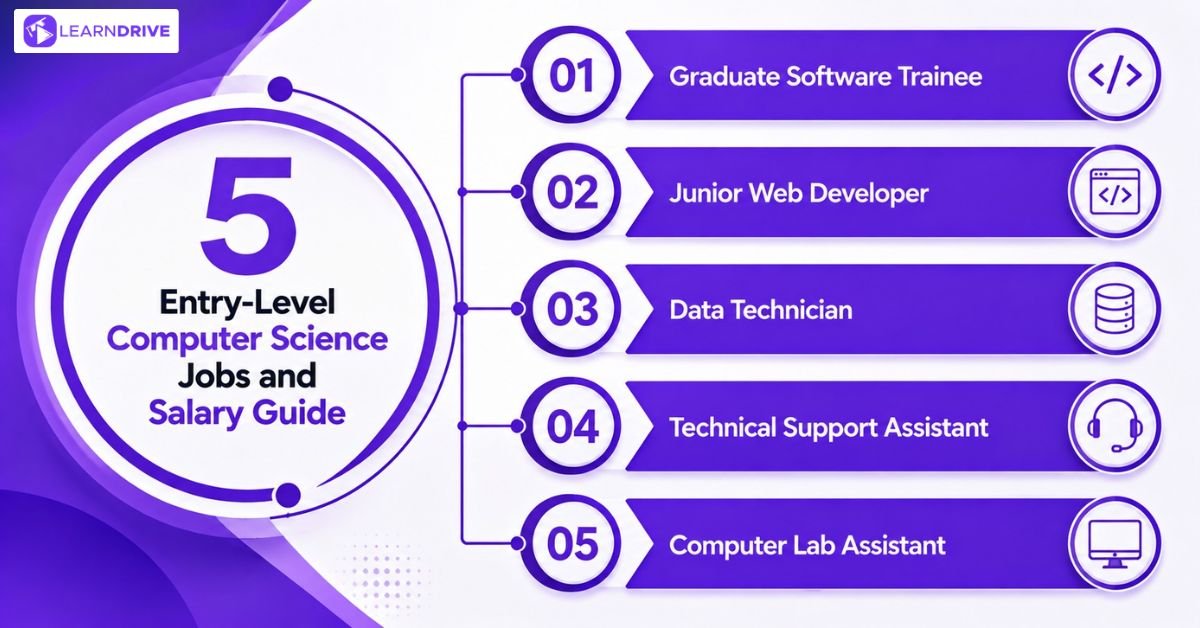
Landing your first role after graduating doesn’t have to mean walking straight into a senior engineering position. These entry level roles are specifically designed for graduates, offering genuine hands on experience, structured learning, and a clear route into more specialised careers once you’ve built a bit of real world confidence.
1. Graduate Software Trainee
Structured graduate programmes like this one teach you to write, test, and maintain software under the guidance of experienced developers. Real projects come into play early on, but training, mentorship, and support are built directly into the role from day one.
Many employers design these programmes specifically around graduates with little to no professional experience, which makes this one of the most straightforward routes into a software career.
Salary: £24,000 to £32,000 per year (according to glassdoor )
Requirements:
Solid understanding of programming fundamentals
Willingness to learn and take feedback
Basic problem solving skills
Good communication for team collaboration
Enthusiasm for continued technical development
2. Junior Web Developer
Websites and web applications need ongoing support to build and maintain, and that’s where this role comes in, usually working under a more senior developer while gradually taking on more independent tasks. Writing front end or basic back end code, fixing bugs, and learning how a professional development workflow actually operates make up the daily work.
Visible results come quickly in web development compared to other technical roles, which is exactly what draws many graduates to this path.
Salary: £25,068 to £36,665 per year (according to glassdoor )
Requirements:
Proficiency in HTML, CSS, and JavaScript basics
Willingness to learn frameworks and tools on the job
Attention to detail
Problem solving and debugging skills
Comfort receiving code review feedback
3. Data Technician
Collecting, organising, and processing data for a business is where this role fits in, usually working under data engineers or analysts while learning the practical side of data systems. Maintaining data quality, running basic queries, and helping prepare data for deeper analysis fill out the responsibilities, skills a SQL database queries course builds from scratch.
Advanced machine learning knowledge isn’t required to get started here, which makes it a strong entry point for graduates interested in the data and AI career path.
Salary: £26,057 to £42,421 per year (according to glassdoor )
Requirements:
Basic understanding of databases and SQL
Attention to detail and accuracy
Analytical thinking
Willingness to learn data tools and platforms
Reliability in handling sensitive information
4. Technical Support Assistant
Users experiencing software problems, hardware faults, or general IT queries usually turn to this role first, since it acts as the initial point of contact when something goes wrong. Diagnosing problems, walking users through solutions, and escalating more complex issues when needed round out the job.
Patience and clear communication carry just as much weight as technical knowledge here, and this role often leads naturally into more specialised IT or cybersecurity careers.
Salary: £21,554 to £28,071 per year (according to glassdoor )
Requirements:
Basic technical troubleshooting skills
Strong communication and patience
Problem solving under time pressure
Willingness to learn new systems quickly
Customer service mindset
5. Computer Lab Assistant
Universities, schools, and training centres all rely on someone to keep their computer labs running day to day, and that’s exactly what this role covers, helping users with basic technical issues while keeping systems maintained. Troubleshooting minor hardware and software problems, assisting students or staff, and ensuring equipment stays in good working order make up the work.
Often taken on alongside study, this genuinely gentle entry point into tech builds exactly the kind of practical troubleshooting experience that strengthens a graduate’s first full time application.
Salary: £18,000 to £23,000 per year (according to glassdoor )
Requirements:
Basic technical troubleshooting skills
Reliability and punctuality
Good communication with users
Patience supporting less technical people
Willingness to learn on the job
Comparison of Entry-Level Computer Science Jobs and Salary Guide
5 Computer Science Jobs You Can Get Without Experience
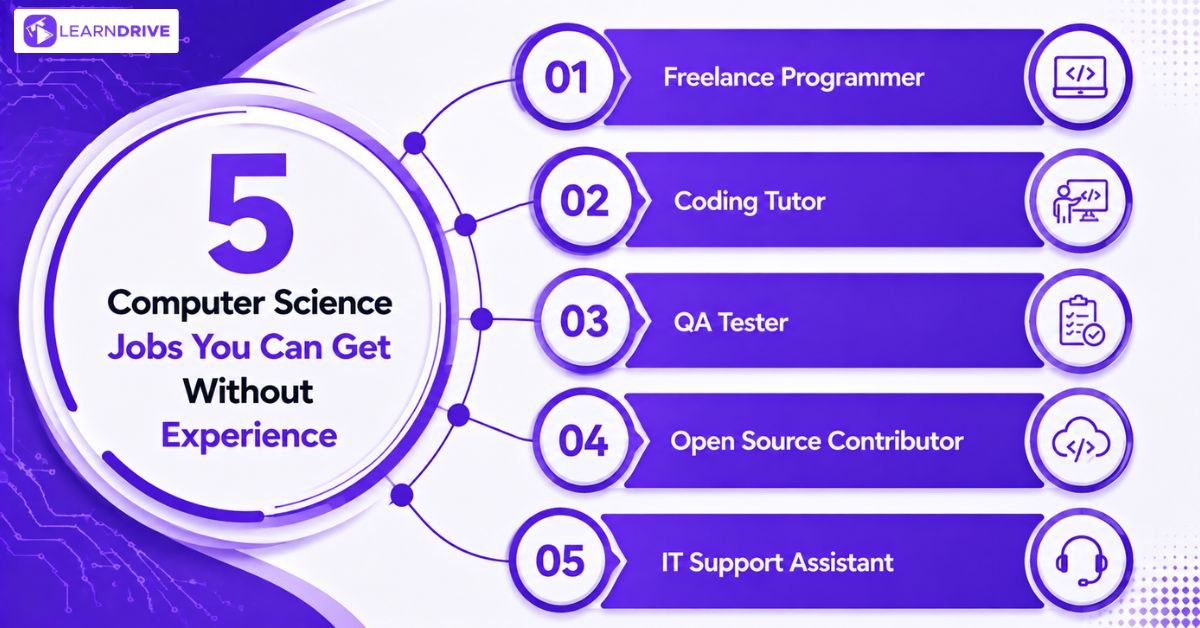
Not every computer science career requires a formal graduate scheme or years of professional history first. These roles let you start building a portfolio and earning immediately, often on your own terms, using nothing more than the skills you already taught yourself or picked up during your degree.
1. Freelance Programmer
Coding projects come directly from clients in this role, whether that’s building a small website, fixing a bug, or developing a custom tool, all without needing to be hired by a single employer first. Managing your own workload, communicating directly with clients, and delivering working code on a project by project basis fills out the day to day, skills a JavaScript from scratch course can help build a foundation for.
Flexibility is the real draw here, and every completed project builds a genuine portfolio that makes future opportunities easier to land.
Salary: £46,992 to £90,501 per year (according to glassdoor )
Requirements:
Solid programming skills in at least one language
Strong self discipline and time management
Basic client communication skills
Problem solving independence
Willingness to build a portfolio from scratch
2. Coding Tutor
Beginners, whether students, career changers, or hobbyists, need someone to teach them programming basics, and that’s exactly what this role covers.
Explaining ideas clearly, reviewing someone else’s code, and adjusting your teaching style to different learning speeds make up the core work, and an instructional design course helps structure that teaching properly rather than winging it session to session.
Teaching something often deepens your own understanding of it, which makes this a genuinely accessible way to earn while reinforcing your own knowledge at the same time.
Salary: £ 33,425 to £59,895 per hour (according to glassdoor )
Requirements:
Solid understanding of programming fundamentals
Strong communication and patience
Ability to simplify complex concepts
Reliability for scheduled sessions
Comfort teaching different skill levels
3. QA Tester
Software needs testing before it’s released, and hunting for bugs, checking functionality, and making sure a product actually works the way it’s supposed to falls to the QA tester. Running through test cases methodically, documenting issues clearly, and working closely with developers to get problems fixed rounds out the role.
Detail oriented, methodical graduates tend to do well here, since the role rewards patience and thoroughness over flashy technical skill.
Salary: £20,000 to £28,000 per year (according to glassdoor )
Requirements:
Strong attention to detail
Methodical, patient approach to testing
Basic understanding of software development
Clear written communication for bug reports
Problem solving and curiosity
4. Open Source Contributor
Publicly available open source projects rely on volunteers who contribute code, documentation, or bug fixes, often unpaid at first but genuinely valuable for building visibility and experience. Collaborating with other developers online, following project guidelines, and gradually building a public track record of real, usable code make up the work.
Potential employers can literally see your contributions and code quality for themselves, which makes this one of the smartest ways to build credibility without formal employment.
Salary: £145,000 to £185,000 per year (according to simplyhired )
Requirements:
Solid programming skills
Willingness to work collaboratively online
Comfort with version control (e.g. Git)
Patience for code review and feedback
Genuine interest in contributing beyond personal projects
5. IT Support Assistant
Everyday technical issues, from software glitches to basic hardware troubleshooting, need someone to resolve them, often making this role a first step into the wider tech industry. Diagnosing problems, communicating solutions clearly, and building genuinely practical, hands on technical experience make up the day to day.
Patience and communication carry just as much weight as raw technical knowledge here, making it one of the most accessible entry points into computer science careers overall.
Salary: £21,554 to £28,071 per year (according to glassdoor )
Requirements:
Basic technical troubleshooting skills
Strong communication and patience
Problem solving under time pressure
Willingness to learn new systems quickly
Customer service mindset
Comparison of Computer Science Jobs You Can Get Without Experience
5 Fastest-Growing Areas and Future Careers in Computer Science

Some corners of computer science are growing faster than others, and knowing where the momentum is heading can genuinely shape which skills are worth investing in next.
These are the areas expected to keep expanding fastest over the next few years, offering strong opportunity for graduates willing to specialise early.
1. Artificial Intelligence and Prompt Engineering
AI has moved from a niche specialism to a skill nearly every tech employer wants somewhere on their team, with organisations such as Google DeepMind pushing research and practical applications across areas like machine learning and advanced AI systems.
This area suits graduates who enjoy experimenting, refining, and understanding exactly how these systems respond to different inputs.
2. Ethical Hacking and Cybersecurity
Building credibility in cybersecurity often involves gaining recognised qualifications, and certifications from CompTIA are widely used by professionals entering security-focused roles.
3. Quantum Computing
Still early stage but developing fast, quantum computing promises to solve certain types of problems far beyond what traditional computers can handle.
It’s a genuinely specialist field right now, but graduates who get in early are positioning themselves at the very edge of where computer science is heading next.
4. Robotics and Automation
As businesses across manufacturing, logistics, and healthcare lean further into automation, the demand for graduates who can design and program physical robotic systems keeps climbing.
This area rewards graduates who enjoy combining software skills with real world, physical engineering problems.
5. Cloud Computing
Businesses have largely abandoned physical servers in favour of flexible, scalable cloud infrastructure, and that shift shows no sign of slowing down. Graduates with strong cloud computing skills are consistently in demand, since nearly every modern business now depends on cloud systems to actually function.
5 Reasons Why You Should Pursue a Career in Computer Science in 2026

If you’re still weighing up whether this degree is genuinely worth the investment, here’s the case for why computer science remains one of the strongest career choices available right now.
1. Strong Demand for Technology Professionals
Nearly every business, regardless of industry, now depends on technology to function, and that dependence keeps growing every year. This sustained demand means computer science graduates rarely struggle to find opportunities, whether they’re just starting out or several years into a specialised career.
2. Competitive Salary Opportunities
Technology roles consistently rank among the higher paying careers available straight out of university, with clear progression toward genuinely high earning potential in specialised fields like AI, cybersecurity, and cloud architecture. Few degrees offer this combination of accessibility and long term earning power.
3. Remote and Flexible Career Options
Computer science careers are among the most naturally suited to remote and flexible working, since much of the work happens on a screen rather than requiring a physical presence. This flexibility gives graduates genuine control over where and how they build their careers.
4. Opportunities Across Multiple Industries
A computer science degree isn’t locked into one sector, it opens doors across healthcare, finance, entertainment, government, and virtually every other industry that relies on technology. That range means graduates can follow their personal interests just as easily as they can follow the highest paying opportunities.
5. Continuous Career Growth
Technology never stands still, and neither do the career opportunities within it. Graduates who keep learning and adapting can continue climbing toward more senior, specialised, and better paid roles throughout their entire career, making this one of the more genuinely future proof paths available.