What Exactly Is Artificial Intelligence for Kids?
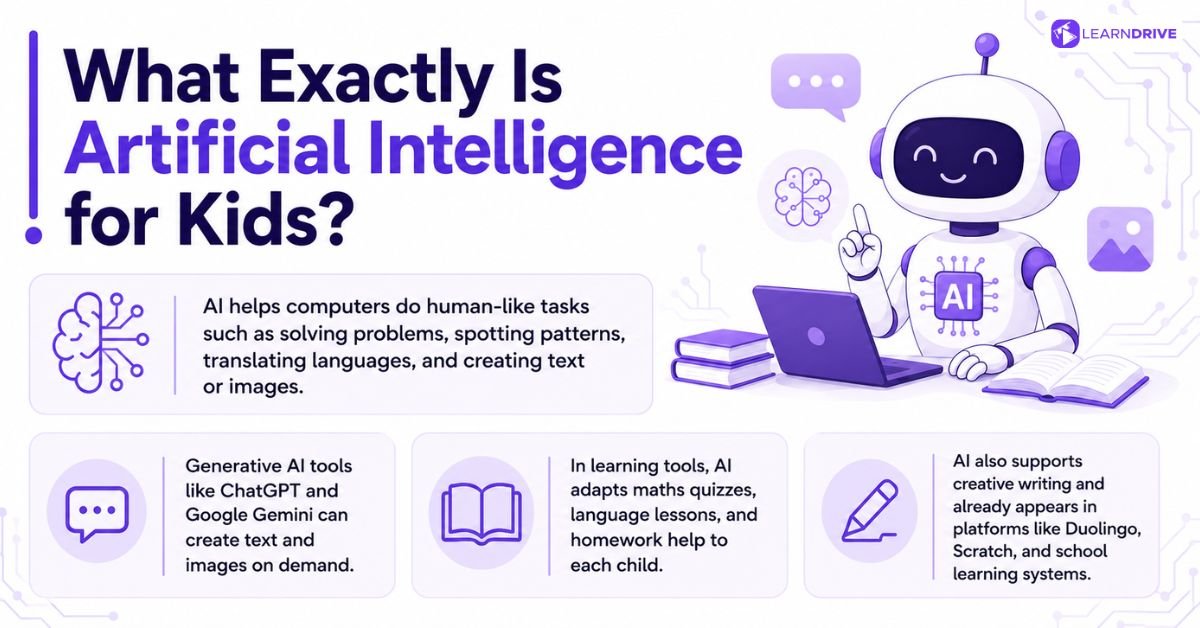
Before we start diving into statistics and debating, we need to ensure we’re on the same page. Artificial intelligence (AI) is when computer systems use data to perform tasks that typically require human intelligence such as solving problems, recognizing patterns, translating languages, or creating text and images.
Currently, much of the conversation revolves around Generative AI, which powers tools like ChatGPT and Google Gemini. These tools can generate new content, including images and text, on demand.
For children, AI is integrated into various learning tools. It powers math quizzes that adapt in difficulty based on performance, language lessons that seamlessly switch between languages, and homework assistants that explain concepts until they are understood.
It is even used in creative writing tools that suggest the next steps in a story. AI is already embedded in many platforms children use, such as Duolingo and Scratch, as well as various school-based learning systems.
How AI Is Actually Being Used in Kids’ Education Today
Walk into any forward thinking classroom today and the AI integration might surprise you. Here is what the data tells us is happening on the ground:
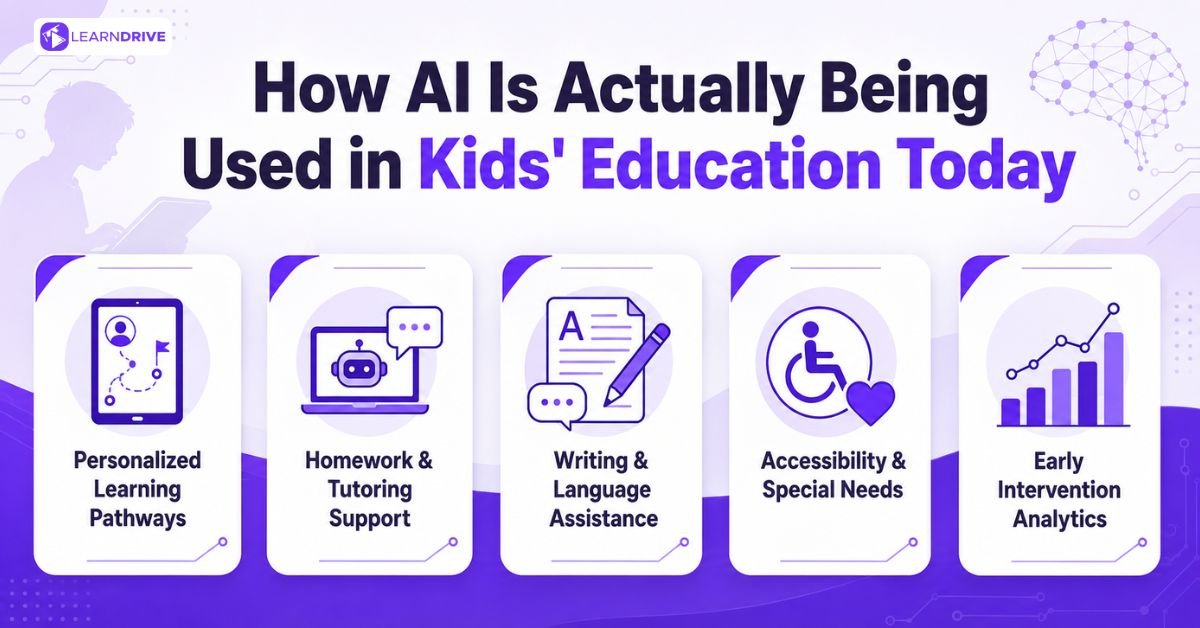
Personalized Learning Pathways: Adaptive platforms assess a student in real time and serve content at precisely the right difficulty level. No more one-size-fits-all lessons.
Homework & Tutoring Support: A remarkable 64% of students now use AI tools for tutoring getting step-by-step explanations.
Writing & Language Assistance: Grammar checkers, essay feedback tools, and instant translation are transforming how multilingual students engage with written work.
Accessibility & Special Needs: Speech-to-text, text-to-speech, and real-time captioning are opening doors for children with dyslexia, hearing impairments, and learning differences.
Early Intervention Analytics: Machine learning flags struggling students weeks earlier than traditional assessment, allowing teachers to intervene before a child falls too far behind.
12 Advantages of AI for Kids
Artificial Intelligence is reshaping education by giving children access to learning experiences that are more personalised, interactive, and engaging than ever before.
Rather than following a one-size-fits-all approach, AI-powered tools can adapt to individual learning needs, provide instant support, and help students progress at their own pace. As technology becomes increasingly integrated into classrooms and homes, many educators and parents are recognising the significant benefits AI can offer when used responsibly. From improving academic performance to boosting confidence and motivation, the undeniable advantages of AI for kids are transforming how young learners develop knowledge and skills in the digital age.
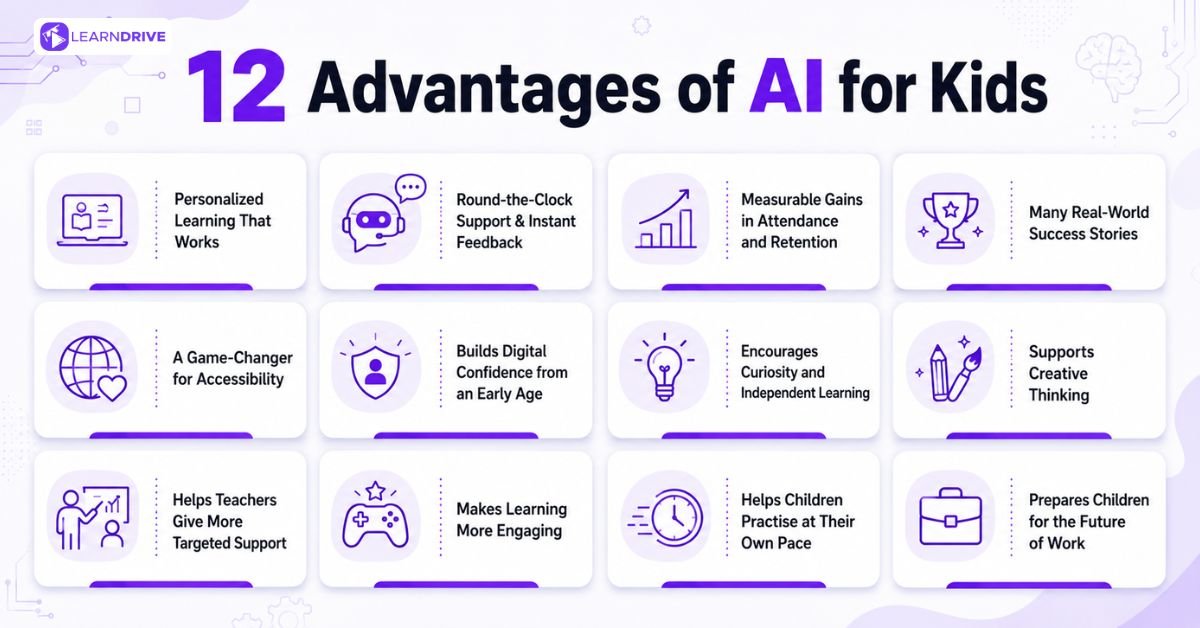
1. Personalized Learning That Works
This is the big one and the science is compelling. A 2025 randomized controlled trial published in Scientific Reports found that students using an AI tutor achieved significantly higher post-test scores in less time: 49 minutes versus 60 minutes in a traditional active-learning class. Learning gains were over double in some measures, with effect sizes ranging from 0.73 to 1.3 standard deviations, the kind of result that grabs any researcher’s attention.
2. Round-the-Clock Support & Instant Feedback
Children don’t learn on a 9-to-5 schedule. When they hit a wall with their homework at 9 PM, they used to be stuck until the next school day. AI changes that dynamic entirely. Immediate feedback keeps students engaged and prevents them from internalizing misconceptions. Students consistently report that one of the biggest benefits is simply not getting ‘stuck’; avoiding the frustration that can quickly kill motivation.
3. Measurable Gains in Attendance and Retention
When learning feels relevant and achievable, students show up. Schools that implement personalized AI learning approaches have documented up to 12% higher attendance rates and 15% lower dropout rates.
4. Many Real-World Success Stories
Students using Khanmigo (Khan Academy’s AI tutor) report strong engagement, step-by-step guidance, and help filling learning gaps. Teachers note students ask more questions and stay motivated. While specific large-scale percentage gains vary by usage and study, Khan Academy’s platform (including AI features) has demonstrated meaningful improvements in math and other subjects when used consistently.
Even PBS Kids AI companions have shown improved scientific reasoning and vocabulary development through interactive dialogue gains that rival human interaction in some controlled studies. The technology is not just promising; it is already delivering.
5. A Game-Changer for Accessibility
For multilingual learners, students with dyslexia, children with ADHD, or young people with hearing or vision impairments, AI is not a nice-to-have, it is a lifeline. One elementary educator described watching her multilingual students master complex vocabulary that previously took weeks, in a matter of days, thanks to AI-powered real-time translation and contextual explanation. This is equity in action.
6.Builds Digital Confidence from an Early Age
AI helps children become more comfortable with technology in a practical way. Instead of only using devices for games or videos, children can use AI tools to ask questions, explore ideas, practise skills and solve problems. This builds digital confidence, which is becoming increasingly important in school, work and everyday life.
When children learn how to use AI responsibly, they also start developing better digital judgement. They learn that technology can support thinking, but it should not replace effort, creativity or independent problem-solving. This kind of early confidence can prepare them for a future where AI will be part of many careers and industries.
7.Encourages Curiosity and Independent Learning
One of the biggest advantages of AI for kids is that it can make learning feel more open and exciting. A child can ask “why”, “how” or “what if” questions and receive instant explanations. This encourages curiosity because children do not have to wait for the next lesson or depend only on one textbook.
AI can also help children explore topics beyond the classroom. A student interested in space, animals, coding, history, music or science can ask follow-up questions and go deeper into the subject. This creates a more active learning experience, where children are not just receiving information but exploring it.
8.Supports Creative Thinking
AI is not only useful for maths, spelling or homework. It can also support creativity. Children can use AI to brainstorm story ideas, generate writing prompts, plan projects, create simple designs, practise dialogue, explore music concepts or develop presentation ideas.
This does not mean AI should do the creative work for them. The real value comes when AI acts like a creative assistant. It gives children a starting point, helps them organise their ideas and encourages them to think in new ways. With the right guidance, AI can help children become more imaginative, not less.
9.Helps Teachers Give More Targeted Support
AI can also benefit children by helping teachers understand where students are struggling. Some AI-powered learning tools can highlight patterns, such as repeated mistakes, weak topics or areas where a child needs more practice. This allows teachers to give more focused support instead of guessing what each learner needs.
For example, if several students are struggling with fractions, reading comprehension or vocabulary, the teacher can respond more quickly with extra practice, group support or a different explanation. This makes classroom support more responsive and helps children receive help before they fall too far behind.
10.Makes Learning More Engaging
Children learn better when they are interested. AI can make learning more engaging by using interactive questions, adaptive challenges, games, quizzes, stories and conversation-based learning. Instead of passively reading or listening, students can take part in the learning process.
This can be especially helpful for children who lose focus easily or feel bored with traditional methods. When learning feels active and personalised, children are more likely to stay involved. Engagement matters because a motivated child is more likely to practise, ask questions and keep trying.
11.Helps Children Practise at Their Own Pace
Every child learns differently. Some children understand a topic quickly, while others need more time and repetition. AI tools can support both groups. Faster learners can move ahead with more challenging questions, while children who need extra help can practise without feeling embarrassed.
This is powerful because many children are afraid to ask the same question again in class. AI gives them a private space to repeat, review and practise until they feel more confident. That kind of pressure-free learning can make a big difference, especially for children who need more time to build understanding.
12.Prepares Children for the Future of Work
AI is already changing how people work, communicate, research, create and solve problems. Children who learn how to use AI wisely can build skills that may help them in future careers. These skills include asking better questions, checking information, using digital tools, thinking critically and understanding how technology supports decision-making.
The goal is not to make children dependent on AI. The goal is to help them become smart users of technology. When children understand both the benefits and limits of AI, they are better prepared for a future where digital skills, creativity and responsible technology use will matter more than ever.
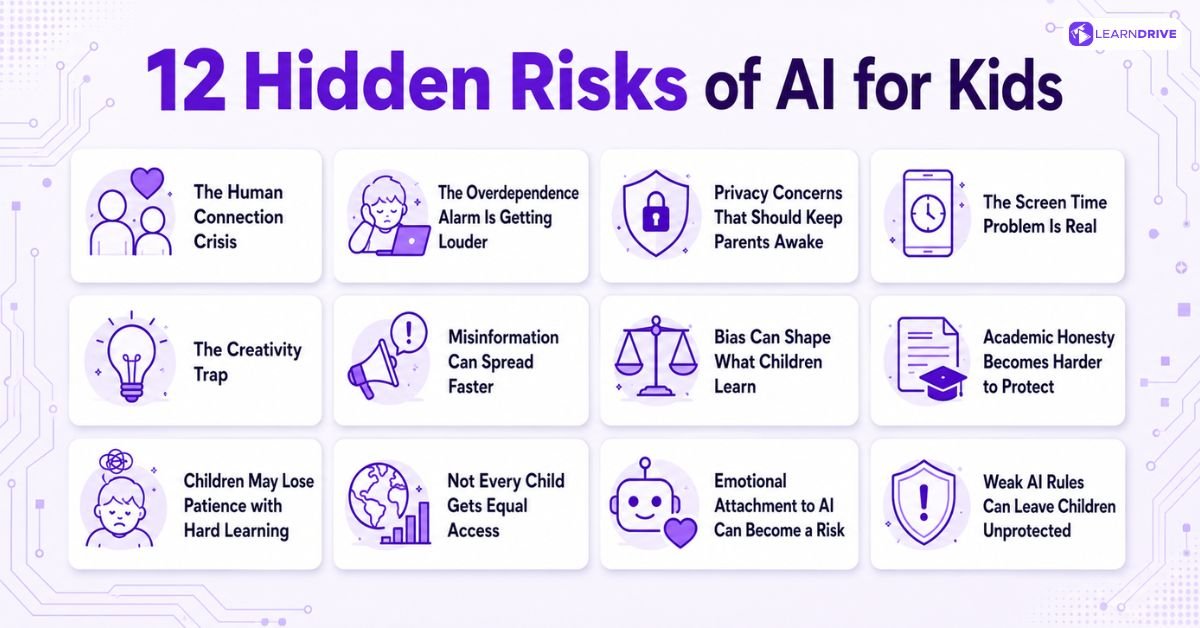
12 Hidden Risks of AI for Kids
Now for the part that gets glossed over in the tech-utopia press releases. Because for every impressive stat about learning gains, there is a troubling counter-data point demanding attention.
1. The Human Connection Crisis
50% of students report feeling less connected to their teachers when AI tools are heavily integrated into their learning experience. A similar proportion report reduced connection to peers. This is not a rounding error. Human relationships are the bedrock of healthy development in children, and any technology that chips away at those bonds deserves serious scrutiny.
2. The Overdependence Alarm Is Getting Louder
In late 2025, a striking 67% of students expressed worry that AI is harming their critical thinking skills up from 54% in earlier surveys. Students themselves are raising the alarm. When a child can ask an AI to solve any problem in seconds, the slow, effortful, character-building process of wrestling with hard questions starts to atrophy. Skills built through productive struggle, patience, resilience, creative problem-solving are not easily replaced by a chatbot shortcut.
3. Privacy Concerns That Should Keep Parents Awake
Every question a child types into an AI tool, every mistake they make, every subject they search, all of it is data. AI tools collect vast amounts of information on children’s interactions, behaviors, and learning patterns.
Without robust privacy-focused frameworks and parental awareness, this data can be misused, sold, or exposed in breaches. Children do not understand what they are handing over, and too many platforms are not designed with their protection as the first priority.
4. The Screen Time Problem Is Real
More AI tools means more screens. A landmark Quebec study found that every additional hour of TV at age 2 corresponded to measurably lower maths performance and classroom participation by grade 4.
International PISA data reinforces this: heavier school screen use correlates with lower reading and maths scores across countries. AI-enhanced education does not get a free pass on the screen time debate just because it is ‘educational.’
5. The Creativity Trap
When AI can draft the essay, design the poster, and generate the story, where does genuine creative expression live? Researchers and educators are raising growing concerns about over-reliance on AI-generated content reducing children’s independent creative output. The muscle of imagination like any other muscle weakens when it is not exercised.
6.Misinformation Can Spread Faster
AI can sound confident even when it is wrong. That is a serious problem for children, because many young learners may not yet have the judgement to question what a chatbot gives them. If an AI tool explains a historical event incorrectly, gives a weak science answer or invents a fact, a child may accept it as true simply because it sounds polished.
This can weaken research habits. Instead of checking sources, comparing information and asking whether something makes sense, children may start trusting the fastest answer. That is dangerous in a world where media literacy and critical thinking are already essential skills.
Bias Can Shape What Children Learn
AI systems are trained on huge amounts of existing data, and that data can include bias. This means AI tools may sometimes reflect stereotypes, unfair assumptions or limited perspectives. For children, this matters because learning tools should expand understanding, not quietly narrow it.
A biased AI answer may give weaker examples, ignore certain cultures, represent some groups unfairly or recommend ideas that are not suitable for every learner. Children may not notice these problems, which is why adult supervision and careful tool selection are so important.
Academic Honesty Becomes Harder to Protect
AI can help students learn, but it can also make cheating easier. A child can ask AI to write an essay, solve a maths problem, summarise a book or complete homework without actually understanding the topic. The final answer may look impressive, but the learning process is missing.
This creates a major challenge for parents and teachers. If children use AI to skip thinking, they may get short-term results while losing long-term ability. Education is not only about producing answers. It is about building the mind that can create those answers.
Children May Lose Patience with Hard Learning
Real learning often feels uncomfortable. Children need time to struggle with a problem, make mistakes, try again and slowly build understanding. AI can remove too much of that struggle if it gives instant answers every time.
This can train children to expect quick solutions instead of developing patience. Over time, difficult reading, long writing tasks, problem-solving and deep study may feel more frustrating because the child is used to immediate help. That is why AI should guide learning, not replace the effort required to learn.
Not Every Child Gets Equal Access
AI can support learning, but only if children have access to the right devices, internet connection, safe platforms and adult guidance. Many families and schools do not have the same level of digital access. This can widen the gap between children who can use AI well and those who cannot.
There is also a quality gap. Some children may use carefully designed educational AI tools, while others may use unsafe, inaccurate or low-quality apps. Without fair access and proper guidance, AI could make educational inequality worse instead of better.
Emotional Attachment to AI Can Become a Risk
Some AI tools are designed to feel friendly, supportive and conversational. For children who feel lonely, anxious or misunderstood, that can become emotionally powerful. The problem is that AI does not truly understand, care or take responsibility like a human adult does.
If a child starts relying on AI for comfort, advice or companionship, it may affect how they build real relationships. Children need parents, teachers, friends and trusted adults. AI can be a tool, but it should never become a substitute for human connection.
Weak AI Rules Can Leave Children Unprotected
AI is moving faster than many school policies, parenting habits and government rules. That creates a dangerous gap. Children may use tools before adults fully understand how those tools collect data, shape behaviour, influence learning or respond to sensitive questions.
This does not mean AI should be banned completely. It means children need strong guardrails. Schools need clear policies.
Parents need awareness. Platforms need safety-first design. Without these protections, children can be exposed to privacy risks, poor information, harmful content and unhealthy dependence before anyone realises the damage.
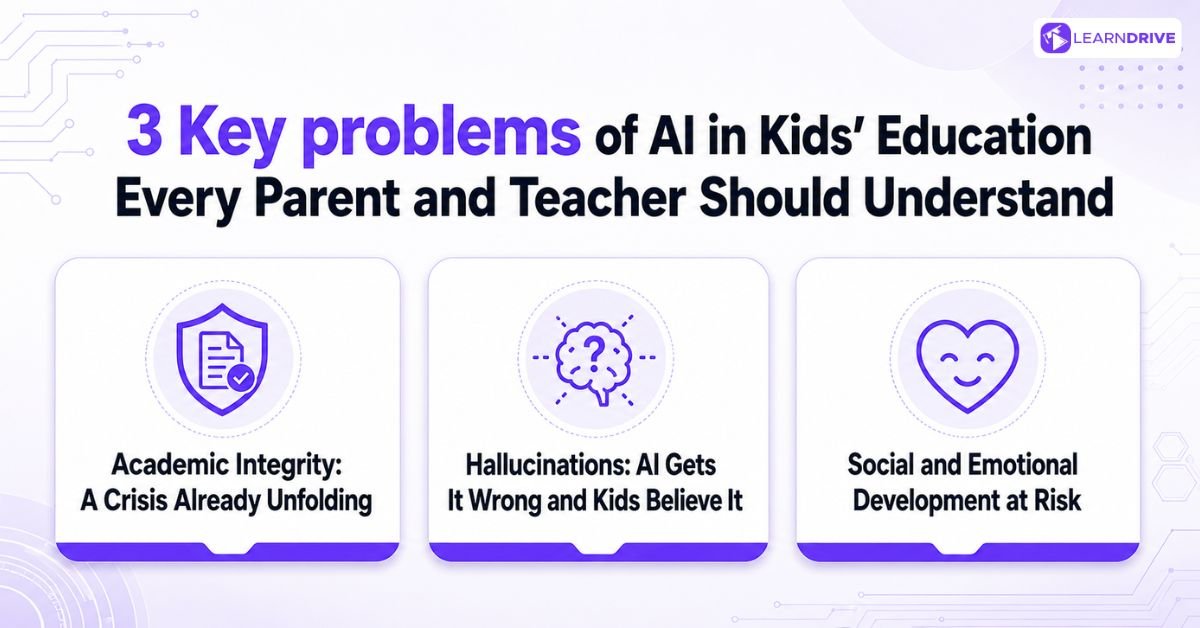
3 Key problems of AI in Kids’ Education Every Parent and Teacher Should Understand
Artificial Intelligence is increasingly being integrated into children’s education, offering personalised learning and instant support. While this brings clear benefits, it also introduces important risks that parents and teachers need to carefully understand.
Issues such as overdependence, reduced critical thinking, data privacy concerns, and exposure to inaccurate information can significantly impact a child’s learning development.
1.Academic Integrity: A Crisis Already Unfolding
Academic dishonesty has long been a challenge within education, even before the rise of artificial intelligence. Students have always had access to various methods of gaining unfair advantages, such as plagiarism, copying work, or receiving unauthorised assistance.
However, the emergence of AI-powered tools has made the issue more complex. These technologies can generate essays, solve problems, and produce content within seconds, making it easier for some students to submit work that does not accurately reflect their own knowledge or abilities.
At the same time, many learners use AI responsibly as a support tool for brainstorming ideas, improving grammar, organising content, or enhancing their understanding of a topic. This has created an ongoing debate among educators about where the line should be drawn between acceptable assistance and academic misconduct.
As AI becomes more integrated into education; schools, colleges, and universities continue to develop policies and assessment methods that encourage genuine learning while maintaining academic integrity.
2.Hallucinations: AI Gets It Wrong and Kids Believe It
AI tools do not know when they do not know something. They confidently generate plausible-sounding but entirely fabricated facts, a phenomenon called ‘hallucination.’ For a 10-year-old doing research on the French Revolution, an AI that invents convincing-sounding citations or dates is actively harmful to learning. Critical fact-checking is an essential companion skill to any AI use.
3.Social and Emotional Development at Risk
Children learn to navigate conflict, build empathy, read social cues, and form deep friendships through messy, imperfect, gloriously human interaction. No matter what, responsive and engaging AI companions cannot replicate this. There is a growing body of research suggesting that children who substitute AI interaction for human connection miss out on critical social-emotional development windows that do not easily reopen.
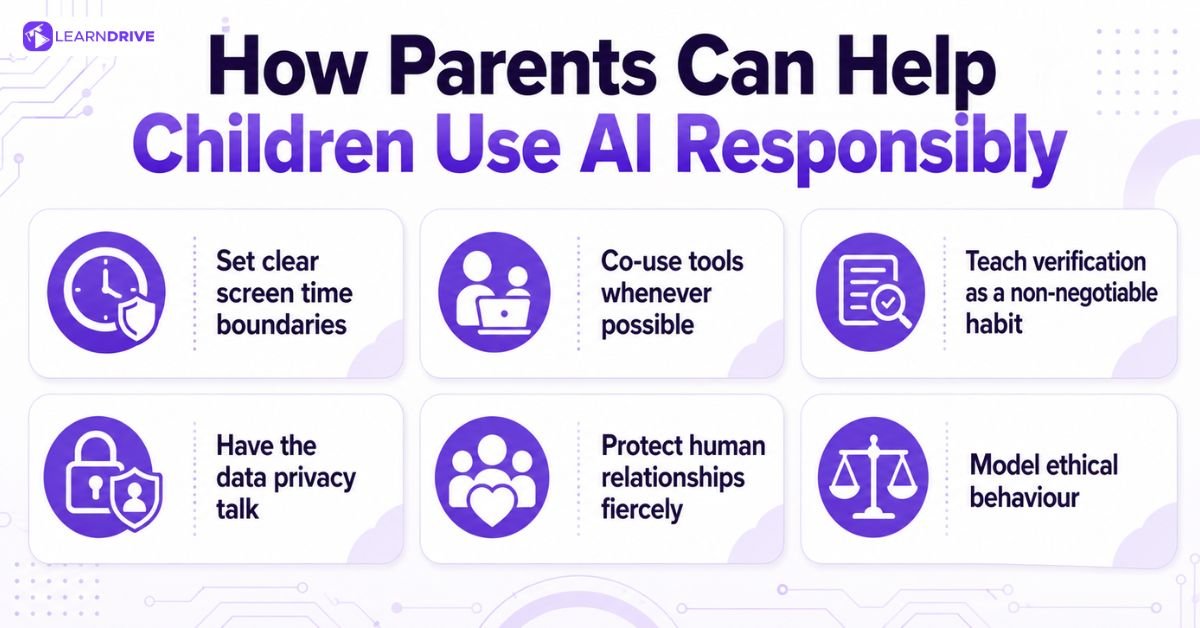
How Parents Can Help Children Use AI Responsibly
The goal is not to ban the AI ship that has sailed and it is not coming back. The goal is to raise children who use AI as a powerful tool without becoming dependent on it. Here is your action plan:
Set clear screen time boundaries: AI learning tools count as screen time. Apply the same thoughtful limits you would to any digital activity.
Co-use tools whenever possible: Sit alongside your child, ask them to explain what the AI is doing, and turn it into a critical thinking exercise rather than a passive consumption session.
Teach verification as a non-negotiable habit: Make it a rule that anything an AI states must be cross-checked with at least one other source. This builds both scepticism and research skills.
Have the data privacy talk: Explain in age-appropriate terms that whatever your child types or uploads to an AI tool can be collected, stored, and potentially shared. Personal information stays offline.
Protect human relationships fiercely: Schedule AI-free time for family conversation, peer play, and real-world exploration. The human moments are irreplaceable.
Model ethical behaviour: Show children what responsible AI use looks like by discussing your own AI interactions openly and critically.
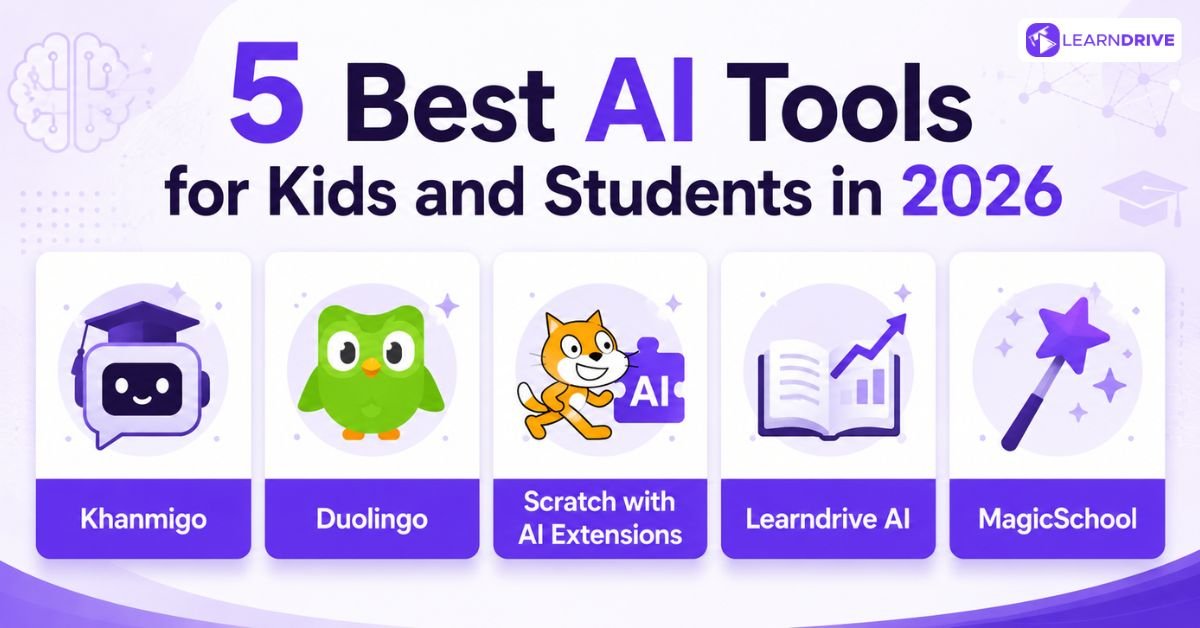
5 Best AI Tools for Kids and Students in 2025
Not all AI tools are created equal. Here are the most evidence-backed, child-appropriate platforms worth exploring always with parental supervision:
1.Khanmigo: Khan Academy’s Socratic AI tutor Khanmigo never just gives the answer, it guides students to find it themselves. Users have reported 23% maths assessment improvements.
2.Duolingo : AI-personalized language learning with proven 21% vocabulary and grammar gains. The gamification feature keeps children engaged without feeling like ‘studying.’
3. Scratch with AI Extensions : Scratch’s “Coding meets Creativity” platform now includes AI extensions, letting kids build their own machine learning projects from as young as age 8.
4.Learndrive AI :Learndrive AI is an AI-powered learning platform that helps learners study online courses with built-in support. Instead of getting stuck on difficult lessons, users can ask questions, clarify topics and continue learning with more confidence. It is useful for younger and older students, professionals and self-paced learners who want a more guided online learning experience.
5.· MagicSchool: MagicSchool is an AI platform built specifically for K–12 education. It offers teacher tools, student support features, classroom controls, content moderation and built-in guardrails. It is useful because children should not use general AI tools without structure; MagicSchool gives teachers more oversight while helping students use AI in a safer, learning-focused way.