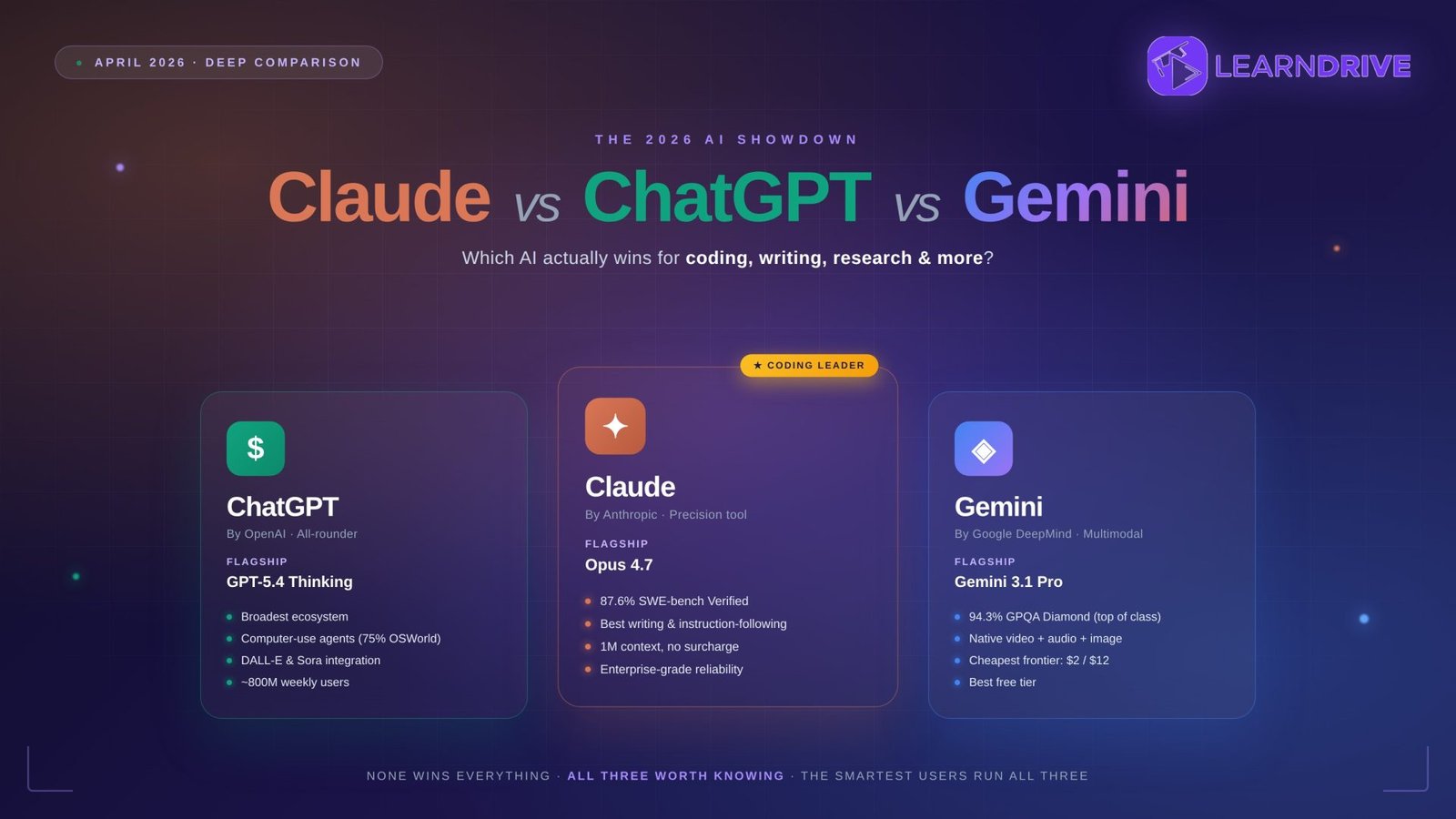
Chat GPT vs Cloude vs Gemini

Claude vs ChatGPT vs Gemini : The 2026 deep comparison

In 2026, the trio of Claude Opus 5, GPT-6 Astra, and Gemini 3.1 Pro have moved beyond simple chatbots to become agentic powerhouses, each reflecting a fundamentally different philosophy of artificial intelligence. While the “best” model used to be a matter of opinion, today it is a matter of utility. Is the priority an AI with a foolproof ethical “constitution,” a versatile generalist that lives in your OS, or a multimodal giant deeply embedded in your existing workspace?


In this deep-dive comparison, we strip away the marketing jargon to benchmark these AI titans across coding, long-form synthesis, and multimodal accuracy to see which one truly earns its place in your professional stack this year.

Table of Contents

Only £1  £249
All-Access Course Bundle
Unlock 100+ CPD-accredited courses for just £1. Industry-recognised certificates. Learn at your own pace.

The executive summary

In April 2026, the three leading general-purpose AI platforms — OpenAI’s ChatGPT, Anthropic’s Claude, and Google’s Gemini — are genuinely close in raw capability at the frontier tier. 


The differences that actually matter for real users show up in three places: specific task domains (coding vs. writing vs. multimodal), the specific model variant you use within each platform (most people default to the wrong one), and the pricing structure at the API level.

The short version

Claude leads on coding accuracy, writing quality, and instruction-following. Gemini leads on multimodal reasoning, raw benchmark scores on abstract reasoning, and price-per-token at scale. ChatGPT leads on ecosystem breadth, agentic computer use, and productivity-suite integration. None of the three wins everything — and the smartest 2026 users run all three.

ChatGPT wins at

Ecosystem breadth, computer-use agents (75% OSWorld), Custom GPTs, image/video generation, general versatility.

Claude wins at

Software engineering (87.6% SWE-bench), natural prose quality, instruction-following precision, enterprise knowledge work.

Gemini wins at

Multimodal (video+audio+image), abstract reasoning (77.1% ARC-AGI-2), price-per-token, Google Workspace workflows.

Basics of the three platforms: ChatGPT, Claude, & Gemini

Before diving into model specifics, it helps to understand the companies behind each platform — because their strategic bets shape what each product is actually optimized for.

1. ChatGPT — by OpenAI — San Francisco

Founded: 2015

Strategy: Broadest general-purpose AI. One product, every use case. Flagship: GPT-6 Astra (September 2026)

Users: ~900M weekly active (Feb 2026, OpenAI’s last official figure); reportedly nearing 1B by mid-2026

Valuation: ~$852B (March 2026); targeting ~$1T at a planned IPO, having confidentially filed with the SEC in June 2026

2. Claude — by Anthropic — San Francisco

Founded: 2021 (by ex-OpenAI researchers)

Strategy: Safety-first, quality-first. Enterprise and pro-user focus.

Flagship: Claude Opus 5 (July 2026)

Approach: Constitutional AI framework

Valuation: ~$965B (May 2026); targeting ~$2T at a planned IPO, expected as soon as September/October 2026

3. Gemini — by Google DeepMind — London

Founded: DeepMind 2010, merged with Google Brain in April 2023

Strategy: Multimodal-native AI embedded in Google ecosystem.

Flagship: Gemini 3.1 Pro (February 2026)

Advantage: Unmatched scale and Workspace integration

Distribution: Built into Google’s billion-user products


These strategic orientations explain a lot. OpenAI optimizes for the broadest possible user base, which means ecosystem depth and feature count. Anthropic optimizes for quality and safety, which means fewer but more polished capabilities. Google optimizes for integration leverage — Gemini is most powerful when it sits inside Docs, Gmail, or Search, not as a standalone chat window.

ChatGPT Vs Claude Vs Gemini: Every model, explained

This is the section most comparison articles skip — and it’s the most important one. Each of these three Generative AI platforms offers multiple distinct models, and picking the wrong one within a platform will give you a worse result than picking a different platform entirely.


Here’s every active model you’d actually consider in April 2026.

Chat Gpt 5 family

Cloude 4 family

Gemini Family

The variant you choose matters more than the platform

A common mistake: comparing ChatGPT’s default Instant model against Claude’s top-tier Opus. These aren’t equivalent — they’re different price points, different reasoning depths, different use cases. 


In every benchmark below, we compare flagship against flagship and mid-tier against mid-tier. If you skip that step in your own testing, your conclusions will be wrong.

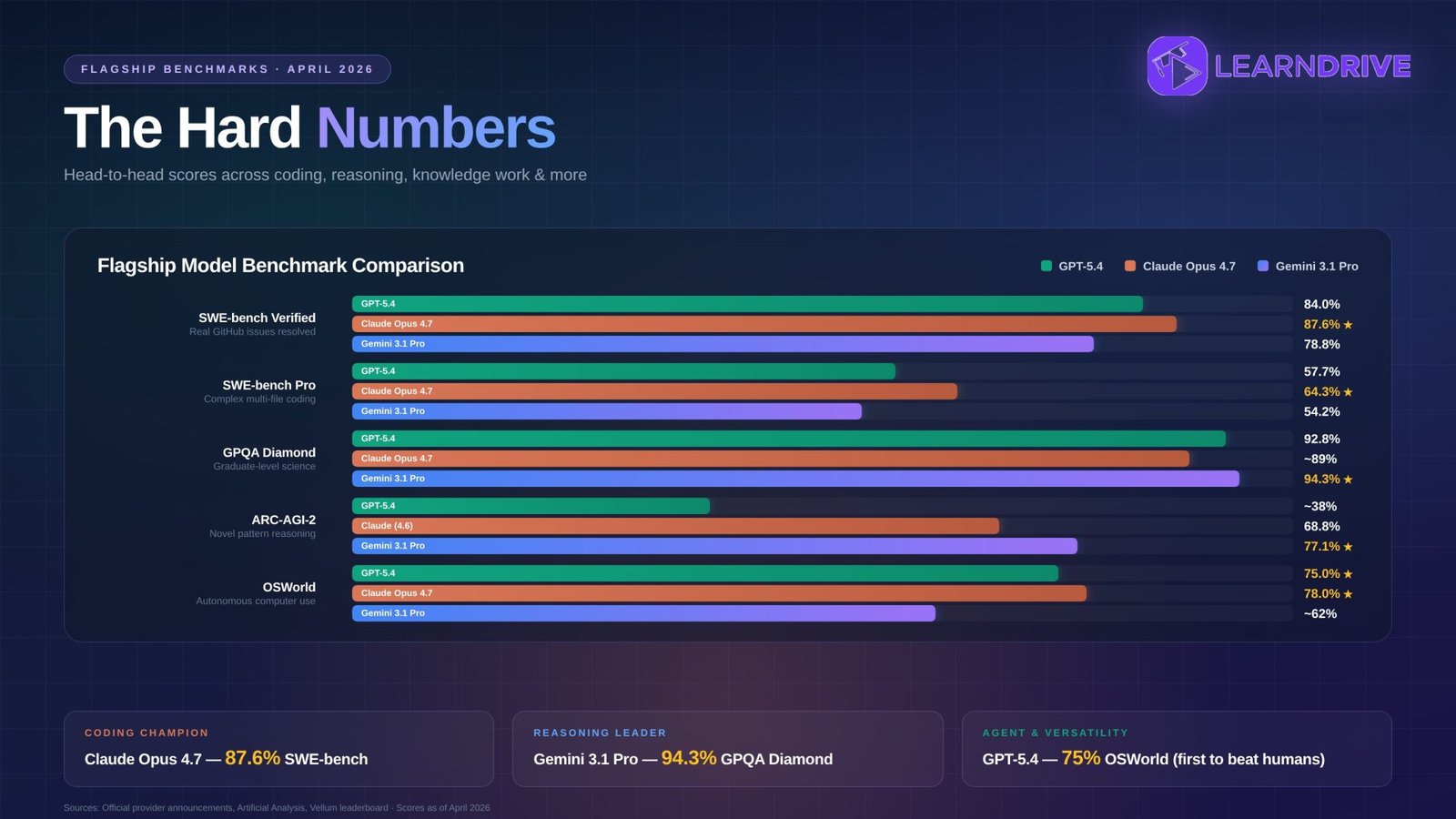
Benchmarks: the hard numbers
Benchmarks of AI

Benchmarks aren’t everything — they measure narrow capabilities, they suffer from training-data contamination, and models increasingly optimize for them. But they’re the most objective comparison data we have, and the 2026 spread across frontier models tells a clear story when you read the right ones.

Flagship model comparison — September 2026

Benchmark of GPT Opus Gemini

What this table reveals is more interesting than the individual numbers. Claude Opus 5 leads on every software-engineering benchmark — SWE-bench Verified, SWE-bench Pro, and enterprise knowledge work (GDPval).

Gemini 3.1 Pro leads on every abstract reasoning benchmark — GPQA Diamond, ARC-AGI-2, Humanity’s Last Exam.

GPT-6 Astra is exceptionally well-rounded, leading on desktop computer-use and competition mathematics while staying within a few points of the leaders everywhere else.

The mid-tier model comparison

Most real users, most of the time, aren’t running flagship models — they’re using the mid-tier option that balances capability with cost. Here’s where the mid-tier models actually land:

The practical implication: for most production AI work, the right mid-tier choice is either Claude Sonnet 4.6 (for coding, agents, writing) or Gemini 3 Flash (for multimodal, high-volume, budget-sensitive tasks). GPT-5.4 Mini sits in an awkward middle — capable but rarely the optimal pick for a specific workload.

Writing quality compared

Writing is the hardest thing to benchmark because quality is subjective. But there’s one dimension we can measure objectively: how often do users prefer one model’s output over another’s in blind comparisons? And on that measure, Claude has held a consistent lead through 2025 and into 2026.


On GDPval-AA v2 — an independent knowledge-work benchmark run by Artificial Analysis, built on an occupational task set originally published by OpenAI,

testing whether models can produce professional-grade deliverables like sales presentations, accounting spreadsheets, and legal analysis across 44 occupations — Claude Opus 5 leads at 1,824 Elo, ahead of GPT-6 Astra (an estimated ~1,665) and Gemini 3.1 Pro (last measured at 1,314).


But that’s self-reported. More telling is the behavior pattern: writers and editors consistently rate Claude highest for nuanced, natural prose that resists the generic “AI voice.”

What each model actually produces

Claude: precision and voice

Claude’s writing is characterized by careful instruction-following, tone consistency across long documents, and what reviewers often describe as “taste.” Opus 5’s instruction-following got stricter in July 2026 — the model executes the exact text you provide rather than loosely interpreting and gap-filling. That’s an improvement for production work but means vague prompts produce more literal results. For course creators, long-form writers, and anyone who cares about brand voice, Claude remains the strongest choice.

ChatGPT: versatility and speed

GPT-6 Astra’s writing is capable, fast, and broad — it handles nearly any genre, tone, or format you ask for. Its Canvas editor is the best integrated writing-and-editing environment of the three platforms. Weakness: for detailed multi-part prompts with specific constraints, ChatGPT can drift or miss earlier instructions in long conversations. Teams doing precision work (legal, compliance, structured documentation) notice this more than casual users do.

Gemini: functional but less polished

Gemini 3.1 Pro produces accurate, well-structured writing — but tends toward functional over polished. It’s better as a drafting assistant than as a finished writer. For Google Workspace users who want AI directly inside Docs, the friction savings are real. For standalone writing projects where voice and nuance matter, Claude is still the stronger choice.   


Learndrive.org
100+ Free
Courses
Enhance your skills — no spending required. CPDQE Accredited.

Coding performance

This is where the 2026 gap is most decisive. Claude Opus 5’s jump from 80.8% on SWE-bench Verified (Opus 4.6) to 89.6% (Opus 5) is one of the largest single-version improvements any frontier model has posted. On SWE-bench Pro — the harder benchmark that measures complex multi-file tasks — the jump is even more pronounced: 53.4% to 68.3% in a single release.


But the story has nuance. Gemini 3 Flash actually beats Gemini 3.1 Pro on coding benchmarks (78% vs 76.2% on SWE-bench Verified). Google’s explanation: coding is fundamentally an agentic task that benefits from faster iteration loops, and Flash’s quicker response times let it get more iterations done in the same wall-clock time. This is a real lesson — bigger isn’t always better for specific task types.

The developer-preferred stack for coding in 2026

  • Complex codebases and architectural work: Claude Opus 5. The 10.9-point SWE-bench Pro jump is confirmed by enterprise partners — Rakuten reports 3x more production task resolutions vs Opus 4.6.

  • Daily coding workflow: Claude Sonnet 4.6. At $3/$15 per million tokens with 79.6% SWE-bench Verified, it delivers 98% of Opus’s coding performance at one-fifth the cost. The most common default for production engineering teams.

  • Terminal and sysadmin work: GPT-5.3-Codex or Gemini 3.1 Pro, which tie at 77.3% on Terminal-Bench 2.0 — ahead of Claude Opus 4.6 at 65.4%.

  • Computer-use agents (filling forms, controlling apps): GPT-5.4 — the first AI to exceed human performance on OSWorld at 75% (vs. 72.4% human expert).

  • High-volume code completion: Gemini 3 Flash for speed; Claude Haiku 4.5 for quality-at-scale.


The 2025 Stack Overflow Developer Survey captures 84% developers are using AI tools for coding: while 81% of developers still use ChatGPT for programming and other developing related tasks, Claude’s adoption has grown to 43% — reflecting developers actively moving to Claude for the coding quality gap.

Reasoning and research

If coding is Claude’s domain, abstract reasoning is Gemini’s. Gemini 3.1 Pro’s 77.1% on ARC-AGI-2 is more than double its predecessor’s score — and ARC-AGI-2 is specifically designed to resist training-data memorization. This is not a benchmark you can game by seeing similar examples during training. It measures genuine novel-problem reasoning.


Gemini 3.1 Pro also leads on GPQA Diamond at 94.3% — expert-validated graduate-level science questions in physics, chemistry, and biology. Claude Opus 4.6 scores 91.3%; GPT-5.4 reaches 92.8%. The gap isn’t enormous, but it’s consistent: across multiple independent reasoning benchmarks, Gemini 3.1 Pro holds the top position.

What about deep research?

All three platforms offer a “deep research” mode that synthesizes multiple sources into structured reports. The differences:

  • Claude’s Research mode pulls from hundreds of sources and produces coherent narrative synthesis. Strong for long-form report generation.

  • Gemini’s Deep Research runs hundreds of searches grounded in Google’s index — the strongest real-time accuracy for time-sensitive topics. Reports take a few minutes but are fully cited.

  • ChatGPT’s Deep Research leverages the largest plugin ecosystem but is less consistent than the other two on raw synthesis quality.


For most knowledge-work research tasks in 2026, Gemini’s search grounding gives it a practical advantage on factual accuracy, while Claude wins on the quality of the final synthesis. Many researchers run both and compare.

Long documents and context

All three platforms now offer 1 million token context windows at the flagship tier — that’s enough to hold roughly 1,500 pages of text or 30,000 lines of code in a single conversation. But raw context capacity and usable context capacity are different things. Many models technically accept long inputs but struggle to use information buried deep in them.


Claude’s 4.6 generation made the largest single-jump improvement here: on the 8-needle retrieval task at 1M context, Opus 4.6 scored 76% — up from just 18.5% on Sonnet 4.5. That’s a 4x improvement in finding information buried deep in long documents. For anyone who actually uploads entire codebases or book-length manuscripts, this is the single most important capability jump of 2026.


Context capability

ChatGPT

Claude

Gemini

Max context (flagship)

400K (GPT-5.4 Pro)

1M tokens

1M tokens

Usable context quality

Strong within 128K

Best at 1M (MRCR 76%)

Good at 1M; variable at edges

Long-context pricing

Premium above 128K

No surcharge

Surcharge above 272K

Projects / persistent workspaces

Yes (good)

Yes (excellent)

Yes (Notebooks / NotebookLM)

For course creators, lawyers, researchers, and anyone working with large document sets: Claude is the most reliable choice at extreme context lengths, followed by Gemini, followed by ChatGPT. The pricing structure matters too — Claude is the only flagship that doesn’t charge a premium for long contexts.

Multimodal capabilities

This is Gemini’s clearest win. While ChatGPT and Claude handle images competently, only Gemini natively processes video, audio, text, and images in a single unified model. Gemini 3 Flash supports up to 1 hour of video or 45 minutes with audio in a single prompt. 


For anyone working with rich media, this is a categorical advantage that no amount of prompt engineering can replicate on the other platforms.

  • Image understanding: All three are strong. Gemini 3.1 Pro leads on MMMU Pro at 83.9%.

  • Image generation: ChatGPT has DALL-E natively integrated. Gemini uses Nano Banana Pro and Imagen. Claude has no image generation.

  • Video understanding: Gemini only. ChatGPT and Claude require transcription pipelines.

  • Video generation: ChatGPT includes Sora; Gemini has Veo 3.1. Claude: none.

  • Audio input: ChatGPT (voice mode) and Gemini have native audio. Claude does not.

  • Audio/speech generation: ChatGPT has the most mature voice mode. Gemini 3.1 Flash TTS is in preview.

If your workflow involves any media beyond text and static images, Gemini is probably the right default — and ChatGPT is the strong runner-up for image and video generation workflows.

Safety and reliability

Safety isn’t just about refusals and content policy — it’s about whether you can trust the model’s output enough to deploy it in production. On that dimension, Claude remains the most cautious of the three. 


Anthropic’s Constitutional AI approach means Claude is more likely to flag uncertainty, refuse harmful requests, and avoid hallucination. This can feel restrictive for casual use, but it makes Claude AI safe and the most trustworthy choice for professional and enterprise applications where a confident-but-wrong answer is worse than “I’m not sure.”


Anthropic’s next-generation Constitutional Classifiers reduced jailbreak success rates from 86% on unguarded models to 4.4% — at roughly 1% additional compute cost. No other major provider has published equivalently detailed jailbreak resistance data.


ChatGPT has significantly improved hallucination rates. GPT-6 Astra makes 30% fewer factual errors than GPT-5.2 and includes built-in fact-checking and source citation in browsing mode. Gemini benefits from Google Search grounding — it can verify claims against live search results, which makes it the most reliable on current-events questions.

One-Time Payment  Best Value
The All-Access Professional Vault
1,100+ Premium Courses  |  £180 One-Time Payment

Privacy and data handling

All three offer broadly similar privacy terms at the consumer level — conversations may be used for training unless you opt out. But the defaults matter:

  • Claude (consumer): As of September 2025, opt-in by default. Users must manually disable “Help improve Claude” in Privacy Settings. Retention jumps from 30 days to 5 years if training is enabled.

  • Claude (API/Team/Enterprise): Never used for training by default. API logs deleted after 7 days.

  • ChatGPT: Opt-out required on consumer plans; Enterprise plans exclude data from training.

  • Gemini: Opt-out required on consumer plans; Workspace and Enterprise plans exclude data.


For business and sensitive work, all three require an enterprise-tier plan. Consumer plans were never designed for confidential data, regardless of the platform. However, without enterprise-tier plan, one should have enough knowledge about Cybersecurity and AI to stay on the safe side.

Pricing deep-dive

Consumer plans are priced near-identically across all three platforms at ~$20/month. The interesting differences emerge at the top tier (where usage caps matter) and the API tier (where token pricing compounds at scale).

Consumer subscription tiers

Key observation on consumer plans: Gemini’s free tier is the most generous (Gemini 3 Flash is available to all users at no cost), Claude’s top-tier Max 20x costs half of Google AI Ultra, and ChatGPT Pro at $200/mo includes the dedicated GPT-5.4 Pro model with a compute guarantee the others don’t match.

API pricing — where the real differences emerge

At the API level, Gemini is consistently the cheapest frontier option. Gemini 3.1 Pro at $2/$12 is significantly cheaper than both Claude Sonnet 4.6 and GPT-5.4 Standard, while matching or exceeding them on most benchmarks. For cost-constrained production applications, this is a real advantage that compounds quickly at scale.

The economic question

The real API cost question isn’t “which is cheapest?” — it’s “when does a higher-quality model save more in reduced rework than it costs?” If Claude Opus produces a usable first draft 80% of the time vs. 60% for a cheaper model, a content team might save $2,500/month in editor labor while paying $200–400 extra in API fees. Benchmark pricing in isolation misses this.

The use-case decision guide

Here’s the one-page cheat sheet — the specific model to pick for specific workflows, based on everything above.


Limited Offer Start Learning for just £1
49 Premium Short Courses Buy Now →

Multi-model workflow Tricks

The smartest 2026 users don’t pick one. They use each model for what it does best. Here’s a practical multi-model stack that costs the same as two subscriptions but delivers better results than any single platform:

The $40/month creator stack

  • Claude Pro ($20/mo) — your primary workbench for writing, coding, and long-document work. Use Projects for persistent context across your ongoing work.


  • Gemini free tier ($0) — for research tasks that need current data, multimodal inputs, and Google Workspace integration.

  • ChatGPT Plus ($20/mo, optional) — add this if you need image/video generation, voice mode, or the broadest Custom GPT ecosystem.

The API routing strategy for developers

For developers and builders, the optimal strategy is a three-tier routing pattern that can cut total API costs by 60–70% without meaningful quality loss:

  • Haiku 4.5 or Gemini 3 Flash for routing, classification, and simple tasks (80% of volume).

  • Sonnet 4.6 or Gemini 3.1 Pro for the main production workload (15% of volume).

  • Opus 5 or GPT-6 Astra reserved only for genuinely hard tasks (5% of volume).

Anthropic’s own Advisor Strategy pattern — where Sonnet 4.6 handles execution and Opus consults only on difficult sub-tasks — cuts cost per agentic task by 11.9% in their published benchmarks. For businesses running AI at scale, this routing mindset saves more money than choosing the right single model.


You can learn to use Claude AI properly by enrolling this online training programme – Claude AI Certification: A Crash Course for Beginners

Training professional
Online Teams Training
Scale Your Team's Skills
with top-notch training
Contact Now!

Frequently asked questions

  1. Which AI is most accurate — Claude, ChatGPT, or Gemini?

“Accurate” depends on the task. For software engineering, Claude Opus 5 leads at 89.6% SWE-bench Verified. For graduate-level science reasoning, Gemini 3.1 Pro leads at 94.3% GPQA Diamond. For factual current events, Gemini’s Google Search grounding gives it an edge. Claude has the most honest uncertainty-flagging (it’s more likely to say “I don’t know” than confidently hallucinate), which matters more than raw accuracy for high-stakes work.


  1. Is Claude really better at coding than ChatGPT in 2026?

Yes, by measurable benchmark margins. Claude Opus 5 scores 89.6% on SWE-bench Verified vs GPT-6 Astra’s ~86%, and the gap on harder benchmarks like SWE-bench Pro is larger (64.3% vs 57.7%). Enterprise partners like Rakuten report 3x more production task resolutions with Opus 5 vs. Opus 4.8. Developer adoption data from the 2025 Stack Overflow survey shows Claude adoption climbed to 43% — reflecting this quality gap.


  1. Why do people say Gemini is underrated?

Because on independent third-party benchmarks, Gemini 3.1 Pro leads more categories than either competitor — abstract reasoning (77.1% ARC-AGI-2), graduate science (94.3% GPQA Diamond), and multimodal (83.9% MMMU Pro) — while being significantly cheaper per token ($2/$12 vs Claude Opus’s $5/$25). Gemini’s reputation hasn’t caught up to the current model’s capabilities, especially since the 3.1 update in February 2026.


  1. Do I need to upgrade to the top-tier Pro/Max/Ultra plan?

Almost certainly not. The top tiers ($200–$250/month) are designed for power users running the AI for 6+ hours daily or building production workflows. For most creators, writers, and knowledge workers, the standard $20/month tier delivers 95% of the value. Upgrade only if you consistently hit usage limits on the standard plan.


  1. Which has the best free tier?

Gemini, by a clear margin. Gemini 3 Flash — a frontier-class model — is available to all users at no cost, with generous daily limits. ChatGPT’s free tier runs GPT-5.3 Instant with usage caps. Claude’s free tier runs Sonnet 4.6 but with tighter session-window limits. For testing all three before paying, the free tiers are capable enough to make a real assessment.


  1. Is Claude Sonnet 4.6 really as good as Opus for most tasks?

For the vast majority of coding and computer-use tasks, yes. Sonnet 4.6 scores 79.6% on SWE-bench Verified vs Opus 4.6’s 80.8% (a 1.2-point gap) and 72.5% on OSWorld vs Opus’s 72.7% (near-parity). The cost difference is 5x ($3/$15 vs $15/$75 per million tokens). Opus is worth the premium only for graduate-level reasoning, novel problem-solving, or the Agent Teams feature. For daily work, Sonnet is the correct default. Have a look at this Claude Sonnet vs Opus comparison for better understanding.


  1. How often do these rankings change?

Every 2–3 months, a new flagship release meaningfully changes the leaderboard. Claude Opus 5 (July 2026) took the coding lead. Gemini 3.1 Pro (Feb 2026) took the reasoning lead. GPT-6 Astra (September 2026) took the computer-use lead. The specific model you should use today may be different six months from now — which is another argument for maintaining familiarity with all three platforms rather than picking one and locking in.


  1. Which AI should a content creator or course builder use?

Claude, primarily. Sonnet 4.6 for daily writing and research, Opus 5 for longer, more complex projects. The combination of best-in-class writing quality, 1M context with no surcharge, and Projects for persistent workspaces is the strongest match for content creation workflows. Keep Gemini free tier for multimodal research; add ChatGPT only if you need image generation in your pipeline.


Final verdict

So, here’s the bottom line- None of them wins everything. All three are worth knowing.


Claude is the precision tool. For professional writing, serious coding work, and enterprise knowledge tasks where quality matters more than breadth, Claude — specifically Sonnet 4.6 for daily use and Opus 5 for hard tasks — is the strongest choice. It leads on software engineering, writing quality, and instruction-following. Best for course creators, writers, developers, and researchers.


ChatGPT is the all-rounder. For the broadest set of use cases in one interface — including image generation, voice mode, computer-use agents, and a vast Custom GPT ecosystem — ChatGPT remains the safest “one subscription” choice. GPT-6 Astra’s desktop automation capabilities are genuinely new territory that neither competitor has matched.

Gemini is the most overlooked. 


On pure benchmarks, Gemini 3.1 Pro quietly leads more categories than any other model — abstract reasoning, scientific questions, multimodal tasks, and price-per-token. Combined with the most generous free tier and deep Google Workspace integration, it’s the most underrated choice of the three. If you haven’t tested it recently, you’re probably underestimating it.


The best answer: use Claude for serious work, keep Gemini free tier open for research and multimodal tasks, and add ChatGPT only if image generation or computer-use agents matter to your workflow. That combination, at ~$40/month total, outperforms any $200/month single-platform subscription for most professional users.


Releted Blogs-

Our Popular Courses

Picture of Zoro Conway
Zoro Conway
[social_share_buttons]