About Course
[course_video id=”1136379299″]
Nitty Gritty
- 40 Minutes on-demand video
- Certificate of completion
- Access on mobile, tablet and TV
Learning Outcome
- Understand the role of personal protective equipment (PPE) and its importance in maintaining safety in the workplace.
- Recognize the hazards faced in different work environments and how to mitigate risks using PPE.
- Identify shared responsibilities in workplace safety and how to implement the hierarchy of safety effectively.
- Learn the personal aspects of safety, including protecting the senses, hands, and arms from workplace dangers.
- Apply smart protection techniques, including strategies for preventing gravity-related accidents and breathing hazards.
- Demonstrate the proper use of PPE, including final checks and ongoing maintenance to ensure maximum protection.
Course Overview
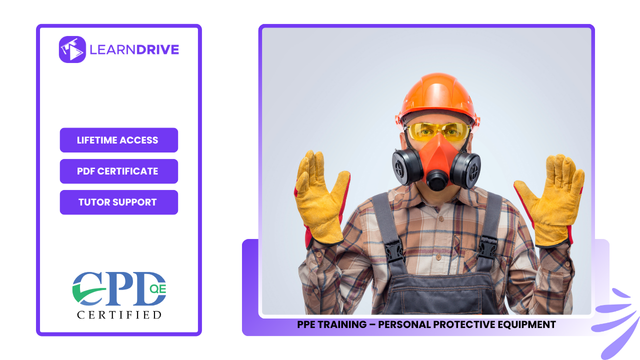
The PPE Training – Personal Protective Equipment course provides comprehensive knowledge about the various forms of personal protective equipment and its importance in safeguarding individuals in the workplace. This course begins with an introduction to what qualifies as PPE and the common hazards it protects against. Learners will gain an understanding of shared responsibility when it comes to safety and the hierarchy of safety measures, emphasizing how PPE fits within broader workplace safety protocols.
In the second module, learners will explore the personal side of safety, understanding why PPE is essential for individual protection. This section covers key areas, such as protecting your senses, hands, and arms, as well as ensuring proper protection for the feet and legs. The course also delves into the final checks necessary before using PPE to ensure its readiness and effectiveness.
The third module goes beyond the basics to introduce smart protection techniques, equipping learners with knowledge on how to outsmart gravity, avoid breathing dangers, and decode warning signs for proper safety measures. This course ultimately aims to empower individuals to identify potential hazards and use PPE effectively to prevent injury and maintain workplace safety.
Upon completion of this course, learners will be able to confidently use various types of PPE, understand their responsibilities in maintaining safety, and ensure compliance with workplace health and safety regulations. The course includes a study guide and an assignment to reinforce the knowledge gained, and learners will be awarded a CPDQE certificate upon successful completion.
Who This Course Is For:
- Health and safety officers responsible for workplace risk management.
- HR managers overseeing employee safety protocols.
- Construction site supervisors ensuring worker safety.
- Warehouse managers responsible for employee health and safety.
- Occupational health professionals advising on workplace safety.
- Safety trainers and educators developing PPE training programs.
- Employees in high-risk industries requiring comprehensive PPE knowledge.
- Managers responsible for implementing and overseeing PPE policies.
Requirements:
- No prior experience is required to take this course.
- Basic understanding of workplace safety principles is helpful but not mandatory.
Course Instructor

Learndrive Courses
Learndrive is uniquely qualified to teach Bomb Threats and Suspicious Packages Training because of its evidence-based instructional design and focus on practical, real-world application. High-risk situations demand clarity, confidence, and calm action. Learndrive simplifies complex emergency procedures into accessible, step-by-step guidance that anyone can follow. Instead of overwhelming learners with technical language, the course explains what to do, why it matters, and how to support safety without taking unnecessary risks.
Learndrive’s expert content developers ensure training aligns with professional safety standards and real emergency response principles. Lessons are structured to improve retention, using clear demonstrations, practical examples, and easy-to-apply instructions. Whether learners work in schools, offices, shops, or public organisations, the training ensures they understand their responsibilities and can act confidently under pressure. Safety is only effective when people know what to do—and that is exactly what this course delivers.
Accreditation
This course is accredited by CPDQE. As Continuing Professional Development becomes increasingly important across careers and industries, CPD accreditation confirms the course meets recognised learning standards and provides measurable value. Completing this accredited training strengthens professional credibility, supports workplace safety compliance, and demonstrates commitment to ongoing development.

What Students say about us
Frequently Asked Questions
PPE stands for Personal Protective Equipment. It includes clothing and gear designed to protect workers from health and safety risks at work — such as helmets, gloves, masks, goggles, high-visibility clothing, and safety footwear.
Being professional isn’t just about dressing well or following rules; it’s about how you interact with others, manage your time, handle challenges, and represent your organization with integrity.
Why is PPE important in the workplace?
PPE acts as the last line of defense between workers and hazards that can’t be removed through other safety measures. It helps prevent injuries, illnesses, and long-term health issues caused by exposure to physical, chemical, or biological risks.
Who is responsible for providing PPE?
Employers are legally responsible for providing appropriate PPE, ensuring it fits correctly, and training employees on how to use it properly. Employees, in turn, must use PPE as instructed and report any damage or defects.
What are the main types of PPE?
The main categories include:
-
Head protection – helmets, bump caps
-
Eye and face protection – goggles, face shields
-
Respiratory protection – masks, respirators
-
Hand protection – gloves
-
Foot protection – safety boots
-
Body protection – coveralls, high-visibility clothing
-
Hearing protection – earplugs, earmuffs
How should PPE be maintained and stored?
PPE should be regularly inspected, cleaned, and stored in a clean, dry location away from sunlight and contaminants. Damaged or expired PPE must be replaced immediately to ensure full protection.
What happens if I don’t wear PPE?
Not wearing PPE increases the risk of injury or illness and may also lead to disciplinary action or legal consequences, as PPE use is often a legal requirement under workplace safety laws.
What is the role of training in PPE use?
Training ensures workers understand when and how to use PPE, recognize its limitations, and know how to maintain and store it safely. Proper training builds awareness and promotes a safety-first culture.
How often should PPE be replaced?
Replacement depends on usage, wear, and manufacturer guidelines. PPE should be replaced immediately if damaged, contaminated, or past its expiry date — even if it appears functional.
Course Content
Module 1: PPE Training Personal Protective Equipment
-
What counts as PPE
-
The Hazards You Face
-
Shared Responsibility
-
Hierarchy Of Safety
Module 2: The Personal Side of Safety
Module 3: Beyond Limits: Smart Protection at Work
Study guide
Assignment
Order your CPDQE Certificate
A Quick Rundown to the Course
Keep it Up
Please take a moment to share your thought
Student Ratings & Reviews